

A new granulator isn’t always the first upgrade to make. Reducing energy consumption in granulation plants often starts with correcting moisture balance, binder choice, airflow, or heat loss. Equipment changes make sense when energy use remains high after comparing the same product grade at similar production rates. Fixed-speed fans running above demand and gas-treatment equipment causing excessive pressure loss are clear upgrade candidates.
It’s understandable to look first at the largest machines, especially when drying dominates energy demand. But a binder that supports shorter drying times, unstable feed moisture, or unnecessary recycle can also drive avoidable energy use. The right decision starts with identifying where energy is consumed and what is causing it.
This article explains how circuit sizing, feed moisture, process modeling, coordinated controls, and binder selection shape energy use. You’ll learn which operating changes to assess first, how to compare performance fairly across product grades, and when the evidence points to an equipment upgrade rather than a process adjustment.
Key Takeaways
- Assess the granulation and drying circuit as one system; the right configuration depends on feed moisture and whether the process requires wet or dry granulation.
- Track incoming moisture across raw materials and liquid additions to identify avoidable drying demand before changing equipment.
- Compare energy use alongside product quality, fines, and recycle flow so an apparent energy saving doesn’t undermine production performance.
- Coordinate feed rate, airflow, and fan controls to avoid moving or drying more material than the process requires.
- Evaluate binder performance for strength, viscosity, and drying behavior; binder selection can influence energy use as well as granule quality.
1. Integrated sizing of granulation and drying circuits
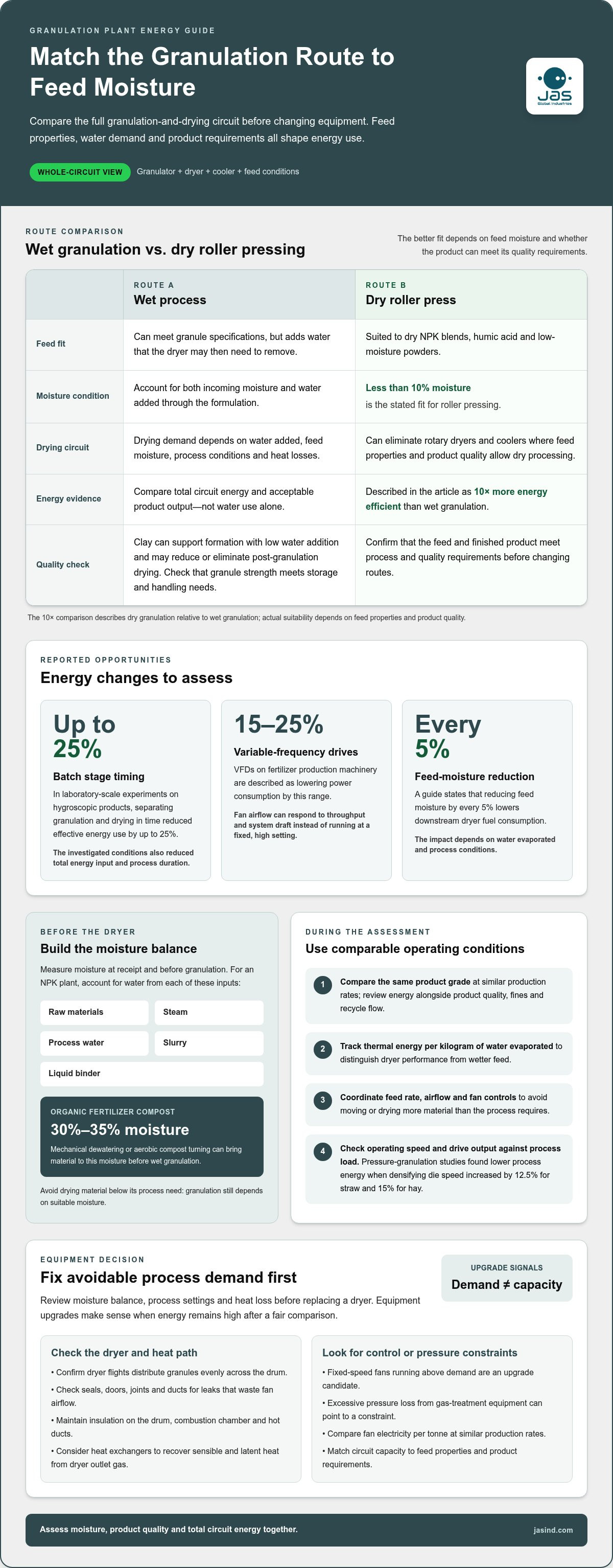
Size the granulator, dryer, and cooler as one connected circuit. The chosen granulation process determines water demand, thermal load, and the mechanical work needed to form each particle. Reducing energy consumption in granulation plants starts with matching circuit capacity to feed properties and product requirements. A wet process may meet granule specifications but leave the dryer to remove avoidable moisture. Compare total energy use and acceptable product output before selecting equipment changes.
Batch fluidized-bed layering granulation shows how operating sequence can affect demand. Laboratory-scale experiments on hygroscopic products found that separating granulation and drying in time reduced effective energy use by up to 25%. Under the investigated conditions, the separation also reduced total energy input and shortened process duration. Assess the timing of each stage alongside equipment capacity when reviewing a batch circuit.
For dry NPK blends, humic acid, and low-moisture powders, double roller press granulation can alter the circuit more fundamentally. These presses suit powders with less than 10% moisture. Dry granulation is described as ten times more energy efficient than wet granulation, and the roller-press approach can eliminate rotary dryers and coolers. A practical route to reducing energy consumption in granulation plants may therefore be changing the process itself, where feed properties and product quality allow dry processing.
In wet fertilizer granulation, clay can support granule formation with low water addition and may reduce or eliminate post-granulation drying. But clay alone may not provide enough strength for demanding storage and handling. Assess required granule strength, formulation, and water addition together before reducing drying capacity. The relevant measure is the performance of the full circuit, not water use in isolation.
Improve granulator motor and drive efficiency by matching drive output to process load. Variable-frequency drives on fertilizer production machinery are described as lowering power consumption by 15%-25%. Pressure-granulation studies also found lower process energy when densifying die speed increased by 12.5% for straw and 15% for hay. These results show why control settings and operating speed belong in an upgrade assessment.
Before replacing a dryer, check how effectively it uses heat. Dryer flights should distribute granules evenly across the drum cross-section, while leaks at seals, doors, joints, and ducts can waste fan airflow. Maintain insulation on the drum, combustion chamber, and hot ducts to limit heat loss. Compare energy indicators by grade at similar production rates. If fixed-speed fans exceed demand or gas-treatment equipment creates excessive pressure loss, an equipment upgrade may address the constraint.
2. Reducing feedstock moisture before granulation
A dryer must remove both water added upstream and moisture already present in incoming material. In an NPK fertilizer plant, the overall moisture balance includes raw materials, steam, process water, slurry, and liquid binder. Track each input by formulation, then relate the combined water load to dryer fuel use. Thermal duty also includes heating the material and drying gas, as well as system losses. This separates excess moisture demand from the energy needed to heat the process itself.
Measure feed moisture at receipt and before granulation, rather than relying on a standard value across grades. A guide states that reducing feed moisture by every 5% lowers downstream dryer fuel consumption. The impact depends on how much water the dryer must evaporate and the process conditions. For organic fertilizer compost, mechanical dewatering or aerobic compost turning can bring material to 30%-35% moisture before wet granulation. Avoid drying material below its process need, since granulation still depends on suitable moisture.
Protect moisture-sensitive feed during storage and transport. Covered sheds help prevent rainfall from raising moisture in raw organic compost and mineral salts. In a fertilizer plant, compare incoming moisture by material and grade, then adjust water, steam, slurry, and liquid binder as one recipe. Formula-specific dryer operating recipes matter because formulations differ in moisture demand and granulation response. Track thermal energy per kilogram of water evaporated to distinguish dryer performance from wetter feed. This measure also helps show whether heating demand changed because of process conditions or incoming material.
For U.S. facilities, incentive eligibility and regulatory obligations depend on jurisdiction and project scope. Assess applicable federal, state, and utility programs alongside requirements related to permitting and emissions. No single project rule applies to every plant.
Heat recovery and insulation reduce energy demand by limiting wasted heat and reusing energy already in the process. Heat exchangers can recover sensible and latent heat from dryer outlet gas to preheat process gas. Maintain insulation on hot equipment and ducts to limit losses before deciding that more heating capacity is needed.
Variable-frequency drives on fertilizer production machinery are described as lowering power consumption by 15%-25%. They let fan airflow respond to throughput and system draft instead of running at a fixed, high setting. Compare fan electricity per tonne at similar production rates to see whether control changes address the actual load.
Use the moisture balance to decide whether the priority is feed handling, process settings, or dryer efficiency. If fertilizer formulation work includes granulation-aid selection, fertilizer granulation aids are one input to consider alongside water addition and drying requirements.
3. Dynamic modeling of product quality and energy use
A useful process model connects energy use to the product leaving the line. In wet-granulation production pathways, granulating equipment accounts for around 13% of total energy in twin screw pathways and 15% in high shear pathways. Drying accounts for around 45% and 84%, respectively. These shares show why modeling only the granulator can miss the larger energy opportunity.
Build the model around production variables that affect both energy efficiency and saleable output: feed rate, liquid addition, binder dosage, granule size, fines, recycle, drying, and cooling. Change one input at a time, then compare predicted quality and energy demand at the same production rate. For example, reducing liquid addition may lower drying demand, but too little liquid can reduce granulation efficiency, increase fines, and send more material through the recycle loop.
Use the model to examine equipment footprint alongside process performance. A machine that takes up less production space may still need supporting equipment or create extra handling between stages. Map material paths, maintenance access, and transfer points before comparing layouts. Include product held inside the machine or left in transfer equipment as residuals, since retained material can become waste during grade changes or cleaning. Modeling these losses alongside energy gives a fuller view of usable output.
Cooling is another operating endpoint to model, not a target to minimize without limits. An NPK cooler uses electrical power to move air through hot granules and remove sensible heat. Set the exit temperature according to the needs of screening, coating, packaging, and storage. Cooling beyond that endpoint consumes power without improving the next production step, while insufficient cooling can disrupt downstream handling. Use the required product condition as a model constraint.
Reducing granulation energy can create safety, quality, and emissions risks if operators change settings without accounting for process limits. Too little liquid can increase fines and recycle, while insufficient drying or cooling can affect handling and storage. Changes to airflow or combustion conditions can also alter exhaust performance. Model these operating boundaries alongside energy before adjusting the process.
Wet granulation can require substantial energy, but energy use alone cannot identify the best upgrade. Compare energy with product quality and output under equivalent conditions. The model should flag whether pressure, binder, or drying changes reduce energy per unit of acceptable product, rather than simply lowering machine demand. That distinction protects production performance while identifying where an equipment or control change could improve efficiency.
4. Feed stability and coordinated process control
Stable feed helps each stage operate against a predictable load. In an NPK fertilizer line, uneven feed rate can disrupt granulator loading, liquid distribution, recycle flow, and dryer demand. Trend these variables together rather than adjusting one machine in isolation. For example, compare feed rate and recycle flow during a grade change, then assess whether the same settings maintain uniform granules as production stabilizes.
Start with the recycle loop. An unnecessarily high recycle ratio increases internal throughput without increasing finished-product output. Track fresh feed, recycle flow, and accepted product as separate process signals. If recycle rises while finished output holds steady, investigate granulation conditions and screening results before increasing machine speed. This helps distinguish a control problem from a genuine increase in production demand.
Coordinate fan control with throughput and system draft. Variable-frequency drives can adjust airflow to actual operating conditions instead of keeping fans at a fixed, high setting. Trend fan speed, pressure, and production rate together, then compare fan electricity per tonne across similar grades. A change that lowers airflow but worsens drying or cooling is not an improvement. The goal is airflow that supports stable product quality without unnecessary electrical demand.
Use process data to manage air conditions around the granulation and drying stages. Record inlet and outlet air temperature and humidity alongside feed moisture, liquid addition, and product condition. During an organic fertilizer run, for example, wetter feed may change the drying load. Operators can use those trends to adjust process settings rather than relying on a fixed recipe. Keep storage conditions in view too, since moisture pickup can affect product handling after cooling.
Build a control routine around clear signals and defined responses. When feed rate shifts, review liquid addition and granulator loading. When recycle increases, inspect screening and granule formation. When draft changes, adjust fan operation to meet process needs. This coordinated approach avoids unnecessary corrections that can cause further swings. It also makes it easier to identify whether energy demand comes from unstable feed, excess recycle, or airflow control.
Energy and carbon tracking add a plant-wide view to those operating signals. Compare fuel and electricity use with finished-product output by grade, then review the same indicators during steady runs and transitions. Rising energy use alongside stable production can point to control drift. Rising energy use alongside changed feed properties may reflect a different process load. These comparisons help teams prioritize adjustments based on operating evidence.
Keep control changes tied to product results. After each meaningful adjustment, review granule size distribution, fines, recycle, drying performance, and storage condition. Uniform product, stable airflow, and consistent feed give operators a stronger basis for setting repeatable process controls, without increasing energy use simply to compensate for inconsistent operation.
5. Binder effects on energy consumption
Binder choice affects more than granule formation. In fertilizer processing, it can change liquid demand, slurry behavior, drying time, and finished-product strength. A binder that needs extra water can increase the volume sent to drying. One that disperses solids effectively may support processing with lower slurry or paste viscosity. Assess the binder across the entire operating sequence, from mixing through storage.
Lignosulfonates have dispersant properties that can reduce slurry and paste viscosity. They’re also described as supporting higher throughput and shorter drying times. These effects make binder selection an engineering variable, not simply a formulation decision. Compare candidate binders at the same feed rate, liquid addition, and drying conditions to determine whether processing improvements reflect the binder or another operating change.
Strength matters too. At a given dosing rate, lignosulfonate-based binders produce higher initial fertilizer-granule crush strength than sugar-based alternatives. In accelerated high-humidity aging, lignosulfonate-bound granules retain strength better over time than granules bound with molasses or vinasse. Those hygroscopic binders can absorb moisture during storage and transport, weakening granules and increasing breakage, dust formation, and caking.
Clay can support granulation with low water addition, but clay alone may not deliver enough strength for demanding fertilizer handling and storage. Combining lignosulfonates with clay improves granule strength while keeping the binder system cost-efficient. Evaluate the combination against the actual formulation, target strength, and drying conditions. Lower liquid demand is useful only if granules remain robust through handling.
Use controlled trials to connect binder dose with energy and product quality. Laboratory and pilot-scale trials can identify the most cost-effective dose for a fertilizer formulation. Record liquid addition, throughput, drying time, temperature, crush strength, and performance after humidity exposure. Lignosulfonates provide a linear granule-strength response to dosage, which can make process control more predictable. Avoid changing dosage and drying settings at the same time, since that obscures the cause of any result.
The takeaway: select binders using both process and product measures. Track energy per unit of acceptable product, not just machine demand, and include strength after storage in the comparison. JAS Global Industries offers ceramic binder options for ceramic applications where binder performance is part of granulation and processing decisions.
JAS Global Industries: Fertilizer Anti-caking Agents
JAS Global Industries offers Fertilizer Anti-caking Agents for fertilizer operations managing caking during storage and handling. After assessing energy use across moisture balance, drying, and binder performance, consider product handling as another part of protecting reliable plant output. Anti-caking agents address a specific downstream concern, while Fertilizer Dust Suppressants are relevant when dust control is also part of the operation.
Consider these offerings when caking or dust affects the handling of finished fertilizer, rather than treating them as substitutes for correcting excess moisture or inefficient drying. Matching the chemical approach to the process concern keeps the energy review and product-quality priorities aligned.
Contact JAS Global Industries to discuss fertilizer anti-caking needs for your operation.
Turn energy findings into your next operating decision
The next step in reducing energy consumption in granulation plants is to turn operating observations into a focused improvement plan. Choose a process area where energy use and product performance can be reviewed together, then define what a successful change must preserve, such as consistent granule quality or reliable downstream handling. This gives your team a practical basis for deciding whether to adjust operating conditions or consider an equipment upgrade.
Product handling matters after granulation too. JAS Global Industries offers Fertilizer Anti-caking Agents and Fertilizer Dust Suppressants for fertilizer operations, as well as Mining Flotation Collectors for mining applications. These offerings address distinct process needs, so connect the discussion to the material and operation at hand.
For a conversation about chemical solutions relevant to your operation, contact JAS Global Industries. A clear process objective is a useful starting point for the next improvement decision.
Frequently Asked Questions
When Does an Equipment Upgrade Make Sense?
An upgrade makes sense when avoidable energy use remains after process losses and control settings have been addressed. For example, fixed-speed fans operating above demand or gas-treatment equipment creating excessive pressure loss point to equipment constraints. Compare energy indicators for the same product grade and similar production rates, then identify whether the excess comes from equipment, feed variation, or operating practice. This helps target an upgrade to a defined bottleneck rather than replacing machinery without evidence.
What are the biggest sources of energy use in granulation plants?
Drying is often a major energy load in wet-granulation pathways, while fans and drives add electrical demand. Dryer duty includes water evaporation, heating the material and gas, and system heat losses. Cooling also uses electricity to move air through hot granules. Separate thermal fuel use from electrical use, then look at the dryer, cooler, and material-handling equipment individually. That breakdown shows whether the main opportunity lies in heat demand, airflow, or mechanical operation.
What process changes reduce energy use in fertilizer granulation plants?
Start by stabilizing the formulation and feed, then coordinate liquid addition, recycle, and airflow. Use grade-specific operating recipes because fertilizer formulations respond differently to moisture. Avoid excessive recycle, which increases internal throughput without raising finished output. Match fan airflow to throughput and system draft, and address dryer leakage and insulation losses. Track product quality alongside energy use so a lower energy reading does not conceal increased fines, unstable granules, or reduced saleable production.
How do wet and dry granulation compare in energy consumption?
Dry granulation is described as ten times more energy efficient than wet granulation. Energy use can vary between dry and wet granulation, so compare the pathways under equivalent process and product conditions. Wet processes require drying when liquid addition leaves moisture to remove, so the comparison depends on the feed and the required product properties. Assess whether the material can be processed dry while still meeting granule quality and downstream handling needs.
What is the energy cost per ton for granulation plants in the United States?
There is no single per-ton energy cost that applies to every United States granulation plant. Calculate your site’s figure by dividing energy expenditure for the chosen period by finished-product tonnage. Keep electricity and thermal fuel separate at first, since tariffs, fuel mix, production rate, product grade, and moisture load affect each differently. State the period and product basis with the result so comparisons remain meaningful and don’t confuse energy use with energy expenditure.
What capital costs and payback periods are typical for granulation energy-efficiency upgrades?
Typical capital costs and payback periods depend on the upgrade scope and plant operating conditions. A fan control change, heat recovery project, and dryer replacement involve different equipment and installation requirements. Build an estimate from the equipment, integration, and operating changes involved, then compare annual energy savings against the investment and ongoing costs. Use measured baseline consumption and production data; a payback calculation based on assumed savings can mislead investment decisions.
How can operators measure and benchmark energy use per ton of granulated product?
Divide the energy consumed by the tonnes of finished product produced over the same period. Track electrical use and thermal fuel separately, and record product grade and production rate with each reading. For dryer performance, monitor thermal energy per kilogram of water evaporated; for airflow, track dryer and cooler fan electricity per tonne. Compare like grades at similar rates, then investigate changes in feed moisture or operating conditions before interpreting a higher reading as deterioration.