
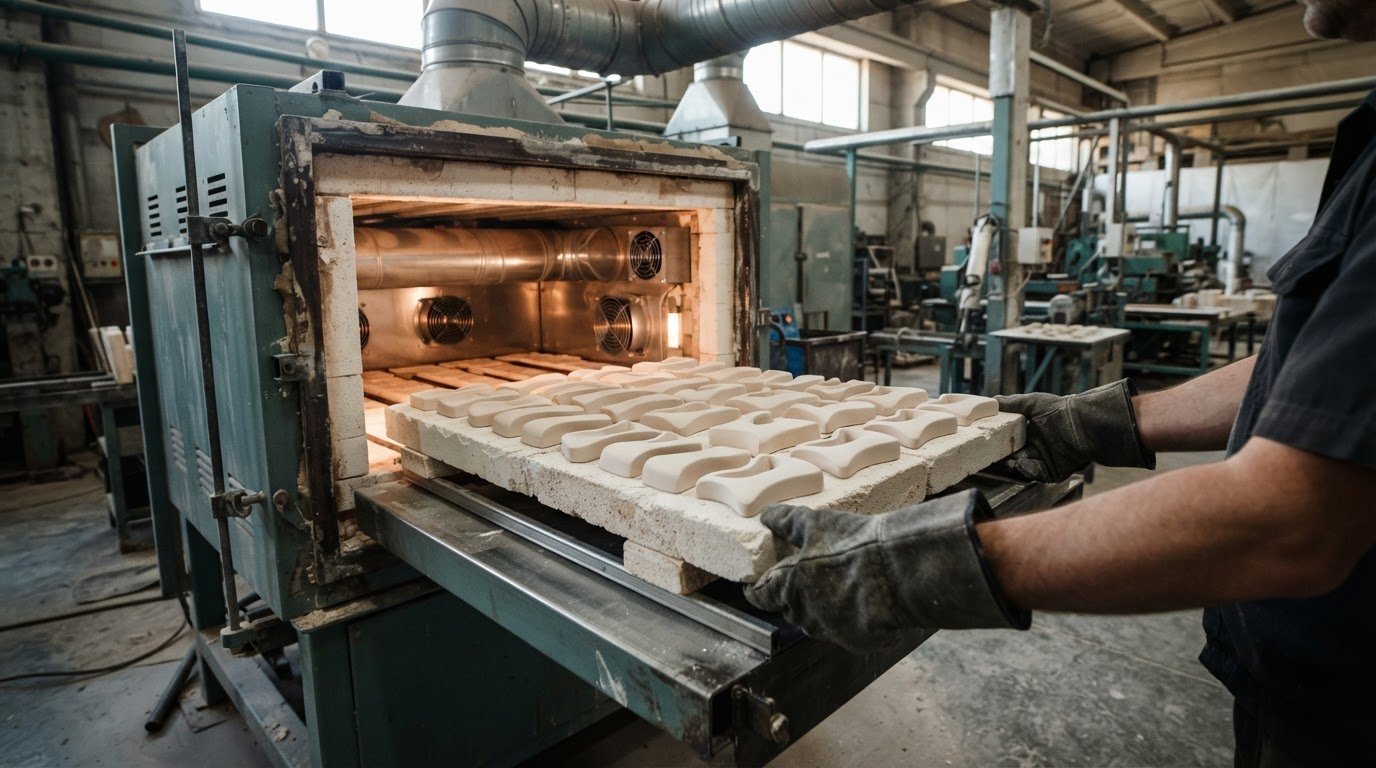
Fast heating is no shortcut to clean burnout. The practical answer to how to achieve clean burnout of organic binders is to use slow, controlled convection heating, with strong circulation and a temperature profile tailored to the binder. Organic binders in ceramic green forms are usually converted from solid to gas below 600°C, but the right atmosphere also depends on the ceramic composition.
It’s understandable to focus on furnace temperature: the heating cycle must remove binder without leaving residue or damaging the part. But temperature alone does not determine the outcome. Binder composition, heating uniformity, gas movement, and the transition from debinding to sintering all matter.
This article explains how binder removal works, why controlled heating and atmosphere selection matter, and how binder content can affect pressing and sintering. It also explains why clean burnout starts with the specific binder and ceramic system, not a single heating schedule for every part.
1. Removing organic binders from green ceramic forms
For manufacturers asking how to achieve clean burnout of organic binders, start with the binder system and ceramic composition. Thermogravimetric analysis, or TGA, measures sample mass as temperature rises and identifies decomposition stages. Use the results to guide heating intervals, atmosphere selection, and exhaust handling for the green part instead of relying on a generic cycle.
Poly(alkylene carbonate) binders decompose completely in air below 300°C, at least 100°C below conventional binders. Pure poly(alkylene carbonate) binder typically leaves less than 50 parts per million of ash. With 3% binder use, finished parts contain well under 2 ppm residual ash. This low residue can support ceramic purity where carbon or other unwanted material could affect the final part.
Perovskite ceramic membranes need a profile suited to their binder and oxide composition. The burnout plan should account for membrane form and binder loading, since decomposition products must escape without leaving trapped carbon. A black core signals carbon residue inside the ceramic, which may affect strength or appearance. TGA data can help establish a suitable removal schedule.
Poly(alkylene carbonate) binders pass through three phases: solid, liquid, and vapor. This sequence matters because vapors can condense on cool furnace surfaces as tars and oils. Conventional binders may decompose at higher temperatures and leave different residues, so a cycle designed for one formulation may not suit another. Some oxide and nitride ceramics can be debound in air; others need inert or reducing atmospheres.
Green strength must support the powder form during handling and firing, while binder removal must limit defects. Uneven heating or a rapid temperature rise can flaw finished ceramics. A practical approach to how to achieve clean burnout of organic binders also accounts for emissions. The European Union’s Industrial Emissions Directive and the United States Environmental Protection Agency’s National Emission Standards for Hazardous Air Pollutants are identified as regulations governing ceramic manufacturing emissions. Consider process emissions alongside residue control when designing the cycle.
3. Binder composition and content
Binder composition shapes how a green body responds during forming and thermal removal. A typical poly(alkylene carbonate) binder use level is 3%. At that level, residual sodium is less than 0.3 parts per million. Loading affects how much organic material must leave the ceramic, while the binder’s chemistry influences its thermal response. Both belong in the process design.
Thermal behavior differs between related polymers. Poly(alkylene carbonate) binders have a glass transition temperature of 40°C; poly(ethylene carbonate) binders have a glass transition temperature of 25°C. These values describe distinct material behavior as temperature rises. For teams planning how to achieve clean burnout of organic binders, they help distinguish formulations when considering handling and heating conditions.
Poly(propylene carbonate) has been used to produce ceramic tapes as thick as 50 mils, or 0.050 inch. It has also demonstrated commercial value in ceramic powder forming operations for over a decade. These examples connect binder selection to part format and forming method. They don’t establish that one polymer suits every ceramic composition or production route.
Record binder identity and loading alongside the ceramic powder composition before selecting a cycle. A blend can behave differently from a single polymer because each component contributes its own thermal response. The heating profile must reflect the actual binder combination, part thickness, and available atmospheres. One described removal method uses an atmosphere containing about 60% carbon dioxide by volume for about 10 hours; it is an example, not a universal recipe.
In practical terms, how to achieve clean burnout of organic binders depends on matching the formulation to the forming and firing requirements. A ceramic binder selection should consider powder composition, part geometry, binder loading, and the intended atmosphere together. Explore ceramic binder options as part of that evaluation.
4. Binder performance in pressing and sintering
During pressing, a binder helps hold ceramic powder together as a shaped green body. Its contribution must suit the forming route and the part’s geometry. Poly(propylene carbonate) has been used to produce ceramic tapes thinner than 1 mil, or 0.001 inch. That example shows its use in thin tape forming, but it doesn’t establish that one binder suits every powder or process.
Ceramic injection molding trials offer a measured comparison. Mean failure stress increased from about 230 MPa with a wax mix to over 300 MPa with a poly(propylene carbonate) mix. The result describes those trials, not a guaranteed value for other compositions. It does show why binder selection can matter to strength before firing, when parts must retain their shape during handling.
Assess the binder against the forming method before setting the sintering route. Pressing, tape forming, and injection molding place different demands on a green part. Treat a cellulose-based formulation as its own composition rather than assuming it behaves like a wax mix or poly(propylene carbonate). The binder’s role in cohesion and the part’s geometry both inform the choice.
After forming, removing the organic phase prepares the ceramic body for sintering. Residue in the part can affect purity, while removal that damages the green structure can compromise it before densification. A useful process review connects forming performance with burnout behavior and intended firing conditions, rather than evaluating pressing strength alone.
Compare formed-part integrity, binder residue, and final sintered quality as distinct outcomes. For example, the injection molding trial’s stress result addresses failure strength, while tape thickness describes a demonstrated forming format. Neither result alone measures final sintering performance. Keeping these outcomes separate helps identify whether a formulation supports the full sequence from pressing through firing.
4. What does clean burnout of organic binders mean, and how is burnout completeness measured?
Clean burnout means removing the organic binder without leaving unwanted carbon or ash in the ceramic body. It also means controlling the process so volatile products escape rather than condensing as tars or oils. The practical aim for a finished part is low residue while preserving shape, strength, and purity.
Thermogravimetric analysis, or TGA, tracks sample mass as temperature rises. Its curve shows where a binder loses mass and when that change slows. A TGA profile can guide a heating schedule, but the test material should represent the binder or blend used in production. Atmosphere matters too, because decomposition can differ between air and reducing conditions.
Assess process completeness by comparing mass before and after debinding, then examining the remaining residue. Mass loss alone does not identify what remains, so ash or residual-carbon analysis adds useful information. Visible black areas, for example, can indicate trapped carbon, while surface deposits may point to condensed decomposition products in the furnace.
Interpret these measurements alongside the ceramic composition and intended sintering conditions. A low residue reading is useful only if the green part retains its required form and the fired ceramic meets its purity and strength needs. TGA data helps set the process window; inspection and residue analysis show how the actual part and furnace performed.
Keep a process record linking the binder batch, sample composition, TGA curve, atmosphere, heating profile, and residue result. This traceable sequence helps distinguish incomplete binder removal from a forming or firing issue. To discuss ceramic binder requirements, connect the material and process needs to the formulation under consideration.
Complete burnout of poly(alkylene carbonate) binders in nitrogen, argon, and hydrogen-containing reducing atmospheres is possible at temperatures as low as 360°C. This provides a specific example of how binder chemistry and atmosphere can shape the burnout conditions, while measurements of residue and inspection of the part remain important for assessing the outcome in a given process.
JAS Global Industries: Ceramic Binders
JAS Global Industries offers ceramic binders for manufacturers assessing binder composition alongside forming and firing requirements. This is a relevant next step when a process needs a binder suited to its ceramic powder, shaping method, and burnout conditions. Binder choice affects green-part handling and the organic material that must be removed before sintering, so consider the formulation within the full production sequence.
Bring material and process requirements into the discussion, including ceramic composition, forming route, and desired fired-part properties. These details provide a practical basis for assessing ceramic binder needs without assuming one formulation fits every application. To discuss ceramic binders for your process, contact JAS Global Industries.
Turn process findings into your next development step
For teams deciding how to achieve clean burnout of organic binders, the next step is to turn production requirements into a clear formulation brief. Define the ceramic body, forming route, binder’s role, firing conditions, and relevant quality measures. This gives technical discussions a practical focus: matching material choice to the process rather than treating binder selection as an isolated decision.
JAS Global Industries offers ceramic binders for this work. Its wider portfolio also includes fertilizer anti-caking agents, fertilizer dust suppressants, and mining flotation collectors, each serving distinct industrial applications. For a ceramic project, keep the discussion focused on the part, process, and performance requirements.
Contact JAS Global Industries to discuss your ceramic binder requirements and next steps. A well-defined process brief is a strong place to begin.
Frequently Asked Questions
How do binder chemistry, loading, and part geometry affect burnout?
Binder chemistry controls how decomposition products form, while loading affects how much material must escape the ceramic body. Geometry influences the path those products travel. A thick or complex part, for example, can restrict gas movement compared with a thin section. Consider the binder, its proportion, and the part’s shape together when setting the process, since each affects gas release and the risk of trapped residue.
What debinding temperature ramp and hold schedule prevents cracking and residue?
Build the ramp and holds around the binder’s measured thermal behavior and the part’s dimensions. Use thermogravimetric analysis to identify mass-loss regions, then allow sufficient time for gases to escape during those stages. A schedule that moves too quickly through decomposition can increase internal pressure and stress. Review the profile against furnace circulation and ceramic composition instead of applying one fixed schedule to every part.
How do manufacturers verify residual carbon, ash, or other binder residue after burnout?
Use complementary checks because no single observation identifies every residue. Compare sample mass before and after treatment, then measure ash or residual carbon with a suitable analytical method. Inspecting cut sections can reveal localized dark cores that surface checks miss. Tie results to the sampled part, binder batch, and firing conditions so process changes can be assessed using comparable evidence.
What safety precautions and emissions controls are needed when burning out organic binders?
Control volatile release, prevent flammable mixtures, and manage exhaust through suitable abatement. A common furnace-design practice keeps the organic fuel and air mixture around 20% of the lower flammability limit. Insulated ducts can keep volatiles above their dew point until thermal abatement, reducing condensation of tars and oils. Ceramic manufacturing emissions are addressed by the EU Industrial Emissions Directive and US EPA National Emission Standards for Hazardous Air Pollutants.
What atmosphere is best for binder burnout: air, oxygen, inert gas, or vacuum?
The best atmosphere depends on the ceramic composition and binder. Some oxide and nitride ceramics can be debound in air, while others need an inert or reducing atmosphere.