

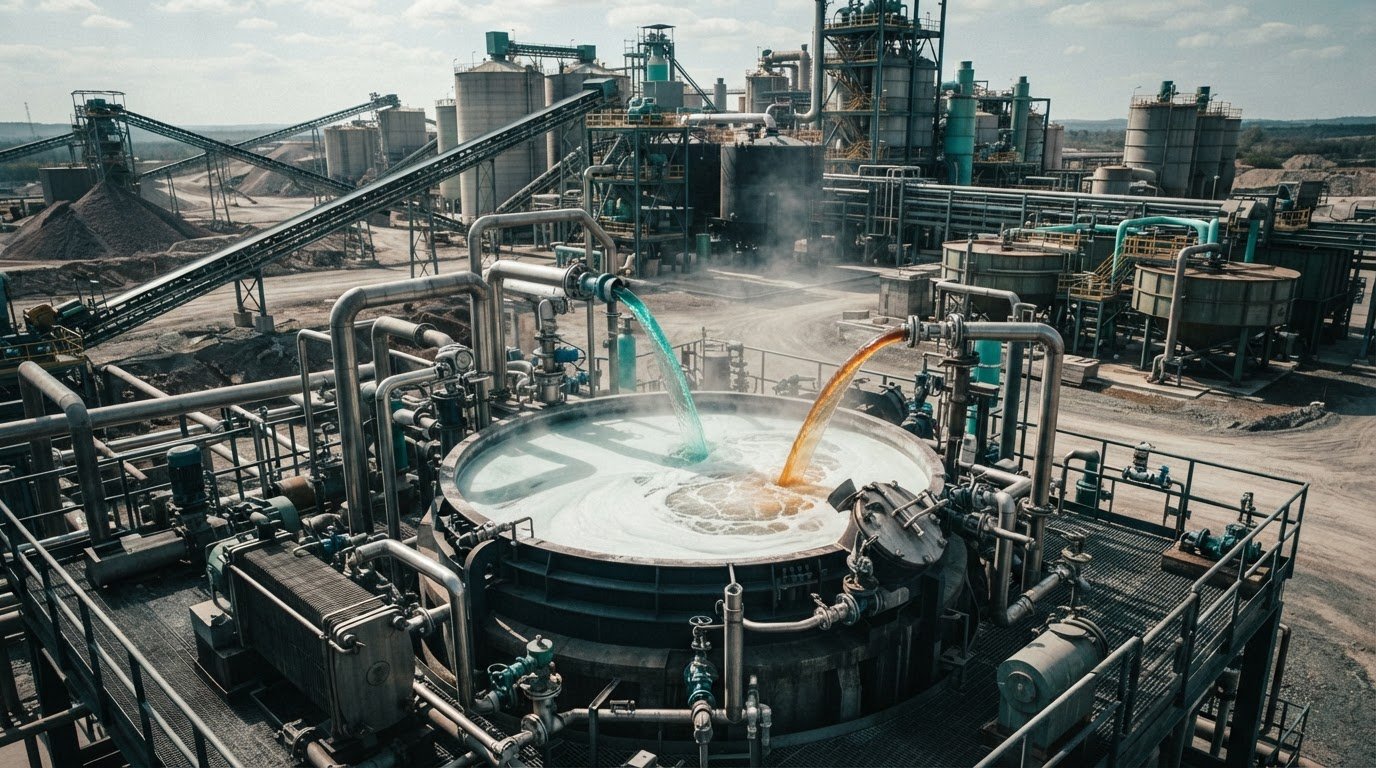
Foam is a process problem, not just a surface nuisance. In wet-process phosphoric acid production, defoamers help control bubbles caused by released gases, agitation, and materials in phosphate rock. Choosing phosphoric acid defoamers for industry means assessing performance in strong acid and heat, along with effects on downstream operations.
Excessive foam can take up reactor space, complicate gypsum separation, and make operating conditions harder to control. Too much or too little antifoam can also disrupt the process, so dosage and performance matter as much as formulation choice.
This article explains what defoamers do and why foam forms during wet-process production. It compares water-based and oil-based options, including their behavior in acidic, hot conditions and the practical trade-offs that can guide selection.
Key Takeaways
- Match the defoamer to the phosphate rock, flotation agents, and operating conditions, since each can influence foam formation.
- Compare water-based and oil-based formulations by dispersion, compatibility with reactor linings, and their effects on downstream handling.
- Prioritize resistance to strong acid and process heat when evaluating a formulation for wet-process production.
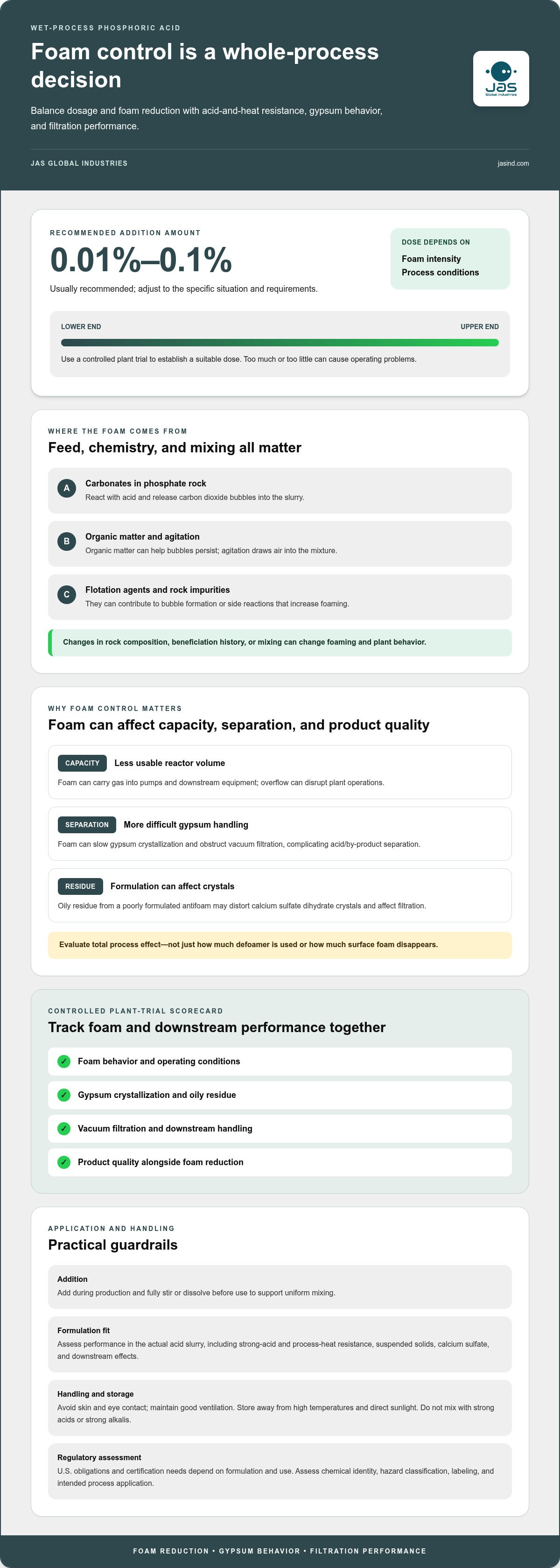
- Control dosage carefully: the recommended addition amount is usually 0.01%-0.1%, adjusted to the specific situation and requirements.
- Use controlled plant trials to assess foam control alongside product quality, gypsum crystallization, and filtration performance.
What defoamer is used for wet process phosphoric acid?
Wet-process plants use antifoam formulations to limit foam during phosphoric acid production. Selection involves balancing foam control, resistance to acid and heat, dosage, and effects on gypsum separation.
Foam Effects on Plant Operations
Foam reduces usable reactor volume and can carry gas into pumps and downstream equipment. Overflow can disrupt plant operations, while foam in the slurry can obstruct vacuum filtration. Reduced reactor capacity and slower filtration can constrain production. Monitoring foam levels helps operators spot changes related to agitation, feed materials, or process conditions.
Production Efficiency and Product Quality
Controlled foam helps equipment operate without persistent buildup and supports steady fertilizer production. Foam can slow gypsum crystallization and complicate separation of phosphoric acid from by-products. The defoamer itself matters too: a poorly formulated antifoam may leave oily residues that distort calcium sulfate dihydrate crystals. This can affect gypsum handling and filtration, making performance and residue behavior important selection criteria.
The cost of foam control involves more than the amount of defoamer used. Foam-related slowdowns, reduced reactor capacity, extra maintenance, and difficult filtration can all affect plant efficiency. Excessive dosing may raise quality concerns, including oily residues, while insufficient dosing can leave foam uncontrolled. Assess the total process effect, including foam reduction, gypsum crystal behavior, and filtration, rather than focusing only on purchase volume.
Dosage and Addition Methods
The recommended addition amount is usually 0.01%-0.1%, adjusted to the specific situation and requirements. Add antifoam during production, and fully stir or dissolve it before use to support uniform mixing. The right dose depends on foam intensity and process conditions; too much or too little can cause operating problems. A controlled plant trial helps establish a suitable dosage while tracking foam, gypsum, and filtration performance.
U.S. regulatory obligations and certification needs depend on the formulation and its use. Assess chemical identity, hazard classification, labeling, and intended process application instead of assuming one certification applies to every phosphoric acid defoamer.
During handling, avoid skin and eye contact and maintain good ventilation. Store defoamer away from high temperatures and direct sunlight, and do not mix it with strong acids or strong alkalis.
Test performance in controlled plant trials before wider application. Compare foam behavior and operating conditions while monitoring gypsum crystallization, oily residue, and vacuum filtration. This connects foam control to both production performance and product quality.
Foam generation in wet-process phosphoric acid production
Industrial phosphoric acid defoamers are used in wet-process phosphoric acid production and related fertilizer manufacturing. Foam sources and operating conditions influence which control approach suits the slurry and equipment.
Sources of Foam
In the wet process, sulfuric acid reacts with phosphate rock to produce phosphoric acid and calcium sulfate. Carbonates in the rock react with acid, releasing carbon dioxide bubbles into the slurry. Organic matter can help bubbles persist, while agitation draws air into the mixture. Changes in rock composition or mixing can therefore alter foaming and plant behavior.
Flotation agents used to concentrate phosphate rock can also contribute to bubble formation. Impurities in the rock may trigger side reactions that increase foaming in the reactor. Foam can therefore vary with the feed and its beneficiation history, not just reactor operation. Recognizing these influences helps distinguish a raw-material change from a shift in process conditions.
Acid-Processing Compatibility
A defoamer for wet-process phosphoric acid must work in the actual acid slurry, not simply in water. Selection depends on the application, acid type, and operating conditions. Resistance to strong acid matters because a formulation that loses performance in the process cannot provide consistent foam control. Compatibility also depends on how the product behaves with suspended solids and calcium sulfate.
Assess process effects as well as visible foam reduction. A formulation that controls bubbles but leaves oily residue may affect gypsum crystal quality or downstream separation. Plant trials can compare foam behavior with crystallization and filtration under operating conditions. This whole-process assessment helps identify a process aid that suits the production system, rather than focusing on surface foam alone.
In fertilizer manufacturing, defoamers are specialty process aids used to control or eliminate generated foam. They are consumed during manufacturing and are not intended to remain in the finished fertilizer. Their role is process control, not serving as a fertilizer ingredient. This distinction helps plants assess the additive where foam disrupts production, rather than as a finished-product component.
Phosphoric acid defoamers may also be relevant in phosphate-rock treatment, where foam can arise during processing and interfere with solids and liquids separation. The production context matters: a defoamer selected for one slurry or operation may not suit another. Feed composition, flotation agents, agitation, acid conditions, and downstream gypsum handling all influence the choice.
Where phosphate-rock beneficiation is also part of the operation, phosphate mining chemicals relate to that upstream process stage.
Water-based versus oil-based defoamers
In phosphoric acid processing, silicone, mineral-oil, and non-silicone defoamers differ in formulation and downstream effects. Water-based products are water-soluble and may reduce the contaminants handled in the effluent treatment plant. Oil-based products use an oil active ingredient, such as mineral oil or silicone oil, and may include water or solvent as a carrier.
The distinction affects more than how an antifoam looks in storage. The formulation must disperse through the process slurry and control foam without creating problems for reactor linings, gypsum separation, or filtration. Compare products under actual plant conditions, including acid strength, temperature, mixing, and downstream equipment. Performance in one chemical process does not establish suitability for another.
Oil-based products can present specific concerns in phosphoric acid plants. Conventional oil-based defoamers can corrode rubber linings in reaction vessels; conventional products are also described as having a low flash point and being inflammable. These characteristics make lining compatibility and safe handling important parts of formulation assessment. They do not mean every oil-based formulation behaves identically, so evaluate the specific product and process.
Water-based defoamers have different process considerations. Their water solubility may reduce contaminants handled in the effluent treatment plant, and some are designed to safeguard reactor linings from effects associated with oil-based alternatives. Suitability still depends on whether the formulation controls foam in the acidic slurry and performs under operating conditions. Water as a carrier alone does not establish process compatibility.
Silicone-based antifoams and mineral-oil-based products are both used in phosphoric acid plants. However, silicone fluids can form silica deposits that blind vacuum filter cloth. For wet-process phosphoric acid, non-silicone defoamers are recommended where this filtration concern applies. Polyglycol-based products are also commonly used in the wet process, so the choice is not limited to water versus oil. Both the active chemistry and the full formulation matter.
Use these distinctions to guide a controlled comparison. Assess foam control alongside lining condition, residue, gypsum behavior, and vacuum filtration. Track effects on effluent treatment when water solubility is a selection factor. For oil-based products, include the stated fire and lining concerns in the assessment. A controlled plant trial can show whether a formulation maintains foam control without compromising sulfate handling or downstream stability.
No single base type is the best choice for every plant. Operating conditions, defoamer chemistry, and filtration requirements shape the trade-offs. Selecting phosphoric acid defoamers for industry therefore requires a whole-process view: foam performance, equipment compatibility, effluent handling, and product separation all belong in the evaluation.
Acid and temperature stability
Wet-process phosphoric acid exposes a defoamer to both strong acidity and process heat. Dihydrate reactors can reach temperatures up to 85°C, so performance at room temperature alone doesn’t establish suitability. Assess whether the formulation maintains foam control in the actual process stream, where acid, suspended solids, and operating temperature act together.
Acidity varies across process streams. Strong wet-process phosphoric acid has a pH range of 1.0-2.0, while dilute acid returned to reactors contains about 18 wt% P2O5. These examples show why product evaluation should reflect the stream receiving the defoamer. A formulation that performs in a weaker stream may behave differently in stronger acid or a slurry containing calcium sulfate.
Temperature matters alongside acid strength. A reactor reaching 85°C presents a different operating environment from a cool storage area or a laboratory mixture. Compare foam control at the relevant process temperature, and observe whether performance remains consistent during operation. That assessment should include the slurry’s mineral solids and any changes in agitation, since these affect how the defoamer meets bubbles.
Feed composition also influences the conditions a formulation must handle. In the wet process, sulfuric acid reacts with phosphate rock, while carbonates release carbon dioxide and organic matter can help bubbles persist. Changes in mineral composition can alter the foaming load. Evaluate defoamer stability against the plant's actual feed and process conditions, rather than treating acid concentration as the only variable.
Stability also involves downstream effects. A product may reduce visible foam yet leave residues that affect gypsum crystals or filtration. For example, oily residue can distort calcium sulfate dihydrate crystals, while silicone fluids can form silica deposits that blind vacuum filter cloth. Assess the entire formulation, not just its active ingredient or initial foam knockdown.
Use controlled plant trials to compare performance under representative conditions. Track operating temperature, foam behavior, gypsum crystallization, residue, and filtration response. Keep the acid stream and agitation conditions consistent when comparing results; otherwise, process variation can obscure the formulation's contribution. A useful trial checks whether the defoamer maintains foam control without compromising separation or creating equipment concerns.
Product handling is also part of process stability. Store phosphoric acid defoamers away from high temperatures and direct sunlight, avoid skin and eye contact, and maintain good ventilation. Do not mix them with strong acids or strong alkalis. These precautions support controlled handling, while process trials establish whether the chosen formulation performs in the hot, acidic production environment.
Benefits of defoamers
In wet-process phosphoric acid production, defoamers help destabilize foam and promote bubble breakup. This supports steadier reaction conditions by limiting foam that takes up reactor space or carries gas into downstream operations. The benefit goes beyond a clearer surface: less foam can keep equipment available for processing and make acid handling more manageable across production stages.
Gypsum separation is one important point of application. Trapped gas in gypsum slurry can contribute to filter-cloth blinding, while releasing that gas can help prevent blinding, reduce wash water, and raise net P2O5 yield. This links foam management with filtration performance and recovery. Operators can assess the effect by observing slurry behavior and filter performance alongside foam levels during production.
Reduced foam can also make phosphoric acid easier to handle and store. Foam can contribute to overflow and spills, while a controlled surface can make movement between process equipment and storage less disruptive. If an incident occurs, defoamers can reduce the time needed to clean up phosphoric acid spills and other accidents. These operational effects make foam control relevant to routine handling and response planning.
In fertilizer manufacturing, controlling generated foam helps maintain stable operating conditions and supports equipment utilization. A process aid can manage foam without being intended to remain in the finished fertilizer. Its value lies in supporting manufacturing. Assess the application in context, including how foam control affects production, gypsum separation, and downstream handling.
Foam control matters beyond phosphoric acid reactors. In phosphate-rock mining and treatment, defoamers can help manage foam and support solids and liquids separation. In water treatment, foam can hinder filtration, sedimentation, and chemical treatment. These examples show why the right technology depends on the process: measure a formulation's benefit against the operation it supports, not just foam collapse in isolation.
Selection should account for the whole process. Compare foam reduction with gypsum crystallization, filter-cloth condition, wash-water use, and handling requirements. Consider whether the defoamer introduces oily residues or other effects that could interfere with separation. Controlled plant trials assess these outcomes under operating conditions, helping teams balance immediate foam control with stable production and product quality.
For applications where foam disrupts production or separation, explore industrial defoamer solutions suited to process needs.
JAS Global Industries: Fertilizer Anti-caking Agents
JAS Global Industries supports fertilizer and mining operations with specialty chemical solutions, including Fertilizer Anti-caking Agents. For fertilizer teams, anti-caking agents are relevant when caking affects material handling; Fertilizer Dust Suppressants address a separate operational need. In phosphate processing, Mining Flotation Collectors and Mining Grinding Aids support upstream mineral-processing operations.
Choose the next step according to the process challenge: fertilizer handling, dust, or phosphate-mineral processing. These offerings complement the process knowledge used to evaluate foam control and production conditions. Contact JAS Global Industries to discuss which area aligns with your operation.
Set a Clear Direction for Your Next Process Review
Make the next evaluation specific to the production challenge. Define what you need from a chemical partner, then align the discussion with your operation's priorities, whether foam control, fertilizer handling, or phosphate processing. Selecting phosphoric acid defoamers for industry is one part of a broader effort to support dependable process performance.
JAS Global Industries offers Fertilizer Anti-caking Agents and Fertilizer Dust Suppressants for fertilizer operations, along with Mining Flotation Collectors for mineral processing. These offerings serve distinct process needs, so identify the challenge your team wants to address and focus the discussion on that application.
For a practical next step, share your process priorities with JAS Global Industries and explore how its specialty chemical offerings may fit your operation. Contact JAS Global Industries to begin the discussion and move forward with a clear operational focus.
Frequently Asked Questions
What Are Defoamers?
Defoamers are process additives that reduce or control foam in industrial liquids. They work by destabilizing bubbles so foam breaks down, or by limiting foam formation during processing. In a reactor, filtration line, or storage vessel, the practical goal is to prevent foam from interfering with equipment or material handling. Use and formulation depend on the liquid and the process where foam develops.
Does the defoamer cause scaling in the acid evaporators?
A defoamer is not inherently a scale inhibitor, and its presence alone does not establish the cause of evaporator deposits. Scaling can involve process chemistry, dissolved components, concentration, and operating conditions. To assess a deposit, compare its composition and location with operating records, then review whether the defoamer leaves residue under those conditions. Distinguish mineral scale from product residue before changing foam-control dosage or formulation.
Will the defoamer reduce P2O5 recovery or harm gypsum crystal quality?
It can affect process results if the formulation or dosage interferes with separation. Oily residue from a poorly formulated antifoam can distort calcium sulfate dihydrate crystals, while trapped gas in gypsum slurry can contribute to filter-cloth blinding and lower net P2O5 yield. Assess recovery alongside crystal shape, filtration, and wash-water use during a controlled trial. Foam reduction alone doesn’t show whether separation performance is maintained.
Why Does Foam Form During Phosphoric Acid Production?
Foam forms as gases enter or emerge from the reacting slurry. Carbonates in phosphate rock react with acid and release carbon dioxide, while agitation can draw air into the mixture. Organic matter may help bubbles persist, and flotation agents used during rock beneficiation can also contribute to bubble formation. A change in feed source or mixing conditions can therefore alter foaming, even when the overall plant process remains the same.
What types of defoamers are compatible with phosphoric acid?
Compatibility depends on the formulation and process conditions, not its base type alone. Mineral-oil-based, silicone-based, polyglycol-based, and other non-silicone formulations are used in phosphoric acid applications. Silicone fluids can create silica deposits that blind vacuum filter cloth, making non-silicone options relevant when filtration is sensitive. Compare foam control with residue, gypsum separation, and equipment effects in the intended process stream.
How do you choose a defoamer for phosphoric acid concentration and temperature?
Start with the acid stream where the additive will be used, then match evaluation conditions to its acidity, temperature, solids, and mixing. A formulation intended for a dilute stream may not perform the same way in stronger acid or a gypsum slurry. Include downstream filtration and crystal quality in the assessment. A controlled trial under representative operating conditions provides a more useful comparison than a room-temperature test alone.
Which defoamers are suitable for food-grade or fertilizer-grade phosphoric acid?
Suitability depends on the intended acid grade and the formulation's documented use. A defoamer used in fertilizer production is not automatically appropriate for food-grade phosphoric acid. Make the grade and end use explicit during product evaluation, and assess the formulation documentation against the application's requirements. Also consider whether residues could affect downstream processing or product quality; process performance alone does not establish suitability for a particular grade.
What do industrial phosphoric acid defoamers cost, and what affects pricing?
There is no single price for every industrial defoamer. Cost depends on factors such as formulation, order volume, supply requirements, and the process conditions the product must address. Dosage and the effects of foam control on filtration or production may also influence the overall evaluation. Pricing is provided after a quote request, based on the specific requirements.