


What if a chemical with the lowest quoted price costs more by the time it reaches your process? The quote is only one part of the decision. A useful total cost of ownership model for chemical procurement connects delivered cost with measured chemical use and process impact, helping teams compare suppliers on operating realities rather than unit price alone.
This guide explains how to build a transparent, repeatable model for comparing sourcing options. You’ll learn to define the comparison boundary, separate verified costs from assumptions, account for delivery and handling, and assess dosing requirements and process-related impacts using consistent measures. The result is a decision-ready view procurement and technical teams can use together.
We’ll cover the cost categories, data inputs, and comparison steps that make a TCO assessment practical, including ways to record sustainability and supply considerations. Technical collaboration can help teams define relevant application data and test assumptions. JAS Global Industries provides laboratory development, on-site implementation, and ongoing industrial support across specialty chemical applications.
Key Takeaways
- Set a consistent comparison boundary and functional unit so supplier options are assessed on equal terms.
- Use a total cost of ownership model for chemical procurement to connect purchase and delivery costs with chemical use over the chosen assessment period.
- Separate observed data, supplier-provided information, and assumptions to make uncertainty visible and comparisons more defensible.
- Give procurement, finance, operations, and technical teams clear roles in gathering, calculating, validating, and reviewing model inputs.
- Use technical evaluation to test application assumptions and support decisions across specialty chemical sourcing.
Why Chemical Procurement TCO Goes Beyond the Supplier’s Unit Price
The lowest chemical quote can look like the obvious choice until the full operating picture comes into view. A lower unit price may not mean a lower overall cost if delivery, storage, preparation, dosing, or waste handling differ between options. For recurring chemical inputs, the decision depends on how the product is received and used, not just the figure on the quote.
Chemical procurement TCO is a decision model that estimates relevant costs from purchase through use over a defined comparison period. It gives procurement and plant teams a shared basis for comparing options, provided each is assessed within the same boundary. A Total Cost of Ownership (TCO) approach considers direct and indirect costs. For chemicals, the assessment also needs to reflect application-specific use and operating context.
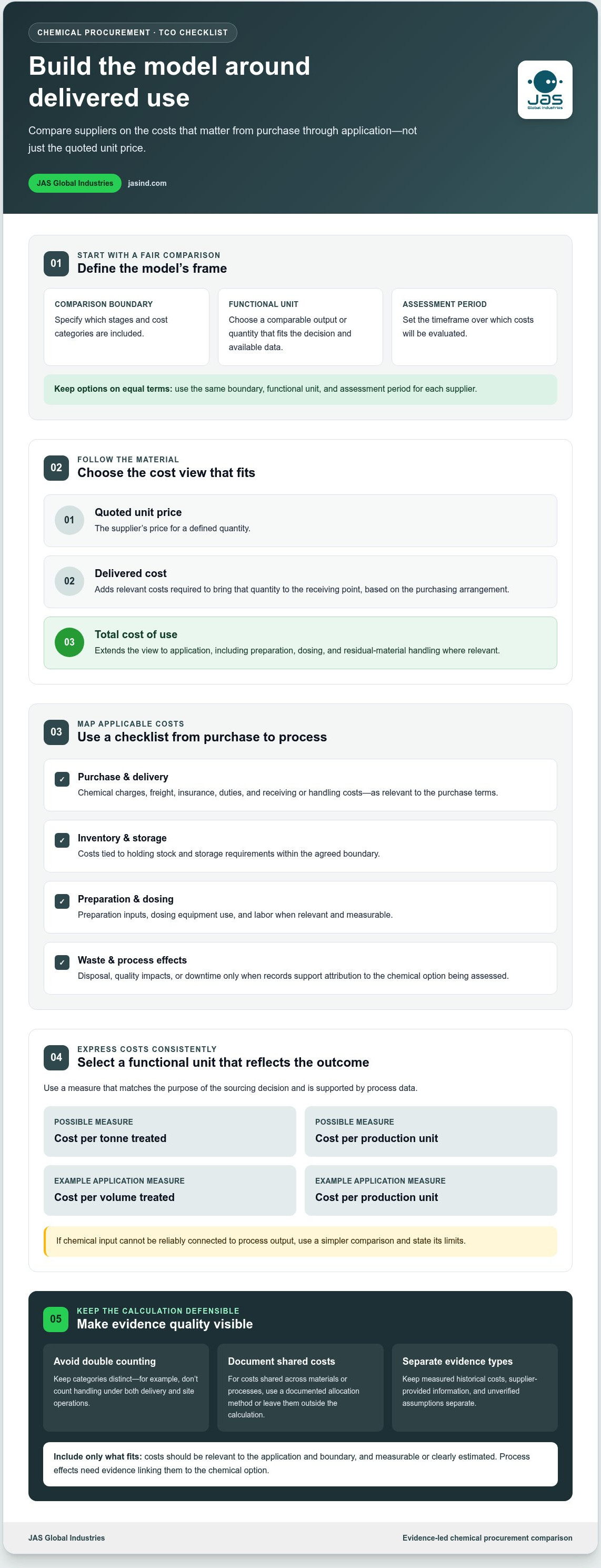
Three cost views help clarify what’s being compared. Quoted unit price is the supplier’s price for a defined quantity. Delivered cost adds relevant costs required to bring that quantity to the receiving point, based on the purchasing arrangement. Total cost of use extends the view to application, including preparation, dosing, and residual-material handling where relevant. A model might compare a water-treatment chemical by cost per volume treated, or a mining chemical by cost per production unit, but only if usage and process data support that functional unit.
Set the boundary to fit the decision. A delivered-cost review might end when the chemical reaches the site, while a use-based comparison may include storage, preparation, dosing, and waste handling. The relevant items depend on the application, contract and delivery terms, assessment period, and available evidence. Don’t add categories just because they appear in a generic template. Include costs that could reasonably affect the choice and can be measured or clearly estimated.
Which decisions benefit from a chemical TCO model?
A TCO comparison can support supplier selection, contract renewal, formulation evaluation, or a proposed sourcing change. It’s particularly useful when purchases recur in meaningful volumes or the chemical is closely tied to process operation, since differences in use may add up over the assessment period. For an occasional, straightforward purchase, a focused delivered-cost comparison may be enough. Match the model’s detail to the scale and operational relevance of the decision.
What the model can and cannot establish
A sound model makes evidence quality visible. Keep measured historical costs, supplier-provided information, and unverified assumptions separate rather than blending them into a single result. Before comparing options, define three things:
- Comparison boundary: which cost stages are included.
- Functional unit: the comparable output or quantity used to express cost.
- Assessment period: the timeframe over which costs are evaluated.
These choices help teams interpret results consistently, but they don’t prove that a supplier will deliver savings or that a chemical will perform as expected. TCO organizes evidence for a decision; technical validation and operating results remain essential. The total cost of ownership model for chemical procurement is most useful when its assumptions are explicit, the comparison is fair, and conclusions stay within what the evidence supports.
Build a Chemical Procurement TCO Model Around Delivered Use
A chemical comparison becomes more meaningful when it follows the material from purchase to application. First, define what the sourcing decision needs to support, then choose a functional unit that reflects that purpose. Depending on the process and available records, this could be cost per tonne treated or cost per production unit. Don’t choose a measure just because it’s familiar. If the data can’t reliably connect chemical input to process output, use a simpler comparison and state its limits.
Map direct and indirect cost categories
Build the cost map around the actual purchasing arrangement and application. Start with the chemical purchase, then include delivery and use costs where they apply and can be supported by evidence.
- Purchase and delivery: chemical charges, freight, insurance, duties, and receiving or handling costs, as relevant to the purchase terms.
- Inventory and storage: costs tied to holding stock and storage requirements within the agreed boundary.
- Preparation and dosing: preparation inputs, dosing equipment use, and labor when relevant and measurable.
- Waste and process effects: disposal, quality impacts, or downtime only when records support attribution to the chemical option being assessed.
Keep categories distinct. For example, don’t count a handling cost under both delivery and site operations. If an item is shared across several materials or processes, use a documented allocation method or leave it outside the calculation. Process effects need particular care: include them only when evidence links the effect to the chemical and it falls within the comparison boundary.
Choose a functional unit and comparison period
The functional unit should represent the outcome procurement is supporting, not simply the quantity on a supplier quote. A treatment chemical might be assessed per volume treated, while a process input might be compared per production unit, if operational data support that relationship. For a fair comparison, keep product scope, volume basis, operating conditions, and assessment period consistent across alternatives.
Set the period to match the decision, such as the term under review or a representative operating interval supported by records. Document exclusions alongside the model. If waste handling, equipment costs, or a process effect isn’t counted, state that clearly so readers understand what the result does and doesn’t represent.
A consistent functional unit makes supplier comparisons fairer because it expresses each option’s relevant costs against the same supported process outcome.
For each alternative, add the included cost categories, then divide by the chosen functional unit:
TCO per functional unit = total included costs during the assessment period ÷ supported functional units during that period
Use the same method for every option and keep a record of each input’s source. The result is only as reliable as the underlying usage, cost, and output data. Technical collaboration can help teams assess whether application assumptions fit the process; JAS chemical application support can be part of that evaluation.
Compare Chemical Suppliers Without Letting Assumptions Decide the Outcome
A comparison can look precise while relying on different definitions of the product, delivery, or expected use. Before ranking suppliers, align the options on the same basis. The total cost of ownership model for chemical procurement should make evidence quality visible, not turn uncertain inputs into facts just because they appear in a spreadsheet.
Use a comparison table to show where each input comes from and how it’s treated. For example:
| Input type | Example | How to use it |
|---|---|---|
| Observed data | Site purchase records, delivery invoices, or logged chemical consumption | Use the recorded value and identify its source and period. |
| Supplier information | Quoted terms, product documentation, or supplier-provided application estimates | Record the supplier and date; distinguish quoted terms from estimates. |
| Unverified assumption | Projected usage or an estimated process effect without supporting records | Label it clearly, assign an owner, and test its influence on the result. |
Then normalize the comparison. Confirm that alternatives cover equivalent product scope and use the same functional unit, delivery terms, assessment period, and operating conditions. If one option is evaluated using actual consumption and another using a supplier estimate, show the difference rather than presenting both as equally established. Don’t compare different shipment or contract terms as though they were identical.
Test process and performance assumptions
Use site records, controlled trials, laboratory results, and operating data where available. Check whether options were assessed under comparable conditions. Changes in feed, equipment, operating practice, or throughput can influence process results alongside chemical choice. Separate these factors where the evidence allows. If it doesn’t, treat the result as uncertain rather than assigning the outcome to a supplier.
A technical review can help determine whether available evidence supports a proposed link between chemical use and a process outcome. The goal isn’t to force every operational effect into a cost figure. It’s to keep attribution defensible and make clear what the comparison can support.
Make uncertainty visible in the comparison
For each material assumption, record its owner, evidence source, confidence level, and review date. Then run sensitivity scenarios for inputs that could change the ranking, such as estimated usage or logistics terms. Vary one uncertain input at a time, or test a clearly documented combination, and show how the result responds. Don’t present a single estimate as certain when the underlying data remain variable.
Keep unquantified sustainability or supply-risk considerations visible in a separate decision record rather than adding unsupported values to the cost total. They may still matter to the sourcing decision, but readers should be able to distinguish them from calculated costs.
TCO doesn’t need to become an elaborate exercise. Scale the model to the decision’s value and complexity: use a focused evidence table for a straightforward purchase, and a more detailed review when recurring use or process dependence makes uncertainty consequential. A transparent, proportionate comparison is more useful than a complex model built on inputs no one can verify.
Put the TCO Model to Work Across Procurement and Plant Teams
A model becomes useful when the people managing purchasing and the people running the process can both stand behind its inputs. Start with a clear decision, such as whether to renew a supply arrangement or evaluate an alternative. Establish the current-state baseline, then record material changes during the comparison, including shifts in operating conditions, supply terms, or data quality. This helps teams distinguish supplier differences from process changes.
An auditable procurement comparison needs a defined scope, traceable inputs, documented assumptions, and clear ownership of review and approval. That governance doesn’t need to be complicated, but it does need to be consistent.
- Define the decision. State which options are being assessed and what the result will inform.
- Set the boundary. Agree on cost categories, functional unit, and assessment period.
- Gather the evidence. Collect records from the teams responsible for each input.
- Calculate consistently. Apply the same method and comparison basis to each alternative.
- Validate and review. Check inputs with stakeholders, document approval, and revisit the model when relevant conditions change.
Assign responsibilities before data collection begins. Procurement can own quotes, contract terms, and supplier records. Finance can review cost treatment and calculation logic. Operations can provide consumption, throughput, and operating-condition records. Technical stakeholders can assess application evidence and whether process assumptions are reasonable. For example, a comparison involving fertilizer anti-caking may need application and handling inputs, while mining solutions or industrial water treatment may call for different process measures. Use data relevant to the decision.
Create a repeatable workflow and data trail
Keep a record linking each figure to its source. Procurement can retain invoices and supplier terms; operations can identify consumption records; logistics inputs should trace to the relevant shipment or delivery documentation; and technical teams can document process evidence. Save the calculation logic, assumptions, exclusions, and approval decisions with the model. Set a review trigger for meaningful changes to operating conditions, supply arrangements, or input data, so an outdated comparison doesn’t quietly become the basis for a new decision.
Use the model to guide supplier discussions
A shared framework turns the result into a focused discussion of cost drivers and evidence gaps. Teams can clarify which inputs are documented, which remain estimates, and what technical evaluation could resolve an important uncertainty. Laboratory development, on-site implementation, and ongoing industrial support can inform testing or implementation needs where relevant to the application. Keep the model’s findings in their proper role: they support sourcing decisions, but estimates don’t guarantee savings or process performance.
Use the total cost of ownership model for chemical procurement as a living decision record. For an application-specific review, discuss chemical procurement requirements with JAS Global Industries’ technical team.
Apply Chemical Procurement TCO with JAS Global’s Technical Partnership
A decision-ready chemical procurement comparison rests on four foundations: comparable scope, relevant costs, validated evidence, and visible uncertainty. Together, they help procurement and plant teams understand what the model supports, where evidence is incomplete, and which considerations still require judgment. A clear result doesn’t need to eliminate uncertainty. It needs to show where uncertainty sits and how it could affect the decision.
Technical collaboration can help translate a sourcing question into an evaluation plan. JAS Global Industries provides laboratory development, on-site implementation, and ongoing industrial support. These capabilities can help teams define application context, identify useful data, and consider appropriate technical evaluation. Procurement teams assessing fertilizer anti-caking agents, mining flotation collectors, or water treatment antiscalants may need different application inputs and operating evidence.
Where technical collaboration fits into TCO
Technical input should complement, not replace, procurement and operations review. Procurement brings purchasing terms and supplier records; operations contributes site conditions and use data; technical stakeholders help interpret application evidence and identify questions to evaluate. Laboratory development or on-site implementation may inform evaluation planning where relevant. Any projected result remains dependent on site conditions and validated, project-specific evidence. Treat proposed benefits as hypotheses until the evidence supports them.
This discipline matters because a model can organize cost inputs, but it can’t make unlike conditions comparable on its own. Distinguish measured results from estimates, and record whether a finding comes from historical operations, laboratory work, implementation observations, or supplier-provided information. If the evidence can’t isolate a chemical’s contribution from other process changes, preserve that limitation in the decision record rather than attributing the result to a supplier.
Turn the comparison into a procurement decision
Present model findings alongside operational needs, supply considerations, and sustainability priorities. Keep calculated cost results distinct from qualitative factors that haven’t been quantified. Before approval, capture:
- Decision rationale: why the selected option best fits the stated requirements.
- Open assumptions: which inputs remain uncertain and who owns follow-up.
- Review conditions: what change in process, supply arrangement, or evidence should trigger a reassessment.
This record helps preserve the integrity of the decision over time. It also gives future reviewers a way to understand why the comparison reached its conclusion, even if operating conditions or sourcing priorities later change.
A total cost of ownership model for chemical procurement is most valuable when it supports sound judgment, not when it suggests certainty the evidence can’t provide. JAS Global Industries technical partnership can help teams consider application requirements and evaluation needs alongside procurement analysis. Discuss your chemical procurement requirements with JAS Global Industries to explore a technical evaluation shaped around your application.
Make Your Next Chemical Sourcing Decision More Resilient
Put your model to work on a live sourcing question. Use the total cost of ownership model for chemical procurement to clarify which evidence would strengthen the decision, where uncertainty could affect it, and what should trigger a future review. That makes the assessment a practical reference for procurement and plant teams, rather than a one-time calculation.
JAS Global Industries has operated since 1998 and brings an established perspective to specialty chemical procurement and application requirements. Its laboratory development, on-site implementation, and ongoing industrial support can inform technical evaluation alongside your team’s operational and commercial review. Results still depend on site conditions and project-specific evidence, so keep the model grounded in what can be validated.
Start with the sourcing decision that matters most to your operation. Discuss your chemical procurement requirements with JAS Global and take the next step toward a clearer, more defensible comparison.
Frequently Asked Questions
What is a total cost of ownership model for chemical procurement?
A total cost of ownership model for chemical procurement compares relevant costs within a defined boundary and period, rather than treating the supplier’s unit quote as the whole decision. Depending on the application, it may account for what it takes to receive, handle, and use the chemical. Include categories supported by records or clearly labeled estimates. The model helps structure a sourcing choice, but can’t promise savings or a particular operating result.
How do you calculate total cost of ownership for chemicals?
Start by selecting a functional unit that reflects the process outcome and a period that fits the decision. Identify relevant cost categories, then gather records for each supplier using the same scope. Calculate each option’s included costs on that shared basis and retain the calculation logic. Delivery, storage, dosing, or process effects may belong in the model when applicable and supported by data. Record assumptions so reviewers can see which inputs need further validation.
What costs should be included in chemical procurement TCO?
Potential categories include chemical purchase, delivery, storage, handling, preparation, dosing, labor, waste management, and documented process impacts. The right set depends on the chemical’s role and the decision being assessed, so no universal checklist fits every operation. Define which stages count before comparing options. For example, don’t include a shared handling expense twice under different labels. If an impact can’t be documented or reasonably attributed, leave it out of the calculated total or identify it as unquantified.
How can procurement compare chemical suppliers when usage differs?
Compare suppliers using the same functional unit, product scope, assessment period, and operating conditions, supported by usage records that represent comparable production or treatment. If consumption data come from different periods or site conditions, flag the mismatch rather than treating the figures as equivalent. Scenario analysis can show how the result shifts under different usage assumptions. Review changes in feed, equipment, or operating practice before attributing a consumption difference to the chemical or supplier.
Can a TCO model include sustainability and supply risk?
Yes. Include sustainability or supply-risk considerations in the decision record, while keeping them separate from calculated costs unless there’s a defensible, approved method for valuing them. Teams might document relevant environmental criteria, supply continuity concerns, and the evidence behind each assessment. State assumptions clearly and apply the same approach across options. Don’t assign a monetary value or claim a cost benefit without a sound basis; qualitative factors can inform a decision without being presented as cost totals.
How often should a chemical procurement TCO model be updated?
Review the model when a material input changes, such as operating conditions, supplier arrangements, usage evidence, or the decision horizon. The appropriate cadence depends on the purchasing decision and how frequently reliable data become available. A long-term sourcing review may need different checkpoints from a one-time purchase. Keep dated versions and note what changed, why, and who reviewed it. This helps decision-makers distinguish current evidence from assumptions used in an earlier comparison.
Who should be involved in a chemical procurement TCO analysis?
Involve procurement, finance, operations, and technical stakeholders, assigning each responsibility for information they can verify. Procurement can provide purchasing records, finance can review cost treatment, operations can describe site conditions, and technical teams can assess application evidence. Supplier technical input may help clarify product or evaluation questions, but internal stakeholders should retain responsibility for assumptions and approvals. This shared review connects the commercial comparison to plant realities without blurring who owns each decision.