
If you’re searching for jasalex, the practical question is which fertilizer anti-caking solution fits your material, equipment, and storage conditions. A name alone can’t establish whether a treatment suits a particular fertilizer grade or operating process.
Caking can be influenced by moisture exposure, temperature changes, and pressure during storage. Fertilizer chemistry and application conditions also shape how an anti-caking approach performs. Comparing options without considering these factors can leave important operational requirements out of the decision.
This article explains how to assess options by fertilizer material, handling environment, application needs, and evaluation criteria. You’ll learn which details help establish technical fit and how to compare solutions using relevant evidence. JAS Global Industries supplies fertilizer anti-caking agents and brings over 25 years supplying innovative chemical additives for Mining & Fertilizers. Its tailored formulation work takes the fertilizer and operating context into account. Use the guidance below to frame a focused, evidence-led evaluation.
Key Takeaways
- Use jasalex as a starting point for researching fertilizer anti-caking options, then compare solutions against the operational problem you need to address.
- Assess anti-caking options against the fertilizer material, such as urea, ammonium nitrate, or NPK, and the conditions it will encounter.
- Follow a clear evaluation sequence: define the caking issue, document the material, map handling conditions, then review supporting evidence.
- Distinguish laboratory observations from on-site operating results when assessing the information available.
Searching for JASalex? Start with the fertilizer caking problem
When searching for “jasalex,” focus your comparison on the operational issue behind the query: fertilizer caking. Caking is the unwanted agglomeration of fertilizer particles into clumps. It can interfere with flow and make storage, discharge, conveying, and other handling steps more difficult.
An anti-caking agent is an additive used to help limit particle agglomeration; it is not a fertilizer or a source of plant nutrients. Its suitability depends on the fertilizer and the conditions in which the material is processed, stored, and moved.
How caking affects fertilizer handling
Clumps can disrupt consistent product flow and complicate movement through storage and handling systems. The effect depends on the operation: a product that flows adequately at one stage may present challenges after storage or transport.
Fertilizer characteristics and exposure to moisture, temperature variation, and physical pressure can all be relevant when assessing caking risk. Urea, ammonium nitrate, and NPK blends have different material compositions, so don’t assume the same treatment or evidence applies to every grade and process.
Why search-term matching is not a technical comparison
A name or search result doesn’t establish how an additive performs with a particular fertilizer. A useful technical comparison considers the material being treated, the handling process, and the conditions the fertilizer encounters. Performance conclusions should be based on relevant evidence, not inferred from a product-like term.
Keeping that distinction in mind shifts the evaluation from labels to operational fit. For a deeper explanation of how anti-caking agents support industrial flow, see this anti-caking agents science guide from JAS Global Industries.
How fertilizer anti-caking solutions differ by material and conditions
Anti-caking selection should reflect both the fertilizer’s characteristics and the conditions it will face through processing, storage, and transport. A product name or broad function won’t show whether a solution fits a specific grade or operating line. Compare the application context with the evidence available for it.
Compare fertilizer type and handling context
Start by identifying the material and grade, then record where and how it is handled. Include storage duration, exposure to changing conditions, whether the fertilizer is stored in bulk or bags, and the stages where flow problems occur. Urea, ammonium nitrate, and NPK are distinct application contexts. Evidence for one should not automatically be applied to another.
Use a comparison like this to identify what a meaningful evaluation should address:
| Material | Operating context | Evaluation question | Evidence needed |
|---|---|---|---|
| Urea | Document storage and downstream movement. | Does the evidence match this grade and process? | Application-specific test conditions and observed flow or caking results. |
| Ammonium nitrate | Record handling stages and storage exposure. | Was the material evaluated in a relevant operating context? | Clear identification of the tested material, conditions, and observations. |
| NPK | Specify the blend and its storage and transport route. | Does the evidence relate to this blend rather than another fertilizer? | Blend-specific evaluation details and results. |
Separate functional needs from supplier language
A stated function describes what an additive is intended to do. On its own, it doesn’t prove performance with a particular fertilizer or process. Look for documented test conditions and results, and distinguish laboratory observations from on-site operating results. Don’t infer ingredients, application rates, or outcomes from a name or general description.
This evidence-led approach makes a jasalex-related comparison more useful by shifting attention from name matching to the questions that matter for the operation. For application-specific fertilizer anti-caking evaluation, align the material, process conditions, and performance evidence before weighing options.
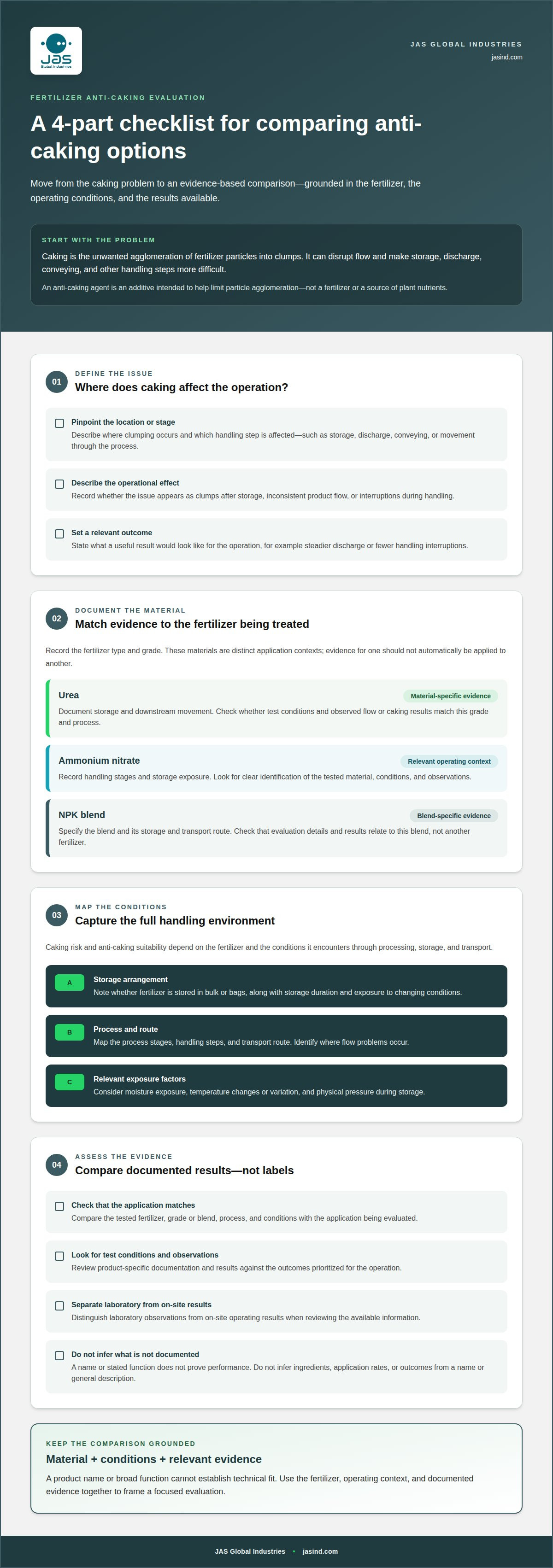
How to evaluate fertilizer anti-caking options before selection
A structured evaluation turns a general need into a practical comparison. Start with the operating problem, then gather evidence that reflects the fertilizer and process. If your research began with jasalex, assess options on the same basis: application details and documented results, not name matching.
- Define the issue. Describe where caking occurs and how it affects operations, such as inconsistent discharge, clumping after storage, or interruptions during handling.
- Document the material. Record the fertilizer type and grade, including whether it is urea, ammonium nitrate, or an NPK blend where relevant.
- Map the conditions. Note the process stages, storage arrangement, transport route, and environmental conditions that matter to the application.
- Assess the evidence. Compare product-specific documentation and test observations against the outcomes your operation has prioritised.
Build an application-specific evaluation brief
Before comparing solutions, write down the material, affected process stages, storage context, and operational issue. Define what a useful result would look like for your site. Priorities might include steadier discharge, fewer handling interruptions, or compatibility with existing processes. Clear criteria make comparisons more consistent without assuming that any option will deliver a particular result.
Assess evidence and sustainability considerations
Separate laboratory observations from results recorded during on-site operation. They can inform different parts of an assessment, but the conditions and scale may differ. Record what was tested, under which conditions, and which outcomes were observed. Review environmental and operational considerations alongside economic priorities, using the requirements relevant to your site. Broad claims should not substitute for application-specific evidence.
Record the fertilizer, process conditions, test context, observed handling outcomes, and environmental and operational priorities. This checklist gives technical discussions a clear starting point and helps keep claims tied to evidence.
To develop an evaluation around your fertilizer and process, discuss an application-specific anti-caking assessment with JAS Global Industries.
How JAS Global supports fertilizer anti-caking evaluation
Once the material, operating conditions, and evidence criteria are defined, the next step is a technical discussion grounded in those details. JAS Global Industries supplies fertilizer anti-caking agents and supports industrial evaluation through a partnership model spanning laboratory development, on-site implementation, and continuous process optimisation.
Over 25 years supplying innovative chemical additives for Mining & Fertilizers. That experience informs a tailored approach: the fertilizer and operating context guide the discussion, not a product name alone. For teams researching jasalex, the focus is the actual application and how an option will be evaluated.
A tailored approach to industrial process needs
Fertilizer operations differ in their materials, process stages, and handling requirements. JAS Global’s tailored-formulation approach connects these operating realities to solution development. Laboratory development can inform evaluation, while on-site implementation and ongoing process optimisation extend the partnership into the operating environment. The aim is a considered technical fit, not a promised result or a one-size-fits-all claim.
Move from comparison criteria to a technical discussion
Prepare a concise brief with the fertilizer type and grade, process stages involved, storage and transport context, observed issue, and outcomes that matter to your operation. Include the evidence already available and note the conditions under which it was gathered. For broader background, the fertilizer anti-caking science guide explains the role of anti-caking agents in industrial flow.
Explore JAS Global’s fertilizer chemical solutions and bring your application priorities into a focused technical discussion.
Turn your evaluation into a practical next step
Make the next stage measurable. Before changing an anti-caking approach, capture current handling conditions and the outcomes your operation wants to improve. Use those priorities to frame a focused technical discussion, keeping the fertilizer, process, and evidence together. This gives your team a consistent basis for assessing options and reviewing what matters in practice.
A jasalex-related evaluation doesn’t need to end with a name comparison. It can become a clearer assessment of how a fertilizer chemical solution fits your operating priorities, with sustainability considered alongside process needs. JAS Global combines technical collaboration with a focus on industrial requirements to support informed decisions without relying on broad promises.
Explore JAS Global’s fertilizer chemical solutions and take the next step toward an evaluation shaped around your operation. A well-defined application is a strong starting point for progress.
Frequently Asked Questions
Can one fertilizer anti-caking agent work for every fertilizer?
No single option should be assumed suitable for every fertilizer and production line. A candidate evaluated for granular urea, for example, shouldn’t automatically be treated as suitable for an NPK blend or a different process. If the material, grade, or handling setup changes, treat it as a new application and assess evidence for that context before relying on previous results.
What information should I provide when comparing anti-caking solutions?
Provide the fertilizer grade, a representative sample description, and where the issue appears, such as after bag storage or during bulk discharge. Note how long the product is stored, its packaging or storage arrangement, and what operators observe during handling. If you have baseline records, such as discharge interruptions or clump observations, include them to give the comparison a practical point of reference.
Do anti-caking agents change fertilizer nutrient content?
An anti-caking agent is used for a physical handling purpose, not as a fertilizer nutrient. However, this alone doesn’t answer questions about the finished product’s composition. Review the specific additive documentation and the producer’s product-quality requirements. If nutrient content is critical to release decisions, use the producer’s established analytical controls to evaluate the finished material.
How can a fertilizer producer assess anti-caking performance?
Use a defined comparison with the same fertilizer grade and comparable handling conditions, then record observable outcomes such as flow at discharge and whether clumps form after storage. Keep laboratory findings distinct from plant observations, since they describe different evaluation settings. Where practical, repeat observations across relevant production or storage batches to see whether results remain consistent, rather than relying on a single sample.
Is JASalex a fertilizer anti-caking product?
JASalex is the search term used in this article. JAS Global Industries supplies fertilizer anti-caking agents, and an effective product-level assessment focuses on the actual product documentation and evidence for the fertilizer application in question. Compare the formulation and evaluation details with the material and operating conditions instead of inferring them from the search term.