
Moisture can turn fertilizer into a caked handling problem, so storage conditions matter alongside time. The long-term storage of fertilizer additives has no single shelf-life: most fertilizers remain effective for 1-2 years, while some inorganic and synthetic granular products can last nearly indefinitely when stored in optimal conditions. Keep products dry, covered, and ventilated, and follow product-specific storage requirements to help protect usability.
It’s easy to assume a sealed bag is enough, but humidity, heat, and the product’s formulation can all affect how it holds up. This guide explains what shelf life can look like across product types and how to reduce caking through practical storage steps. You’ll learn how to control moisture, manage airflow and temperature, and rotate stock so stored materials stay in better condition for longer.
Key Takeaways
- Use microbial inoculants within their two-year expiration date, while some inorganic granular fertilizers can remain usable nearly indefinitely under optimal storage conditions.
- Keep products in tightly sealed original packaging, elevated off the ground, and protected from moisture.
- Match storage conditions to the formulation: temperature, light, and humidity can affect different products in different ways.
- Reduce particle bonding by controlling moisture and pressure; anti-caking agents can help protect fertilizer flow and handling.
Storage duration and shelf life by fertilizer type
Set a storage window for each formulation: granular blends, liquids, and microbial products age differently. For long-term storage of fertilizer additives, track every product separately and follow its label instructions.
For expired or degraded additives in the United States, follow label directions and ask local waste authorities about disposal options. Climate-controlled storage generally costs more to operate because it manages temperature; total costs depend on facility needs and product requirements.
-
Check Shelf Life by Fertilizer Type
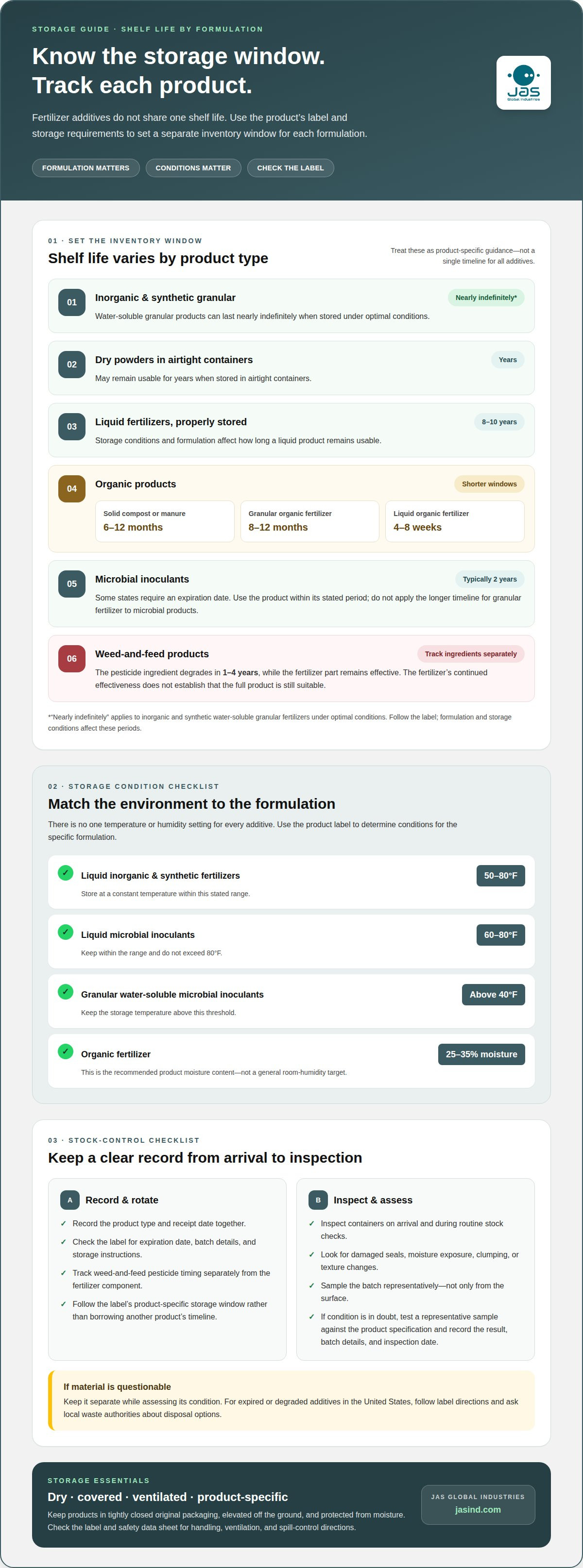
Compare the formulation with its stated shelf life before setting an inventory date. Inorganic and synthetic water-soluble granular fertilizers can last nearly indefinitely under optimal conditions; dry powders in airtight containers can remain usable for years. Properly stored liquid fertilizers may last 8-10 years. Storage conditions and formulation affect these periods, so don’t apply one product’s timeline to another.
Separate organic products from longer-lasting categories. Solid compost or manure has a recommended storage life of 6-12 months, while granular organic fertilizer has a recommended 8-12 months. Liquid organic fertilizer has a shorter recommended window of 4-8 weeks. Record product type and receipt date together.
-
Review Expiration Dates and Ingredient Shelf Life
Before rotating stock, check the label for an expiration date, batch details, and storage instructions. Some states require microbial inoculant manufacturers to include an expiration date, typically for a two-year period. Use microbial inoculants within that stated period for best results; don’t assume granular fertilizer’s longer shelf life applies to microbial products.
Check weed-and-feed products separately because ingredients can age at different rates. The pesticide ingredient degrades in 1-4 years, while the fertilizer part remains effective. Track the pesticide timeline independently; the fertilizer component’s continued effectiveness doesn’t establish that the full product remains suitable.
-
Inspect and Test Stored Products
Inspect containers when they arrive and during routine stock checks. Compare labels and batch details with inventory records, and look for damaged seals, moisture exposure, clumping, or texture changes. Sample the batch representatively rather than checking only the surface. A batch log makes long-term storage of fertilizer additives easier to manage.
If the product’s condition raises concerns, test a representative sample against the product specification using a suitable method. Record the results, batch details, and inspection date. Keep questionable material separate while assessing it, and follow label handling directions during inspection.
Dry, covered storage and ventilation
Choose a dry, roofed storage area with good airflow. Separate products by type and protect their packaging from moisture and temperature swings.
In the United States, follow each product’s label and safety data sheet for handling, ventilation, and spill-control directions. Contain and clean spills promptly; don’t hose fertilizer into a ditch or field.
-
Set Up Dry, Covered, Ventilated Storage
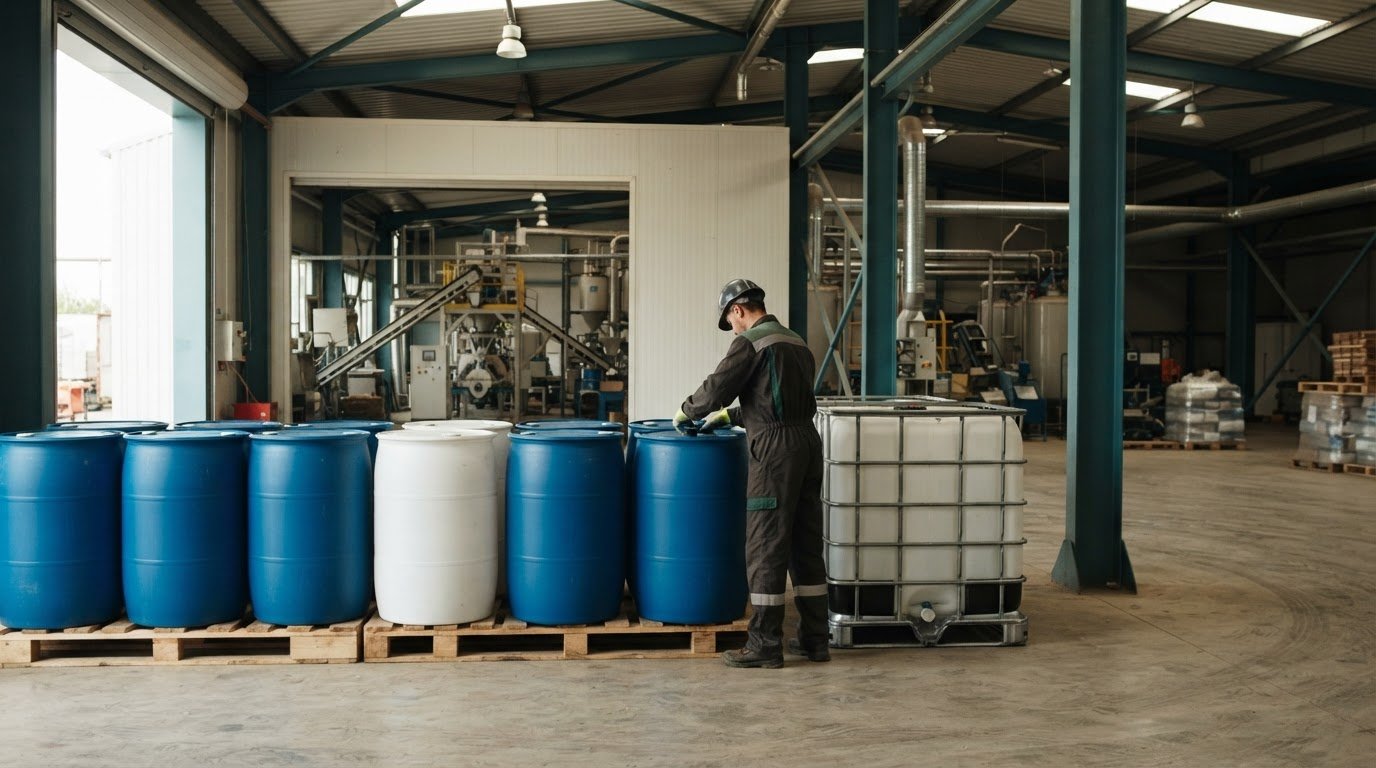
Store fertilizer in a shed or outbuilding with a solid roof and good ventilation. Keep each product in its original container, close it tightly, and raise it off the ground to limit moisture contact. Check the floor and nearby walls for dampness before arranging stock: a covered space can still expose products to moisture.
Follow product-specific temperature instructions rather than applying one storage setting to every chemical. Heat can affect product condition: a reported Brazil example found fertilizer nitrogen content dropped by 50% after storage in a metal shed that reached 48°C. Keep stock shaded and away from direct sunlight where product conditions call for it.
-
Prevent Storage Deterioration
Keep bags and containers closed between uses, and avoid transferring material into unmarked packaging. Store pesticides separately from fertilizers to reduce the chance of cross-contamination. Check seals and containers for leaks, corrosion, or damage during routine stock handling, and separate affected packaging from sound stock.
Moisture and pressure can promote particle bonding, settling, or separation. Avoid unnecessary stacking pressure, and follow product-specific directions before mixing or agitating settled liquids. For granular products prone to caking, fertilizer anti-caking agents can help reduce particle bonding during storage and handling.
-
Control Spills and Protect Application Areas
Keep spill-cleanup materials accessible near the storage area, and contain and clean spills promptly. Don’t wash residues toward a drain, ditch, field, or waterway. Before returning a container to storage, check its closure and exterior for residue that could spread during handling or application.
Before handling damaged packaging or cleaning a spill, review the label and safety data sheet. Follow their product-specific directions for protective handling, ventilation, and cleanup rather than applying one procedure to every additive.
Fertilizer storage conditions by product type
Set storage conditions for each formulation: temperature, moisture, and light affect products differently.
-
Set Conditions by Product Type
Match the storage area to the product label. Store liquid inorganic and synthetic fertilizers at a constant 50-80°F; liquid microbial inoculants need 60-80°F and should not exceed 80°F. Keep granular water-soluble microbial inoculants above 40°F. For organic fertilizer, the recommended moisture content is 25-35%, not a general room-humidity target.
There is no single temperature or humidity range that suits every additive. Use the formulation’s stated conditions to set the storage environment and limit changes that could affect nutrients, including nitrogen and phosphorus.
-
Identify Environmental Sensitivities
Check whether the formulation is sensitive to heat, moisture, light, or freezing, then position it accordingly. Temperatures above 35°C/95°F can kill beneficial bacteria in organic fertilizer; below 0°C/32°F, their activity slows to a halt. Moisture can cause powder clumping, while calcium and magnesium may react and become insoluble after sufficient moisture exposure.
Keep fertilizer stock solutions sealed to reduce evaporation and the risk of fungal or bacterial growth. Store dilute solutions away from direct light, which can contribute to trace-element degradation. Follow the product’s directions for managing air exposure rather than assuming every additive has the same oxygen sensitivity.
-
Separate Incompatible Products
Store pesticides separately from fertilizers, and keep each chemical in its labeled, closed container. Don’t assume products can share a shelf or storage area simply because both are used in agriculture. Check label instructions for storage compatibility and segregation, particularly where spills or damaged packaging could allow materials to mix.
Keep fuels and other chemicals separate from fertilizer additives unless product directions specify compatible storage. Separation lowers the risk of contamination and helps prevent a spill from spreading between products. Use distinct, clearly identified areas, and avoid placing incompatible materials together during transfer or application preparation.
Causes and consequences of fertilizer caking
Moisture, pressure, and chemical interactions can bind fertilizer particles into hard clumps. Identify what has changed in the material, then address the likely cause before handling or application.
- Trace the source of clumping. Check whether moisture entered through a damaged closure, humid air, or contact with a wet surface. Stacked bags can compact granular material under pressure, and chemical interactions may strengthen particle bonds. Identifying the likely cause helps distinguish a storage problem from a product change.
- Assess how the cake affects use. Clumped granular product may no longer spread evenly, making accurate handling and application harder. Breakable clumps and hardened masses are different conditions, so inspect the material and packaging before deciding how to proceed. Moisture absorption can change powder color without affecting fertilizer quality; color alone does not show a loss of effectiveness.
- Check for changes beyond appearance. Moisture can turn fertilizer powders into sludge even when the material remains viable. With sufficient moisture exposure, calcium and magnesium can react and become insoluble. Sediment in liquid fertilizer may dissolve with agitation. Follow the product’s handling directions before mixing or applying it.
- Reduce particle bonding. Keep storage conditions dry and limit pressure on bags to address two common causes of caking. Anti-caking agents act as a protective barrier that reduces particle bonding linked to moisture, pressure, or chemical interactions. As part of a product formulation, they can help preserve granular flow and support consistent spreading.
- Choose a response based on product condition. Don’t assume every cake is unusable, or that potassium-containing material can be treated like a liquid. Compare the material with its normal appearance and handling properties, and follow its label instructions. For help addressing caking during fertilizer production and handling, explore fertilizer caking control options.
JAS Global Industries: Fertilizer Anti-caking Agents
JAS Global Industries offers Fertilizer Anti-caking Agents for fertilizer production and handling. These additives form a protective barrier that reduces particle bonding associated with moisture, pressure, or chemical interactions. When granular material cakes, flow and consistent handling become more difficult. Anti-caking agents can help protect storage and application performance by reducing this bonding. JAS also offers Fertilizer Dust Suppressants, a separate option for managing dust during fertilizer handling. Consider anti-caking support when recurring clumping creates operational challenges despite suitable storage practices. The right approach depends on fertilizer composition and process conditions. Contact JAS Global Industries to discuss your fertilizer anti-caking needs and handling challenges.
Build Storage Into Your Process
Make long-term storage of fertilizer additives part of routine process control, not a task reserved for receiving or cleanup. Assign responsibility for inventory records, inspection notes, and follow-up when product condition changes. Clear records help teams link recurring caking or handling issues to specific batches and storage practices, then refine procedures based on what they observe.
When formulation support is relevant, JAS Global Industries offers Fertilizer Anti-caking Agents and Fertilizer Dust Suppressants for fertilizer handling challenges. Its specialty chemical offerings also include Mining Flotation Collectors. Discuss the specific material and process issue so the next step addresses your operational needs rather than relying on a generic storage approach.
Contact JAS Global Industries to discuss fertilizer additive handling needs and identify a practical next step for your operation.
Frequently Asked Questions
What are the storage requirements for common fertilizer additives such as micronutrients, humic acids, and biological inoculants?
Use each micronutrient or humic-acid product’s label to set its storage conditions, since formulations differ. For a biological inoculant, distinguish liquid from granular: liquid microbial inoculants are stored at 60-80°F and not above 80°F; granular water-soluble inoculants need sealed packaging in a cool, dry place and should not be stored below 40°F. Keep product identity and batch details with their containers.
How long can different fertilizer additives be stored before shelf life or effectiveness declines?
Storage life varies by formulation: microbial inoculants have a two-year expiration date, while inorganic and synthetic granular fertilizers may last nearly indefinitely under optimal conditions. Properly stored liquid fertilizers may last 8-10 years. Organic liquid fertilizer has a much shorter recommended storage life of 4-8 weeks. Record receipt and expiration details by batch, and rotate stock so older products are used first.
What are the costs of climate-controlled storage versus standard warehouse storage for fertilizer additives?
Climate-controlled storage generally costs more to operate because it manages temperature. Total costs depend on facility needs and product requirements.