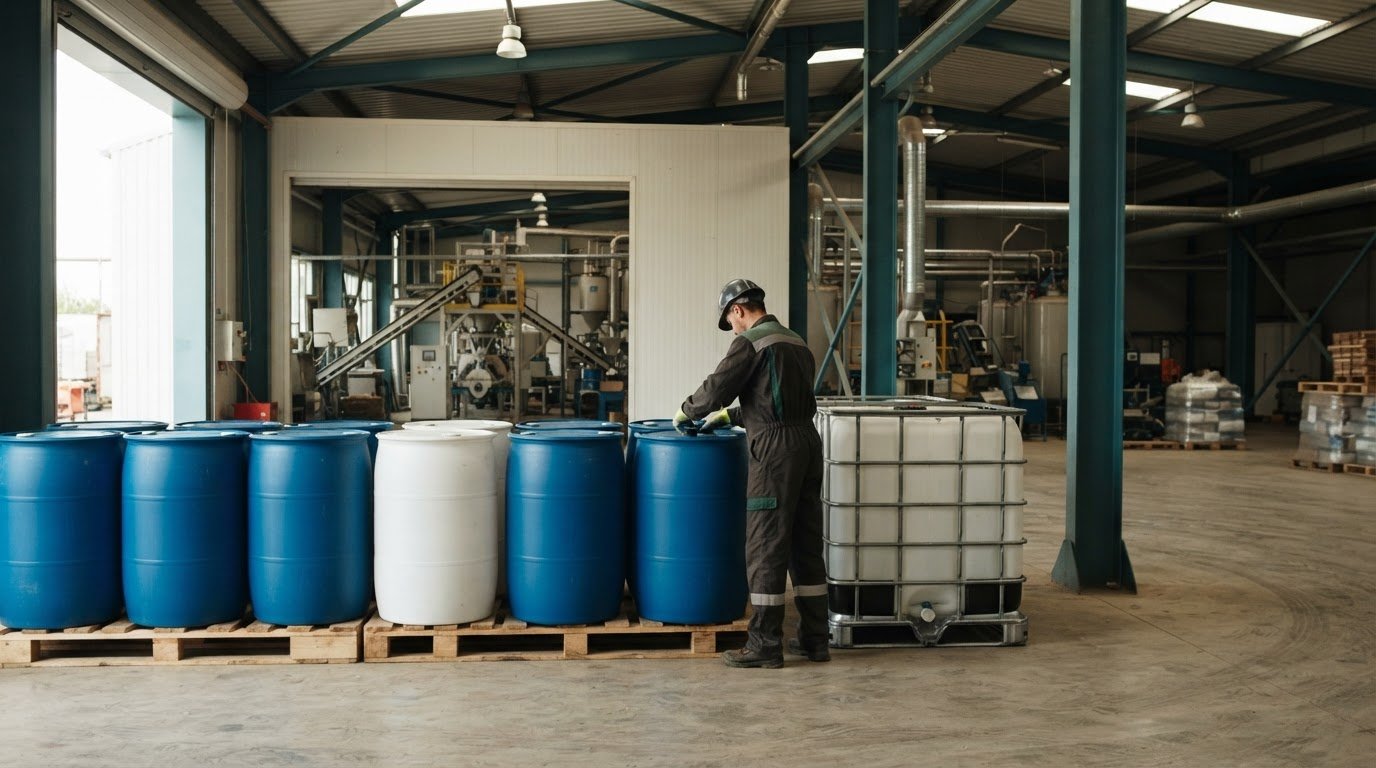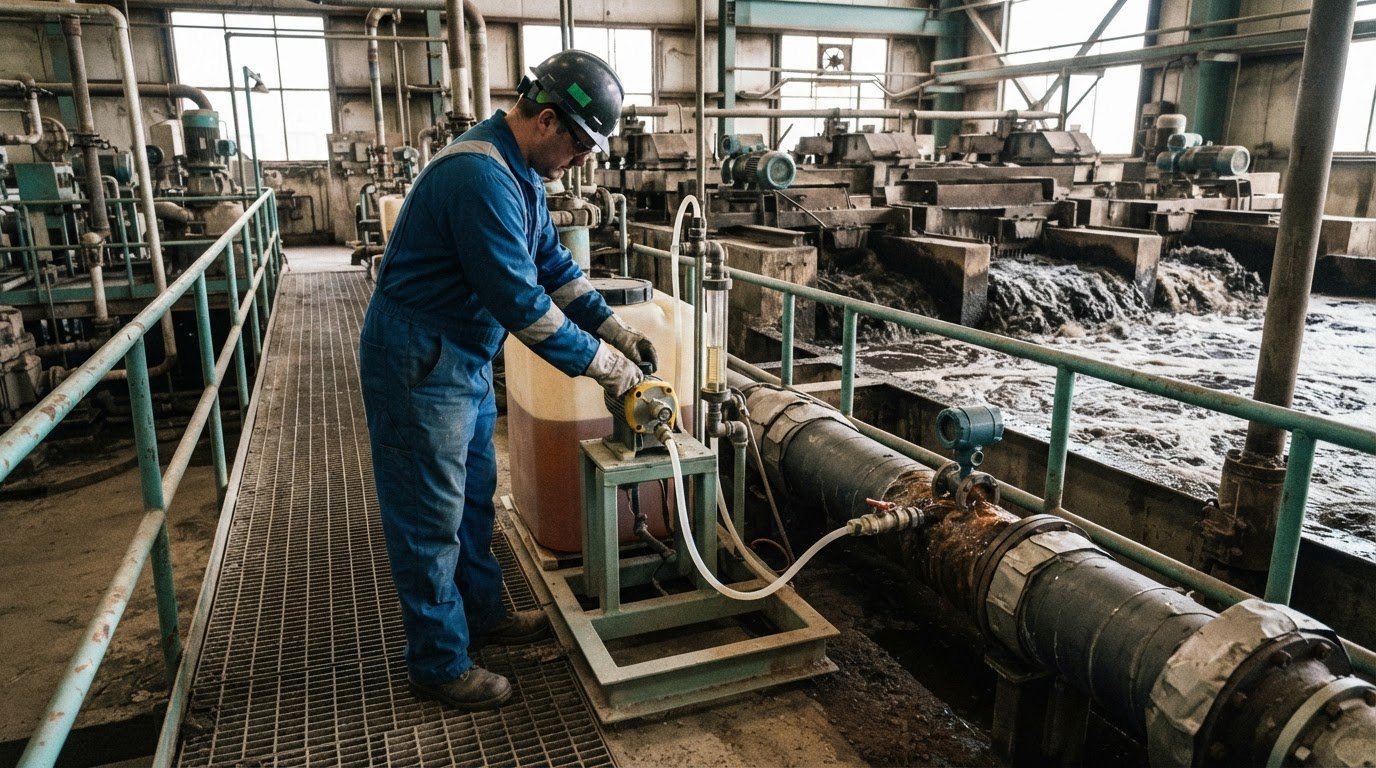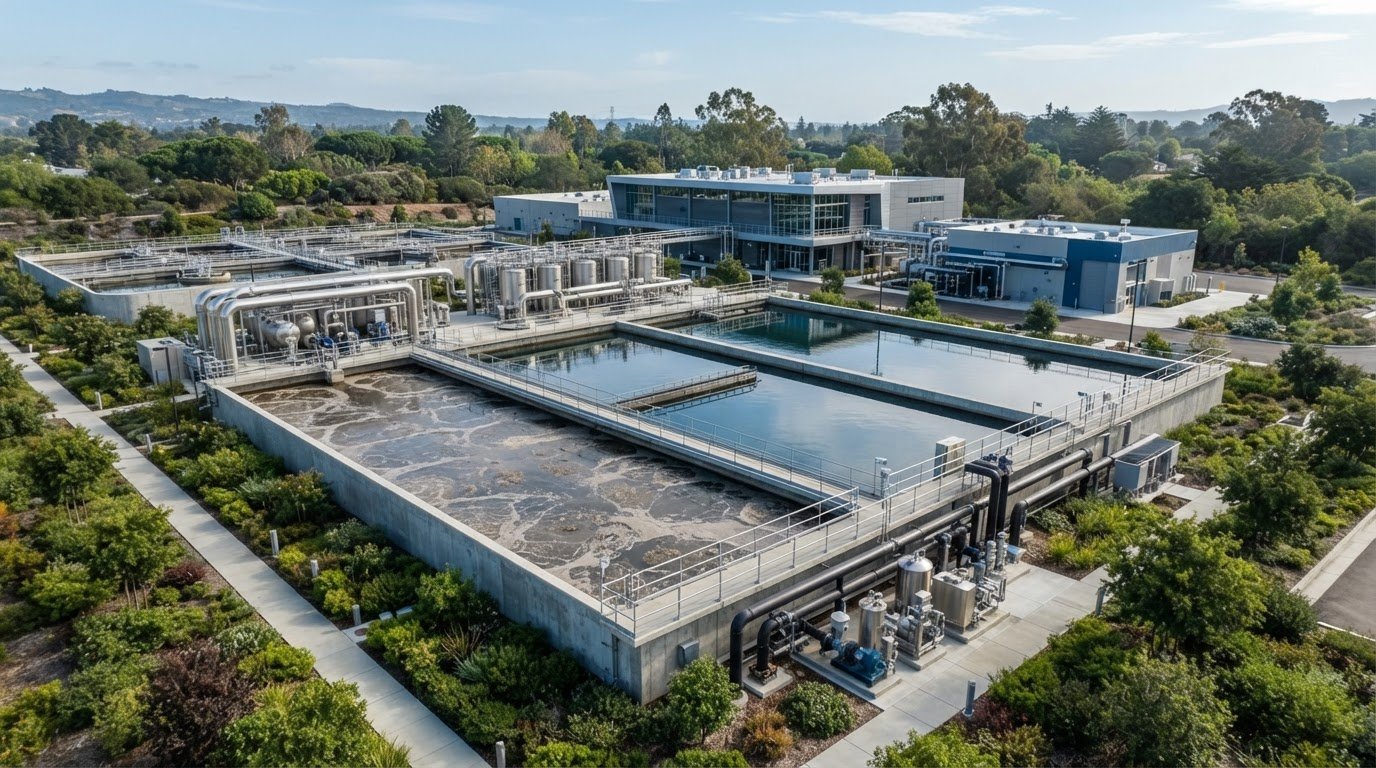


The lowest quotation is not necessarily the best choice. To understand how to qualify a new specialty chemical manufacturer, compare total cost with product fit, documented quality, production capacity, and supply continuity. Award business only when mandatory requirements are met or covered by explicit conditions.
Price matters, but so do the costs and risks behind it. Process changes, raw-material ownership, inventory, waste, scheduling, and documentation all affect the commercial fit. The supplier also needs to show that its process is repeatable and suited to your application.
This guide explains how to define requirements and decision ownership, assess manufacturing capability and scale-up readiness, identify supply and quality risks, and compare contract terms. It also shows how to weigh the evidence together, so your selection supports reliable operations rather than a low quote alone.
Key Takeaways
- Start with the intended application and required specifications, then set clear technical, commercial, and documentation criteria before comparing suppliers.
- Distinguish manufacturers, distributors, and toll producers by the work each performs and the responsibilities each retains.
- Look beyond certificates: assess traceability, repeatability, quality-deviation handling, and how changes to specifications or processes are controlled.
- Compare capacity and continuity against your demand profile, including production scheduling, packaging, lead times, and plans for changing demand.
- Make ownership, inventory, yield, waste, intellectual property, and post-launch performance expectations explicit before awarding business.
Identifying the manufacturer and assessing its production base
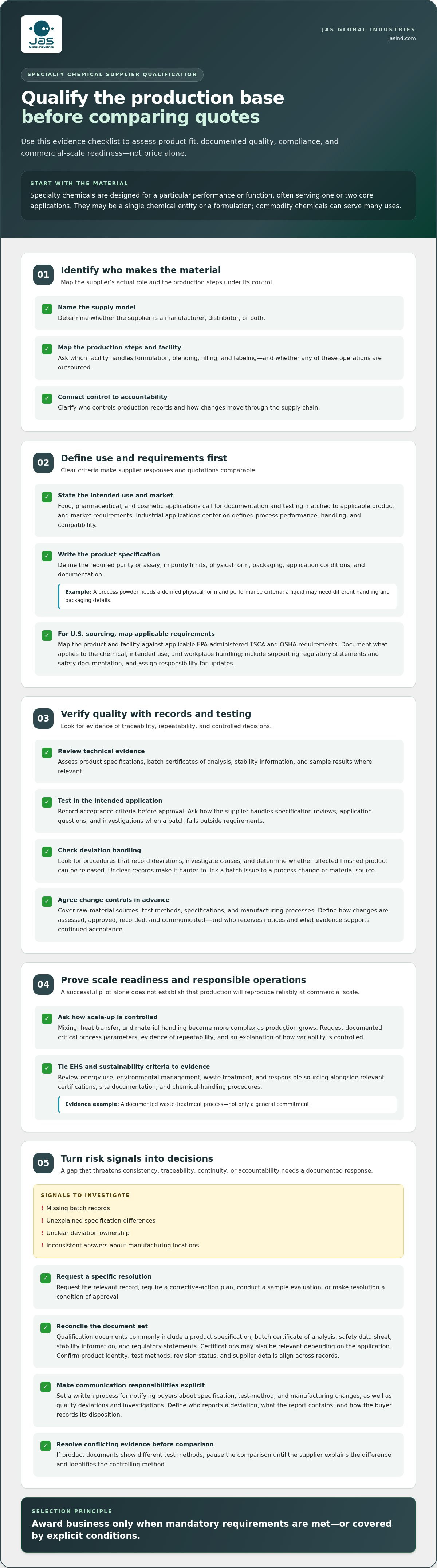
Start by identifying who makes the material and which production steps they control. A supplier may be a manufacturer, a distributor, or both. Ask which facility handles formulation, blending, filling, and labeling, and whether any of these operations are outsourced. This affects technical oversight, production records, and how changes move through the supply chain.
Specialty chemicals are designed for a particular performance or function, often serving one or two core applications. They may be single chemical entities or formulations, unlike commodity chemicals, which can serve many uses. Custom production can involve formulation development, process optimization, or adapting chemistry to customer requirements. Proprietary producers may instead supply finished products based on their process knowledge or specialized capabilities.
Qualification requirements depend on the intended use and market. Food, pharmaceutical, and cosmetic applications call for documentation and testing matched to applicable product and market requirements. Industrial applications center on defined process performance, handling, and compatibility. State the intended use clearly so the supplier can identify relevant specifications and records.
For U.S. sourcing, map the product and facility against applicable EPA-administered TSCA and OSHA requirements. Document which requirements apply to the chemical, its intended use, and workplace handling. Include supporting regulatory statements and safety documentation in the qualification file, then assign responsibility for maintaining and communicating updates.
Write the product specification before comparing quotations. Define the required purity or assay, impurity limits, physical form, packaging, application conditions, and documentation. For example, a powder used in a process needs a defined physical form and performance criteria, while a liquid may require different handling and packaging details. Clear criteria make supplier responses comparable.
Evaluate technical capability against your requirements, not broad claims. Review product specifications, batch certificates of analysis, stability information, and sample results where relevant. Test the material in its intended application and record acceptance criteria before approval. Ask how the supplier handles specification reviews, application questions, and investigations when a batch falls outside requirements.
Environmental, health, safety, and sustainability criteria should address energy use, environmental management, waste treatment, and responsible sourcing. Review relevant certifications and site documentation alongside chemical handling procedures. Tie each criterion to evidence, such as a documented waste-treatment process, rather than relying on general commitments.
Finally, assess whether the production base can reproduce the process at commercial scale. Pilot results may not transfer directly because mixing, heat transfer, and material handling become more complex as production grows. Before increasing volume, ask for documented critical process parameters, evidence of repeatability, and an explanation of how variability is controlled.
What are the biggest risk signals?
Risk signals matter when they undermine product consistency, traceability, or supply control. Turn each concern into evidence to review, a condition to document, or a decision to assign.
Quality Systems and Change Controls
A quality system defines how a manufacturer controls production records, deviations, and changes. Look for documented procedures that support traceability and repeatability across batches. Ask how the supplier records a deviation, investigates its cause, and decides whether affected finished product can be released. Unclear records make it harder to link a batch issue to a process change or material source.
Change control matters because a new raw-material source, test method, specification, or manufacturing process can affect product performance. Agree in advance how changes will be assessed, approved, recorded, and communicated. Define who receives notices and what evidence supports continued acceptance.
Recognizing and Managing Risk Signals
A risk signal is a gap that could disrupt quality, continuity, or accountability. Examples include missing batch records, unexplained specification differences, unclear deviation ownership, or inconsistent answers about manufacturing locations. These gaps matter because consistent evidence is essential to assess the supplier’s ability to control the finished product.
Turn each signal into a decision. Request the relevant record, require a corrective-action plan, conduct a sample evaluation, or make resolution a condition of approval. For example, if two product documents show different test methods, pause the comparison until the supplier explains the difference and identifies the controlling method.
Qualification documents commonly include a product specification, batch certificate of analysis, safety data sheet, stability information, and regulatory statements. Certifications may also be relevant, depending on the application. Review the documents as a set, confirming that product identity, test methods, revision status, and supplier details align across each record.
Communication failures can turn routine updates into operational risks. Set a written process for notifying buyers about specification, test-method, and manufacturing changes. Include quality deviations and investigations in the communication protocol. For example, define who reports a deviation, what information the report contains, and how the buyer records its disposition.
Clarify the supplier’s role in the supply chain, too. A business may manufacture, distribute, or perform both functions, and that distinction affects who controls production records and communicates changes. Identify the manufacturer and production site for the finished product, then establish which organization owns quality responses and document updates. This prevents requests from being passed between companies without clear accountability.
- Match product specifications, batch CoAs, and SDS documents by product identity and revision.
- Record each open concern with its evidence requirement and approval condition.
- Assign an owner for change notices, deviations, and corrective actions.
- Confirm which party controls the production site and quality documentation.
For mining applications, qualification criteria should reflect the process and material requirements of Phosphate Mining Chemicals, alongside the supplier’s quality and change-control evidence.
Assessing supplier capacity and continuity
Capacity is the supplier’s ability to meet your demand while maintaining consistent production. Compare available capacity with your forecast, required delivery schedule, and expected changes in demand. A facility’s stated production capability matters only if the relevant equipment, labor, raw materials, and packaging are available for your product.
Ask how production is scheduled and where your orders fit. Production schedules and shift patterns can vary by facility, so ask which operating windows can support your product. Find out which shifts can support your product and how maintenance, competing orders, or unexpected downtime affect schedules. A specialty-chemical batch may take hours or days, depending on the process.
Review the capacity plan against your demand profile. Compare production quantity, packaging format, minimum order quantity, lead times, and forecast requirements. A supplier may have production capability but lack the packaging format or schedule needed for your delivery pattern. These details reveal whether nominal capacity translates into dependable supply.
Continuity also depends on materials and logistics. Discuss how raw-material sourcing, inventory planning, packaging availability, and export documentation connect to the production schedule. For international shipments, align required documentation and shipping preparation with delivery dates. If demand rises or falls, clarify how revised forecasts affect production slots, order quantities, and commitments.
- Compare forecasted demand with production capacity and available scheduling windows.
- Align minimum order quantities and packaging with actual consumption and storage needs.
- Map lead times across materials, production, packaging, documentation, and shipment.
- Define how forecast changes affect order timing and production allocation.
Use the same assumptions for every supplier in a competitive comparison. Request capacity information for the product and production route under consideration, rather than relying on broad facility figures. A clear comparison distinguishes current capability from capacity that depends on future equipment, staffing, or schedule changes.
Assess continuity by examining how the supplier responds to disruption. Discuss the production plan for equipment maintenance, delayed raw materials, and unexpected demand changes. Ask how each event would affect your next order, its schedule, and its packaging. Record the response process and the communication path for revised delivery expectations.
Finally, connect capacity evidence to the order plan. Match the agreed production schedule with forecast updates, lead times, packaging requirements, and export documentation. This gives procurement and operations a shared basis for monitoring supply. If demand changes, the defined planning process helps teams identify the impact on production and delivery before an urgent shortage develops.
Contract conditions and post-award performance review
A contract turns the selected production model into clear operating responsibilities. Before signing, align commercial terms with demand, process ownership, and the risks each party accepts. A toll arrangement differs from contract manufacturing: toll manufacturers generally process customer-supplied materials under customer-provided procedures, while contract manufacturers often source raw materials and coordinate inventory. Define the model before setting obligations.
Document who owns raw materials and finished goods, who carries inventory risk, and how yield expectations are calculated. Specify responsibility for waste handling, production scheduling, and priority when demand changes. For example, a supply interruption can affect both inventory and delivery commitments. The contract should state how the parties handle that interruption and which costs or decisions belong to each.
Protect the formula and technical information with confidentiality terms. Custom chemical production and related intellectual property are commonly covered by nondisclosure agreements. Define permitted access, data handling, and use of process information. Clarify ownership of customer inputs, improvements, and production records, especially when the manufacturer contributes technical development or process expertise.
Make operating expectations measurable and practical. Set requirements for product specifications, batch documentation, data exchange, deviation notification, and investigation timelines. State how the manufacturer communicates changes to raw materials, test methods, or process conditions. If a batch deviates from specification, identify who investigates, who approves disposition, and what records support the decision.
- Raw-material sourcing, ownership, inventory control, and finished-goods ownership.
- Yield expectations, waste responsibility, scheduling priority, and demand changes.
- Confidentiality, intellectual-property boundaries, data access, and permitted use.
- Documentation, deviation handling, change notices, and corrective actions.
Before awarding the contract, list remaining risks and name the role that accepts each one. A procurement lead may own commercial exposure, while quality owns unresolved documentation or deviation controls. Technical and operations teams should record process risks and supply dependencies. Approval is stronger when every open item has an owner, a response, and an explicit condition for closure.
Post-award reviews should test whether actual performance matches the agreed terms. Review batch acceptance, delivery adherence, yield, documentation completeness, deviation trends, and responsiveness. Compare results with the contract’s definitions, not informal expectations. If recurring deviations appear, document corrective actions and due dates, then assess whether those actions restore consistent performance.
Set the review cadence and information exchange before production begins. Define which records the supplier provides, who reviews them, and how findings reach decision-makers. A scheduled review can connect quality trends with demand forecasts and inventory exposure. When performance changes, use the agreed escalation path to resolve issues and update responsibilities without obscuring accountability.
Defining procurement requirements and decision ownership
Start with the buying requirement, not a list of manufacturers. Define the application, the outcome the chemical must support, and who owns each decision. This keeps supplier screening focused on operational needs rather than persuasive quotations.
Organize requirements into three categories: mandatory technical and regulatory criteria, quality and documentation expectations, and commercial or operational conditions. Mark each item as pass-or-fail or suitable for comparative scoring. For example, an impurity limit may be mandatory, while packaging options can be scored against handling needs.
Before requesting quotations, document the intended use, required purity or assay, impurity limits, physical form, packaging, regulatory market, annual volume, and documentation needs. Add process conditions that affect performance, such as how the material will be introduced or stored. Include environmental criteria relevant to the application and procurement policy, so suppliers respond to the same scope.
- Technical: application, specification, physical form, and acceptance criteria.
- Quality: required records, test methods, and change communication.
- Commercial and operational: annual volume, packaging, schedule, and supply structure.
Make decision ownership explicit before market screening begins. Assign procurement responsibility for quotation comparability and commercial terms. Give technical and operations teams authority to assess application fit and production needs. Quality should own documentation review and product acceptance criteria, while regulatory and environmental specialists address applicable market requirements.
Set a clear approval route. For example, technical reviewers can assess sample performance, quality can review batch documentation, and procurement can compare commercial responses. Name one decision owner to consolidate findings, resolve conflicting recommendations, and record the final rationale. This prevents a low quotation from overriding a mandatory specification.
Use a consistent request for proposal so each supplier responds to the same volume assumptions, packaging needs, documentation list, and delivery expectations. Ask suppliers to identify exceptions against each requirement, not just make a general claim about capability. This makes gaps visible and supports a fair comparison between direct manufacturers and other supply models.
Before signing, confirm that every mandatory requirement is met or covered by an explicit condition. Record remaining risks, who accepts each risk, and what evidence is needed for closure. For a requirement still tied to development, specify its acceptance criteria and approval point. The decision record should explain why the selected supplier fits the application, not merely why its offer ranked highest.
JAS Global Industries: Fertilizer Anti-caking Agents
JAS Global Industries offers Fertilizer Anti-caking Agents for buyers assessing chemical solutions for fertilizer handling and storage. Its offerings also include Fertilizer Dust Suppressants, Mining Flotation Collectors, and Mining Grinding Aids, which address distinct process requirements in fertilizer and mining applications.
Consider JAS Global Industries when your defined procurement scope aligns with one of these categories. Bring your intended application, product requirements, quality expectations, and supply needs into the discussion. This helps focus the evaluation on product fit and the criteria that matter to your operation.
For a potential fit with Fertilizer Anti-caking Agents or another listed offering, contact JAS Global Industries.
Turn Your Requirements Into a Supplier Conversation
The next step is to apply your qualification criteria to a specific operating need. A focused discussion can clarify whether a product category aligns with your process and what information your team needs to evaluate the fit. This is a practical way to decide how to qualify a new specialty chemical manufacturer without leaving the selection as an abstract procurement exercise.
For fertilizer operations, JAS Global Industries offers Fertilizer Anti-caking Agents and Fertilizer Dust Suppressants. For mining applications, its offerings include Mining Flotation Collectors. These categories offer a relevant starting point when your requirements align with fertilizer handling or flotation processes.
Bring your application and priorities into the conversation, then continue with a defined evaluation. Contact JAS Global Industries to discuss a potential fit. A clear next step can help your team move forward with purpose.
Frequently Asked Questions
How should cost, quality, capacity, and fit be compared?
Compare suppliers against the same product specification and demand assumptions, then weigh trade-offs rather than choosing on unit cost alone. Include freight, packaging, inventory needs, testing, and the operational impact of inconsistent batches in your cost assessment. For example, a lower-priced material may not be competitive if it requires extra handling or disrupts a process. Treat quality, capacity, and application fit as decision criteria, not optional advantages.
What Red Flags Should Make You Walk Away From a Chemical Manufacturer?
Consider pausing or rejecting a supplier if it cannot identify the actual production site, provide consistent product records, or explain who controls manufacturing changes. Unresolved discrepancies between a specification and a batch record also need a clear resolution before approval. Separate correctable gaps from essential failures: document the concern, define the evidence or condition needed, and decide whether the risk is acceptable before committing business.
What Should You Actually Evaluate Before Signing With a Chemical Manufacturing Partner?
Evaluate responsibilities that affect product control and continuity, not just the quoted scope. Confirm who owns the formula, raw materials, finished goods, process records, and development outputs. Define how the parties will handle deviations, changes, rejected material, scheduling conflicts, and confidential information. For example, if the manufacturer develops a formulation, the agreement should clarify how technical data and later modifications may be used.
What belongs in the shortlist decision?
A shortlist should show which suppliers meet mandatory requirements, which offer the strongest application fit, and what risks remain unresolved. Record the evidence behind each assessment, such as sample results, production details, or document reviews. Do not let a single high score hide a failed essential criterion. A short decision note can identify the preferred candidate, the rationale, conditions before award, and the team member responsible for each open issue.
What does a sound supplier selection process involve?
A sound process moves from a defined business need to a documented award decision. Screen relevant suppliers, issue a comparable request, evaluate technical and commercial responses, and assess samples or application performance where appropriate. Then complete qualification, resolve material gaps, and document approval conditions. For example, a supplier may advance technically while approval remains conditional on an agreed documentation item. Keep the decision record available for later performance reviews.
Which criteria should buyers evaluate?
Evaluate whether the chemical performs in its intended application, whether the manufacturer can produce it consistently, and whether supply arrangements fit demand. Include documentation quality, change communication, packaging, delivery planning, commercial structure, and environmental management. Criteria interact: a material that meets its specification may still be a poor operational fit if its format conflicts with the receiving process. Rank requirements by consequence so the team weighs critical needs appropriately.
What are the steps to qualify a new specialty chemical manufacturer as a supplier?
To determine how to qualify a new specialty chemical manufacturer, start by documenting the application, specification, and demand profile. Screen suppliers for relevant production capabilities, compare aligned proposals, then assess samples and supporting records. Resolve gaps through defined conditions, assign risk ownership, and approve the supplier only when mandatory criteria are met or explicitly covered. After award, monitor quality, delivery, and communication against agreed expectations.
How do you assess a chemical manufacturer's quality management system and audit its facility?
Review controlled procedures and records, then compare them with actual production practices. During a facility audit, trace a representative batch from incoming material records through processing, testing, release, and retained documentation. Compare written procedures with operator practice, equipment status records, and deviation handling. Ask how access to records is controlled and how corrective actions are closed. Record observations by risk and assign owners for required follow-up.