

A supplier audit is only as strong as the evidence behind its findings. A chemical supplier audit checklist for 2026 should test whether documented procedures, quality records, process controls and corrective actions show that the supplier can meet your requirements. Use risk to set the audit’s depth, with ISO 19011:2018 auditing guidance and ISO 9001:2015 quality requirements as useful reference points.
It’s easy to treat a completed questionnaire or certificate as proof that a supplier is under control. Both are useful inputs, but neither replaces an audit that reviews records, observes processes, and tracks issues through to resolution. The aim is a clear, defensible picture of what works, what falls short, and what needs to change.
This checklist explains what a chemical supplier audit must prove, how to prepare and tailor checklist items to supplier risk, and which documents and process records can support each finding. You’ll also learn how to write objective audit reports, assign corrective actions and confirm that changes are effective, so supplier decisions rest on evidence rather than assumptions.
Key Takeaways
- Set audit scope and depth according to supplier criticality, process risk and the impact of a failure.
- Build checklist items around observable evidence, including controlled procedures, batch records and process controls.
- Review hazardous chemical handling and wastewater management as part of a supplier’s operational and environmental controls.
- Record findings with clear evidence, assign corrective actions to owners and verify that changes address root causes.
- Use audit results to guide supplier approval, follow-up reviews and ongoing performance monitoring.
How Does the Supplier Quality Management Process Work?
A supplier quality management system connects approval, production controls, delivery, and follow-up. Use ISO 19011:2018 as auditing guidance and ISO 9001:2015 as a quality management reference. The process should show how the supplier prevents failures, detects them, and responds with documented corrective action. A certificate is one input, not a substitute for reviewing actual records and operations.
To verify a chemical supplier’s SDS, GHS labels, and hazard classifications, compare each product identifier and hazard statement across the current SDS, container label, and specification. Check that the SDS is consistent with the product label and specification, then record mismatches for correction before relying on the documents.
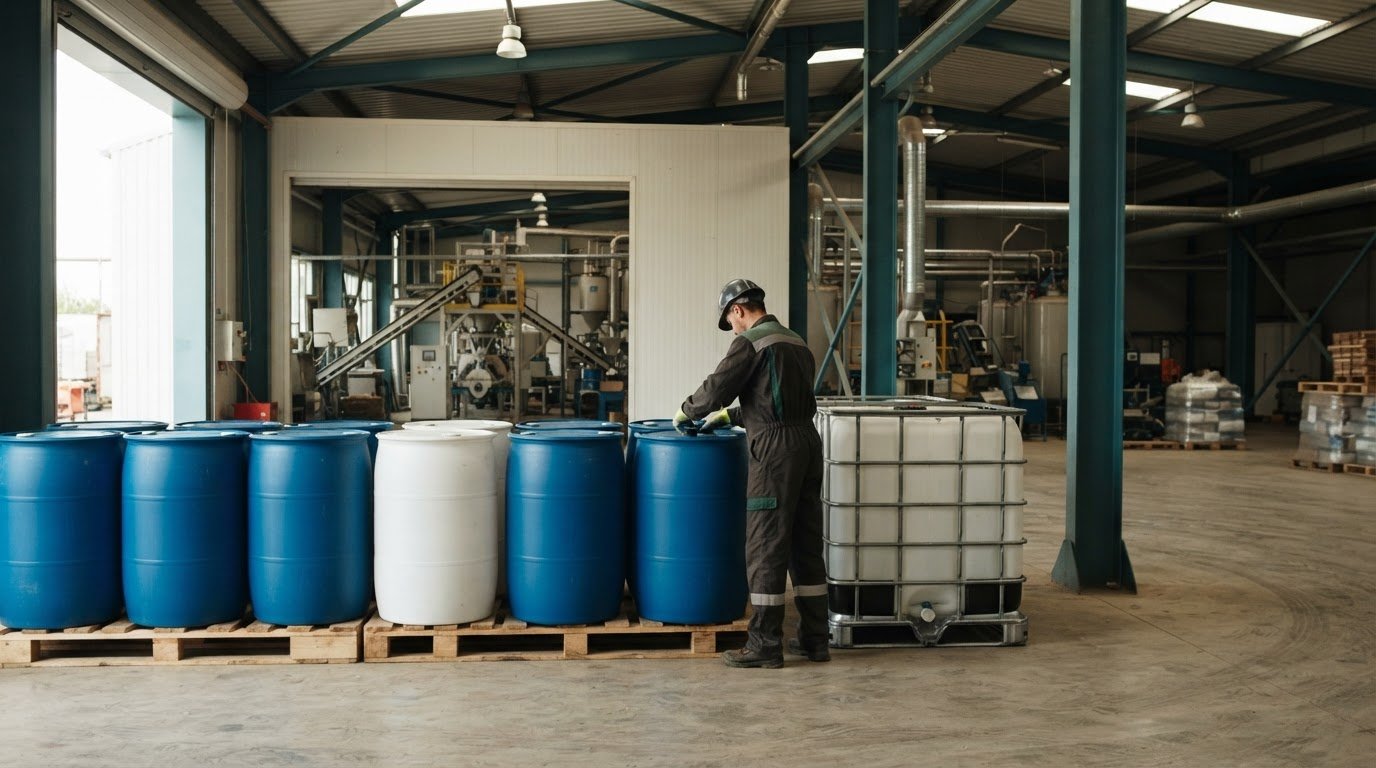
- Check hazardous chemical controls. Follow one chemical from receipt through storage, transfer, use, and disposal; compare container labels, access controls, and handling instructions with observed practice.
- Trace wastewater controls. Review the supplier’s wastewater process, monitoring records, maintenance logs, and applicable discharge conditions to see how it identifies and manages process changes.
- Review governance and ethics. Confirm that the quality policy, measurable objectives, assigned responsibilities, and escalation steps are documented and used when a compliance concern arises.
- Test inventory and sourcing controls. Trace a raw material from an approved source into a finished batch, checking receipt inspection, lot identification, storage conditions, and inventory status.
- Assess allergen and cross-contact controls where relevant. Walk through material segregation, equipment cleaning, and line-clearance records to see how the supplier prevents unintended carryover between products.
- Examine environmental management. Use ISO 14001 as a reference for environmental management audits, and assess whether identified risks have owners, controls, and retained evidence.
To assess chemical quality management, compare approved specifications with incoming-material checks, in-process results, and final test records. Then trace a specification or process change through its documented review, approval, implementation, and customer communication.
For cybersecurity and business continuity, review access controls for quality records, backup and recovery evidence, and the response process for system outages. Assess supply-chain resilience by tracing critical raw materials to approved sources and reviewing how shortages or supplier changes are escalated.
Check whether the supplier’s quality manual and procedures are current, controlled, and consistent with actual work. ISO 9001:2026 was expected to be published in fall 2026, so record the edition used for each audit and assess transition planning against the applicable requirements. Keep the audit trail clear: requirement, evidence, gap, owner, and follow-up action.
What Is a Supplier Quality Audit and What Does It Have to Prove?
A supplier quality audit tests whether documented controls work in actual manufacturing and supply-chain practices. Define its objective first: qualify a new source, reassess an approved supplier, investigate a failure, or confirm corrective actions. The chemical supplier audit checklist for 2026 should connect each objective to evidence, a decision, and a follow-up owner. A certificate alone cannot prove that daily controls meet your requirements.
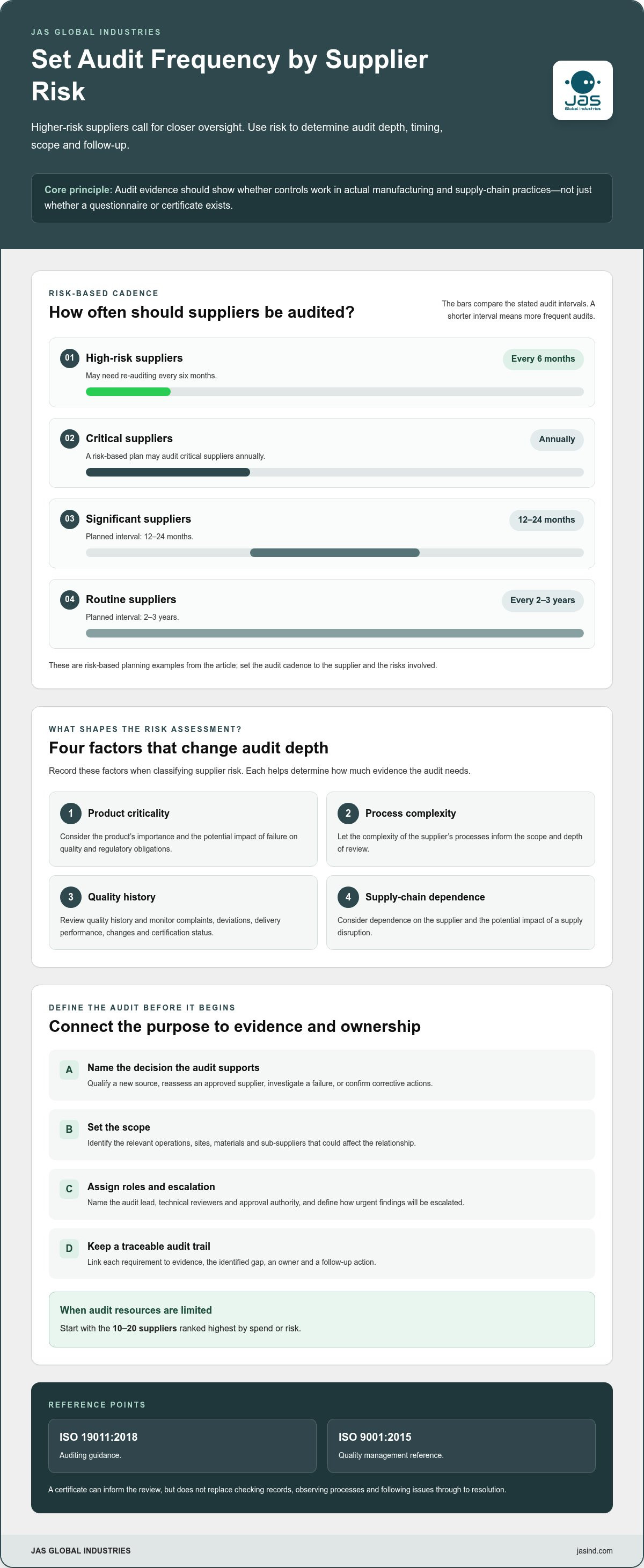
Set the audit scope according to supplier criticality and the potential impact on product quality, regulatory obligations, and continuity. Apply greater GMP scrutiny to suppliers of active pharmaceutical ingredients, critical excipients, stability testing, or computerized systems. If resources are limited, start with the ten to twenty suppliers ranked highest by spend or risk. Include relevant processes, sites, materials, and sub-suppliers that could affect the relationship.
- Classify supplier risk. Record product criticality, process complexity, quality history, and supply-chain dependence, because each factor changes the depth of evidence required.
- Set an audit cadence. A risk-based plan may audit critical suppliers annually, significant suppliers every 12-24 months, and routine suppliers every 2-3 years.
- Escalate high risk. High-risk suppliers may need re-auditing every six months, while strategic suppliers may receive annual re-audits.
- Define objective and scope. State what decision the audit must support, which operations it covers, and what records or observations will demonstrate control.
- Assign ownership and escalation. Name the audit lead, technical reviewers, approval authority, and route for urgent findings before the audit begins.
Audit effort also depends on supplier size, location, and audit type. Cost is shaped by travel, audit duration, technical scope, site complexity, and whether the review is remote or onsite. Requirements depend chiefly on risk and applicable quality standards. A typical onsite audit at a contract chemical manufacturing site is planned as a one-day audit, while a standard manufacturing capability audit typically takes one to two man-days.
Monitor supplier risk between audits through complaints, deviations, delivery performance, changes, and certification status. Lower-risk suppliers may be audited every two to three years when they complete annual questionnaires and share key metrics and certifications. For organizations managing more than 20 suppliers, digital data collection can help organize records and flag overdue actions where spreadsheets become difficult to manage.
Keep the audit decision traceable: risk rating, evidence reviewed, findings, approval status, and next review trigger. A supplier’s quality agreement and performance history can reveal whether controls support a stable supply chain. If evaluating chemical inputs for water systems, explore water treatment chemicals as part of your sourcing review.
Preparing audit checklists and reviewing supplier documents
Build the audit checklist from the supplier’s risk profile, product specifications, and purchasing requirements. A broad vendor checklist may contain 99 items, but critical chemical suppliers handling hazardous chemistry or proprietary formulations warrant 30-40 focused items and an onsite visit. Align the assessment with ISO 9001:2015 Clause 8.4 and ISO 19011:2018 guidance, then tailor every question to evidence the auditor can examine.
Before the facility assessment, send a controlled document request with a deadline and a named owner. If requested pre-audit documents aren’t provided within five business days, record the delay as a finding. Request the quality manual, current procedures, organizational responsibilities, applicable certifications, product specifications, and document revision history. Check each certification’s scope, issuing body, and current validity date; a logo alone does not prove that every process is covered.
Request records that connect raw materials to shipped products. Review incoming-material inspection procedures, certificates of conformance or test reports, calibration schedules, and valid calibration certificates. Ask for COAs from the supplier’s last five lots and compare results with the approved specification. For GMP suppliers, examine batch records for completeness, accuracy, and approval. Trace a finished-goods lot through production, testing, release, and distribution records.
- Check document control. Compare procedure revision numbers against the master list and sampled records; confirm obsolete versions are removed from use.
- Test inspection records. Review final-product testing, acceptance criteria, and recorded results against customer requirements.
- Follow traceability. Select a shipment and trace its lot identifier backward to inputs and forward through distribution documentation.
- Review record retention. Compare sampled records with the supplier’s retention policy and confirm retrieval is practical.
- Assess electronic records where relevant. Check that audit trails are enabled and reviewed where required, and that access and approvals are controlled.
For shipment-level verification, obtain COAs for the last five shipments and compare each result with the specification sheet. This can reveal differences a single representative document would miss. Confirm that each COA identifies the relevant product and lot, and investigate inconsistent units, missing tests, or unexplained specification revisions. Keep the comparison in the audit file.
Use checklist columns for the requirement, sampled document or record, result, and evidence reference. Link each finding to a specific record, revision, or observed step. This makes the assessment reproducible and gives corrective-action owners a clear starting point. A questionnaire or certification can support supplier documentation, but neither replaces a documented audit, risk review, and follow-up.
Audit reports, non-conformities, and corrective action plans
Common chemical supplier findings include incomplete batch records, uncontrolled document revisions, overdue calibration, and weak handling of non-conforming materials. For a major audit nonconformance, contain the issue immediately, establish root cause within 30 days, submit a corrective plan within 60 days, and verify effectiveness within 90 days.
Write each report finding so the supplier can understand and act on it. Record the requirement, objective evidence, gap, risk, and affected product or process. Avoid conclusions such as “controls are inadequate” without a supporting record or observation. ISO 9001:2015 Clause 8.4 places responsibility on the buyer to verify the effectiveness of the supplier’s quality management system.
- Contain the immediate risk. Identify affected lots, stop or restrict use where appropriate, and document how the supplier protects customers while investigating.
- State the evidence. Link the finding to a sampled record, observed practice, or specific requirement, so the conclusion can be independently reviewed.
- Require root-cause analysis. Ask the supplier to distinguish the direct cause from system contributors, using a method such as 5Why or a Fishbone diagram.
- Set measurable actions. Assign an owner, due date, completion evidence, and effectiveness test to each corrective action.
- Track closure and recurrence. Review repeat findings, complaints, and CAPA status during ongoing supplier monitoring.
For critical non-conformities, schedule a re-audit within 30-60 days. A quality failure can also trigger a post-incident re-audit within 30-60 days. Use the visit to confirm that corrective actions were implemented and verify that process evidence supports the change. A supplier mock recall conducted within the last 12 months can test whether traceability and response actions work in practice; document results and resulting actions.
Corrective action plans should strengthen supplier performance, not merely close an audit item. For example, a missing inspection record may require a revised work instruction, staff training, and review of later inspection records. Confirm each action addresses the cause, then test effectiveness using a relevant record sample, process observation, or trend review. A commonly used target for corrective action closure rate is 95% or higher, but closure alone does not prove effectiveness.
Keep the report, CAPA records, verification evidence, and re-qualification decision connected in the supplier file. Inspection-based non-conformities climbed by 21% in the fiscal year ending 2024 compared with the previous year. Consistent categorization helps distinguish isolated errors from recurring system failures, direct monitoring, and focus supplier development on the controls that need improvement.
Audit evidence and checklist categories
A chemical supplier audit checklist for 2026 should cover quality governance, process control, equipment, personnel, deviations, and supplier oversight. Each item needs a clear requirement, an evidence source, and a way to judge conformity. The key test is whether the quality management system operates in practice, not simply whether a procedure exists.
Collect evidence in three ways: review records, interview responsible employees, and observe work as it is performed. Compare what you learn across all three. For example, a work instruction may describe a controlled process, while observing an operator shows whether the instruction is available and followed at the workstation.
- Quality agreements: Review agreements with relevant suppliers to see whether responsibilities and quality expectations are documented.
- Equipment and maintenance: Examine preventive maintenance plans and records, then compare planned work with equipment condition and maintenance history.
- Work instructions and training: Sample workstation instructions and training records to assess whether employees are competent before assigned GMP-related tasks.
- Testing and investigations: Trace an out-of-specification result through its investigation, documented conclusion, and approved follow-up.
- Electronic records: Assess whether electronic signatures are controlled and meet applicable requirements for the system and process.
- Process records: Observe a critical operation and compare its defined parameters with contemporaneous production and inspection evidence.
Record evidence precisely in the audit file, including the document title, revision, record identifier, process observed, and relevant date. When an employee explains a control, compare that account with a record or direct observation. This triangulation helps distinguish a consistent control from an isolated example or an unsupported explanation.
Use a consistent rating scale to make checklist results comparable. Supplier audit categories may be scored from 0 to 5, where 0 means critical failure and 5 means fully conformant with evidence. Define the evidence threshold for each score before the audit; otherwise, two auditors may rate the same condition differently. A score should describe the evidence, not the auditor’s impression.
For chemical operations, include controls that protect people, products, and the environment. Evidence may include approved handling instructions, employee training records, maintenance documentation, and investigations of process deviations. Trace each control from its written requirement to its use and retained evidence, then document any gap clearly.
Build a checklist that supports consistent evidence collection across sites and suppliers. Discuss chemical process requirements as part of your supplier review and sourcing planning.
JAS Global Industries: Fertilizer Anti-caking Agents
JAS Global Industries can be a sourcing partner when your audit defines requirements for fertilizer anti-caking agents. Use the audit evidence to clarify the material specification, documentation expectations, and process needs before discussing product fit. This keeps supplier selection grounded in your quality requirements, not just a checklist score.
JAS Global Industries also offers fertilizer dust suppressants, mining flotation collectors, and mining grinding aids. For a fertilizer operation, anti-caking agents may be the relevant category to discuss, while dust suppressants address a different process need. Align the product discussion with the specifications, handling requirements, and evidence identified in your supplier assessment.
Contact JAS Global Industries or visit jasind.com to discuss your requirements.
Turn Audit Findings Into Stronger Sourcing Decisions
Use your audit outcomes to sharpen the requirements behind future sourcing decisions. A clear specification, evidence expectations, and change-notification process give procurement and quality teams a shared basis for evaluating chemical inputs. The chemical supplier audit checklist for 2026 can support that work, but its lasting value comes from applying findings to real product and process needs.
For fertilizer and mining operations, JAS Global Industries offers fertilizer anti-caking agents, fertilizer dust suppressants, and mining flotation collectors. These product categories can frame a focused discussion around the application, specification, and supplier evidence your team requires. Align the discussion with your approved requirements and internal qualification process.
Contact JAS Global Industries to discuss chemical requirements for your operation. A considered next step can help keep sourcing decisions aligned with quality priorities and operational needs.
Frequently Asked Questions
How Do You Ensure Suppliers Meet Quality and Compliance Standards Consistently?
Use recurring performance reviews to confirm that supplier controls remain effective between formal audits. Compare delivery, complaint, deviation, and testing trends with the quality agreement and approved specifications. For example, repeated out-of-specification results should prompt a documented review of affected lots, investigation quality, and recurrence. Update supplier status when evidence changes, and assign an owner to monitor open actions. Apply the same criteria across reviews, sites, and supplier decisions to support consistent assessments.
How can smaller companies run supplier sustainability audits with limited resources?
Start with the ten to twenty suppliers ranked highest by spend or risk, then focus on material environmental and worker impacts. Request existing energy, water, waste, and workforce records before scheduling a visit. Where labor practices are in scope, review payroll and working-hour records covering at least three recent months. Use annual sustainability audits for high-risk or strategic suppliers, and include findings in routine supplier reviews to avoid duplicating effort.
Which U.S. regulations apply to chemical suppliers in 2026, including OSHA, EPA, and DOT requirements?
Applicability depends on the supplier’s activities, chemicals, facility, and role in transportation. Structure the audit around an obligation register identifying relevant OSHA workplace-safety topics, EPA environmental and waste topics, and DOT hazardous-material transportation topics. Compare the register with the supplier’s actual operations, permits, training records, shipping documents, and incident procedures. Treat this as an audit-planning framework, not a universal list of legal duties; requirements vary by operation and jurisdiction.
What should a supplier audit cover for chemical storage, handling, process safety, and emergency response?
Walk through the path from receiving to storage, transfer, use, and emergency response. Compare container identification and segregation with written procedures, then observe whether staff follow them. Review inspection and maintenance records for storage areas and handling equipment. Ask staff to explain spill reporting, evacuation, and emergency communication steps, then compare their answers with the response plan. Record any gap between documented controls and actual practice.
How can auditors evaluate a chemical supplier's environmental compliance, waste management, and emissions controls?
Trace a waste stream from generation through labeling, temporary storage, transfer, and final disposition. Compare records with the supplier’s stated procedures and applicable environmental obligations. For emissions controls, review monitoring results, equipment maintenance, and investigations of abnormal readings. Check whether wastewater results are reviewed and deviations lead to documented action. Connect each environmental control to an owner, supporting evidence, and an escalation process for changes in performance.
What questions should a chemical supplier audit ask about worker training, PPE, and occupational safety?
Ask how the supplier determines required training for each task, records completion, and checks worker competence. Compare training records with the duties performed by employees in production and chemical handling. Ask workers how they select, inspect, and replace task-specific personal protective equipment, then compare their answers with site procedures. Review accident and near-miss investigations for identified causes and follow-up. Evidence should show that training and protective measures match actual work, not just job titles.
How often should chemical suppliers be audited, and how should audit risk scores be calculated?
Set frequency by criticality: the recommended cadence is annually for critical suppliers, every 12-24 months for significant suppliers, and every 2-3 years for routine suppliers. Score checklist categories from 0 to 5, then apply defined weights to calculate an overall result. A weighted score of 80 or higher supports approval, 60-79 indicates conditional approval with CAPA, and below 60 indicates rejection or probation. Increase review frequency when risk or performance worsens.