


A thicker coating isn’t automatically a more stable one. When liquid separates during storage, adding a thickener may seem like the obvious fix. But preventing syneresis in water-based coatings starts with investigating why the coating’s structure is failing. The wrong adjustment can reduce visible separation while affecting flow, leveling, or film build.
Liquid separation can signal instability and raise questions about product quality. It can also be difficult to distinguish from other storage or appearance defects, which may have different causes. A sound response begins with diagnosis, not a rushed additive change.
This guide explains what syneresis may indicate, how to investigate possible formulation and process factors, and how to compare stabilization approaches against application needs. It also outlines a controlled way to assess changes before applying them in production. JAS Global Industries provides chemistry for paints and coatings, supported by laboratory development and technical support.
Key Takeaways
- Distinguish syneresis from settling and surface water before choosing a corrective action.
- Investigate formulation balance, particle interactions, and ingredient compatibility as possible stability factors.
- Compare rheology modifiers, mineral-based stabilization, and dispersion-focused corrections against application needs.
- Use a baseline and change one relevant variable at a time when testing approaches to preventing syneresis in water-based coatings.
- Assess stability and application performance together, using controlled trials to guide formulation decisions.
What Syneresis Means in Water-Based Coatings, and Why It Matters
Syneresis in a water-based coating is the visible release of liquid from the coating’s structure, creating a separated liquid phase. The term describes an observable defect, not its cause. In chemistry, syneresis refers to liquid being expelled from a gel; the What is Syneresis? overview provides that broader context. In a coating, the appearance can prompt investigation, but it doesn’t identify which ingredient or interaction is responsible.
That distinction matters. A coating may show a clear or watery layer, but similar-looking defects can result from other forms of separation. Treating every visible liquid layer as evidence of the same formulation problem risks choosing an intervention before the cause is understood.
How to Recognize Syneresis Versus Other Stability Defects
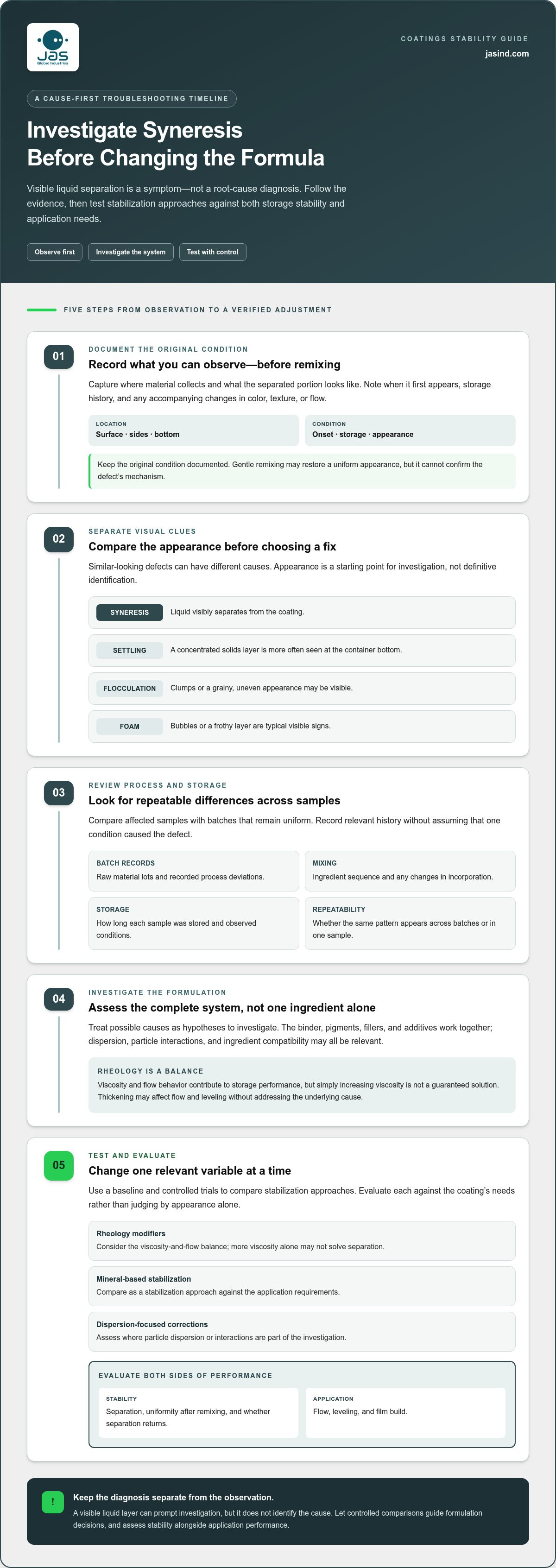
Start by noting where material collects and what the separated portion looks like. Syneresis may appear as liquid separating from the coating. Pigment settling more often appears as a concentrated solids layer at the container bottom, while flocculation may show up as clumps or a grainy, uneven appearance. Foam is typically visible as bubbles or a frothy layer. These signs can overlap, so appearance is a starting point, not a definitive identification.
- Record where the separation appears, such as at the surface, along the sides, or at the bottom.
- Note when it first becomes visible and the sample’s storage history.
- Observe whether gentle remixing restores a uniform appearance and whether separation returns afterward.
- Describe any accompanying changes in color, texture, or flow without assuming they share one cause.
Remixing can help characterize a defect, but it cannot confirm its mechanism. A sample that looks uniform after stirring may still behave differently during storage or application. Record the original condition before remixing so it remains documented.
Why a Cause-First Diagnosis Protects Coating Performance
Separated liquid can make a product look inconsistent and raise concerns about storage stability. If the coating doesn’t remix uniformly, or its flow and appearance change during use, application confidence may suffer. Even if remixing improves the appearance, that alone doesn’t show whether the coating will handle consistently or form a consistent film.
Increasing viscosity may seem like a direct fix, but separation isn’t always a simple viscosity issue. The defect could involve particle settling, ingredient compatibility, or another stability imbalance. A change aimed at thickening could affect flow and leveling without addressing the underlying cause.
To prevent syneresis in water-based coatings, first document the defect and separate what you can observe from what still needs testing. Then investigate the formulation and process history before choosing a stabilization approach. This cause-first method keeps corrective work focused and helps you assess stability alongside application performance.
What Causes Syneresis in Water-Based Coatings?
Visible liquid separation can have more than one underlying driver. The formulation may be out of balance, particles may interact in ways that disrupt uniformity, or the coating may not suspend its dispersed components effectively. These are possibilities to investigate, not universal explanations. Syneresis alone cannot identify which factor is responsible.
Syneresis is a symptom, not a root-cause diagnosis. Establish what is driving the separation before choosing an intervention. This distinction keeps troubleshooting focused. A change that addresses one possible cause may do little for another, and an untested adjustment can introduce new effects on application behavior.
Formulation Factors That Can Destabilize the Liquid Network
Consider how the binder, pigments, fillers, and additives work together. Inadequate dispersion or particle interactions may affect suspension and uniformity, while ingredient compatibility can influence overall stability. Rheology matters too: the balance of viscosity and flow behavior contributes to storage performance, but increasing viscosity alone isn’t a guaranteed solution. The Rheology Modifiers and Syneresis in Latex Systems thesis offers a focused technical reference on latex-HEUR systems. The mechanisms in a particular coating still need to be verified.
Review the complete additive package rather than assessing one ingredient in isolation. A dispersant, binder, or rheology modifier can behave differently depending on the rest of the system and the order in which materials are combined. Treat a proposed ingredient interaction as a hypothesis to test, not a settled explanation.
Process and Storage Conditions to Include in the Investigation
Formulation isn’t the only variable. Mixing sequence, batch execution, storage duration, and handling conditions can reveal or worsen instability. Record these details for affected samples, then compare them with batches that remain uniform. Look for repeatable differences instead of assuming a particular storage condition caused the defect. Don’t apply a temperature threshold or storage limit without evidence for that formulation.
- Compare batch records, including raw material lots and any recorded process deviations.
- Document the mixing sequence and any changes in how ingredients were incorporated.
- Record how long each sample was stored and the conditions observed during storage.
- Check whether the same pattern appears across affected batches or is isolated to one sample.
A repeatable link between a process difference and the defect can narrow the investigation, but it still needs controlled testing. When preventing syneresis in water-based coatings, separate formulation variables from storage and handling factors before selecting a correction. JAS Global Industries provides chemistry for paints and coatings, with laboratory development and technical support to help assess stability challenges systematically. Learn more about JAS Global’s coatings chemistry solutions.
Comparing Syneresis Prevention Options: Rheology Modifiers, Minerals, and Dispersion
Once you have investigated the likely driver, compare interventions by what they are intended to change, how they might affect application, and what evidence would show whether they helped. A category’s reported benefits don’t guarantee performance in every coating. The right choice depends on the diagnosed issue, the coating’s end use, and results measured in the formulation itself.
| Approach | Intended function | Formulation questions | Trade-offs and validation |
|---|---|---|---|
| Rheology modifiers | Adjust viscosity and flow behavior to support the coating’s structure. | Is storage behavior linked to rheology? Does the modifier suit the binder and existing additive package? | Check storage stability alongside flow, leveling, and application behavior. Higher viscosity alone doesn’t prove the defect is resolved. |
| Mineral-based stabilization | May contribute to suspension and structure in a suitable system. | Is inadequate particle suspension implicated? How will the mineral interact with the coating’s other components? | Assess dispersion, appearance, storage behavior, and application performance in controlled trials. |
| Dispersion-focused correction | Address a potential issue with pigment or filler dispersion. | Is uneven dispersion supported by observations or test results? Are process conditions consistent? | Evaluate uniformity and storage behavior, then check that application properties remain acceptable. |
When Rheology Modification May Be Relevant
HEUR and ASE are categories of rheology modifiers used in water-based paint formulation. Their effects depend on the specific coating and formulation data, so don’t assume either category will produce a particular low-shear structure or application profile in every system. If testing indicates rheology is relevant, compare samples for separation as well as the required flow and leveling behavior. An increase in viscosity alone doesn’t prove syneresis has been corrected.
When Mineral Stabilization or Dispersion Work Deserves Evaluation
Attapulgite is a mineral-based approach described by a supplier for supporting suspension and syneresis control. That reported role makes it a candidate for evaluation, not a universal recommendation. First establish whether inadequate suspension or dispersion is involved. If particle distribution is the concern, a dispersion-focused correction may be more relevant than simply changing viscosity. For broader additive context, including surfactant chemistry, see this industrial surfactant chemistry reference provided by JAS Global Industries.
To prevent syneresis in water-based coatings, use a controlled comparison: retain an unchanged baseline, alter one relevant variable at a time, and assess storage stability and application behavior. Define the observations that matter before testing, such as visible separation, uniformity after remixing, flow, and leveling. Choose an intervention only when the results support its fit for the diagnosed cause and intended use.
How to Prevent Syneresis: A Controlled Formulation Troubleshooting Workflow
Effective troubleshooting turns an observed defect into a testable formulation question. Avoid changing several additives at once: if the result improves or worsens, you won’t know which adjustment drove the outcome. A documented baseline and staged comparison make findings easier to interpret and help protect application performance while you assess stability.
Set Up a Useful Baseline Before Changing the Formula
Start with a representative sample of the affected coating and retain an unchanged control. Record the formulation version, batch details, mixing sequence, original appearance, and known storage history. Define evaluation criteria before testing, based on the coating’s intended use and customer requirements. These may include visible separation, viscosity, appearance, flow, leveling, or application behavior.
Run, Compare, and Document Formulation Trials
Use the baseline to judge each change. Keep sample handling and observation points consistent, and set an observation schedule suited to the project rather than assuming one test duration fits every coating. Record both the result and the rationale for the adjustment. A trial is useful even when it doesn’t improve the coating, provided it answers a clear question.
- Document the defect. Describe where separation appears, what the separated material looks like, and whether the sample changes after gentle remixing. Note other visible changes, but keep observations separate from assumptions about cause.
- Review formulation and batch records. Compare the affected material with a stable reference, if available. Check the formulation version, raw material or batch changes, mixing sequence, and recorded process or storage differences. This review can help narrow which variables warrant a trial.
- Define a testable cause. Turn the evidence into a specific question. For example, if batch records point to a change in ingredient addition order, test that process variable while holding the formulation constant. If the evidence instead suggests a formulation factor, identify one relevant adjustment to evaluate.
- Establish the baseline and control. Keep an unchanged sample alongside the trial material. Record its initial appearance and relevant measurements, including viscosity where appropriate. The control helps show whether a difference reflects the adjustment or variation in observation and handling.
- Change one variable and compare. Document the adjustment and why it was selected. Evaluate trial and control samples at the same observation points. Assess separation alongside viscosity, appearance, and application behavior against the criteria set for the coating.
- Review before adoption. If the trial reduces separation but compromises flow, leveling, or another required property, it may not be a suitable correction. Repeat or refine testing only when the results point to a clear next question, then document the evidence supporting any production decision.
Controlled comparisons build reliable conclusions; simultaneous additive changes obscure them. This principle is central to preventing syneresis in water-based coatings while keeping the finished coating’s performance requirements in view. JAS Global Industries provides chemistry for paints and coatings, with laboratory development and technical support. Explore JAS Global’s coatings chemistry solutions.
Applying a Tailored Coatings Chemistry Approach to Syneresis
Intervention should follow evidence. A visible defect may have several possible drivers, and a change made too early can complicate the formulation without addressing the source. Use diagnostic observations and controlled trial results to define the technical question: what changed, what response did the trial produce, and which coating requirements must remain intact?
A tailored approach connects the evidence to the formulation, manufacturing process, and intended application instead of defaulting to an additive category. The goal is an informed technical response, not the assumption that one adjustment will suit every water-based coating.
From Formulation Evidence to a Tailored Technical Response
Bring together the defect description, relevant batch history, trial rationale, control comparison, and observed effects on stability and application. These details help frame a formulation-specific discussion. JAS Global Industries serves the paints and coatings sector with specialty chemistry solutions, laboratory development, and technical support. Its support can help relate laboratory findings to process evaluation.
A useful technical review considers the full performance picture. A trial may reduce visible separation yet alter flow or leveling. It may also point toward a process factor rather than a formulation change. Keeping these possibilities in view helps teams assess what the evidence supports and identify the next question without overstating a result.
- Share the observed defect and how it changed during the evaluation.
- Summarize which formulation or process variable was adjusted and why.
- Compare the trial with the unchanged control using the project’s agreed criteria.
- Note any trade-offs in application behavior that could affect production or use.
Build Stability and Performance Through Partnership
A durable decision should reflect operational priorities as well as coating performance. JAS Global’s stated commitment is to support safe, cost-effective, and efficient operations, alongside sustainability. These priorities inform a partnership-led process, while formulation-specific evidence remains central to the decision.
JAS Global has more than 25 years of experience and provides laboratory development, on-site implementation, and ongoing industrial support. These capabilities can connect formulation investigation with practical process considerations, keeping stability and application requirements in view. The coating’s measured response remains central to any decision.
For manufacturers assessing a coating stability challenge, a discussion grounded in trial findings can help clarify the next technical step. Discuss a coatings chemistry challenge with JAS Global Industries.
Turn Stability Findings Into Your Next Formulation Decision
A stability challenge can become a useful decision point for your coating program. Treat each trial as evidence: record what changed, how the coating responded, and which application requirements still need to be met. This creates a clearer basis for deciding whether to refine the formulation, review a process variable, or gather more data before making a production change.
Preventing syneresis in water-based coatings isn’t about chasing one appearance result. It’s about assessing whether stability and the coating’s intended use remain aligned. Keep the evaluation focused on evidence, and let the next step follow from what the samples show.
JAS Global Industries provides chemistry for paints and coatings, with laboratory development, on-site implementation, and ongoing industrial support. If you’re ready to discuss how your findings could inform a technical response, contact JAS Global Industries about your coatings chemistry challenge.
A disciplined evaluation and the right technical perspective can help you move forward with greater clarity.
Frequently Asked Questions
What is syneresis in water-based coatings?
Syneresis is visible liquid separation from a coating system, but the appearance alone doesn’t explain why it happened. For a useful assessment, photograph the unopened sample if possible, note where liquid has collected, and preserve a portion before remixing. Then consider whether the separated sample still meets the coating’s intended appearance and application requirements. These records help distinguish a recurring stability concern from a one-off observation.
What causes syneresis in water-based paint?
There isn’t one cause that applies to every water-based paint. Possible factors include formulation balance, particle dispersion, ingredient interactions, and storage or handling history. For example, compare a sample from an affected batch with one from an unaffected batch, and review ingredient lots and process records for differences. Treat any suspected mechanism as a hypothesis. A repeatable relationship between a change and the defect can guide further testing.
Can a rheology modifier prevent syneresis?
A rheology modifier may be relevant if the coating’s structure or suspension behavior contributes to separation, but it isn’t a universal fix. A trial should assess more than a viscosity reading: consider whether the coating still flows, levels, and applies as required. For example, a sample that looks more uniform but no longer suits its intended application may not be an acceptable formulation change. Judge the complete system against project criteria.
How do you test a water-based coating for syneresis?
Begin with a labeled baseline sample and record its formulation version, batch history, and visible condition. Set evaluation criteria suited to the coating rather than relying on a universal storage duration or protocol. Keep a control and compare it with trials that change one variable at a time, using consistent sample handling and observation points. Record both separation and application behavior, and confirm that the test approach fits project requirements.
Does attapulgite stop syneresis in every coating?
No. Attapulgite is a mineral-based approach described by a supplier as supporting suspension and syneresis control, but that doesn’t establish its suitability for every coating. Its effect depends on the specific formulation and required performance. Consider it only when the investigation suggests suspension is relevant, then evaluate a controlled sample against an unchanged control. Check not just visible separation, but also whether the coating retains its intended appearance and application behavior.
Can increasing coating viscosity solve liquid separation?
Not necessarily. Higher viscosity may leave the underlying cause untouched and may change how the coating handles during application. Before adjusting viscosity, determine whether the observed issue is liquid separation or another stability defect. Then compare the adjusted sample with a control using the project’s evaluation criteria. Consider the change only if it addresses the suspected cause while maintaining required application properties.
How can a coatings formulator choose between rheology and dispersion adjustments?
Base the choice on evidence about the specific coating, not a general preference for one additive category. If observations or test results point to suspension or structure, a rheology approach may warrant evaluation. If pigment or filler distribution appears implicated, assess dispersion factors separately. When preventing syneresis in water-based coatings, document each trial and compare storage stability with application behavior. Technical review can help interpret results that point in more than one direction.