
More viscosity alone is not the answer. Preventing pigment settling in coatings depends on building a low-shear structure that holds particles in suspension but yields during application. Organoclay can help create that structure, though its performance depends on compatibility with the dispersant and the rest of the formulation.
Settling is frustrating, especially when a coating develops dense sediment that is difficult to remix evenly. Simply adding more thickener is rarely enough: pigment wetting and dispersion, particle properties, rheology, and additive interactions all affect storage stability.
This article explains how organoclay supports suspension, why soft settling differs from hard sediment, and how stabilization approaches vary between waterborne and solvent-borne coatings. It also covers additive compatibility and formulation balance, helping you understand what contributes to a stable coating without sacrificing flow, leveling, or application performance.
Key Takeaways
- Assess pigment properties and dispersion quality together to identify the factors driving instability.
- Balance low-shear suspension structure with the flow and leveling the coating needs during application.
- Match the stabilization mechanism to the coating medium: electrostatic effects are more relevant in waterborne systems, while steric stabilization is common in solvent-borne paints.
- Evaluate additive compatibility and the type of sediment; loose deposits and hard, compact layers point to different formulation challenges.
What Factors Influence Pigment Stability?
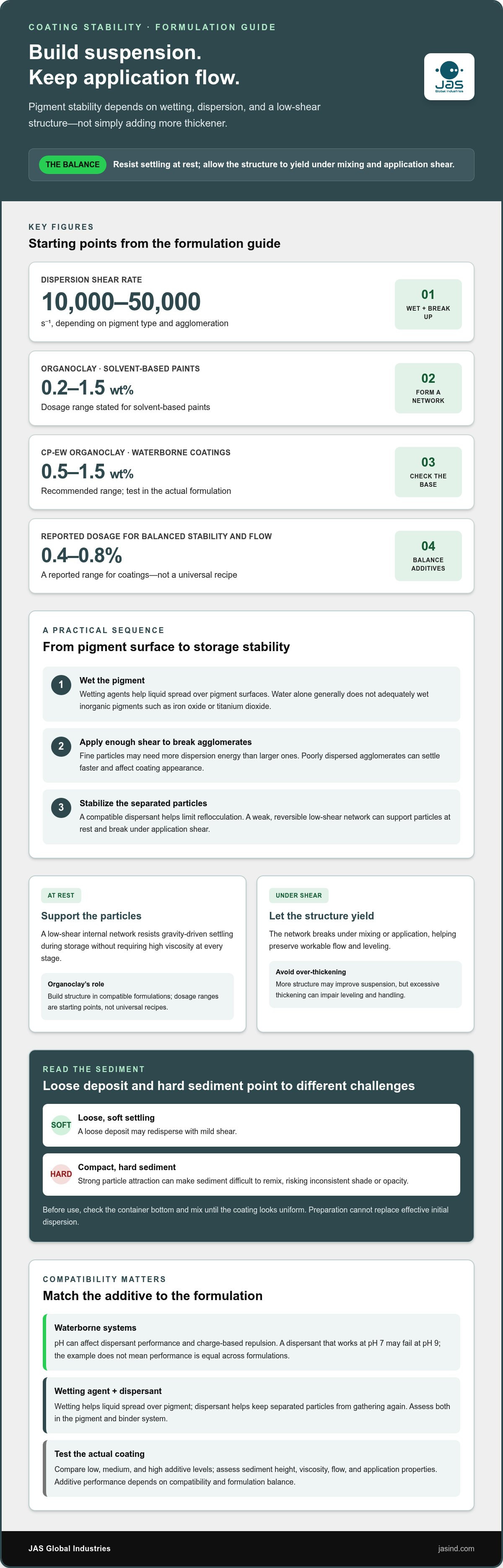
Reduce settling by wetting pigment surfaces, dispersing agglomerates, then stabilizing the suspension. Effective dispersion can require shear rates of 10,000-50,000 s⁻¹, depending on pigment type and agglomeration.
Formulation stability also depends on pH, particle properties, and how dispersants and wetting agents work together. These factors influence sediment formation, appearance, and flow.
Dispersant Activation and Suspension
Dispersant activation means distributing an additive so it can interact with pigment surfaces. It matters because poorly dispersed agglomerates settle faster than well-distributed particles, reducing suspension stability and affecting coating appearance.
For example, fine pigment particles may need more dispersion energy than larger ones. The sequence matters: wet the pigment, apply enough shear to break up agglomerates, then stabilize the separated particles. A suitable dispersant can help limit reflocculation, supporting a more uniform formulation during storage and better flow during application.
PH Effects on Dispersant Performance
Formulation pH affects whether a dispersant performs effectively at pigment surfaces. A dispersant that works at pH 7 may fail at pH 9, so the same additive cannot be assumed to deliver equal stability across formulations.
Changes in pH can affect particle interactions and reduce dispersion quality, increasing the risk of settling. Consider pH alongside the pigment and binder system when assessing performance. In water-based systems, pH can also influence charge-based repulsion, making it relevant to both particle separation and initial dispersion.
Redispersion and On-Site Preparation
Redispersibility describes how easily settled pigment returns to a uniform suspension after mixing. It matters at the application site: soft settling forms a loose deposit, while strong particle attraction can create compact sediment that is difficult to restore.
Before use, check for a deposit at the bottom of the container and mix until the coating looks uniform. A loose layer may disperse with mild shear; hard sediment may resist remixing and leave shade or opacity inconsistent. Preparation cannot replace effective initial dispersion, which helps prevent agglomerates from forming in the first place.
Balancing Dispersants and Wetting Agents
Wetting agents help liquid spread over pigment surfaces, while dispersants help prevent separated particles from gathering again. Balancing both matters because water alone generally does not adequately wet inorganic pigments such as iron oxide or titanium dioxide.
In water-based formulations, water’s polarity and surface tension can make wetting low-polarity pigments more difficult. A suitable surfactant can address that mismatch, while a compatible dispersant supports particle separation. One reported dosage range for balanced stability and flow in coatings is 0.4-0.8%. The right balance supports suspension without sacrificing formulation flow or finished appearance.
Low-shear rheology and suspension structure
Low-shear rheology determines how a coating holds particles during storage and flows under mixing or application. Effective control balances resistance to settling with leveling and application properties.
Low-Shear Suspension Structure
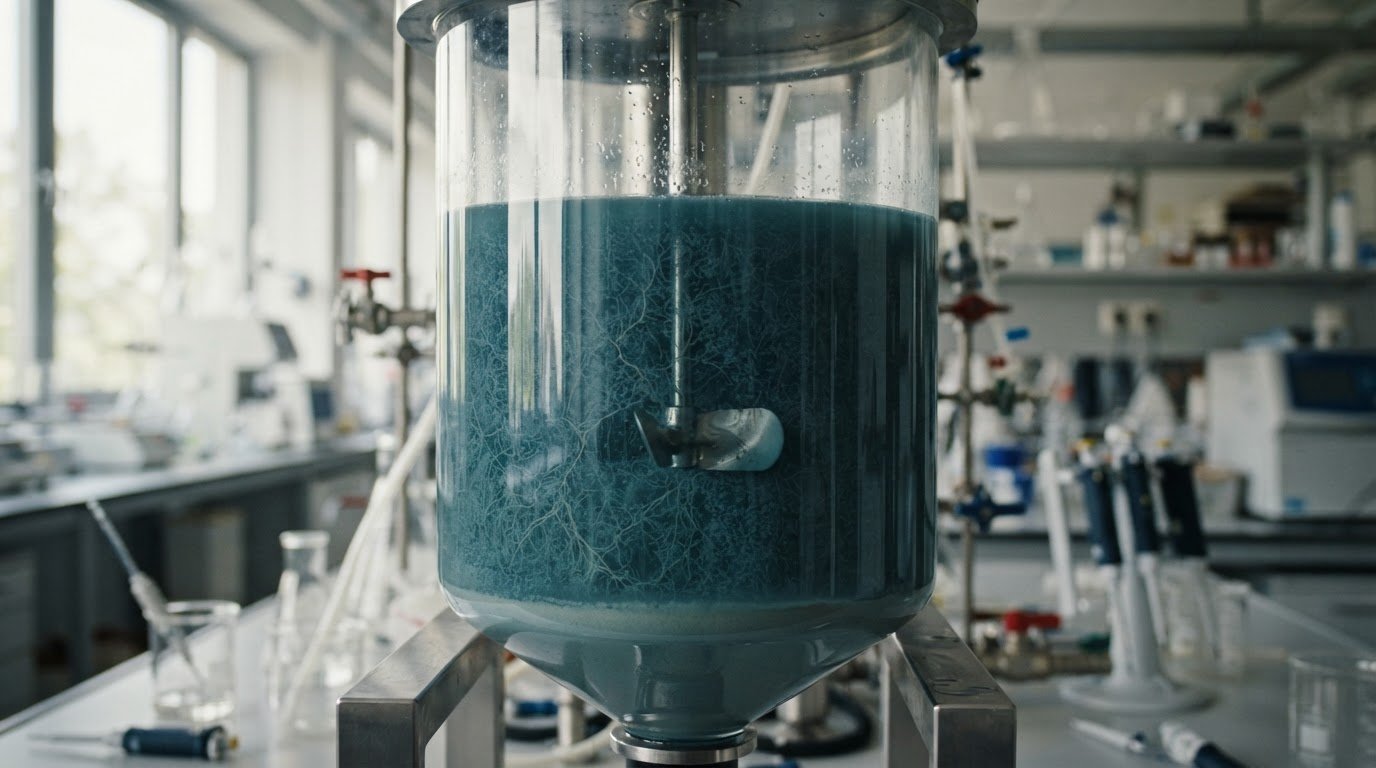
A low-shear suspension structure is a weak internal network that supports particles while the coating rests. It matters because gravity can otherwise draw dense pigments and fillers toward the bottom of the container.
Anti-settling networks break under shear and rebuild during storage. This reversible structure helps suspend solids without requiring high viscosity at every stage. Attapulgite clay, for example, forms a network through its associated needle-like particles. The structure breaks readily under shear, supporting storage stability and workable flow.
Rheology Additives for Settling Control
Rheology additives act as anti-settling agents by building internal structure that resists sediment formation. Their role is to provide sufficient low-shear viscosity without making the coating difficult to mix or apply.
Organoclay is used in solvent-based paints at 0.2-1.5 wt%; CP-EW organoclay is recommended at 0.5-1.5 wt% for waterborne coatings. These ranges are starting points, not universal recipes. Additive costs depend on chemistry, dosage, formulation, and scale, and are provided after a quote request. Castor oil derivatives are another thickener example that can promote soft, readily redispersible settling.
Viscosity and Rheological Control
Viscosity measures resistance to flow; rheological control describes how that resistance changes under force. This distinction matters because a coating needs structure in storage and flow during application, not simply maximum thickness.
A stronger network can improve suspension, but excessive thickening can impair leveling and handling. Formulators can compare low, medium, and high additive levels, then assess sediment height, viscosity, and application properties. This shows whether the structure provides enough resistance during storage while still breaking down under mixing or application shear.
Choosing Additives by Coating Base
Choosing an additive for a coating base means matching its compatibility and activation needs to the waterborne or solvent-based chemistry. The right match supports a stable network without disrupting other formulation properties.
Organoclay dosage ranges differ by base: solvent-based paints use 0.2-1.5 wt%, while the recommended CP-EW range for waterborne coatings is 0.5-1.5 wt%. Screen the additive in the actual formulation and assess storage sediment alongside flow and leveling. For dispersion-focused formulation support, explore paints and coating dispersing agents.
Steric and electrostatic pigment stabilization
Steric and electrostatic mechanisms help keep dispersed pigment particles from rejoining during storage. Their effectiveness depends on the coating medium, pigment properties, and formulation compatibility.
Two Stabilization Mechanisms
Electrostatic stabilization uses like surface charges to make pigment particles repel one another. It is more applicable to waterborne coatings, where particle charge helps maintain separation. Steric stabilization uses adsorbed material around particles to limit close contact and is more common in solvent-borne paints.
These mechanisms affect behavior after dispersion, not just the initial mix. For example, a waterborne formulation relies more on charge repulsion, while a solvent-based system more commonly relies on steric barriers. Choosing a dispersant suited to the coating medium helps maintain a stable, evenly dispersed appearance.
Factors That Influence Stability
Pigment density, particle size, shape, distribution, and dispersion quality all affect settling. Sedimentation velocity increases with the square of particle diameter and with the density difference between particles and the coating medium. As a result, larger or denser particles can settle faster than smaller, lighter particles in the same formulation.
Flocculation also changes particle behavior: loose aggregates can affect color development, gloss, and hiding, even if mild shear can reverse them. Review pigment and filler composition alongside the dispersion stage and rheology profile. These interacting properties help explain why a fresh batch may appear stable but develop sediment at the bottom during storage.
Assessing Aged Storage Stability
A fresh sample alone cannot establish storage stability. Test the coating after storage, checking sediment formation, viscosity, and whether mixing restores a uniform appearance. Paint dispersion systems are designed to maintain stability across storage conditions for often 12 months or longer.
Include the actual binder-pigment combination in accelerated storage and sedimentation tests. Compare the aged sample with its initial state: note any bottom deposit, changes in flow, and whether color remains evenly dispersed after remixing. For products exposed to transport, assess samples after relevant handling and storage conditions to reveal settling behavior that a freshly prepared batch may not show.
Additive compatibility and hard settling
Additive compatibility affects whether pigment remains suspended or forms compact sediment. Dispersants, wetting agents, and rheology additives each influence particle interactions, so assess their combined behavior in the complete formulation.
Hard settling is a dense, compact deposit that is difficult to remix uniformly. Strong attraction between pigment particles can cause cementing or agglomeration, while resin or wetting agent may encapsulate aggregates. Unlike a loose deposit, this sediment can persist after mixing and produce uneven shade or opacity during application. The distinction matters: a coating that looks smooth after manufacture may still develop a hard layer in storage.
Compatibility screening should include the pigment package, liquid medium, and additive combination. For example, a dispersant may initially keep particles separated but interact poorly with a thixotrope, weakening suspension structure. Conversely, a rheology additive may build viscosity yet interfere with wetting or flow. Assessing these effects together helps determine whether settling reflects inadequate dispersion, incompatible additives, or both. Fine-particle silica and other rheology agents also need evaluation for their effects on flow and finished appearance.
For safety and regulatory considerations, follow the additive’s safety data sheet and product label, and account for requirements applicable to the intended market and application. Test compatibility using the actual coating formulation, including its dispersant, pigment, and rheology agents.
Compare fresh and stored samples for sediment strength, remixing behavior, viscosity, and appearance. A dense bottom deposit that resists remixing signals a different problem from soft settling that readily redistributes. Record mixing conditions and assess the coating after storage, because early stability alone does not reveal later hard-set behavior. This focused evaluation supports a more reliable choice of additive and dosage while protecting application properties.
For formulation support related to paints and coating dispersing agents, explore JAS Global Industries’ coating chemical solutions.
JAS Global Industries: Fertilizer Anti-caking Agents
JAS Global Industries offers Fertilizer Anti-caking Agents for fertilizer operations where caking affects stored-material handling. These agents address a different stability challenge from pigment settling in coatings, so coating formulations still require coating-specific decisions about dispersion, rheology, and compatibility.
Turn to JAS Global Industries when your operation also needs support with fertilizer or mining process chemicals. Relevant offerings include Fertilizer Dust Suppressants, Mining Flotation Collectors, and Mining Grinding Aids. Matching an additive to the material and process keeps the solution focused on the operating need, rather than treating different settling or handling problems as interchangeable.
For information about Fertilizer Anti-caking Agents or related offerings, contact JAS Global Industries or visit jasind.com.
Make Stability a Formulation Decision
Make stability work a controlled formulation decision, not a one-time adjustment. When preventing pigment settling in coatings, align laboratory observations with the production process and intended application. Record changes as a batch moves from formulation trials to routine manufacture, including mixing sequence, shear conditions, and behavior after storage. This provides a useful basis for distinguishing repeatable performance from a temporary fix.
When dispersant selection is central to that work, JAS Global Industries’ Paints & Coating Dispersing Agents are relevant to the formulation discussion. Keep evaluations tied to the actual coating system, pigment, binder, and application conditions. Documenting these factors also helps teams assess future formulation changes consistently instead of treating each adjustment as an isolated decision.
Contact JAS Global Industries to discuss coating dispersing agents for your formulation. A clear evaluation plan can help turn stability goals into practical next steps.
Frequently Asked Questions
How does organoclay prevent pigment settling?
Organoclay helps limit settling by creating a temporary structure within the coating. At rest, the structure supports suspended solids; during mixing or application, shear breaks it down so the material can flow. Organoclay can therefore help when a formulation needs stronger storage suspension without permanently restricting application. It does not replace pigment wetting or dispersion, so assess those functions separately.
What Causes Pigment Settling in Paint?
Pigment settles when gravity overcomes the coating’s ability to keep particles suspended. For example, in paint containing dense mineral pigment, poorly dispersed particles or insufficient suspension structure can allow solids to collect at the container bottom. Higher pigment or filler loading can add to the challenge. The deposit may remain loose or become compact, depending on particle interactions and formulation balance.
What is an Anti-Settling Agent?
An anti-settling agent helps keep solid particles suspended in a liquid coating during storage. Unlike a dispersant, which primarily helps separate and stabilize pigment particles, an anti-settling agent focuses on suspension. For example, a rheology additive can create a weak internal structure that supports solids at rest. Formulators assess its effect alongside mixing, flow, and the coating’s intended application.
What causes pigments to settle in coatings and paints?
Settling can result from several conditions acting together, including particle density, size, dispersion quality, and coating rheology. It also matters whether particles remain individually dispersed or form aggregates. To diagnose a problem, compare the coating before and after storage: note deposit firmness, remixing behavior, and any change in shade or opacity. These observations help distinguish loose sediment from hard settling.
Which additives prevent pigment settling in coatings?
Rheology modifiers such as organoclay, attapulgite clay, fine-particle silica, and castor oil derivatives can help improve suspension. Dispersants and wetting agents have complementary roles, helping particles separate and interact with the liquid medium. No additive works independently of the formulation: pigment type, coating base, and other ingredients affect performance. Evaluate candidate additives in the complete coating rather than in isolation.
How do thixotropic agents and anti-settling agents work in paint?
Thixotropic agents build a structure that supports pigments while paint is at rest, then reduce resistance when mixing or application applies shear. Many anti-settling agents work through this kind of reversible rheology. For example, a thixotropic coating may resist sediment formation in storage but still spread under a brush or another application method. Formulation testing should consider both storage behavior and application flow.