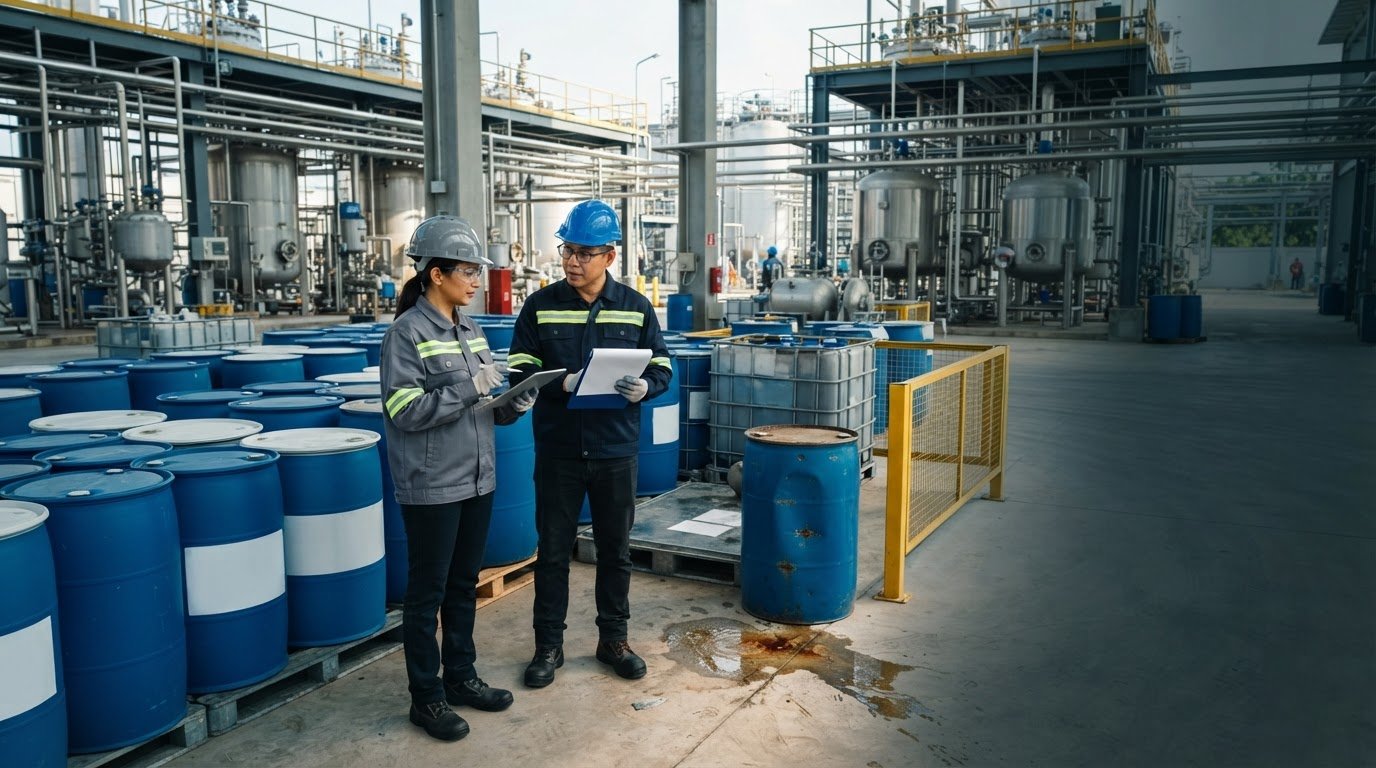


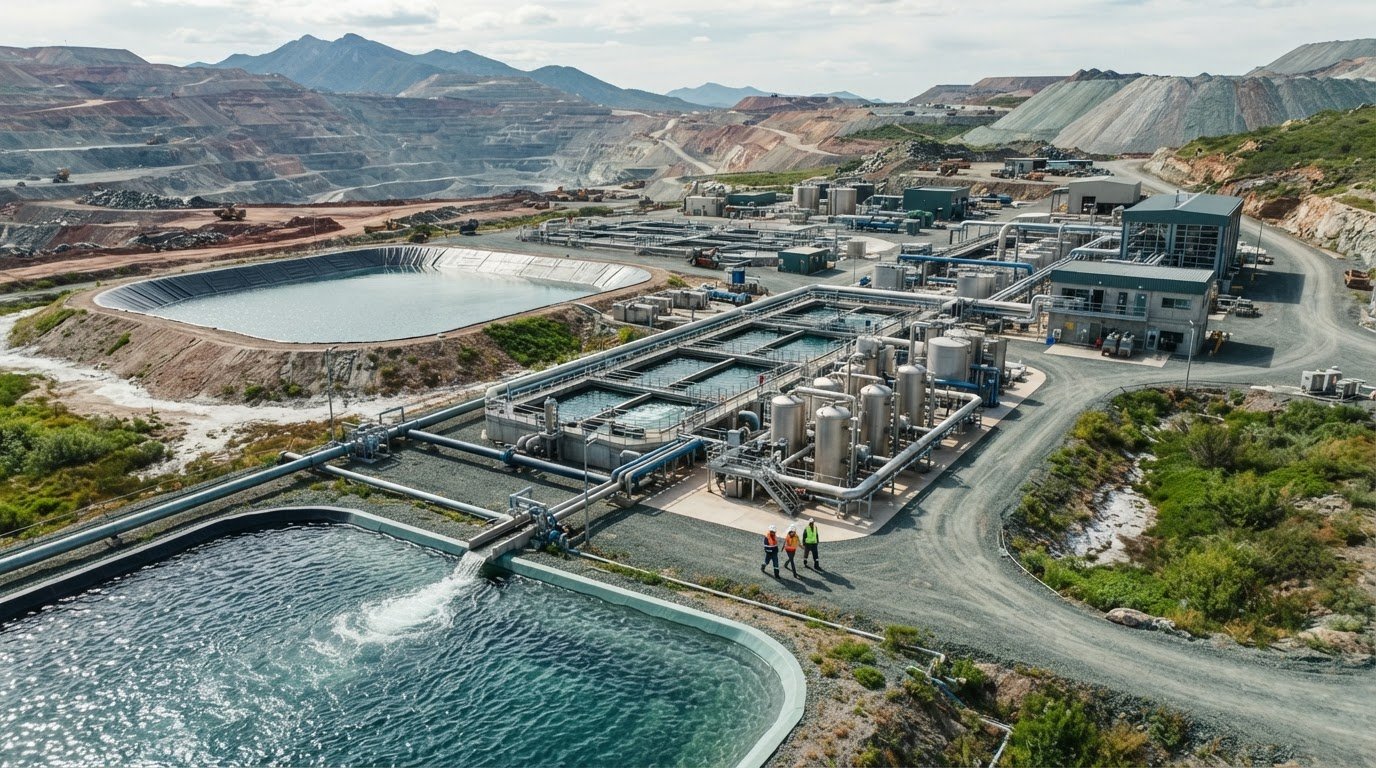
Removing salt is only half the challenge; controlling where the water and concentrated brine go is just as important. Managing high salinity in mining process water starts with understanding water quality, then matching treatment, reuse and disposal to the mine’s water balance and site conditions. Mine brackish water is described as having mineralization or total dissolved solids above 1000 mg/L.
Salinity can affect equipment, water reuse and the surrounding environment. High salinity in mine water can contribute to corrosion, maintenance needs and downtime, while poorly managed water can harm nearby ecosystems. The right response depends on the water’s chemistry and how it moves through the operation.
This article explains how salinity affects mining operations, how water management and recycling can help control it, and what to consider when evaluating treatment or disposal. Treatment can support reuse and conserve freshwater, but the concentrated brine that remains still needs responsible management.
Key Takeaways
- High salinity can contribute to equipment corrosion, added maintenance and downtime, while poorly treated water can affect surrounding ecosystems.
- Trace how saline groundwater and mine water move through the site to understand where salt can enter rivers and other water sources.
- Recycling treated water can conserve freshwater; zero-liquid-discharge systems can achieve water recovery rates of 95-99%.
- Compare treatment and disposal options against water characteristics, site conditions, regulatory requirements, public acceptance and economic factors.
- Water blending, interception and monitored management plans can help control salinity when they suit the site’s water balance.
Operational and environmental effects of high salinity
Salinity affects water reuse, equipment reliability and water and land quality around a mine. A useful assessment links water chemistry to operational needs and environmental pathways.
Discharge and Reuse Regulations
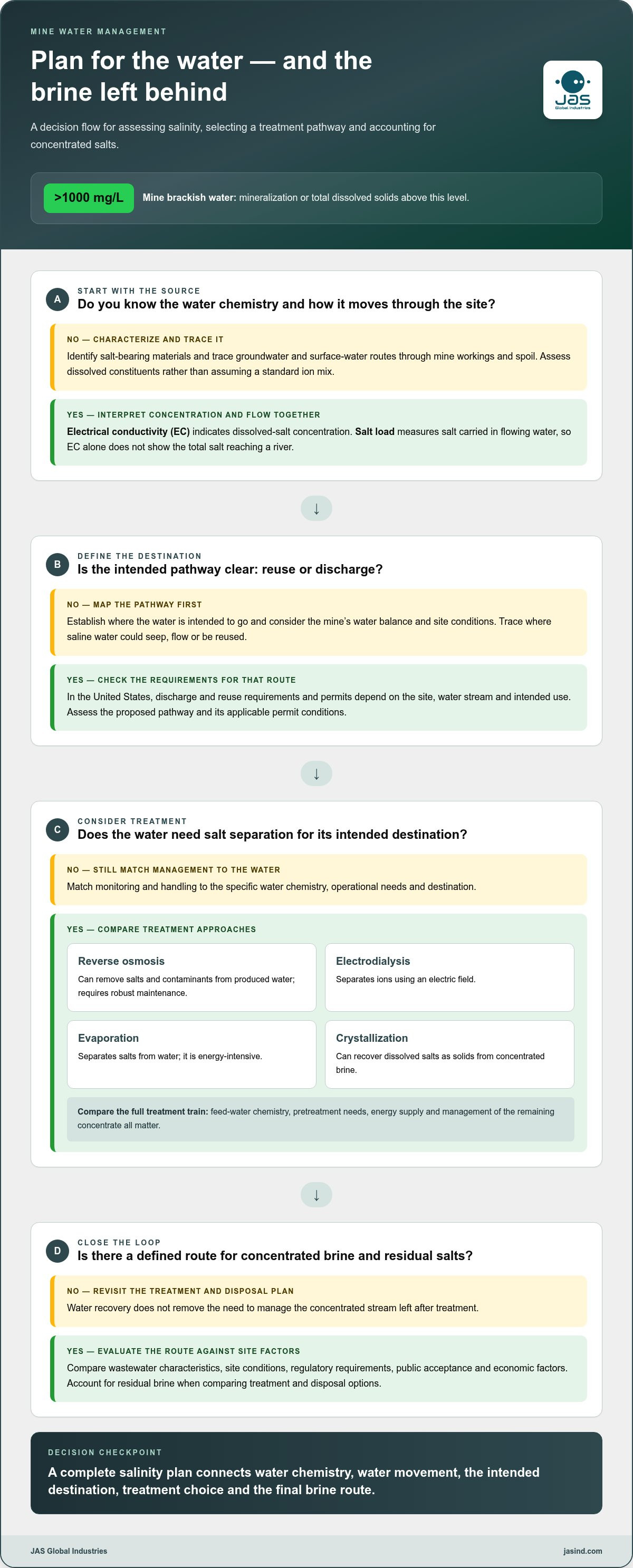
In the United States, discharge and reuse of saline mining water are governed by requirements and permits that depend on the site, water stream and intended use. A treatment approach must suit both the water’s characteristics and its destination. Assess the proposed reuse or discharge pathway and applicable permit conditions when planning water management.
Scaling, Corrosion, and Membrane Fouling
Scaling, corrosion and membrane fouling risks vary with dissolved ions, suspended material and other constituents. Scale-forming minerals can precipitate as water chemistry changes, corrosive constituents can damage equipment, and particles or organic matter can obstruct membrane surfaces. These effects influence treatment performance, maintenance needs and operational reliability. Match monitoring and treatment to the specific water chemistry.
Salts also affect plants by making water harder to absorb. As dissolved salts increase, plants must use more energy to draw water through their roots. Salt accumulation can disrupt nutrient balance and limit growth even when soil appears moist. In irrigated agriculture, the impact depends on water quality, soil drainage, crop sensitivity and irrigation practices.
Texas A&M guidance classifies irrigation water with a sodium adsorption ratio (SAR) of 10-18 as a medium sodium hazard, for which amendments and leaching are recommended. At 18-26 SAR, it is a high sodium hazard and generally unsuitable for continuous use. Above 26 SAR, it is a very high sodium hazard and generally unsuitable for use. These categories show why a salinity assessment should examine sodium hazard, not just total dissolved salts.
Environmental effects extend beyond the mine boundary. Inadequately treated produced water can harm local flora and fauna. In the Murray-Darling Basin, salinity degrades water quality, hinders plant growth, and reduces biodiversity. From the 1960s to the 1980s, it increasingly affected farmers, wildlife, and the environment there. These examples underline the need to consider where saline water flows, seeps, or is reused.
Saline drinking water also has documented health associations. A study of households using saline well water found that a one-standard-deviation increase in salinity was associated with a 3.3 percentage-point increase in the share of adults with health problems preventing them from working. For the average household in the cited analysis, a two-standard-difference increase was associated with disease prevalence rising from 15% to 19%. These findings make protection of water sources a community concern, as well as an operational one.
Managing high salinity in mining process water means linking water assessment to equipment needs, reuse, discharge and nearby ecosystems. This joined-up view helps identify which strategies address the main risk and where monitoring is most important.
Saline groundwater and salt mobilisation
Mine water can mobilize dissolved salts from mineralized ground, workings and spoil. Tracking water movement helps identify routes into rivers and opportunities for reuse.
Sources and Concentrations of Salts
Salinity develops when water contacts salt-bearing materials and carries dissolved minerals through mine workings or surrounding ground. In New South Wales, saline water from working and abandoned mines can reach rivers through groundwater seepage or rain contacting mine workings and spoil. Mine brackish water is described as having mineralization or total dissolved solids above 1000 mg/L. The ion profile depends on the water source and contacted materials, so assess dissolved constituents rather than assuming one standard mix.
Electrical Conductivity and Salt Load
Electrical conductivity (EC) indicates dissolved-salt concentration, while salt load measures the salt carried in a volume of flowing water. In New South Wales, river salt load is driven by water-flow volume. EC alone therefore cannot show the total salt reaching a river: interpret water quality alongside flow. This distinction helps prioritize monitoring locations and assess whether a strategy reduces salt concentration, total load or both.
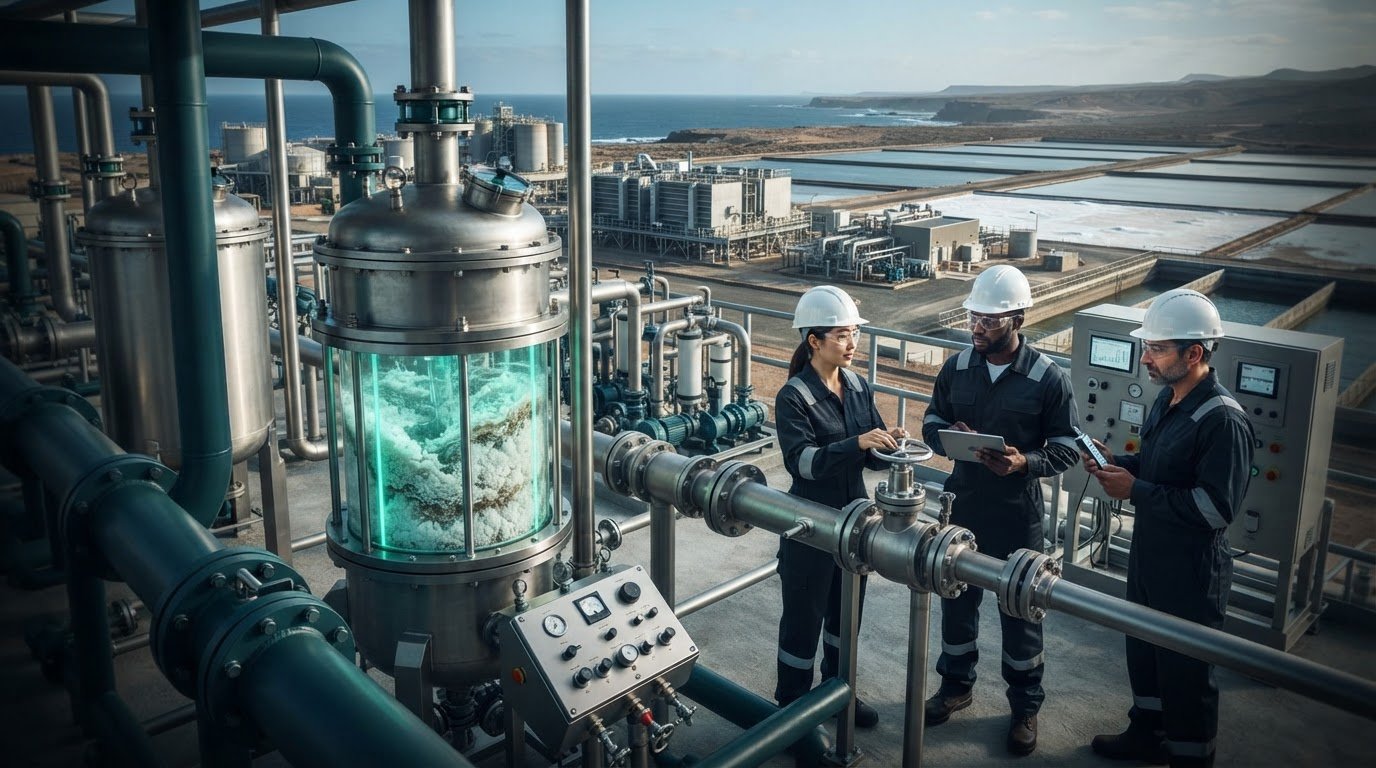
Reverse osmosis can remove salts and contaminants from produced water, but requires robust maintenance. Electrodialysis separates ions using an electric field, while evaporation separates salts from water but is energy-intensive. Crystallization can recover dissolved salts as solids from concentrated brine. Performance depends on feed-water chemistry, pretreatment needs, energy supply and management of the remaining concentrate. Compare the full treatment train, not just the separation step.
Brine Management and Salt Recovery
Brine management addresses the concentrated stream left after treatment; salt recovery may turn some dissolved material into solid residue. Disposal depends on wastewater characteristics, site conditions, regulatory requirements, public acceptance and economic factors. Account for residual brine when comparing reverse osmosis, evaporation or crystallization. Even a system that recovers water needs a defined route for concentrated salts.
Limiting salt entry to rivers starts with tracing movement through groundwater and surface pathways. In New South Wales, improved farming and irrigation practices can help prevent extra salt from seeping or washing into rivers. Mine operations can take the same watershed approach by identifying seepage points, rainwater contact with spoil and water leaving the site. Interception schemes can divert saline groundwater to evaporation basins, helping limit movement toward sensitive waterways.
Agricultural impacts also depend on what grows in affected soils. Barley and Bermuda grass are examples of salt-tolerant crops, while suitable native vegetation can support land restoration. In a Northern Plains demonstration, rotations combining cover crops with an early-season, salt-tolerant crop extended crop-growing time in salt-affected fields by up to four months. These examples show how crop selection and vegetation can complement water treatment; local soil and water conditions determine their suitability.
Distillation and wastewater recycling
Treatment choices depend on feed-water chemistry, intended reuse and the concentrate left behind. Comparing water recovery with energy demand and residual management helps define a workable system.
Comparing Salt Removal Technologies
Reverse osmosis, electrodialysis, evaporation and crystallization separate salts in different ways, so their suitability depends on water chemistry and reuse goals. Reverse osmosis removes salts and contaminants but needs robust maintenance. Evaporation separates water from salts but is energy-intensive; crystallization can produce solid salts from concentrated brine. Compare each method by its ability to supply reuse water and manage the remaining concentrate.
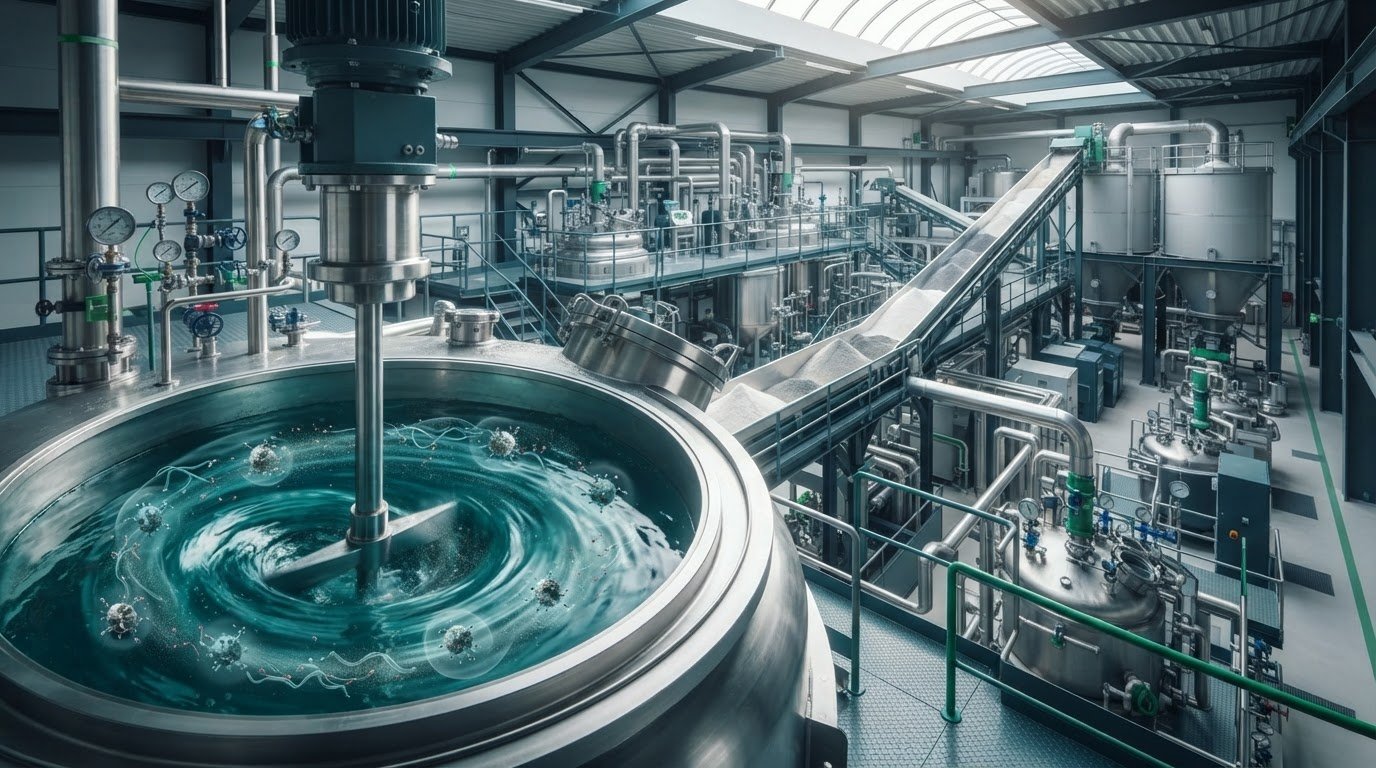
For high-salinity streams, zero-liquid-discharge systems can achieve water recovery rates of 95-99%. That recovery still leaves concentrated material requiring management. Treatment trains may combine methods: pretreatment protects downstream equipment, a separation stage recovers water, and a final concentration step handles residual brine. The right sequence depends on dissolved constituents, scaling potential, and the quality required for the next operation.
Reverse osmosis can help operations reuse treated water and reduce freshwater withdrawals. On-site produced-water treatment can also mitigate costs associated with transportation and off-site processing. In the arid Permian Basin, treating produced water can reduce freshwater use. Reuse can conserve resources and funds, but recovered water must suit its intended application, whether process use, irrigation or another operational need.
Treatment Costs and Energy Requirements
Treatment costs vary by method and treatment level. These figures offer context, not a direct project budget.
Energy demand also varies. Evaporation is energy-intensive because heat drives water separation; reverse osmosis instead requires robust maintenance. Feed salinity, pretreatment, recovery goals and concentrate handling shape system design and ongoing demands. A method with lower treatment costs may not meet the reuse target or manage residual brine effectively. Compare the full process, including drainage and concentrate disposal, rather than the separation stage alone.
Water recycling works best when the operating plan connects treatment output to actual demand. Map the volume and quality needed across operations, then match recovered water to suitable uses. If one process cannot accept the treated water, another application may be suitable. This demand-led approach supports sustainable water use and avoids producing water without a defined destination. Monitoring treatment performance and water quality also reveals changes in operating conditions.
Leaching can move salts below the active root zone, but excessive leaching can waste water, carry nutrients beyond roots and create groundwater concerns. For irrigation reuse, consider application rates and drainage alongside treatment performance. This keeps salt management in view when deciding how to use recovered water.
Evaporation ponds and land application
Evaporation ponds and land application manage concentrated saline water by containing it or applying it to land. Suitability depends on site conditions, soil and water chemistry, drainage and the intended environmental controls.
An evaporation pond holds saline water while evaporation removes water and leaves salts behind. This reduces liquid volume but does not eliminate the salt load: the remaining brine or salt deposits still need management. Pond design and operation must account for seepage pathways, nearby groundwater and handling accumulated solids. Thermal evaporation is also energy-intensive, so passive pond evaporation and heat-driven concentration should not be treated as the same method.
Land application requires particular care because water evaporates from soil and leaves dissolved salts near the surface. Repeated application can increase salinity, especially where drainage is poor or water raises saline groundwater tables. Flood irrigation can contribute to salinization through overapplication. Before application, assess electrical conductivity alongside sodium adsorption ratio, bicarbonate, chloride, boron, calcium, magnesium and pH. Each factor helps characterize risks to soil structure and plants.
Soil sodicity changes how land responds to saline water. New South Wales guidance associates an exchangeable sodium percentage (ESP) of more than 6% with sodic soils. Sodium can impair soil structure and water infiltration, making drainage and salt movement harder. Gypsum may be considered when sodium hazard threatens infiltration or soil structure, but its value depends on water and soil chemistry. An amendment is not a substitute for managing the water pathway.
Removing salt from the root zone requires enough water to move salts downward, followed by drainage to carry them away. Without drainage, leaching only redistributes salts. Where subsoil drainage is poor, drainage tiles might be needed to remove saline water. This creates a key design challenge: adding water can flush salts, but excess water can worsen groundwater salinity or move beyond the managed area. Soil-moisture monitoring helps guide application and limit over-irrigation.
In arid regions, irrigation systems need both a water supply and drainage provisions. Drip irrigation with low-salt water and surface mulch can limit salt concentration compared with allowing soil to dry. Choose an application method to suit the crop or vegetation, soil permeability and drainage capacity. Where land application is considered, testing the salinity and sodicity of both water and soil can inform use and reveal changing conditions.
Evaporation ponds, land application, deep-well injection, sewer discharge and surface-water discharge are direct disposal options for concentrated mine water. Selection should account for wastewater characteristics, site conditions, regulatory requirements, public acceptance and economic factors. A pond may contain water on site, while land application depends on soil suitability and drainage. Comparing these constraints early helps align disposal with site protection and long-term water management.
Salinity control through water management
Water management controls where saline water moves, how it is treated and where recovered water goes. The central strategy is to manage the site’s entire water balance, not just the treatment plant.
Assessing Mine Water Chemistry
Assessing mine water chemistry involves measuring dissolved salts and other constituents that affect treatment and reuse. Compare water quality at intake, through treatment and at intended reuse points to identify changes and select a suitable process.
Assess salinity alongside flow volume, scaling potential and the quality required by each operation. Electrical conductivity indicates dissolved-salt concentration, while flow helps show the salt load moving through a system. Together, these measurements help determine whether the priority is reducing concentration, limiting total salt movement or preparing water for reuse.
Next, match treatment to the water stream and its destination. Blending lower- and higher-salinity water can reduce salinity risk when infrastructure and reliable supplies are available. Treatment plans should also define a route for concentrated brine. Monitoring and review show whether the strategy remains effective as water sources and operating conditions change.
Mine Water Management Examples
In the arid Permian Basin, treating produced water can reduce freshwater use. On-site produced-water treatment can also mitigate costs associated with transportation and off-site processing. These examples show how treatment and reuse can connect water-quality management with local freshwater needs.
A practical site plan maps water inputs, process demand, reuse points and discharge pathways. It can identify where blending fits, where saline groundwater needs interception and which streams require treatment. Interception schemes can divert saline groundwater to evaporation basins, limiting movement toward surface water. The selected approach depends on wastewater characteristics, site conditions, regulatory requirements, public acceptance and economic factors.
Salinity control also depends on preventing avoidable water movement. Use process water where its quality suits the operation, reserve cleaner sources for uses that need them, and prevent unnecessary contact between water and salt-bearing materials. In New South Wales, guidance emphasizes efficient irrigation and supplying crops only the water they can use. The same water-balance principle supports reducing excess flow and salt mobilization at industrial sites.
Blending is useful only when supply and infrastructure support consistent mixing. Interception is relevant where saline groundwater threatens rivers or other surface water. Treatment and recycling suit streams with a viable reuse destination. A monitored salinity management plan should specify selected measures, track water quality and flow, and be reviewed for effectiveness. This links operational decisions with environmental protection.
For process-water planning, explore water treatment antiscalants as one consideration for managing scale risks in water systems.
Salinity management plans should specify treatments suited to site conditions, monitor and review their effectiveness, and use findings to guide subsequent management decisions.
JAS Global Industries: Fertilizer Anti-caking Agents
JAS Global Industries offers specialty chemical solutions for mining and fertilizer operations, including Fertilizer Anti-caking Agents. These agents address caking in fertilizer products; they do not treat saline mine water. For mineral processing, JAS offers Mining Flotation Collectors and Mining Grinding Aids, which support processing rather than salt removal.
That distinction matters when choosing a response to salinity. Water management, treatment, reuse and brine disposal remain central to controlling dissolved salts. JAS Global Industries is a relevant partner when your operation also needs specialty chemicals for mineral processing or fertilizer handling. Match the product category to the operational challenge, and base water-treatment decisions on mine-water chemistry and reuse objectives.
Contact JAS Global Industries or visit jasind.com to discuss its specialty chemical solutions.
Build a Practical Path for Water Reuse
Make water management part of operational planning, with clear responsibilities for water quality, reuse and residual streams. This keeps decisions about managing high salinity in mining process water connected to the mine’s wider resource priorities, rather than treating salt removal as an isolated task.
JAS Global Industries offers Fertilizer Anti-caking Agents and Fertilizer Dust Suppressants for fertilizer handling, as well as Mining Flotation Collectors for mineral processing. These products address distinct operational needs; they are not substitutes for salinity treatment. For water-related planning, focus on the process-water challenge and the role of suitable water-treatment chemicals.
Contact JAS Global Industries to discuss water management and identify a practical next step for your operation. A considered plan can support more responsible water use and strengthen long-term resource stewardship.
Frequently Asked Questions
How does high salinity affect mineral processing, equipment, and water reuse?
High salinity changes ionic conditions in mineral-processing circuits and can affect flotation selectivity, reagent demand and separation consistency. It can also increase corrosion and scaling risks in water-contact equipment, while limiting reuse in processes with stricter water-quality needs. Compare recovery and reagent performance across water sources, then track conductivity and major ions alongside process results. This links water chemistry to product quality and operational reliability.
How can mining operations manage high salinity through source control, segregation, and water recycling?
Start by mapping water inputs and separating streams by quality and intended use. Keep clean stormwater apart from water that contacts ore, tailings or spoil, so it does not acquire unnecessary dissolved salts. Segregate high-salinity flows for targeted treatment, while directing suitable lower-salinity water to processes that can reuse it. Track flow and water quality at transfer points to identify mixing or changing conditions early.