



What if the lowest quote leads to the highest cost over time? For procurement teams, presenting a TCO analysis to justify supplier choice means looking beyond purchase price to show how delivery, operating requirements, support, downtime, and risk affect total cost. The challenge is comparing supplier proposals built on different assumptions and assessing operational benefits without overstating what the evidence shows.
Stakeholders are right to scrutinize upfront spend. A fair comparison puts suppliers on a consistent basis and makes costs, assumptions, and exclusions visible. In specialty chemical sourcing, a formulation or technical support may be relevant to operating performance, but include a financial benefit in the model only when project-specific evidence supports it.
This article explains how to build a credible, auditable comparison that connects delivered cost, operating performance, and evidence. You’ll learn how to set a shared scope and time horizon, normalize supplier scenarios, identify cost drivers and uncertainty, and present substantiated benefits. The result is a decision record stakeholders can review, challenge, and defend.
Key Takeaways
- Define the decision, suppliers, and evaluation period before comparing lifecycle costs.
- Use one cost register with consistent categories, units, and time periods for every supplier scenario.
- Separate quoted prices from modeled lifecycle costs, and make assumptions easy to audit.
- Use sensitivity analysis to show how changes in key assumptions could affect the recommendation.
- Connect the approved decision to an implementation and review plan, including relevant technical support.
Why a Supplier Recommendation Needs More Than a Price Comparison
Start with the decision stakeholders need to make: which supplier should provide which product or supply arrangement, for which operation, and over what period? State who approves the decision and define the evaluation horizon. Reviewers can then see whether they are assessing a chemical product, a broader supply arrangement, or a supplier relationship that includes technical support.
The lowest initial quote is a useful starting point, but it does not show every cost that may arise during use and support. A price comparison can omit logistics, implementation, consumption, operating requirements, support, and end-of-life handling. The aim is not to assume that a higher-priced option is better. It is to compare options on the same basis and show what the available evidence supports.
Define the decision and analysis boundary
Set the operational scope and evaluation period before gathering figures. Choose a horizon that reflects the planned purchasing or operating cycle, and explain why it fits the decision. Then specify what the analysis includes and excludes. For example, state whether it covers delivery, implementation, internal handling, ongoing technical support, and disposal, or only selected parts of the arrangement.
Make the boundary visible. Record the approving stakeholder, the operational requirements being assessed, and any excluded costs that could affect how readers interpret the result. A clear boundary prevents one supplier’s scenario from including costs another supplier’s scenario leaves out.
Explain purchase price versus total cost of ownership
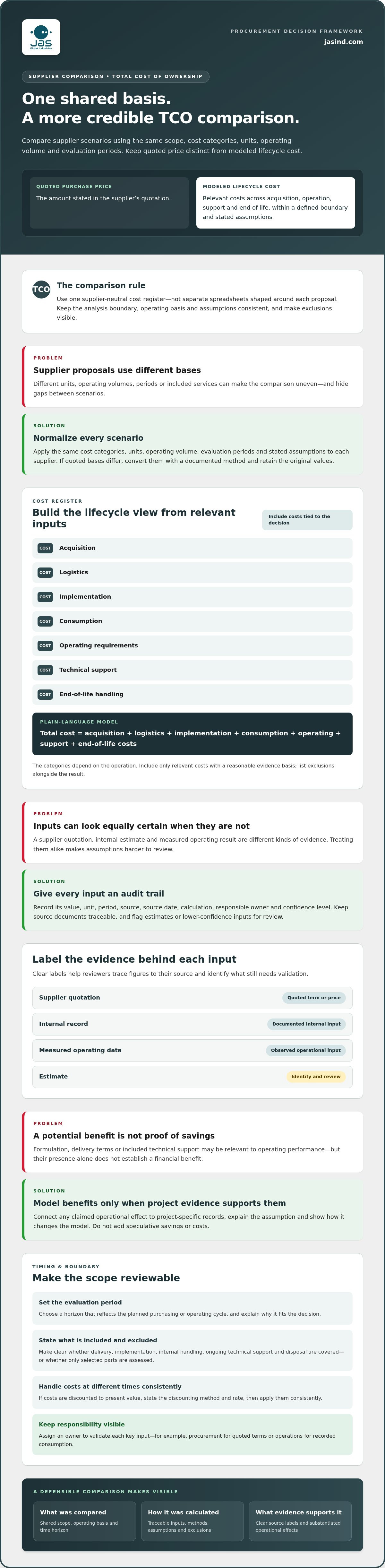
Keep the quoted purchase price separate from the modeled lifecycle total. The purchase price is the amount in the supplier’s quotation; the TCO view adds relevant costs across acquisition, operation, support, and end of life. As a foundational overview, Total Cost of Ownership (TCO) on Wikipedia describes the concept and its application across different contexts.
TCO is the total of the relevant lifecycle costs included in an analysis, calculated under clearly stated assumptions and within a defined evaluation boundary.
In specialty chemical sourcing, proposals may differ in formulation, delivery terms, or included technical support. These differences can affect which cost inputs belong in the comparison, but they do not prove an operational benefit by themselves. Include a potential benefit only when project-specific evidence supports it, and show how it affects the model.
- List the costs included in the comparison and label exclusions.
- Use the same evaluation period and operating scope for every supplier.
- Separate quoted figures from estimates and document each assumption.
With this groundwork, presenting a TCO analysis to justify supplier choice becomes a decision process rather than a defense of a preferred quote. Reviewers can see what was compared, how the lifecycle view was defined, and where the evidence supports the recommendation.
Build a Comparable Supplier TCO Model from Verifiable Cost Inputs
A reliable model starts with one supplier-neutral cost register, not separate spreadsheets built around each proposal. Give every supplier the same cost categories, units, operating volume, and evaluation periods. This reveals gaps and prevents the way a proposal is presented from shaping the comparison.
For every input, record its value, unit, period, source, source date, calculation, responsible owner, and confidence level. Label evidence clearly: supplier quotation, internal record, measured operating data, or estimate. A quoted delivery charge, for instance, is not the same as an internally estimated handling cost. These distinctions help reviewers trace each number to its source and identify what still needs validation.
Choose cost categories that reflect the operation
Include costs only when they relate to the decision and have a reasonable evidence basis. Depending on the operation, categories may include acquisition, logistics, implementation, consumption, operating requirements, technical support, and end-of-life handling. For fertilizer handling, a comparison might consider the supply of fertilizer anti-caking agents and relevant process inputs. A guide to fertilizer anti-caking agents can help frame the operational context, but any modeled effect must come from project-specific records.
Use consistent units that match how the operation tracks activity, such as cost per delivered unit or cost per defined operating period. If suppliers quote on different bases, convert the figures using a documented method and retain the original values. Do not add speculative savings or costs simply because they seem plausible.
Document assumptions and source evidence
Supplier scenarios are comparable only when they use the same scope, operating basis, and stated assumptions. Assign an owner to validate each key input, such as procurement for quoted terms or operations for recorded consumption. Mark estimates and lower-confidence inputs for review rather than presenting them with the same certainty as measured data.
Set out the calculation plainly. A simple model may use: total cost = acquisition + logistics + implementation + consumption + operating + support + end-of-life costs. If costs occur at different times, state whether they are discounted to present value, identify the discounting method and rate used, and apply them consistently. List exclusions beside the formula so readers can see what the result does not cover.
- Keep source documents and calculations traceable to each register entry.
- Use a common volume, period, and unit across supplier scenarios.
- Flag estimates, exclusions, and assumptions that could materially change the result.
This evidence trail gives stakeholders a model they can inspect and challenge, rather than a recommendation based on opaque calculations. For specialty chemical requirements, JAS Global Industries technical support for industrial applications can be considered when its scope and project evidence are relevant to the comparison.
Address the Core Objection: Is the Higher-Quoted Supplier Really Better Value?
A higher quote is not automatically better value, and a lower quote is not automatically the stronger choice. Show the quoted purchase price separately from modeled lifecycle costs, then explain what evidence supports any difference between supplier scenarios. This keeps the recommendation focused on what the data demonstrates, not on a supplier’s preferred narrative.
Compare like with like before interpreting the result
Normalize each proposal to the same volume, delivery scope, operating conditions, evaluation period, and included services. If one quotation includes delivery and another does not, show the quoted terms as submitted, then make any adjustment using a documented basis. Do not silently fill a gap in a supplier response with an assumed cost. Mark the input as missing, explain how it affects comparability, and show whether it changes the decision.
A compact comparison can make the evidence easy to review:
- Quoted cost: The supplier’s stated price and the scope it covers.
- Other included costs: Modeled logistics, implementation, consumption, operating, support, and end-of-life inputs.
- Evidence: The source for each cost or claimed operational difference, such as a quotation, internal record, or measured result.
- Confidence: Whether the input is measured, documented, estimated, or uncertain.
- Modeled lifecycle total: The calculated result under the shared assumptions.
If a specialty chemical supplier describes a tailored formulation or technical support, treat it as a potential difference to assess, not proof of lower operating cost. Include a financial effect only if relevant operating records or other project-specific evidence support the calculation. Otherwise, describe the difference qualitatively and keep it outside the modeled savings.
Test whether the recommendation holds under uncertainty
Build a base case from the best-supported inputs, then test uncertain variables one at a time. Depending on the project, these might include consumption, delivery frequency, or the level of support required. Use documented, plausible alternatives rather than arbitrary adjustments. Show how each scenario changes the lifecycle total and whether the supplier ranking changes.
Label scenarios plainly, such as “base case” and “alternative delivery assumption.” Separate measured performance from forecasts: measured data describes observed conditions, while a forecast depends on assumptions about future operations. State the limits of each. If a small change in an uncertain input reverses the result, describe the recommendation as sensitive to that assumption rather than definitive.
Presenting a TCO analysis to justify supplier choice is most credible when the conclusion stands up to transparent scrutiny. A higher-quoted supplier may be the stronger option under evidence-supported assumptions, but the analysis should show the conditions behind that conclusion, the remaining uncertainty, and what new evidence could alter it. This gives stakeholders a basis to approve the decision without treating modeled benefits as guaranteed savings.
Turn the TCO Analysis into a Clear, Auditable Decision Presentation
Decision-makers need the conclusion first, followed by a clear path back to the evidence. Open with the decision required, your recommendation, the analysis boundary, and the main reason for the choice. State the evaluation period and name the suppliers compared. This gives reviewers the context they need before examining the calculations.
Presenting a TCO Analysis to Justify Supplier Choice in an Executive Review
Use a logical sequence that moves from the decision to its supporting detail. Follow a concise executive summary with the scope and method, supplier comparison, key risks and sensitivities, and recommendation. Keep each headline conclusion traceable to a visible model input or documented source. If a conclusion depends on an estimate, label it clearly.
A comparison table can help stakeholders scan the case. Show each supplier’s quoted price separately from modeled lifecycle costs, then include the evidence basis and confidence level for significant inputs. Use charts only when they make a difference easier to understand, such as showing how a changed assumption affects the relative ranking. Avoid visuals that hide underlying figures or imply more certainty than the evidence supports.
Make the recommendation auditable and fair
Put audit details where reviewers can find them: model version, evaluation period, assumptions, exclusions, data sources, and reviewers. State the preferred supplier’s relevant advantages alongside trade-offs, unresolved assumptions, and uncertainties. If technical support is part of the comparison, distinguish documented service scope from any forecast of operational impact. Do not present a modeled benefit as a guaranteed saving.
Make decision conditions explicit. Identify which changes to key inputs could alter the recommendation, and summarize sensitivity results rather than burying them in an appendix. If the ranking depends on a forecast, say so. This lets stakeholders assess both the recommendation and its limits.
Close with a specific approval request. Name the accountable owner for the next step and the next decision milestone, such as confirming the implementation scope or reviewing an assumption with the relevant team. A clear close turns analysis into action without overstating what the model can establish.
A TCO presentation is more persuasive when its reasoning is easy to follow, test, and revisit. For an industrial chemical requirement, explore JAS Global Industries as part of a discussion about the operational context, technical requirements, and evidence relevant to your supplier decision.
Move from Supplier Selection to an Evidence-Led JAS Partnership
Approval is the start of implementation, not the end of the analysis. Convert the supplier recommendation into a working plan: restate the operational requirement, identify the evidence behind the decision, and define the technical discussion and implementation scope. This keeps the transition grounded in the requirements stakeholders approved, rather than broadening the case with new or untested claims.
Translate the selected supplier case into a practical next step
For a specialty chemical requirement, outline the process context, relevant operating conditions, and questions that need technical review. Set out who will provide information, who will assess it, and what criteria will guide the next stage. JAS Global Industries supplies specialty chemical solutions and provides technical support that can include laboratory development and on-site implementation, connecting product consideration with the realities of industrial operations.
Keep the scope specific. Record the agreed product requirement, responsibilities, implementation activities, and assumptions that still need validation. If a tailored formulation is under consideration, identify the project evidence and technical criteria that will inform the discussion. A defined scope gives both teams a shared reference point and helps prevent expectations from extending beyond the approved decision.
Set up ongoing value review without overstating outcomes
Agree in advance which operational indicators are relevant to the project and how their data will be recorded. Depending on the application, the review may draw on existing measures related to consumption, process conditions, delivery, or support activity. Assign owners and a review point, and document changes in operating conditions that could affect interpretation.
Compare observed results with the assumptions used in the TCO model. Separate measured outcomes from forecasts, explain differences, and update the model transparently when better evidence becomes available. The purpose is to understand performance and improve future decisions, not to claim savings that the data does not establish.
A practical review record can capture:
- The operational indicator and its agreed measurement basis.
- The data source, collection responsibility, and review timing.
- Any relevant change in operating conditions or implementation scope.
- How actual results compare with the model’s assumptions.
This discipline strengthens future procurement decisions. It also gives stakeholders a clear line from the original supplier rationale to implementation evidence, while preserving the distinction between verified performance and expected value. For JAS, technical support can span laboratory development, on-site implementation, and ongoing industrial support, providing a basis for continued technical discussion as project requirements evolve.
Presenting a TCO analysis to justify supplier choice should lead to an agreed path for implementation and review, not a promise of a predetermined result. To discuss a tailored industrial chemical solution in the context of your operation, start a discussion with JAS.
Make the Next Supplier Decision a Stronger One
A TCO decision can do more than support one approval. It can establish a practical standard for future sourcing: define what matters operationally, identify useful evidence, and review results against stated assumptions. That discipline helps procurement and operations make decisions around shared priorities, while leaving room to adjust when conditions or project requirements change.
For industrial chemical requirements, JAS Global Industries brings experience operating since 1998 and a global supply presence with particular strength in the GCC. Its technical support spans laboratory development, on-site implementation, and ongoing industrial support. These capabilities can inform a project discussion, with specific requirements and measures shaped by the operational context rather than assumed outcomes.
Use presenting a TCO analysis to justify supplier choice as the starting point for an evidence-led conversation about what your operation needs next. Discuss your industrial chemical requirements with JAS Global Industries and take the next step toward a well-grounded supplier decision. A thoughtful evaluation today can support stronger decisions over time.
Frequently Asked Questions
How do you calculate total cost of ownership when comparing suppliers?
Start by defining the purchase decision and the period the model should cover. To present a TCO analysis that justifies supplier choice, map each relevant cost to a source document or responsible data owner, then calculate each supplier’s scenario on the same basis. For example, reconcile quotation totals against procurement records and flag any difference before modeling. Keep the working spreadsheet or calculation notes so a reviewer can trace how each total was produced.
What costs should a supplier TCO analysis include?
Include costs that relate to the specific purchase and have a reasonable evidence basis. Depending on the arrangement, this could include acquisition, freight, setup, consumption, operating requirements, maintenance or technical support, and disposal. For a chemical supply decision, distinguish the chemical purchase from any separately modeled delivery or process-related input. Check for double counting, such as adding a delivery charge already included in a quotation, and make exclusions visible.
How can I justify choosing a supplier with a higher initial quote?
Show the higher quotation alongside the other modeled costs, then explain what evidence supports any difference in lifecycle value. If a chemical supplier proposes technical support, for example, identify the scope and any project records that demonstrate its relevance. If benefits are forecasts rather than measured results, label them and test whether the recommendation still holds without them. A fair case includes trade-offs and uncertainty, not only advantages.
How do you compare supplier proposals with different assumptions?
Translate proposals to a shared comparison basis and preserve the original quoted terms for reference. If one supplier quotes per shipment and another per unit, document the conversion and the volume used. Keep a missing delivery detail clearly marked, or place it in a separate scenario with its assumption identified. This prevents an estimate from being mistaken for a supplier commitment and makes the effect of incomplete information easier to assess.
How should uncertainty be shown in a TCO presentation?
Separate measured results from supplier statements, internal records, and estimates, then identify which assumptions have the greatest influence on the recommendation. A sensitivity table can show the base case beside alternative values for one uncertain input at a time. If the preferred supplier changes under a plausible alternative, state that plainly and explain what further evidence would reduce uncertainty. Keep forecasts distinct from observed results, and do not present modeled outcomes as guaranteed.
How often should a supplier TCO analysis be reviewed?
Review the model when a meaningful change could affect its original basis, such as a revised supply arrangement, different operating conditions, or new cost evidence. Set the review trigger with the relevant procurement and operations stakeholders rather than using an arbitrary universal schedule. Retain the earlier version, record who approved changes, and show how revised inputs affect the result. This creates an audit trail and helps future sourcing teams learn from actual operating records.