


A certificate alone doesn’t qualify a chemical supplier. Apply pre-qualification criteria for industrial chemical suppliers that cover quality and environmental systems, workplace safety, product documentation, trade and transport compliance, and the ability to meet operational needs. Approve suppliers against defined requirements, then maintain an approved list for each chemical or material.
Consistency, safe handling, and dependable supply are essential. A robust assessment also ties each requirement to the chemical, its intended use, and the countries involved.
This guide explains what to assess, from ISO certifications, safety data sheets, and product specifications to hazardous-material labeling, import compliance, and supplier audits. It also shows how to set clear approval criteria and distinguish initial qualification from ongoing performance monitoring, helping you support quality, safety, and operational continuity through sourcing decisions.
Key Takeaways
- Build a documentation trail that links each product’s technical requirements to its certificate of analysis and the supplied lot.
- For hazardous-material shipments in the United States, include U.S. DOT 49 CFR transport standards in your compliance review.
- Record chemical identity, grade, purity, and physical specifications clearly so purchasing and receiving teams can compare materials consistently.
- Set approval criteria for each chemical, document the qualification decision, and maintain an approved supplier list that supports ongoing oversight.
1. Why are certifications and safety protocols essential in chemical sourcing?
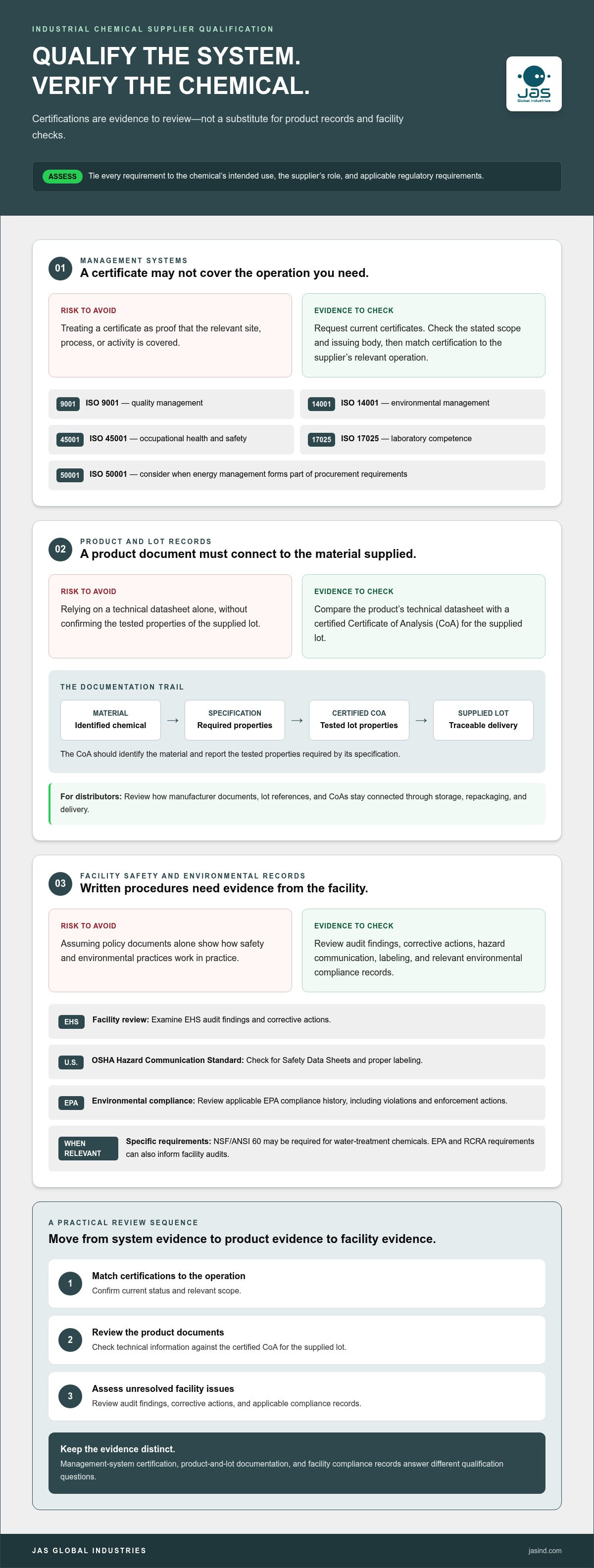
Certifications help buyers assess how a supplier manages quality, environmental impacts, and worker safety. Pre-qualification criteria for industrial chemical suppliers should reflect the chemical’s intended use, the supplier’s role, and applicable regulatory requirements. Treat each certificate as evidence to review, not a substitute for product and facility records.
For quality management, request the supplier’s ISO 9001 certification and confirm its scope covers the relevant operation. ISO 14001 addresses environmental management, while ISO 45001 covers occupational health and safety. For laboratory testing, ISO 17025 is relevant to laboratory competence. ISO 50001 may also matter when energy management forms part of procurement requirements.
Request current certificates, check their stated scope and issuing body, then compare the product’s technical datasheet with a certified Certificate of Analysis (CoA) for the supplied lot. The CoA should identify the material and report the tested properties required by its specification. For distributors, review how manufacturer documents, lot references, and CoAs remain connected through storage, repackaging, and delivery.
Safety and environmental records show how written practices work at the facility. Review EHS audit findings and corrective actions, plus applicable EPA compliance history, including violations and enforcement actions. In the United States, the OSHA Hazard Communication Standard requires Safety Data Sheets and proper labeling. For water-treatment chemicals, NSF/ANSI 60 may be required. EPA and RCRA requirements can also inform facility audits.
Environmental, health, and safety reviews typically examine audit findings, corrective actions, hazard communication, labeling, and relevant environmental compliance records. A practical sequence is to match certifications to the operation, review the product documents, then assess unresolved audit or compliance issues. This distinguishes evidence of management systems from evidence about the chemical and its handling.
2. Import, export, and hazardous-material transportation compliance
Map each shipment from its manufacturing site to its destination before approving a supplier. Identify the countries of origin, transit, and use, then match documentation and handling practices to applicable regulatory requirements. For chemicals imported into the United States, include proof of compliance with the Toxic Substances Control Act (TSCA). For European markets, assess applicable REACH requirements. Specific obligations depend on the chemical and destination.
Transportation records should identify the material, packaging, hazard information, and shipment route. Check that suppliers follow U.S. DOT 49 CFR transport standards for hazardous materials, according to the U.S. Department of Transportation. Review whether shipping papers, package markings, and labels align with the relevant requirements. Also assess how the supplier manages carrier handoffs and communicates changes that could affect safe delivery.
For chemical handling and labeling, assess alignment with the Globally Harmonized System (GHS), where applicable. Compare labels and hazard information with the product’s safety documentation. Differences between a label, shipping record, and product document can delay a shipment or complicate receiving. Build destination-specific review into sourcing procedures rather than assuming paperwork for one market meets another market’s requirements.
Supplier monitoring technology can centralize certificates, shipment records, and regulatory updates. Assess access controls, record-change history, and whether teams can trace a shipment to its product lot, origin, and destination. Cybersecurity, data protection, and traceability reviews should cover user permissions, secure handling of commercial and product records, and a clear audit trail. These controls improve visibility and reduce reliance on disconnected files.
Environmental sourcing criteria can include transport emissions tracked and reported as Scope 3 emissions. Record the supplier’s method and the shipment boundaries used, so comparisons remain consistent. Review how regulatory changes are communicated and assigned to responsible teams. For chemical sourcing, specialty chemical solutions can be considered alongside these compliance requirements when evaluating materials for industrial processes.
3. What should you look for when selecting a chemical supplier?
Define acceptance criteria before comparing suppliers. Record each chemical’s identity, grade, purity limits, and physical specifications, such as appearance or solubility, where relevant. Use a CAS number to distinguish chemical identity; for isopropyl alcohol, the example identifier is 67-63-0. Match these fields across the purchase specification, product label, Safety Data Sheet (SDS), and lot documentation.
Request an SDS for every chemical product, plus current quality documents that connect the named material to its supplied lot. ISO 9001:2015 involves ongoing supplier monitoring, risk analysis, and documentation. Compare the supplier’s specification with your process requirements, then document acceptance limits and how deviations are handled. A broad product portfolio matters only if the supplier can clearly distinguish grades and provide product-specific records.
- Check identity, grade, and stated purity against the procurement specification.
- Compare physical properties and handling information across the SDS and product records.
- Link lot-level documents to the chemical received and the purchase record.
For imports, align product identity and shipment records with destination-market requirements. Keep the chemical name, CAS number, grade, country-of-origin information, and shipping documents consistent. A mismatch between the invoice description and product documentation, for example, can complicate receiving and traceability. Apply the same review if a product’s manufacturing site or specification changes.
Digital qualification tools can organize certificates, SDS files, specifications, and audit records in one controlled workflow. AI-supported document analysis may help flag missing fields or version differences, but a qualified reviewer should assess their technical meaning and decide whether to accept discrepancies. Preserve document versions and review decisions to maintain a traceable supply chain record.
Red flags include conflicting identifiers, unexplained specification changes, incomplete lot records, and repeated document revisions without clear change control. Treat these as reasons to pause qualification and resolve the gap before approval. Continuous audits and supplier monitoring can then show whether corrective actions remain effective, linking strategic decisions to day-to-day product quality. These rigorous verification principles also apply when vetting specialized production partners; for businesses developing custom formulations and wellness products, harmonypharmalab.com provides contract manufacturing guided by strict ingredient qualification and quality control standards.
4. Approved supplier lists and qualification criteria
An approved supplier list turns procurement requirements into a controlled decision. Maintain an entry for each chemical or material, not just a broad vendor category. Record the approved product, manufacturing source, destination market, qualification status, and any conditions of use. This helps purchasing teams confirm approval before placing an order.
Compare suppliers with one scorecard and consistent evidence. Set minimum thresholds for critical requirements, such as product documentation, applicable compliance, and corrective-action closure. Score noncritical factors separately, such as service responsiveness or sustainability practices. A consistent on-time delivery performance of 95% or higher is an indicator of operational reliability, not a replacement for quality and safety thresholds.
- Define pass-or-fail requirements for safety, regulatory compliance, and product identity.
- Use the same scoring scale for quality systems, capacity, delivery, and document control.
- Record evidence, scores, exceptions, and the approval decision for each supplier.
To pre-qualify a supplier, define the chemical’s intended use and acceptance requirements first. Collect supplier documents, assess risks, and conduct an audit when warranted by the risk profile. Resolve gaps, document the evaluation, and approve the supplier only when applicable requirements are met. Then add the chemical and supplier to the relevant approved list.
Qualification takes place before a business relationship begins; performance evaluation monitors an existing one. Reassess using delivery records, quality issues, audit findings, and changes to the product or manufacturing source. Set review triggers based on risk and material changes, and use change control to assess specification or supplier updates. Document the review frequency and keep it consistent with your procurement risk process.
A clear list supports sourcing efficiency and prevents unapproved substitutions. Discuss industrial chemical sourcing requirements as you define your qualification process.
JAS Global Industries: Fertilizer Anti-caking Agents
JAS Global Industries supplies Fertilizer Anti-caking Agents for buyers assessing specialty chemicals for fertilizer operations. Consider this product when your procurement scope includes an anti-caking agent and your qualification process defines the product documentation, compliance, and quality criteria required for approval.
Apply the same disciplined review: match the product specification to process needs, assess relevant supplier records, and document the approval decision. JAS Global Industries also supplies Fertilizer Dust Suppressants, Mining Flotation Collectors, and Mining Grinding Aids. Assess each category against its specific application and purchasing requirements.
Contact JAS Global Industries to discuss Fertilizer Anti-caking Agents for your operation.
Make your next sourcing decision with purpose
Keep qualification tied to operational needs. Pre-qualification criteria for industrial chemical suppliers should reflect the chemical’s role in your process, the evidence your teams need, and the conditions that would trigger a fresh evaluation. Treat the approved list as an active procurement tool, not a file separate from daily decisions. This keeps supplier selection deliberate as operational needs evolve.
For fertilizer operations, JAS Global Industries supplies Fertilizer Anti-caking Agents and Fertilizer Dust Suppressants. Mining operations can consider its Mining Flotation Collectors. Start with the relevant chemical category, then assess its fit against process requirements and your qualification framework. This connects a supplier discussion to a defined operational need.
Explore chemical solutions with JAS Global Industries and identify a relevant starting point for your sourcing needs. A clear process can help your team move forward with focus and confidence.
Frequently Asked Questions
What should you look for when selecting a chemical supplier?
Select a supplier whose product capability, documentation, and delivery model fit the chemical’s role in your process. Compare the proposed grade with receiving and production needs, then assess how specification changes are communicated. If manufacturing moves to a different site, for example, include the source change in your review before accepting substituted material. This tests operational fit alongside supplier records.
Why are certifications and safety protocols essential in chemical sourcing?
Certifications provide evidence of management practices, while safety records help assess how those practices work at facilities. Read each certificate’s scope and match it to the relevant site or activity; a certificate for one operation may not cover another. Then compare audit findings with corrective-action records. This helps distinguish a documented system from evidence that identified issues are addressed.
What are standard pre-qualification criteria for industrial chemical suppliers?
Standard criteria cover product suitability, documentation, applicable compliance, operational capacity, and risk controls. Pre-qualification criteria for industrial chemical suppliers should also specify who approves exceptions and how decisions are recorded. For high-risk chemical purchases, include EHS approval in the workflow. Keep supplier qualification separate from ongoing performance evaluation, which tracks the relationship after purchasing begins.
What licenses and regulatory registrations must U.S. chemical suppliers hold?
No single registration applies to every chemical supplier; requirements depend on the product, activity, and destination. For imported chemicals, include proof of applicable TSCA compliance in the review. Assess relevant EPA requirements for environmental handling and waste, and OSHA Hazard Communication requirements for safety information and labeling. Match each obligation to the supplier’s role in the transaction.
What chemical safety, handling, storage, and transportation requirements apply to suppliers?
Requirements depend on the chemical and shipment. Assess whether the supplier’s safety information, hazard labels, packaging, and handling instructions align with the material and destination. For hazardous-material transport in the United States, include applicable DOT 49 CFR standards. For storage, compare the supplier’s instructions with the receiving site’s procedures, including how incompatible materials and damaged packages are managed.
What financial, insurance, and business stability requirements should buyers assess?
Assess whether the supplier has the financial stability and capacity to support the expected business relationship. Review financial statements, production capability, and dependence on critical manufacturing inputs as part of a broader continuity assessment. Set insurance requirements according to procurement risks, and record the required coverage types and limits. Revisit these criteria if the supply scope or operational exposure changes.