


Uneven color or pigment settling doesn’t always mean a coating needs more additive. Pigment dispersing agents for water-based coatings help address dispersion challenges, but performance depends on the pigment and the full formulation. Increasing the dispersant level alone does not guarantee a stable coating.
Pigment agglomeration and settling can affect appearance and consistency. It is also easy to confuse a dispersant’s role with a rheology modifier’s. Both can influence coating behavior, but they address different formulation needs. Choosing between them, or assessing how they work together, calls for more than broad product claims.
This guide explains what dispersants do in water-based coatings, how their role differs from rheology control, and how to evaluate compatibility and performance. It covers practical formulation factors to review and observations to record, so decisions reflect the coating’s actual behavior. JAS Global Industries supplies paints and coating dispersing agents and provides tailored formulation expertise and technical support.
Key Takeaways
- Assess dispersants by how well they support pigment wetting, deagglomeration, and dispersion stability in the specific coating.
- Consider how pigment type and the surrounding formulation affect dispersant compatibility and performance.
- Distinguish the role of pigment dispersing agents for water-based coatings from rheology modifiers, then evaluate each against its own purpose.
- Set a clear evaluation objective and compare candidates under controlled, documented formulation and processing conditions.
- Tailored formulations and technical support can help inform application-specific dispersant evaluation.
What Pigment Dispersing Agents Do in Water-Based Coatings
A pigment dispersing agent is an additive that helps distribute pigment particles through a coating and supports their separation in the formulation. Pigments may enter a mix as clusters, or agglomerates, rather than as evenly distributed particles. A dispersant helps manage this challenge and supports a more consistent coating appearance.
Uniform distribution matters beyond appearance. Poorly dispersed pigment can cause color variation across a batch or on a coated surface. Clusters may also affect application and coating performance. The effects depend on the pigment and formulation, so assess a dispersant against the complete coating’s needs rather than relying on broad performance claims.
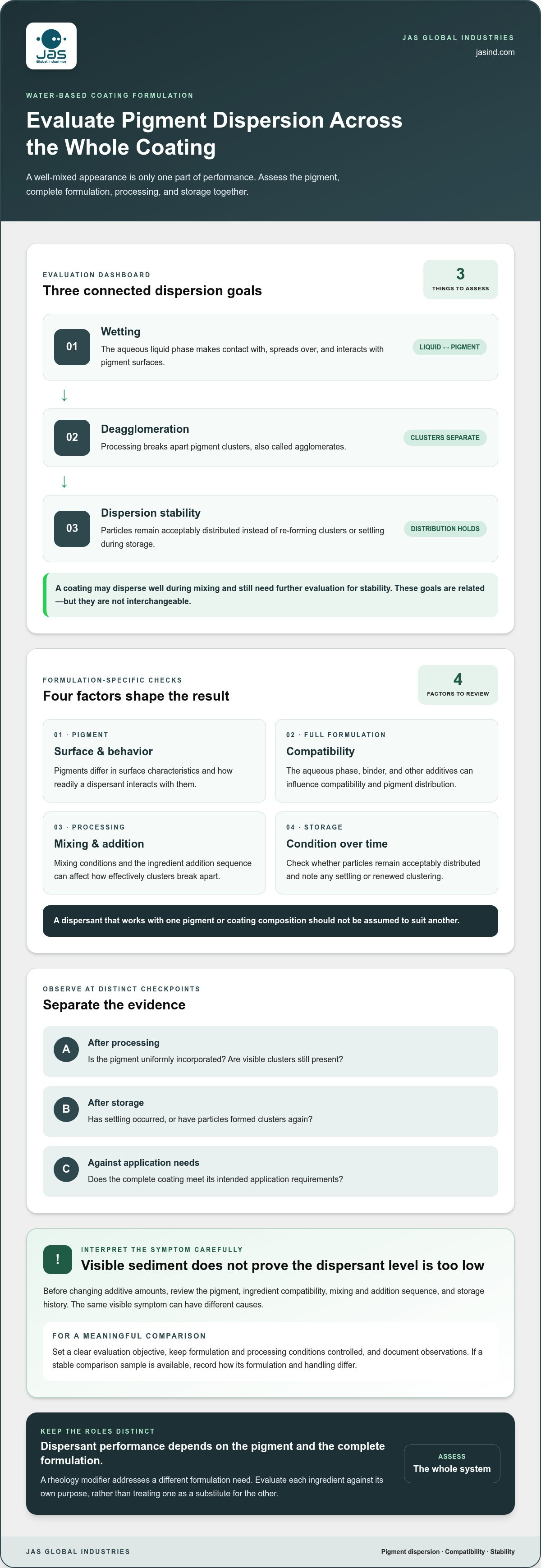
Two related goals are often confused. Deagglomeration means breaking apart pigment clusters during processing. Dispersion stability means keeping particles distributed rather than allowing them to re-form clusters or settle during storage. A coating can disperse well during mixing and still need further evaluation for stability. A general overview of how a dispersant helps separate and suspend particles provides useful background, but coating performance depends on the full formulation.
How Pigment Dispersion Differs from Pigment Wetting
Wetting occurs when the liquid phase makes contact with pigment surfaces. In practical terms, the aqueous portion of the coating must spread over and interact with the pigment. Dispersion is the broader process: it includes bringing liquid around the particles, breaking up agglomerates, and distributing the resulting particles through the coating.
These stages are connected, but they are not interchangeable. A pigment that is difficult to wet may resist even incorporation, while processing conditions affect how effectively clusters break apart. Other formulation ingredients can also influence interactions between the liquid and pigment. Consider the dispersant, the other ingredients, and mixing conditions together.
Why Water-Based Coatings Need Formulation-Specific Dispersants
Water-based coatings disperse pigment in an aqueous formulation, but pigments differ in their surface characteristics and behavior. The binder and other additives can also influence compatibility and dispersion. A dispersant that performs well with one pigment or coating composition should not be assumed to suit another.
Assess compatibility in the complete coating. Check whether the pigment is uniformly incorporated, whether it remains acceptably distributed during storage, and whether the coating meets its intended application requirements. Keep processing conditions consistent when comparing candidates. This helps distinguish the dispersant’s contribution from changes caused by mixing or other formulation differences. Selecting pigment dispersing agents for water-based coatings is a formulation-specific decision, not a choice based on a generic product description.
How Pigment Dispersants Stabilize Water-Based Coating Formulations
A coating can look well mixed and still become unstable later. A dispersant’s contribution depends on its interaction with the pigment surface and how that interaction performs in the complete aqueous formulation. The goal is not only to break up visible clusters during manufacture, but also to support a distribution that remains suitable through storage and application.
Depending on the dispersant chemistry and pigment, dispersant molecules may adsorb onto or otherwise associate with pigment surfaces. This interaction can help particles remain separated rather than come back together. The mechanism varies, so a description of one dispersant’s action should not be applied to every dispersant or pigment.
Surface Interactions and Dispersant Compatibility
Pigments have different surface characteristics, which affect how readily a dispersant interacts with them. A candidate that associates effectively with one pigment may interact less effectively with another. Compatibility also depends on the aqueous phase and other coating ingredients, which can affect whether the dispersant remains available to support pigment distribution.
Selection is therefore a system-level decision. Assess the dispersant with the actual pigment and the rest of the intended formulation instead of inferring compatibility from a broad product category. The key question is whether the combination provides the required dispersion and remains consistent under the formulation’s processing and storage conditions.
What Can Destabilize a Pigment Dispersion?
Instability can start at different stages. Incomplete processing may leave agglomerates that were never fully dispersed. Formulation incompatibility may limit the dispersant’s ability to support particle separation. Changes during storage can also affect the sample. The same visible symptom can have different causes, so identify what changed before adjusting the formulation.
For example, visible sediment does not by itself prove that the dispersant level is too low. It may indicate that particles have settled, but investigate the formulation before changing additive amounts. Review the pigment, ingredient compatibility, mixing and addition sequence, and storage history. If a stable comparison sample is available, record how its formulation and handling differ from the unstable sample.
Separate two observations during evaluation: dispersion quality after processing and the coating’s condition after storage. A formulation may look uniform immediately after mixing but show settling or renewed clustering later. A change during storage can also have more than one explanation. Track each result against a defined observation period and consistent handling conditions rather than assigning the cause to the dispersant prematurely.
- Check the starting point: Note whether pigment clusters remain after processing.
- Track the stored sample: Record changes in appearance or distribution over time.
- Compare the whole formulation: Review the pigment, other ingredients, and processing conditions before adjusting the dispersant.
Matching pigment dispersing agents for water-based coatings to the pigment and formulation supports a more disciplined evaluation than simply increasing additive loading. JAS Global Industries supplies paints and coating dispersing agents, with tailored formulations and technical support for application-specific evaluation.
Pigment Dispersing Agents vs. Rheology Modifiers: Different Roles in Paint Separation
Pigment separation can signal a formulation issue, but it does not identify which additive role needs attention. A dispersant supports pigment wetting, agglomerate breakdown, and particle distribution. A rheology modifier affects how the coating flows and resists movement. These functions can complement each other, but they are not interchangeable by default.
Use the purpose of each additive to guide the investigation:
| Additive | Primary role | Evaluation question |
|---|---|---|
| Pigment dispersant | Supports pigment wetting, deagglomeration, and dispersion stability. | Is the pigment adequately distributed, and does that distribution remain suitable? |
| Rheology modifier | Adjusts coating flow behavior and resistance to movement. | Does the coating’s flow and resistance to movement suit its handling and application needs? |
A coating might show uneven pigment distribution after processing, or pigment might settle during storage. These observations warrant investigation, but neither proves that the dispersant alone is responsible. A change in flow behavior may also influence how readily particles move through the coating. Diagnose the issue before adjusting either additive category.
When Separation Points to a Dispersion Issue
Visible pigment clusters, uneven color, or inconsistent distribution can prompt a closer look at dispersion quality. Appearance alone, however, does not identify a single cause. Pigment characteristics, dispersant compatibility, mixing conditions, and storage history may all be relevant. Compare samples and process records, then assess these factors together instead of treating every instance of separation as a reason to add more dispersant.
When Rheology Modification Is Part of the Investigation
Rheology affects how a coating moves, including how readily suspended particles can shift within it. That makes rheology relevant when investigating settling, but it does not replace wetting or breaking up pigment agglomerates. In a controlled comparison, assess dispersion quality separately from flow behavior. This helps show whether each additive role is meeting its own formulation objective.
Keep the investigation structured. First, describe the observation: for example, pigment clusters after mixing, sediment during storage, or a change in application flow. Then review the formulation and processing conditions associated with it. Compare candidate adjustments under consistent conditions, changing one relevant factor at a time where practical. Record both pigment distribution and coating flow behavior.
This role-based approach helps avoid two common mistakes: using a rheology adjustment to mask an unresolved dispersion problem, or expecting a dispersant to control every aspect of coating movement. A formulation may need both functions, but evaluate each against a distinct objective. For pigment dispersing agents for water-based coatings, the central question is whether the dispersant supports pigment distribution in the actual formulation, not whether it can substitute for rheology control.
How to Evaluate a Pigment Dispersing Agent for a Water-Based Coating
Start with the result the formulation needs. A screening plan focused on pigment distribution may differ from one focused on storage stability or an application requirement. Define the objective before comparing candidates, then decide what observations will indicate success. This keeps selection tied to coating performance rather than a broad claim that an additive suits water-based systems.
Use a consistent sequence to guide the evaluation:
- Define the objective. State whether you are assessing dispersion quality, storage stability, or an application-specific property.
- Set the comparison conditions. Keep pigment, binder, other ingredients, and processing conditions consistent across candidate formulations.
- Choose relevant observations. Select methods suited to the coating and its use, and define acceptance criteria before reviewing results.
- Record and compare. Document formulation details, processing, test conditions, and observations so results can be interpreted and repeated.
Build a Controlled Formulation Screening Plan
Control matters. If pigment, binder, mixing sequence, or processing conditions change between samples, the results may not show whether the dispersant caused the difference. Record the order of addition and processing conditions, along with other factors that could affect the comparison. Repeatable preparation makes candidate screening more informative.
Choose evaluation methods based on the coating’s purpose rather than relying on one universal test. Set acceptance criteria that reflect the application, such as the required appearance or an agreed method for assessing dispersion. If the coating has a defined processing or application requirement, include it in the plan instead of judging candidates only by how they look in the container.
Assess Compatibility and Storage Stability
Assess each candidate in the complete formulation, not as an isolated ingredient. Observe the sample after preparation and during a defined storage period appropriate to the evaluation. Note visible changes, such as separation or a change in appearance, and record how samples were prepared and stored. A short-term observation can reveal an issue, but it does not establish long-term stability.
Keep a comparison record for every sample. Include ingredient identities, addition sequence, processing conditions, storage conditions, observation timing, and results. This context helps distinguish a possible compatibility issue from differences in preparation or storage. It also makes follow-up trials more focused: adjust a relevant factor, document the change, and compare it against the same criteria.
No universal dosage recommendation can replace formulation-specific screening. The useful level depends on the pigment, surrounding ingredients, and evaluation objective. Assess pigment dispersing agents for water-based coatings under controlled conditions and against application-relevant criteria, then use the results to guide the next formulation step.
For application-specific formulation evaluation, discuss your coating requirements with JAS Global Industries.
How JAS Global Supports Dispersant Evaluation for Coatings
Choosing a dispersant is an application-specific decision. The pigment system, the rest of the coating, processing conditions, and performance objective all shape what a formulation needs. JAS Global Industries supplies Paints & Coating Dispersing Agents as part of its specialty chemical offering, alongside tailored formulations and technical support.
JAS provides end-to-end technical support spanning laboratory development, on-site implementation, and ongoing industrial support. This can connect formulation evaluation with the realities of a coating operation. The work starts from the application and its requirements rather than assuming one dispersant or test approach fits every formulation.
From Formulation Objective to Technical Partnership
A useful technical discussion starts with the coating application, pigment system, and a clearly defined objective. Is the priority consistent pigment distribution, storage stability, or a specific application requirement? A clear objective helps focus formulation evaluation and makes screening and processing observations easier to interpret.
JAS’s technical support connects laboratory development with on-site implementation and ongoing industrial support. These capabilities support work across formulation development and production contexts. They do not replace application-specific assessment: evaluate candidate formulations against the coating’s defined criteria and actual conditions.
A Practical Next Step for Coatings Teams
Before a technical discussion, organize the information that gives the formulation context. A concise record can clarify the evaluation goal and make comparisons easier to interpret.
- Application: Describe where and how the coating is used, along with any defined performance requirement.
- Pigment system: Identify the pigments involved and note any observed dispersion or storage concerns.
- Formulation context: Summarize the binder and other relevant ingredients, as well as any formulation constraints.
- Processing and observations: Record the mixing sequence and conditions, evaluation methods, and what you observed after preparation and storage.
These details keep the discussion grounded in the actual system rather than general product descriptions. They also give the team a practical basis for deciding what to assess next. JAS’s laboratory development capabilities support early formulation work, while on-site implementation and ongoing industrial support connect evaluation with operating conditions.
For teams assessing pigment dispersing agents for water-based coatings, focus on fit with the pigment, complete formulation, and intended use. Explore JAS coating dispersing agents as part of that application-specific evaluation, or discuss coating dispersant requirements with JAS.
Turn formulation learning into your next decision
A useful evaluation does not end when one sample looks promising. Carry the learning into the next formulation decision by documenting what the coating needs, what the trial showed, and which questions remain. That record gives your team a clearer basis for refining pigment dispersing agents for water-based coatings as formulation and application needs develop.
Technical partnership can connect those priorities to practical formulation work. JAS Global Industries has operated for over 25 years, bringing experience in specialty chemical solutions to its work with coatings teams. Base the next step on your pigment system, coating application, and evaluation objectives rather than assuming a general product claim predicts performance in your formulation.
Explore JAS paint and coating dispersing agents as you plan your next evaluation. A clear objective and a well-documented trial can help your team move forward with greater confidence.
Frequently Asked Questions
Can pigment dispersing agents prevent flocculation and settling completely?
No. A dispersing agent cannot guarantee that flocculation or settling will be eliminated under every condition. Its contribution depends on the pigment, formulation, processing, and storage environment. Define acceptable performance for the coating’s intended use and observe samples under relevant conditions. If separation occurs, determine whether it is loose sediment, persistent clustering, or another change before deciding what formulation adjustment to test.
How does pigment particle size influence dispersant selection?
Particle size can affect how much pigment surface is exposed to the liquid and dispersant. For a given pigment mass, finer particles generally present more total surface area, which can change the interaction needed for effective dispersion. Nominal size alone is not enough to select an additive. Consider the pigment’s surface characteristics and behavior in the complete formulation, then compare candidates through controlled trials using the actual pigment grade.
Is a pigment dispersant the same as a surfactant?
No. The terms describe different functions, although some materials may have overlapping surface-active behavior. A surfactant commonly helps liquids interact at surfaces or interfaces, while a pigment dispersant is selected for its role in pigment incorporation and distribution. A formulation may use an ingredient that contributes to wetting as part of dispersion, but its label alone does not establish suitability. Evaluate its performance with the pigment and coating system.
What can cause a water-based coating to separate during storage?
Storage separation can have several causes, including pigment settling, renewed particle association, or incompatibility among formulation ingredients. Temperature changes or differences in storage and handling may also affect what you observe. A clear layer above settled material and a change in coating texture, for example, are not necessarily the same issue. Record storage conditions and appearance, then compare the sample with a freshly prepared one before changing the formulation.
How should a dispersant be added during coating production?
Follow the dispersant’s product guidance and the established process for the coating, since addition sequence and mixing conditions can vary. In a screening trial, keep the sequence consistent between samples and document when the dispersant and pigment enter the batch. Avoid changing addition order and processing intensity at the same time, or it will be harder to identify which change influenced the result. Confirm the chosen sequence at the relevant production scale.
Can a rheology modifier replace a pigment dispersing agent?
Generally, no. A rheology modifier changes how the coating flows and resists movement, while a dispersant addresses pigment incorporation and distribution. Changing flow behavior may affect how readily particles move in the coating, but it does not necessarily correct poorly dispersed pigment. If a coating has both uneven pigment and settling concerns, assess dispersion and rheology as separate objectives, then determine whether the formulation needs one or both functions.
To discuss an application-specific evaluation, contact JAS Global Industries about coating dispersing agents.