

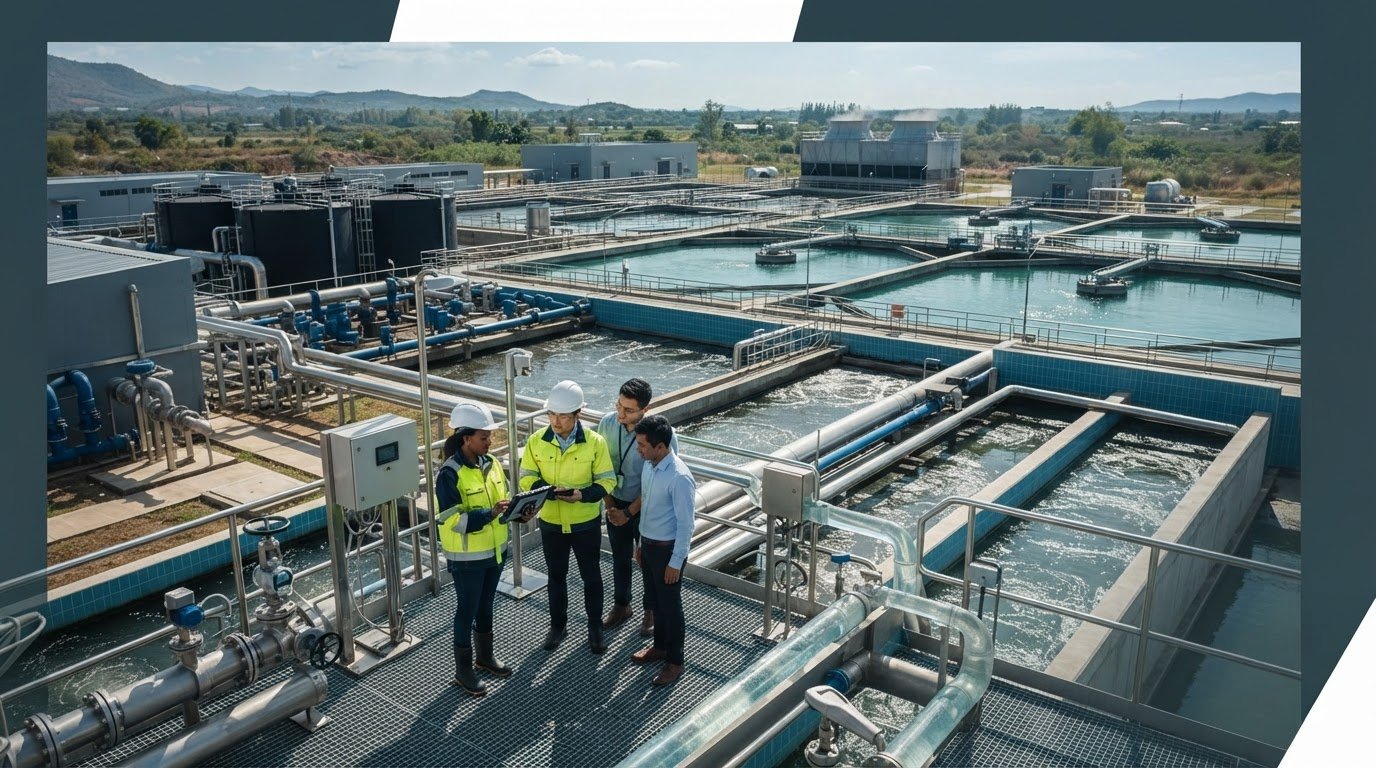
How can you change a water treatment program without putting performance or daily operations at risk? Migrating to a new water treatment program is not a simple product swap. The proposed approach needs to fit the site’s water chemistry, equipment, process demands, and treatment objectives. A controlled transition gives teams clear criteria for what to monitor, who reviews the results, and when to respond.
Start with operating data, compare the current and proposed approaches against the same objectives, and verify performance at each stage. This guide explains how to establish a baseline, assess program fit, plan implementation, and respond to deviations. It also shows how technical evaluation, implementation, and ongoing monitoring work together as one process.
JAS Global Industries has over 25 years of operation and provides water-treatment support spanning laboratory development, on-site implementation, and ongoing industrial support. The aim is a technically supported program that fits site conditions, while keeping operational continuity and responsible water management in view.
Key Takeaways
- Identify what has changed in the site’s treatment needs and define the outcomes the program must achieve.
- Build the migration plan around operating records, a clear baseline, site conditions, and accountable technical review.
- Compare programs against the treatment objectives, operating requirements, and monitoring needs of the specific water system.
- Keep the transition controlled through approved change procedures, defined roles, and documented performance checks.
- Connect chemical selection with implementation and ongoing support so the program stays aligned with site conditions.
Why Migrate to a New Water Treatment Program?
Begin by asking what has changed in the site’s treatment needs. Feedwater quality, process conditions, operating objectives, or compliance requirements may shift over time. A program that once suited the system may need review, but the case for change should come from evidence rather than assumption.
Migrating to a new water treatment program means making a planned change to treatment chemistry, strategy, or technical support. The goal is to address a defined need while maintaining continuity and reliable operations. First, map the treatment process and identify where the proposed change would take effect. The overview of Water treatment processes provides context on the range of methods involved; decisions for a facility must still reflect its own conditions.
What signals that the current treatment program needs review?
Look for changes in the system and patterns across its records. A new feedwater source, altered production demands, equipment changes, or revised treatment objectives can change what the program needs to control. Recurring scale, corrosion, foaming, microbiological growth, or effluent concerns warrant investigation, but do not by themselves prove that the treatment program has failed.
- Compare water-quality and operating records over time instead of relying on one unusual reading.
- Check whether process changes have affected flow, temperature, concentration, or other relevant operating conditions.
- Review deviations and maintenance observations alongside treatment and monitoring data.
- Separate confirmed trends from assumptions, and record the evidence behind each concern.
Check whether an issue could have another cause, such as an operating change or equipment condition. Changing chemistry before understanding the cause can complicate diagnosis and make it harder to judge the program’s performance.
What should a migration be expected to achieve?
Set objectives before comparing treatment approaches or chemical options. Specify what the site needs the program to control, which operating conditions it must accommodate, and what evidence will show whether the change is working. Use the system’s actual priorities, not broad promises of improvement.
- Operational reliability: Identify the operating indicators and approved limits that matter to continuity.
- Treatment performance: Specify the relevant parameters to monitor, using existing site data and established criteria.
- Environmental requirements: Include applicable discharge or effluent objectives and the records used to assess them.
Make each objective measurable against site data and approved operating criteria. For example, identify which monitoring results must stay within the facility’s defined range and how often they will be reviewed under site procedures. Also decide who reviews deviations and what actions follow. Clear objectives give the team a consistent basis for judging whether a proposed program fits and whether the transition is maintaining the safeguards the operation depends on.
How to Build an Evidence-Based Migration Plan
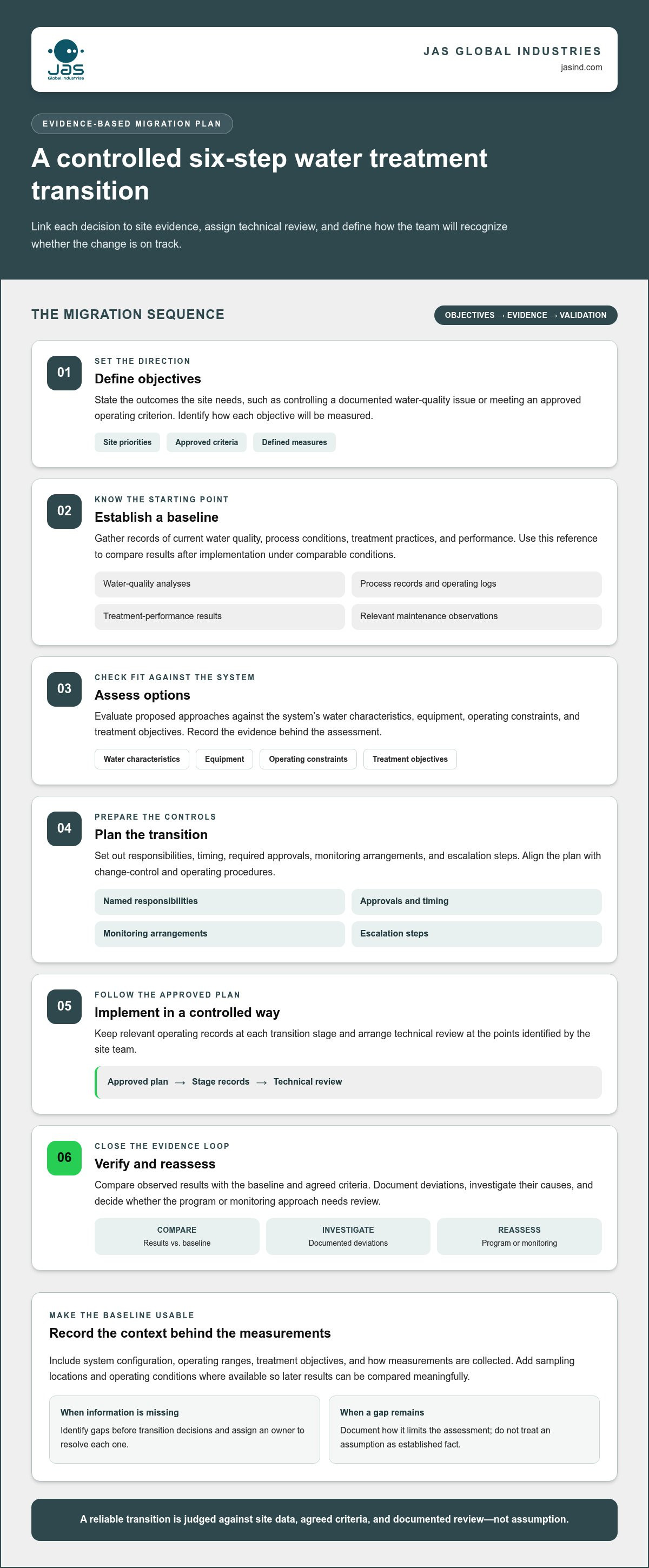
A controlled migration follows a documented sequence, with details tailored to the system, treatment goals, and approved site procedures. Link each decision to evidence, name who is responsible for reviewing it, and define how the team will recognize whether the change is on track.
- Define objectives. State the outcomes the site needs, such as controlling a documented water-quality issue or meeting an approved operating criterion. Identify how each objective will be measured.
- Establish a baseline. Gather records showing current water quality, process conditions, treatment practices, and performance. Use this reference to compare results after implementation under comparable conditions.
- Assess options. Evaluate proposed approaches against the system’s water characteristics, equipment, operating constraints, and treatment objectives. Record the evidence behind the assessment.
- Plan the transition. Set out responsibilities, timing, required approvals, monitoring arrangements, and escalation steps. Align the plan with change-control and operating procedures.
- Implement in a controlled way. Follow the approved plan and keep relevant operating records at each transition stage. Arrange technical review at the points identified by the site team.
- Verify and reassess. Compare observed results with the baseline and agreed criteria. Document deviations, investigate their causes, and decide whether the program or monitoring approach needs review.
Which baseline information should operators assemble?
Bring together available water-quality analyses, process records, operating logs, treatment-performance results, and relevant maintenance observations. Record the system configuration, operating ranges, treatment objectives, and how measurements are collected. Include sampling locations and operating conditions where available. Without that context, a result may be difficult to compare later.
Identify gaps before making transition decisions. Assign an owner to resolve each one, such as obtaining a missing analysis or determining which operating record is authoritative. If a gap cannot be resolved in time, document how it limits the assessment instead of treating an assumption as established fact.
How should technical teams assess a proposed program?
Review the proposed treatment against the system type, water characteristics, process steps, equipment, and relevant compliance objectives. Record which parts of the assessment rely on site data and which assumptions remain. Industry resources, including AWWA Publications, can provide technical context, while site-specific decisions still need to be checked against local operating evidence.
For migrating to a new water treatment program, document monitoring needs, decision criteria, responsible reviewers, and the conditions that would trigger reassessment. Make the record practical for operations staff: specify what to measure, where to record it, and who reviews the results. A technical discussion based on site conditions can also help teams evaluate tailored water-treatment support as part of the transition plan.
How to Compare the Current and Proposed Water Treatment Programs
Compare both programs against the same site objectives and evidence. Avoid judging a proposal by a single claimed benefit or comparing it with the current program under different operating conditions. A side-by-side worksheet can show what each approach is intended to do, what evidence supports that assessment, and what the site will need to manage during operation.
Match the comparison to the application. Cooling systems may require attention to scale, corrosion, foaming, and microbiological growth. Boiler treatment, thermal desalination, reverse osmosis (RO), wastewater treatment, and ion exchange each have distinct process needs. Do not assume an approach suited to one application will fit another.
Which criteria make a comparison useful?
Use the same baseline and agreed treatment objectives for both options. For each criterion, record the current program’s documented approach beside the proposed program’s approach. Mark unavailable evidence as a gap, not as an expected benefit. This makes trade-offs visible and gives technical reviewers a consistent basis for discussion.
- Treatment objectives: Which site-defined concerns or performance criteria does each program address?
- Process fit: How does each approach relate to water characteristics, process steps, and equipment?
- Operating practicality: What changes to routine tasks, handling, or coordination would be involved?
- Monitoring: Which parameters will be tracked, under which site procedures, and who will review results?
- Environmental considerations: How does each program align with relevant effluent objectives and compliance requirements?
- Implementation and support: What technical review, site coordination, and follow-up monitoring are needed?
For example, assess a proposed approach for an RO system against that system’s feedwater, operating conditions, objectives, and monitoring plan. Do not rely on generic claims or expectations from another application. Keep supporting records and assumptions beside each entry so reviewers can distinguish evidence from judgment.
How can operators evaluate transition risk without overstating it?
A risk review should identify dependencies and constraints, not presume that a transition will fail. Map the process steps and equipment the treatment program interacts with. Note operating limits, planned maintenance, sampling arrangements, and periods when a change could complicate routine operation or interpretation of results.
Connect each concern to a practical safeguard, such as an approval point, a defined monitoring check, or an escalation route under site procedures. Assign a role to review it and specify what observation would prompt reassessment. This gives operations and technical teams a shared response framework without implying that every deviation signals a serious problem.
Migrating to a new water treatment program involves site-specific trade-offs. A proposed program may better match a defined objective while requiring different monitoring or implementation support. Record both sides. A sound decision rests on relevant evidence, transparent assumptions, and a plan to oversee the transition under the conditions where the system operates.
How to Implement and Validate the New Treatment Program
A sound comparison is useful only if implementation is controlled and results are checked against agreed criteria. Treat the rollout as a managed operational change, not a single switch. Follow approved change-control and operating procedures, adapting the sequence to the system, treatment objectives, and plant requirements.
What should happen during the transition?
Before work begins, assign responsibility for operations, technical review, monitoring, and escalation. Make sure affected personnel understand the approved plan, what they need to record, and whom to notify if observations fall outside defined criteria. Coordinate timing with plant operations so the change fits process demands and the responsible teams are prepared.
Use a staged approach when site procedures and system conditions call for it. At each stage, confirm that required approvals and checks are complete before proceeding. Do not assume the same rollout sequence suits every facility. Appropriate stages and safeguards depend on the treatment system and its operating constraints.
- Operations follow approved procedures and record relevant operating conditions.
- Technical reviewers assess results against treatment objectives and the baseline.
- Monitoring owners collect and report agreed measurements at defined intervals.
- Escalation leads coordinate review when results or operating conditions require action.
Keep a transition log throughout. Record the date and stage of each change, relevant operating conditions, monitoring observations, adjustments, decisions, and follow-up owners. This gives the team a shared account of what happened and helps everyone interpret results consistently, rather than relying on memory or isolated notes.
How should teams verify performance after the change?
Set monitoring measures and review intervals before implementation, based on the system’s needs and approved operating criteria. Compare results with the baseline under comparable operating conditions wherever possible. Record relevant process changes alongside each measurement, since a reading without context may be difficult to interpret.
If a result deviates from an agreed criterion, follow the site’s escalation route. Review the observation, its operating context, and the transition log. Document the investigation, any corrective action, and the person responsible for follow-up. Do not attribute a deviation to the new program before technical review considers other relevant conditions.
Validation continues after initial implementation. Review subsequent monitoring records to assess whether the program remains aligned with treatment objectives as operating conditions vary. If trends or process changes warrant it, use the site’s review process to reassess the approach and update monitoring or operating steps as approved. This supports a measured transition without treating any program change as risk-free.
For a transition shaped around your system’s requirements, JAS Global Industries provides site-specific water-treatment support.
How JAS Global Supports a Site-Specific Water Treatment Transition
A treatment program should fit the system it serves, not an abstract model of plant operations. JAS Global Industries develops tailored water-treatment chemical solutions for industrial applications, with technical support spanning laboratory development, on-site implementation, and ongoing industrial support. This connects program evaluation with the practical conditions operators manage throughout a transition.
The application matters. Thermal desalination, reverse osmosis, wastewater treatment, steam boilers, cooling systems, and ion exchange each present different operating contexts and treatment objectives. JAS Global’s water-treatment solutions address scale formation, foaming, corrosion, microbiological growth, and effluent compliance. The relevant objective depends on the system and its documented needs.
What technical support can contribute to the migration?
Laboratory development supports the assessment of site-specific treatment needs before a program change is planned. It provides a technical basis for considering how a tailored chemical solution relates to the site’s water and objectives. Consider the findings alongside operating records and approved criteria, rather than as a substitute for reviewing how the system runs.
On-site implementation brings the technical assessment into the operating environment and supports coordination during the transition. Ongoing industrial support gives teams a continuing point of technical collaboration as they monitor results, review operating conditions, and assess whether the approach remains aligned with treatment objectives. JAS Global Industries has operated for over 25 years, supporting industrial water-treatment needs across these stages.
How can a site take the next step with JAS?
Prepare a concise picture of the system for a technical discussion. Useful material includes the treatment process, system configuration, current objectives, available water-quality and operating records, and the issues prompting review. Include known constraints and relevant compliance or effluent objectives, as well as gaps in the available evidence. This context focuses the discussion on the site’s actual requirements.
For teams migrating to a new water treatment program, a technical conversation connects the proposed change to the operating conditions it must serve. JAS Global’s laboratory development, on-site implementation, and ongoing industrial support can help guide evaluation and implementation around the facility’s needs.
JAS Global’s water-treatment work is grounded in tailored solutions and technical partnership. Bring your site context and treatment priorities into the conversation to explore an appropriate path for evaluation and implementation. Discuss your water treatment requirements with JAS Global.
Make the Next Change More Deliberate
A well-managed transition can also prepare a site for future changes. Preserve decision records, clarify ownership, and capture what the team learns about operating conditions. That knowledge helps future program reviews draw on the facility’s experience instead of starting from assumptions.
As you consider migrating to a new water treatment program, identify the operational question you most need to resolve and the evidence available to answer it. A focused technical discussion can connect that question to your system’s treatment objectives and practical requirements.
JAS Global Industries brings over 25 years of operation and technical support spanning laboratory development, on-site implementation, and ongoing industrial support. Take the next step toward a transition shaped around your site: start a site-specific water-treatment discussion. Clear priorities and technical collaboration help your team make better-grounded decisions.
Frequently Asked Questions
When should an industrial facility consider migrating to a new water treatment program?
Consider a review when site conditions, treatment objectives, or compliance needs change, or when records show a recurring performance pattern that warrants investigation. A new feedwater source, for example, may justify reassessing whether the existing approach still fits. One unusual reading or isolated operating issue does not prove program failure. Review the data, operating context, and possible contributing factors before deciding whether migration is appropriate.
How do you compare a current water treatment program with a proposed one?
Compare both programs against the same baseline and treatment objectives. Assess how each fits the system’s water characteristics, equipment, process steps, and operating constraints. Include monitoring needs and relevant compliance considerations so the comparison reflects day-to-day requirements, not only intended treatment effects. Document assumptions separately from evidence. If information is missing, identify it as a gap rather than treating an unverified advantage as established.
Can a water treatment program be changed without disrupting plant operations?
Disruption cannot be ruled out for every facility because the transition depends on the process, equipment, and operating schedule. Site-specific planning helps teams coordinate the change with plant requirements, communicate responsibilities, and establish monitoring and escalation arrangements. Planned maintenance or production changes, for example, may affect suitable implementation timing. Follow approved operating procedures and review actual conditions during the transition rather than assuming risk is absent.
What information is needed before changing an industrial water treatment program?
Assemble available water-quality analyses, process descriptions, operating logs, current treatment records, and relevant compliance or effluent information. Include the system configuration and conditions under which measurements were taken, such as sampling location or process state where recorded. This context helps technical reviewers interpret results. List missing, outdated, or inconsistent records separately, then assign responsibility for addressing each gap before relying on the data for a transition decision.
How long does it take to migrate to a new water treatment program?
There is no standard duration for every facility. Timing depends on system scope, operating conditions, the assessment required, and implementation needs, including how the site coordinates review and monitoring. A change in one process area may require different planning from a transition affecting several connected systems. Establish a schedule after technical review identifies the necessary steps, approvals, operational coordination, and follow-up checks.
How can a facility verify that a new water treatment program is working?
Evaluate results against baseline data and predefined site-specific acceptance criteria, using measurements that relate directly to treatment objectives. Record observations with their operating context so changes in feedwater or process conditions are not mistaken for program effects. If a result falls outside criteria, document the review and any corrective action. Continue follow-up after initial implementation to determine whether the program remains suited to actual operating conditions.
Can one water treatment program serve cooling systems, boilers, and reverse osmosis?
Do not assume a program will suit all three systems. Cooling, boiler, and reverse osmosis applications can have different water characteristics, equipment, process demands, and treatment objectives. A chemical approach considered for one application may not address another’s needs. Assess each system against its own operating data and requirements, then use site-specific technical review to determine whether a program fits each application or needs tailoring.