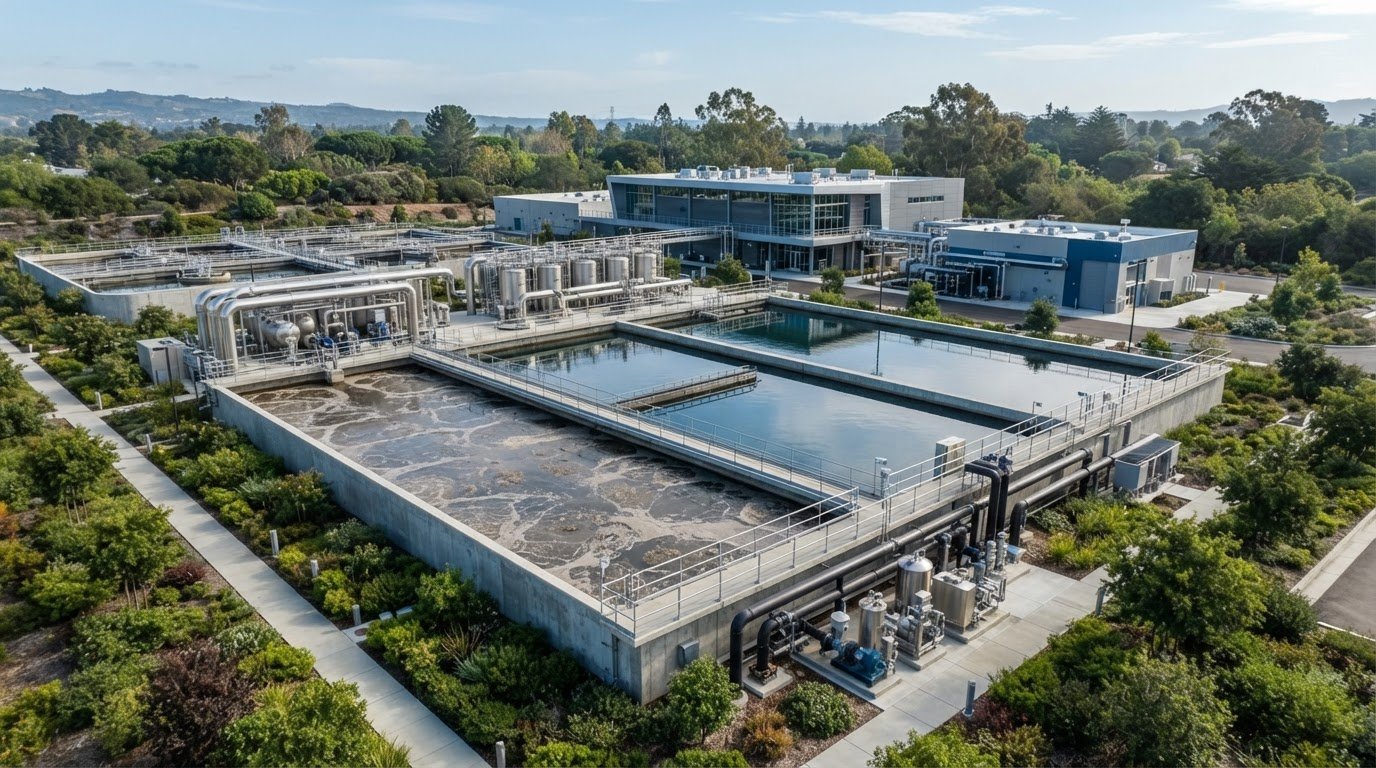

More reagent does not automatically mean better mineral recovery. Optimizing chemical dosing for mineral processing means matching reagent selection and application to changing ore and process conditions, then using reliable monitoring and calibrated equipment to keep delivery consistent. The right dose supports separation without disrupting the wider circuit.
That balance matters in flotation, thickening, and clarification, where both underdosing and overdosing can affect performance. This guide explains the roles of collectors, frothers, depressants, and flocculants, and how feed variability changes reagent demand. It also covers how sensors, dosing controls, and equipment checks help operators understand process conditions and respond precisely. The practical principle is to match chemical choice to the process, then assess dosing decisions against measurable plant results.
Key Takeaways
- Match reagent choice and application to ore variability and the separation outcome you need.
- Use flow, density, and level measurements to connect dosing adjustments with changing process conditions.
- Validate dosing equipment regularly so control decisions reflect accurate delivery and measurement.
- Watch settling, overflow clarity, and flotation response to spot the effects of underdosing or overdosing.
Sensor integration and closed-loop dosing control
U.S. mineral processing plants must manage chemical storage, handling, and discharge under applicable federal, state, and local requirements. Depending on the chemicals and site activities, these may cover hazardous materials, worker protection, air emissions, wastewater permits, and mine waste. Discharge permits specify site-specific limits and monitoring requirements, which can also depend on receiving waters.
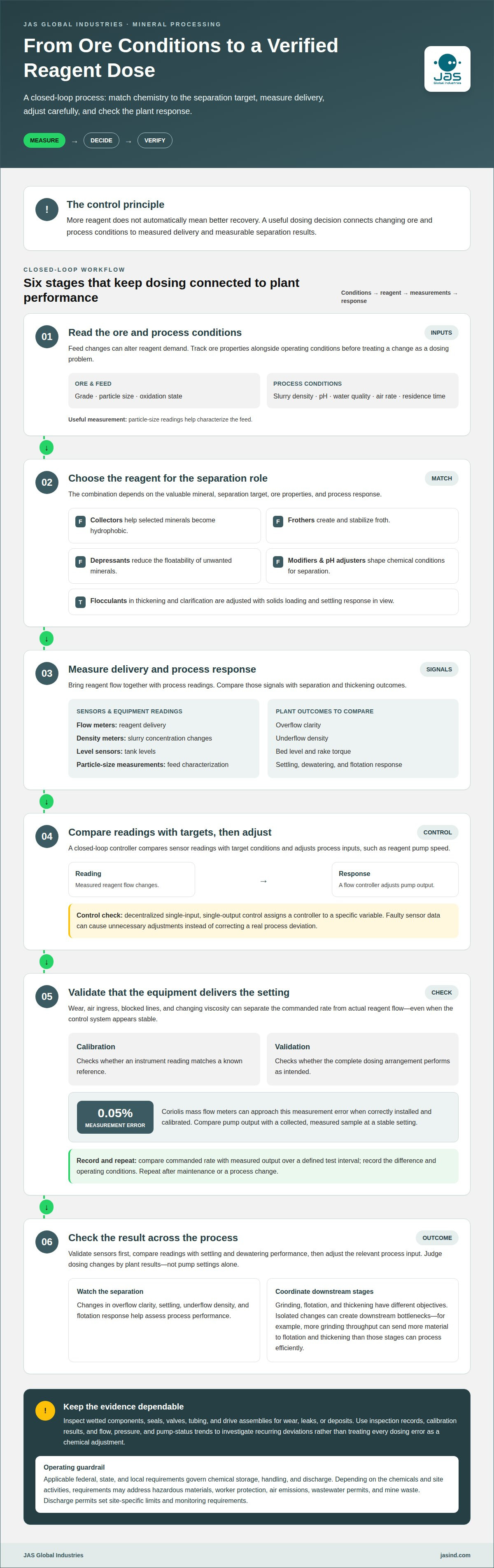
Control loops connect measurements to process responses. Flow meters track reagent delivery, while density meters indicate changes in slurry concentration. Level sensors monitor tanks, and particle-size measurements help characterize feed. Operators can compare these readings with outcomes such as overflow clarity, underflow density, bed level, and rake torque. Taken together, the signals help show whether a dosing change improves separation or creates instability.
In a closed loop, a controller compares sensor readings with target conditions and adjusts process inputs, such as reagent pump speed. Decentralized single-input, single-output control assigns a controller to a specific variable, helping stabilize individual operations. For example, a flow controller can adjust pump output as measured reagent flow changes. Reliable measurements are essential: faulty sensor data can trigger unnecessary adjustments instead of correcting a genuine process deviation.
Comminution and separation need different control strategies because they have different objectives. Grinding control responds to variables such as throughput and particle size; flotation control responds to feed conditions and separation performance. Plants can coordinate the stages using shared process measurements, while avoiding isolated changes that create downstream bottlenecks. For example, increased grinding throughput can send more material to flotation and thickening than those stages can process efficiently.
Concentrate dewatering adds another control point. Moisture and solids measurements help operators assess the consistency of thickener underflow and filter feed. A shift in underflow density can affect water recovery and the load reaching filtration. A practical sequence is to validate the sensors, compare readings with settling and dewatering performance, then adjust the relevant process input. This links dosing decisions to plant-wide performance, not just pump settings.
Applicable federal, state, and local requirements govern chemical storage, handling, and discharge. Depending on the chemicals and site activities, rules may address hazardous materials, worker protection, air emissions, wastewater permits, and mine waste. Discharge permits establish site-specific limits and monitoring requirements, which can also depend on receiving waters.
Calibration and validation of dosing equipment
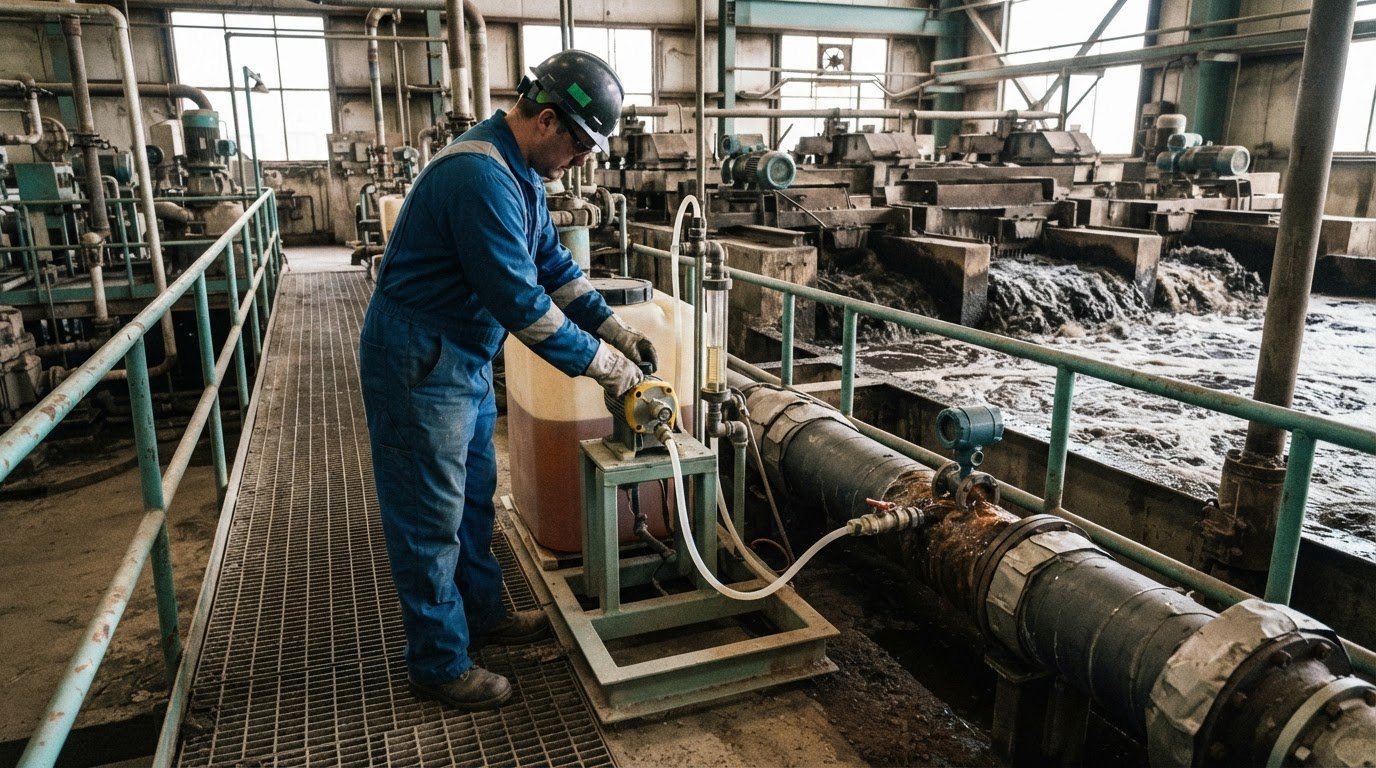
Dosing equipment turns a target rate into actual reagent flow. Wear, air ingress, blocked lines, and changing viscosity can create a gap between the setting and the delivered dose, even when the control system appears stable. For each application, compare the commanded rate with measured output over a defined test interval. Record the difference and operating conditions, then repeat the check after maintenance or a process change.
Calibration checks whether an instrument’s reading matches a known reference; validation checks whether the complete dosing arrangement performs as intended. A practical validation compares pump output with a collected, measured sample at a stable setting. Coriolis mass flow meters can approach 0.05% measurement error when correctly installed and calibrated. Scheduled calibration and manual sample comparisons help detect drift before it shapes dosing decisions.
Remote telemetry can bring equipment and process readings, including flow, pressure, and pump status, into a control room. Trend views help operators compare requested delivery with measured output as conditions change. For example, if pump speed rises while measured flow falls, investigate a possible blockage or equipment issue. Telemetry can support diagnosis, but its value depends on sound sensors and well-maintained instruments.
Maintenance helps protect dosing consistency and equipment service life. Inspect wetted components, seals, valves, tubing, and drive assemblies for wear, leaks, or deposits. Recurring flow deviations can reveal a failing component before it causes a larger interruption. Use inspection records with calibration results to identify repeat problems, plan replacements, and avoid treating every dosing error as a chemical adjustment. Equipment condition can also affect energy use if drives must work harder to maintain delivery.
Where process water chemistry affects dosing conditions, review relevant water treatment chemical applications alongside equipment measurements. Calibration then remains connected to the chemistry and operating conditions the system must support.
Reagent roles in flotation, thickening, and clarification
Reagent choice and dose depend on the separation target, ore properties, and process response. Assessing these together helps balance recovery, throughput, and concentrate quality.
Flotation Reagent Selection and Types
Flotation reagents affect how minerals interact with water and air bubbles. Collectors help selected minerals become hydrophobic; frothers create and stabilize froth, while depressants reduce the floatability of unwanted minerals. Modifiers and pH adjusters shape the chemical conditions for separation. Each reagent has a distinct role, and the right combination depends on the valuable mineral and separation objective.
Ore and Process Effects on Flotation
Ore mineralogy and feed conditions influence flotation response. Changes in grade, particle size, or oxidation state can alter reagent demand; slurry density, pH, water quality, air rate, and residence time also affect separation. Monitoring these conditions helps distinguish ore-related changes from dosing problems. In thickening and clarification, solids loading and settling response guide flocculant adjustments.
Dosing, Recovery, and Optimization
Optimizing flotation dosing means relating reagent additions to plant response instead of maintaining a constant rate as feed changes. Consider feed characteristics and operating data alongside recovery, froth behavior, and concentrate quality. For testing, compare a baseline with controlled changes under comparable conditions. Screen candidate doses in laboratory tests first, then assess promising conditions in plant trials. Where practical, change one relevant factor at a time and record both separation results and operating conditions.
Dosage Evaluation and Calculation
Calculate dosage per tonne by dividing the mass of reagent used by the dry tonnes of ore treated over the same interval. Compare candidate doses using reagent consumption per tonne alongside recovery, throughput, and concentrate grade. A lower dose may not be better if recovery or grade falls, and higher throughput can change total reagent use. Evaluate the overall operating balance, not a single result.
Accurate dosing and the risks of underdosing or overdosing
In mining, accurate dosing supports process stability, while an incorrect rate can affect recovery, concentrate quality, and reagent consumption. The consequences depend on the reagent’s role and the circuit’s response.
Incremental Chemical Dosing
Incremental dosing means changing the chemical rate in controlled steps and observing the process response after each adjustment. This helps operators distinguish a useful change from a reaction caused by shifting ore or operating conditions. For example, assess a small collector adjustment against flotation performance before making another change. Record the target rate and process outcome so each trial is easier to interpret.
Dosing Accuracy and Consistency
Dosing accuracy describes how closely delivered reagent flow matches the target; consistency describes how reliably that delivery holds over time. Both matter because a pump setting alone does not confirm that the chemical reaches the process at the expected rate. Compare the target with measured delivery, then review flow variation alongside feed conditions and process response. A recurring mismatch may indicate an equipment or measurement issue rather than a need to change the recipe.
Underdosing and Overdosing Risks
Underdosing can weaken separation: in flotation, valuable minerals may report to tailings, while inadequate flocculant can slow settling and increase fines in the overflow. Overdosing can increase reagent consumption, disturb process balance, and create secondary problems. Excessive reagent additions in flotation can also reduce concentrate grade. Because no single metric tells the whole story, review recovery, grade, settling response, and reagent use together before deciding whether a rate change helped.
For flotation circuits where collector selection is part of dose control, explore mining flotation collectors to support your reagent evaluation.
JAS Global Industries: Fertilizer Anti-caking Agents
JAS Global Industries supports mineral processing operations evaluating reagent needs alongside dosing accuracy and process performance. Its mining chemical offerings include Mining Flotation Collectors and Mining Grinding Aids, which serve different stages of mineral processing.
For flotation, collector selection should reflect the separation objective and the ore’s response. Grinding aids address a different requirement in grinding circuits. Keeping these roles distinct helps focus product discussions on the application instead of treating every dosing challenge alike. JAS Global Industries also offers Fertilizer Anti-caking Agents for fertilizer applications.
Contact JAS Global Industries to discuss chemical options for your operation.
Turn dosing insight into sustained process control
Make the next step a focused operating review: choose a process objective, decide how to assess it, and keep the evaluation grounded in actual plant conditions. A consistent improvement cycle turns optimizing chemical dosing for mineral processing into a practical discipline rather than a one-time adjustment. It also helps operations teams prioritize changes and carry useful learning across shifts.
When reagent selection is part of the review, JAS Global Industries offers Mining Flotation Collectors for mineral processing applications. Its fertilizer offerings include Fertilizer Anti-caking Agents and Fertilizer Dust Suppressants. Each product category serves a distinct need, so align the discussion with the process and material involved.
For a conversation about chemical options suited to your application, contact JAS Global Industries. A clear operating objective is a strong place to begin.
Frequently Asked Questions
What factors determine optimal reagent dosing in mineral processing?
Optimizing chemical dosing for mineral processing means weighing ore characteristics, reagent purpose, and the separation result the plant needs. Mineral liberation, feed grade, particle size, slurry density, pH, water chemistry, and residence time can all shift the response. Compare dose on a consistent production basis, such as reagent use per dry tonne, while tracking recovery and concentrate quality. A changed ore blend can make a previous setting less effective.
What are typical dosage ranges for flotation collectors, frothers, and depressants?
No single dosage range applies to every collector, frother, or depressant. Product concentration, mineralogy, feed conditions, and reagent purpose all affect the required rate. Keep the dosage basis consistent: distinguish active reagent mass from diluted solution flow, and relate use to dry ore treated. This makes operating records more useful when comparing formulations or ore blends.
How do ore mineralogy, water chemistry, and pH affect reagent consumption?
Mineralogy, dissolved water constituents, and pH influence mineral response to reagents and can change the amount needed for effective separation. A new ore blend, for example, may expose different mineral surfaces, while a shift in process-water quality can alter reagent interactions. Track these conditions alongside reagent consumption; otherwise, a feed or water change may be mistaken for a dosing-equipment problem.
What sensors and control systems enable real-time reagent dosing optimization?
For optimizing chemical dosing for mineral processing, flow, density, and level instruments provide core operating measurements. Online X-ray fluorescence, Raman spectroscopy, and froth imaging can add information about feed composition and flotation behavior. A control system can compare readings with process targets or kinetic models, then adjust pump output. Align sensor readings with the relevant process interval and distinguish valid measurements from instrument faults.
What are the safety and environmental risks of mineral processing chemicals and overdosing?
Risks depend on the chemical and how it is stored, transferred, and used. Poor handling can create exposure or spill hazards, while overdosing can increase reagent consumption, disturb process balance, and cause secondary process problems. Chemical losses can also affect process water and downstream treatment. Follow chemical-specific handling instructions, maintain suitable containment, and monitor process and discharge conditions under the site’s applicable controls.