

High-solids paint isn’t simply low-solids paint with less solvent; its performance depends on how pigment and binder share space in the dry film. Pigment volume concentration (PVC) measures the pigment’s volume relative to the total volume of pigment and binder, making it a central guide when formulating stable high-solids industrial paints. A PVC of 10% to 30% is commonly classified as low-PVC and binder-rich, while 50% to 80% is high-PVC and pigment-rich.
Higher solids can deliver greater film build with less solvent, but only if latex particles pack efficiently and form a continuous acrylic film. If pigment loading approaches the critical pigment volume concentration too closely, the coating may lose gloss, cohesion, or protective performance. Thickener can also make viscosity difficult to control if particle interactions are overlooked. This article explains how PVC and CPVC, acrylic film formation, latex particle-size distribution, and thickening mechanisms interact, helping you assess the trade-offs among solids, application, stability, and finished-coating performance.
Key Takeaways
- Distinguish weight solids from volume solids so formulation comparisons reflect the coating’s dry-film contribution.
- Understand how acrylic particle composition and film formation affect the continuity and performance of the cured coating.
- See why a bimodal latex particle-size distribution can help balance higher solids with manageable viscosity.
- Recognize how shear behavior and thickener interactions shape application flow and storage stability.
- Weigh high-solids coatings’ potential film-build and coverage advantages against their formulation and application demands.
What is Pigment Volume Concentration (PVC)?
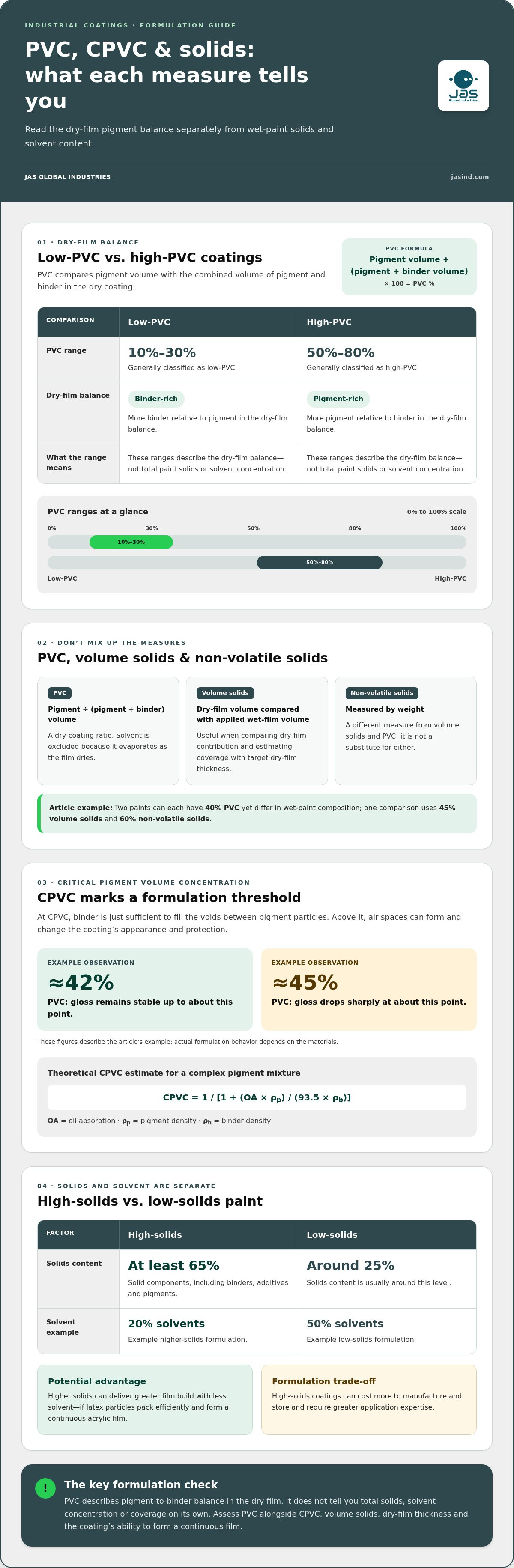
Pigment volume concentration, or PVC, is the pigment volume divided by the combined volumes of pigment and binder in a dry coating. Multiply that ratio by 100 to express PVC as a percentage. Solvent is excluded because it evaporates as the film dries. A paint with 10% to 30% PVC is generally low-PVC and binder-rich; one with 50% to 80% PVC is high-PVC and pigment-rich. These ranges describe the dry-film balance, not the paint’s total solids or solvent concentration.
That distinction matters when comparing formulations. Two paints can each have 40% PVC yet differ in wet-paint composition: one comparison uses 45% volume solids and 60% non-volatile solids. Non-volatile solids are measured by weight, while volume solids compare the dry-film volume with the applied wet-film volume. Neither figure is a substitute for PVC. The pigment’s oil absorption, density, and packing also influence how much binder is needed to fill the spaces between particles.
At the critical pigment volume concentration, or CPVC, binder is just sufficient to fill the voids between pigment particles. Above that point, air spaces can form, changing film appearance and protection. A theoretical estimate for a complex pigment mixture is CPVC = 1 / [1 + (OA × ρp) / (93.5 × ρb)]. Here, OA is oil absorption, and ρp and ρb are pigment and binder densities. In one example, gloss remains stable up to about 42% PVC, then drops sharply at about 45% PVC.
Solvent concentration affects application and surface coverage, but it doesn’t define PVC. An example low-solids formulation contains 50% solvents, while a higher-solids example contains 20%. As solvent evaporates, it leaves less coating volume on the surface than the wet application initially suggests. Compare volume solids and target dry-film thickness to estimate coverage; don’t infer it from PVC alone. Pigment loading instead helps explain the balance between binder-rich films and pigment-rich films.
Regulatory requirements shape solvent selection. Compliance with applicable VOC standards, including US EPA standards or European VOC Directives, is legally mandatory for paint manufacturers. California Air Resources Board Regulation 1113 restricts the sale and use of paints containing more than a specified small quantity of organic solvent. APEO-free surfactants can support alignment with European and American environmental export requirements.
Surfactants and emulsifying agents disperse monomers in water and stabilize growing latex particles during emulsion polymerization. Carboxylic acid monomers add acid groups to acrylic polymers, and their ionization can help stabilize particles in water. The balance of acid groups, surfactant, and emulsifier affects dispersion stability and the resulting film. When formulating stable high-solids industrial paints, assess these materials alongside PVC rather than treating them as separate formulation choices.
Acrylic polymer composition and film formation
An acrylic coating forms a continuous film as water or solvent evaporates and polymer particles come together. Polymer composition influences whether particles deform, merge, and develop a coherent surface. In an acrylic latex, softer polymer segments help particles deform, while harder segments contribute to film hardness. Formulators balance these properties against the adhesion and resistance required for the coating’s intended service. Without adequate particle coalescence, a coating can remain weak or porous even if the wet formulation contains substantial polymer.
High-solids coatings contain at least 65% solid components, including binders, additives, and pigments; low-solid paint usually contains around 25% solids. Solventborne coatings rely on organic solvent, a major source of harmful volatile organic compounds (VOCs), while waterborne coatings use water as their main liquid phase. High-solids coatings generally combine higher resin concentration with lower VOC concentration than low-solids coatings, but they can cost more to manufacture and store and require greater application expertise.
Choose application equipment according to the coating’s viscosity, the substrate, and the required film build. Airless spray can handle viscous industrial coatings, while conventional or air-assisted spray, rollers, and brushes suit other materials and access conditions. Match the pump, hose, tip, and method to the paint’s flow behavior and the manufacturer’s application guidance. A method that atomizes one formulation well may give another poor coverage or an uneven film.
Common defects include pinholes, sagging, poor leveling, and incomplete film formation. Entrained air can leave pinholes, excessive wet-film build can cause sagging, and unsuitable drying conditions can interrupt particle coalescence. Control dispersion quality, application thickness, substrate condition, and drying environment together. For example, reducing excessive wet-film build can limit sagging, but the coating must still reach the required dry-film thickness.
Polymer composition also determines the balance between flexibility and resistance. Methyl methacrylate can contribute hardness, while butyl acrylate can contribute flexibility. Their ratio and the polymer architecture affect how the film responds to temperature and movement. Depending on the chemistry, functional groups can support adhesion or crosslinking. Because these choices interact with pigments and additives, a resin’s properties on their own do not predict the finished coating’s performance.
For waterborne acrylics, film formation proceeds as water evaporates, particles pack together, and polymer chains interdiffuse across particle boundaries. The process depends on particle softness, drying conditions, and the formulation’s ability to maintain a stable dispersion before application. Dispersing agents help manage pigment distribution and reduce agglomeration, while defoamers address foam that can disrupt the wet film. Where pigment dispersion is the formulation challenge, paints and coating dispersing agents are a relevant part of the materials toolkit.
Latex particle packing and achievable solids
Latex particles must pack closely enough to raise solids without making waterborne paint unworkable. Particle-size distribution determines how much space remains between particles: smaller particles can fill gaps between larger ones, increasing the achievable volume fraction. This is the principle behind bimodal latexes. Tighter packing, however, also increases particle interactions. The formulation must maintain flow and stability while allowing particles to deform and join during film formation.
A study comparing five acrylic latexes found a clear difference between unimodal and bimodal designs. The unimodal latexes had a solids content of 61 wt%, while the bimodal latexes reached 65 wt%. In the bimodal systems, the large particle mode was either below or above 350 nm. Those latexes enabled waterborne paint formulations with volume fractions up to 53% at reasonable viscosities. The result illustrates how particle distribution can influence loading; it doesn’t mean every blend will reach the same level.
Size ratio matters alongside the proportion of each mode. Earlier paper-coating research used large particles ranging from 2.5 to 10 times the diameter of small particles. A reported large-to-small particle blend ratio of 80/20 showed a higher maximum volume fraction. These findings offer packing principles, not a universal industrial paint recipe: pigment type, binder chemistry, additives, and dispersion stability all affect the outcome. Particle size is one formulation lever, not a stand-alone guarantee of performance.
Solids content also depends on the application and the way results are measured. Earlier high-solids paper-coating formulations using bimodal latexes had solids contents between 60 and 70 wt%. In one formulation example, 100 parts filler by weight were combined with 14 to 18 parts bimodal latex. That ratio belongs to paper-coating formulations; it should not be transferred directly to an industrial paint. Paint design must account for its own pigment volume, binder demand, and film properties.
Temperature affects how particles deform during drying. If they cannot deform and merge under the coating’s drying conditions, close packing alone will not produce a continuous film. A well-packed dispersion can also become difficult to handle if particle interactions raise viscosity too much. Assess wet-paint flow, storage stability, and dry-film formation together. Balancing these factors is essential to increasing solids without compromising application or protective performance.
Before application, organic polymer particles need a stable aqueous environment. Surfactants and other additives help prevent unwanted aggregation, but excessive competition at particle surfaces can disrupt stabilization. Bimodal designs change the amount of particle surface that needs stabilizing, so the dispersant balance may need adjustment. Assess particle distribution, additive compatibility, and storage behavior together, then evaluate both achievable solids and the integrity of the resulting film.
Paint viscosity and thickening mechanisms
Viscosity is the ratio of shear stress to shear rate, which is measured in reciprocal seconds. Paints and coatings generally shear-thin: their viscosity falls as mixing, pumping, or application increases shear. High-solids dispersions can instead shear-thicken, becoming harder to move as shear rises. Pigments, binders, particle interactions, and additives all affect this response, so one viscosity reading cannot describe performance both at rest and during application.
To reduce viscosity, formulators can choose a compatible solvent or reactive diluent, adjust the binder, and optimize dispersants. Reactive diluents can lower viscosity while participating in film formation, but compatibility with the binder and cure chemistry matters. Water-miscible solvents can weaken associative thickening by increasing hydrophobe solubility in the water phase. Butyl CELLOSOLVE is one example of a solvent that can make industrial coatings difficult to thicken with associative rheology modifiers.
Thickeners shape different parts of a paint’s flow profile. Associative thickeners link hydrophobic groups with latex particles and other components, while cellulosic and other polymeric thickeners increase resistance through the liquid structure. Surfactants can compete for the latex surface and disrupt those hydrophobe associations, reducing thickener efficiency. As a result, increasing pigment concentration can shift viscosity even if the thickener dose remains unchanged.
Compare fresh and aged samples for visible sediment, hard settling, surface skin, and viscosity drift. Stir each sample gently to see whether settled pigments redisperse, then compare its appearance and flow with the original batch. Measure viscosity under consistent low- and higher-shear conditions to reveal changes a single reading could miss. These checks connect storage behavior with handling and application performance.
At rest, higher low-shear viscosity helps resist pigment sedimentation and settling. During spraying or brushing, shear-thinning helps the coating flow; after application, viscosity recovery can help limit sagging. Excessive structure can impair leveling, while insufficient structure can allow settling or uneven film build. Track the entire process, from storage and mixing through application and drying, rather than optimizing only for easy pumping.
Use consistent conditions when comparing batches: same sample temperature, instrument geometry, and measurement procedure. Record the shear conditions alongside each result, since viscosity depends on shear rate. Keep a sealed 1-liter sample of every commercial batch for at least two years. That retained sample supports later comparison if pigments settle, a skin develops, or viscosity changes during storage. Together, rheology measurements and visual checks help distinguish a reversible change from a persistent stability problem.
Advantages of high-solid paints
The main advantage of high-solid paint is more dry-film material per volume of wet coating. That can mean fewer coats to reach a target thickness. In one comparison, a 50% solids coating needs two coats to match the cured thickness of a 100% solids coating. The practical benefit depends on application control, specified film build, and whether the coating cures into a continuous film.
Solvent content helps explain the difference. An example low-solids formulation contains 50% solvent, compared with 20% in a higher-solids example. Another description puts solvent at around 60% of low-solid paint. Less volatile material in the wet coating can leave more of its applied volume on the surface after drying. The example higher-solids formulation increases surface coverage by 30%; treat that as an example, not a universal result.
Lower solvent content can also reduce VOC emissions associated with solvent evaporation. Solvent-based coatings are a major source of harmful volatile organic compounds, while high-solids coatings generally combine higher resin concentration with lower VOC concentrations. A 100% solids coating is described as having zero VOCs. Actual environmental impact depends on the full formulation and application conditions, not solids content alone.
Solids content can affect productivity, but it does not eliminate process demands. A thicker wet coating may deliver greater film thickness in one application, yet viscosity, atomization, leveling, and curing still determine the finished surface. High-solids coatings require greater technical expertise to apply. Operators need process control suited to the material, substrate, and target dry-film build, particularly when uneven application could compromise protection.
High-solids coatings involve trade-offs across production. They cost more to manufacture and store, and their viscosity can complicate pumping, mixing, and application. Low-solids coatings may be easier to apply and store, but their higher solvent content evaporates after application, reducing the coating volume left on the surface. Compare options by considering film build, handling, VOC objectives, and storage needs together.
For manufacturers, the useful takeaway is to compare coatings by dry-film performance, not solids percentage alone. Consider required thickness, number of coats, solvent loss, application control, and the cured film’s service needs. Paint and coating chemicals, including dispersing agents and defoamers, can support formulation performance by addressing pigment distribution and foam. Explore paint and coating chemicals as part of your formulation planning.
JAS Global Industries: Fertilizer Anti-caking Agents
JAS Global Industries supplies Fertilizer Anti-caking Agents for fertilizer operations addressing product flow and storage. This offering serves a different need from paint formulation, so it is relevant when your work also involves fertilizer production or handling, not as an additive for industrial paints.
For fertilizer operations dealing with caking, Fertilizer Anti-caking Agents are the relevant part of JAS Global Industries’ portfolio. Other offerings include Fertilizer Dust Suppressants, Mining Flotation Collectors, and Mining Grinding Aids, each addressing a distinct process need. Start selection by identifying the material and the operating challenge the chemical must address.
Contact JAS Global Industries to discuss Fertilizer Anti-caking Agents for your fertilizer operation.
Turn Formulation Insight Into a Stronger Production Brief
Turn formulation goals into decisions your production team can apply consistently. Define the coating’s service demands, application conditions, and acceptable handling behavior before adjusting ingredients. Then consider how dispersants, defoamers, and other paint and coating chemicals support those priorities. This keeps material choices tied to the finished coating instead of treating solids, flow, and film performance as separate targets.
For teams formulating stable high-solids industrial paints, a focused discussion can help identify which formulation challenges to address first. JAS Global Industries offers Paints & Coating Chemicals, including Paints & Coating Dispersing Agents and Paints & Coating Defoamer. These product categories are relevant when pigment distribution or foam control is part of the formulation challenge.
Contact JAS Global Industries to discuss paint formulation and identify a practical direction for your coating materials. A clear formulation brief is a constructive starting point for building dependable industrial performance.
Frequently Asked Questions
Why high solids are not used as much?
High-solids coatings can be harder to manufacture, store, and apply, which may limit their adoption. Their higher viscosity can require changes to mixing, pumping, and application practices. A plant optimized for a lower-solids coating may need process adjustments to handle the new material consistently. The decision also depends on required film build, workforce experience, storage conditions, and whether reduced solvent use justifies the operational changes.
What defines a high-solids industrial paint, and what solids-by-volume targets are typical?
High-solids paint is described as containing at least 65% solid components, including binders, pigments, and additives. That definition doesn’t itself set a volume-solids target: weight-based solids and volume solids measure different things. A study of bimodal acrylic latexes achieved waterborne paint volume fractions up to 53% at reasonable viscosities. Treat that as a reported result, not a standard target for every industrial coating.
How do resin chemistry and binder selection affect high-solids paint viscosity and performance?
Binder selection affects both coating flow and cured-film properties. Resin concentration and compatibility with pigments and additives also influence viscosity during production and application. A coating intended for a flexible surface, for example, needs a different performance balance from one designed for a hard, protective finish. Compare candidates in the complete formulation, because binder behavior can change when other materials are added.
How do pigment volume concentration and pigment dispersion affect stability in high-solids industrial paints?
PVC describes the pigment’s share of the combined pigment-and-binder volume in the dry film; dispersion quality describes how evenly pigment particles are distributed. Poor dispersion can leave agglomerates that disrupt flow, appearance, and film uniformity. When formulating stable high-solids industrial paints, assess both the pigment-to-binder balance and dispersion during storage and application. A smooth initial batch alone does not show whether particles will remain evenly distributed over time.
How can rheology, sag resistance, leveling, and application viscosity be balanced?
Evaluate the coating at rest, under application shear, and after it reaches the surface. Greater low-shear structure can help keep pigments suspended during storage and resist sagging, while easier flow during application supports spreading and leveling. If structure is too strong, the film may not level well; if it is too weak, settling or sagging can result. Compare these behaviors under consistent test conditions and with the intended application method.
Which U.S. VOC regulations and air-quality limits apply to high-solids industrial coatings?
U.S. EPA VOC standards and applicable state or local requirements govern relevant coatings; California Air Resources Board Regulation 1113 restricts the sale and use of paints containing more than a specified small quantity of organic solvent. The applicable limit depends on the coating and jurisdiction. High-solids status alone doesn’t establish compliance, so manufacturers need to assess the finished formulation against the rules for its intended market and use.
What mixing, milling, and letdown steps are used to formulate high-solids industrial paint?
Disperse with a high-speed disperser at a blade-tip speed of 18-25 meters per second, then use a media mill with 0.5-2.0 mm grinding beads. For high-gloss industrial finishes, target a Hegman reading of 7-8, corresponding to less than 10 microns.