
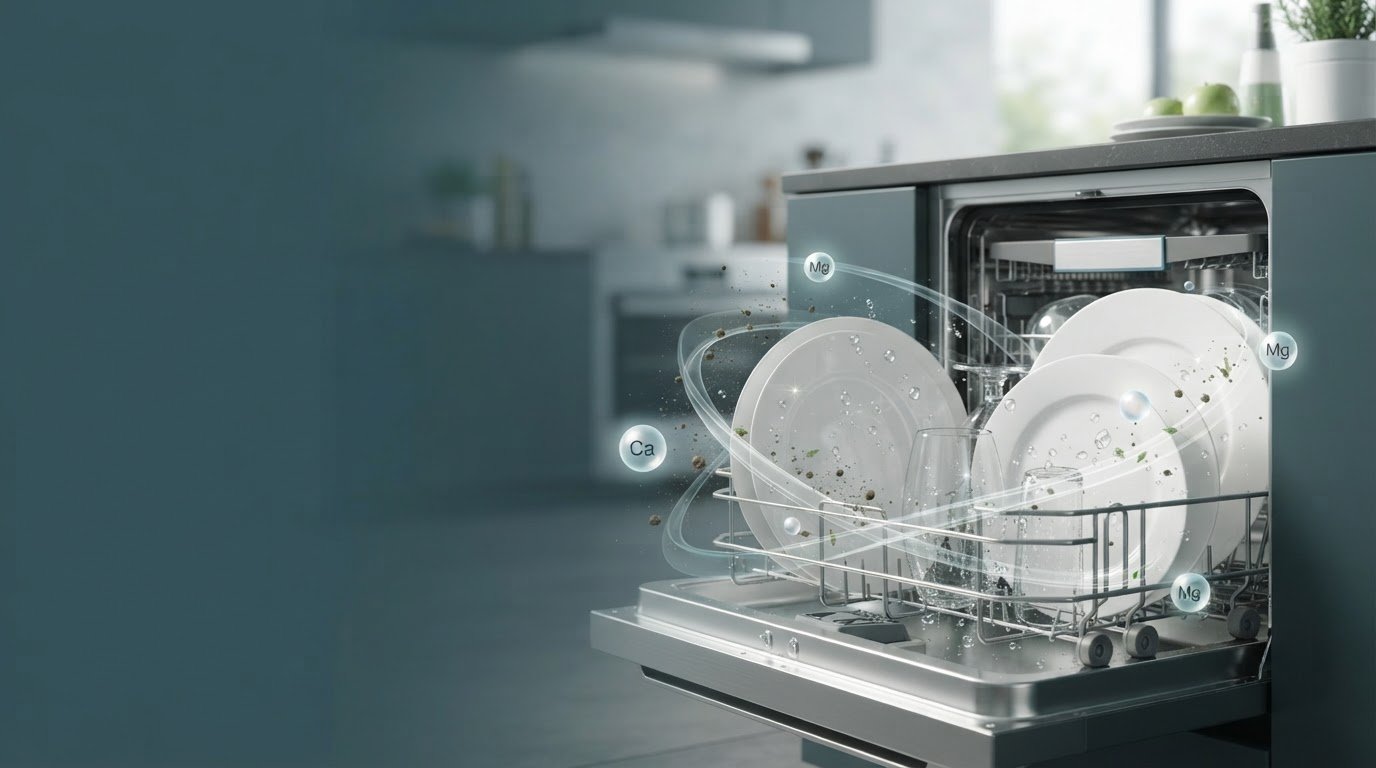
A homo-polymer for automatic dishwashing can help keep loosened soil dispersed and limit its redeposition on dishes. Acrylic acid homopolymers can also act as co-builders, helping complex calcium and magnesium hardness ions. In one described detergent composition, a dispersant polymer blend containing acrylic acid homopolymer makes up 0.5 to 15 wt% of the formula.
Clean dishes depend on more than removing food during a wash: soil and water hardness also affect detergent performance. This guide explains how a homo-polymer for automatic dishwashing can act as a dispersant and co-builder, how it supports detergent formulations, and how it differs from other polymer types. It also shows how polymers work alongside builders and other ingredients, helping formulators assess their role.
Key Takeaways
- Assess a polymer by how it keeps loosened soil dispersed alongside the detergent’s builder system.
- Understand how limiting soil redeposition can help protect dish surfaces during the wash cycle.
- Consider the full pre-wash, main-wash, and rinse sequence when evaluating a polymer’s role in automatic dishwashing.
- Compare polymer type and molecular weight with the formulation’s other ingredients to understand how each component contributes.
Polymer roles as soil dispersants and co-builders
A homopolymer is made from one type of monomer, or repeating building block. Acrylic acid homopolymer contains repeating acrylic acid units with carboxylic acid groups. Under detergent conditions, these groups can interact with calcium and magnesium ions and help keep loosened soil dispersed. A soil dispersant helps suspended particles stay apart instead of gathering on dish surfaces. A co-builder supports the main builder by helping manage hardness ions. Polyethylene also consists of repeating units, but it is not an acrylic acid homopolymer: its structure lacks the same carboxylic acid groups.
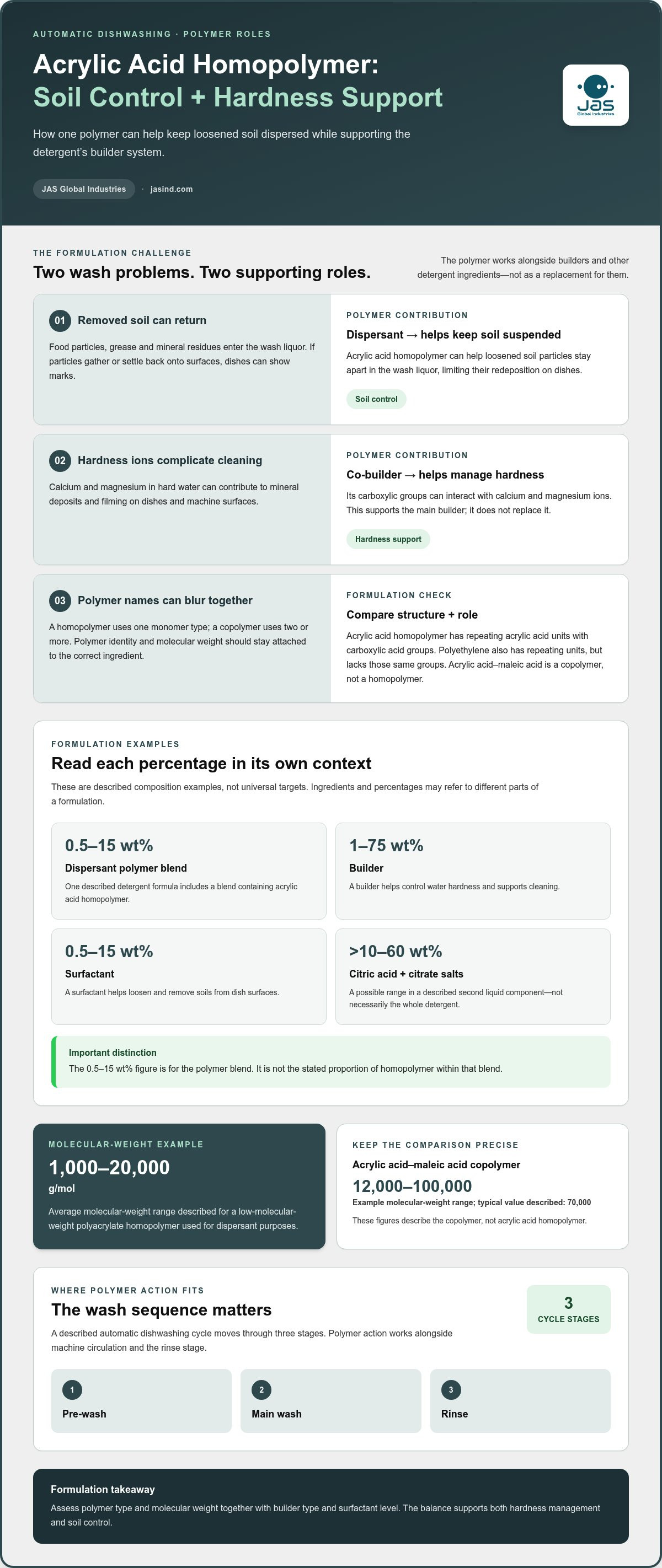
What dosage of polymer is typical in automatic dishwasher detergent formulations? One described composition contains 0.5 to 15 wt% of a dispersant polymer blend that includes acrylic acid homopolymer. This is a formulation example, not a universal dose. The required level depends on the polymer system and the detergent’s other ingredients. For analysis, distinguish the proportion of the whole polymer blend from the proportion of homopolymer within that blend.
A builder is an ingredient that helps control water hardness and supports cleaning. One described composition contains 1 to 75 wt% builder, while its surfactant proportion is 0.5 to 15 wt%. A surfactant helps loosen and remove soils from dish surfaces. Citric acid and citrate salts can serve as builders; in a described second liquid component, they make up more than 10 wt%, with a possible range above 10 wt% to 60 wt%. These proportions belong to that specific component, not necessarily the entire detergent.
How do homopolymers prevent scale and filming in dishwashers? Their carboxylate groups can help complex calcium and magnesium ions, while dispersant action helps keep soil particles suspended. That combination can reduce mineral deposits and soil redeposition on dishes and machine surfaces. It complements, rather than replaces, a builder such as citrate. In formulation analysis, compare polymer molecular weight, builder type, and surfactant level together. A low-molecular-weight polyacrylate homopolymer is described for dispersant use at an average molecular weight of 1,000 to 20,000 g/mol. The right balance supports both hardness management and soil control.
Anti-redeposition
Anti-redeposition means preventing removed soil from settling back onto dishes during washing. In an automatic dishwasher, food particles, grease, and mineral residues enter the wash liquor as cleaning proceeds. A dispersant polymer helps keep suspended soil from clumping or attaching again to glass, ceramic, and other surfaces. Soil removed from one dish can still leave visible marks elsewhere if it redeposits.
A liquid detergent is supplied in pourable form. A copolymer is made from two or more types of monomer. Formulators can combine polymer technologies to manage different soil and hardness conditions. One described phosphate-free dishwashing agent includes an acrylic acid homopolymer and at least one builder. Phosphate is a chemical form used in some builder systems, while this example is explicitly phosphate-free. The homopolymer and builder are separate formulation components, not interchangeable ingredients.
A sulfonic acid is an acid containing a sulfonic functional group. Sulfonic-acid-containing polymers and carboxylate polymers have distinct structures, so their contribution depends on the complete detergent composition. A copolymer of acrylic acid and maleic acid is one comparison: its example molecular-weight range is 12,000-100,000, with a typical molecular weight of 70,000. Those values describe the copolymer, not an acrylic acid homopolymer. In formulation analysis, keep polymer identity and molecular weight attached to the correct ingredient.
Test conditions also matter. A reported multicycle automatic-dishwashing test used a normal wash program at 50 °C and hard water of 20 US gpg. Its comparative composition recorded 97 spots and 210 grit. These are comparative-test readings, not a universal performance prediction or proof that one polymer alone caused the result. They show why formulation assessment should consider spotting and grit alongside soil suspension, water hardness, and the wash sequence.
For formulations where limiting soil return is a priority, anti-redeposition agents are a relevant ingredient category to consider alongside polymer selection.
Automatic dishwashing use
Automatic dishwashing is machine-based cleaning that circulates detergent through a programmed wash cycle. A homopolymer contains repeating units derived from one monomer, while a copolymer contains units from different monomers. Acrylic acid homopolymer is one example used in dishwashing detergent. Its molecular structure helps explain its role, but formulation performance also depends on the wash stages and companion ingredients.
How does a homopolymer compare with a copolymer in automatic dishwashing? A homopolymer uses one type of monomer, while a copolymer combines different types, such as acrylic acid and maleic acid. Both can serve as dispersant polymers, but their structures can influence how they interact with soil and hardness ions. Choose based on the formulation’s cleaning needs, not simply the polymer label.
A described automatic dishwashing cycle has three steps: pre-wash, main wash, and rinse. The detergent composition is applied to an article inside the machine. During cleaning, a polymer can help keep loosened particles dispersed in the wash liquor, reducing the chance they settle on dishes before rinsing. A homopolymer-containing formulation combines polymer action with the machine’s circulation and rinse stages.
Environmental assessment should distinguish wastewater removal from biodegradation. Estimated removal during wastewater treatment is 25% for acrylic acid homopolymer and 89% for acrylic acid-maleic acid copolymer. Those removal estimates alone don’t establish how much polymer biodegrades. For acrylic acid homopolymer, predicted river-water concentrations are 0.07 mg/L at 90th-percentile mean flow and 0.57 mg/L at 90th-percentile low flow. Its predicted no-effect concentration is 1.2 mg/L. These figures help frame environmental exposure; they are not a direct measure of persistence or breakdown.
When assessing a formulation, compare the polymer’s identity with its intended cleaning function and wastewater-treatment profile. A carbon-based organic compound’s structure matters, but environmental evaluation and performance also depend on treatment conditions and receiving-water flow. Assess homopolymer and copolymer data separately; measurements for one polymer do not establish the properties of another. This keeps ingredient selection relevant to the material and its intended use.
Dishwashing detergent formulation ingredients
A detergent formula is the complete recipe of active materials and supporting ingredients. A patent describes dispersant polymer use from 0.1% to 30% by weight of the detergent composition. Another described composition contains a dispersant polymer blend at 0.5 to 15 wt%. These are examples from separate formulations, not a universal dose or safety limit. The selected polymer and proportion must fit the rest of the formula.
A homopolymer is made from one type of monomer; a copolymer contains different monomer types. Acrylic acid homopolymer examples span molecular weights of 1,000-78,000, with a typical value of 4,500. For low-molecular-weight polyacrylate dispersants, a particularly preferred average range is 2,000 to 10,000 g/mol. Polyitaconate homopolymers are also described as suitable polycarboxylate polymers, with a separate polymer example ranging from 60,000 to 1,500,000 daltons.
Are homopolymers in dishwasher detergents regulated or subject to safety limits in the United States? A patent’s composition ranges describe claimed formulations; they do not establish a U.S. safety limit. Formulation decisions must account for applicable requirements and intended product use.
Ethylene is a simple chemical building block used in polymers such as polyethylene. Sulfonic and hydroxy describe functional groups that can occur in other detergent ingredients; their presence alone doesn’t determine compatibility with an acrylic homopolymer. A described multi-component detergent places bleach in a first liquid component and builder in a second. An optional fourth component may contain more than 0.1 wt% protease and/or amylase, measured on an active enzyme basis. This architecture shows why ingredient placement matters, but doesn’t establish universal compatibility. Enzyme activity, bleach stability, and polymer performance must be assessed in the complete formula.
For a formulation review, compare polymer identity, molecular weight, concentration, and the placement of bleach or enzymes. Discuss detergent polymer formulation to explore how home care polymer ingredients fit your formulation needs.
One automatic dishwashing composition describes a polymer molecular weight from 60, 000 to 1,500, 000 daltons and specifies n from 2-6. In the patented dishwashing agent, the copolymer-to-homopolymer weight ratio is between 10:1 and 1:3. The optional third liquid component is preferably anhydrous; the claimed composition may contain 0 to 75 wt% of an additive.
JAS Global Industries: Fertilizer Anti-caking Agents
JAS Global Industries offers Fertilizer Anti-caking Agents for fertilizer manufacturers addressing caking during material handling and storage. These agents serve a different formulation need from dishwashing polymers, so they are relevant when your work involves fertilizer processing rather than automatic dishwashing detergent development.
Caking control and dust management are distinct needs in fertilizer operations. JAS Global Industries also offers Fertilizer Dust Suppressants. For mining applications, its offerings include Mining Flotation Collectors and Mining Grinding Aids. These specialty chemical categories serve fertilizer and mining processes, not dishwasher detergent formulations.
If your formulation challenge involves fertilizer caking or dust, contact JAS Global Industries to discuss the relevant chemical solution.
Turn formulation priorities into your next step
Guide your next decision by identifying the performance issue, process conditions, and ingredient role required. Selecting a homo-polymer for automatic dishwashing is a focused detergent-formulation decision. JAS Global Industries serves other process needs with specialty chemicals, including Fertilizer Anti-caking Agents and Fertilizer Dust Suppressants for fertilizer operations, and Mining Flotation Collectors for mining applications.
These are distinct applications, not substitutes for dishwasher detergent ingredients. If your work extends to fertilizer handling or mineral processing, match the operational challenge to the relevant chemical category and discuss the process context directly. This keeps the conversation focused on the need at hand, whether caking, dust, or flotation.
Contact JAS Global Industries to discuss a specialty chemical need for fertilizer or mining operations. A clear description of your process challenge is a practical starting point for the conversation.
Frequently Asked Questions
What is a homopolymer in automatic dishwashing detergent?
A homopolymer is formed from one type of monomer; acrylic acid homopolymer is one example used in detergent formulations. The phrase “homo-polymer for automatic dishwashing” describes an ingredient category, not a complete detergent recipe. When reviewing a formulation, distinguish the polymer’s chemical identity from its concentration, molecular weight, and the other ingredients that determine its role.
What does polyacrylic acid homopolymer do in dishwasher detergent?
Polyacrylic acid homopolymer helps manage suspended soil and mineral ions in the wash liquor. When assessing a homo-polymer for automatic dishwashing, consider its contribution alongside the machine’s wash conditions and the detergent’s other ingredients. This helps formulators judge whether the polymer suits a particular cleaning objective, rather than treating it as a stand-alone solution.