
Fatty Acid based Flotation Collectors work by attaching to mineral surfaces, but their performance depends on more than collector choice. For phosphate minerals, adsorption is fastest at pH 8.5-10.5, where deprotonated carboxylate species dominate. Conditioning, temperature, and frothing behavior also shape how effectively the collector supports separation.
This chemistry helps explain why a collector that performs well with one ore or circuit may behave differently in another. Mineral assemblage, pulp conditions, and water chemistry all influence the result, so understanding these mechanisms is essential for interpreting flotation performance.
This article explains how fatty acid collector chemistry relates to calcium phosphate flotation, why conditioning time and temperature matter, and how froth behavior affects the process. It also explores tall oil fatty acid collectors in spodumene flotation, including how collector composition and operating conditions influence results. Together, these factors offer a practical framework for understanding the role of fatty acid collectors in non-sulphide mineral processing.
Key Takeaways
- Assess conditioning as a set of interacting controls: pulp density, agitation, pH response, and time can all influence collector dispersion and mineral response.
- Separate collector action from froth behavior; changes in gas-volume response can affect how flotation results should be interpreted.
- For phosphate feeds, account for carbonate minerals when considering collector dosage, since stronger collection can come at the expense of selectivity.
- When evaluating tall oil collectors for spodumene, consider fatty acid composition and rosin content alongside operating conditions.
- Use test conditions as a starting point for understanding a circuit, not as a universal recipe; ore characteristics and slimes can change conditioning needs.
Collector conditioning temperature and time
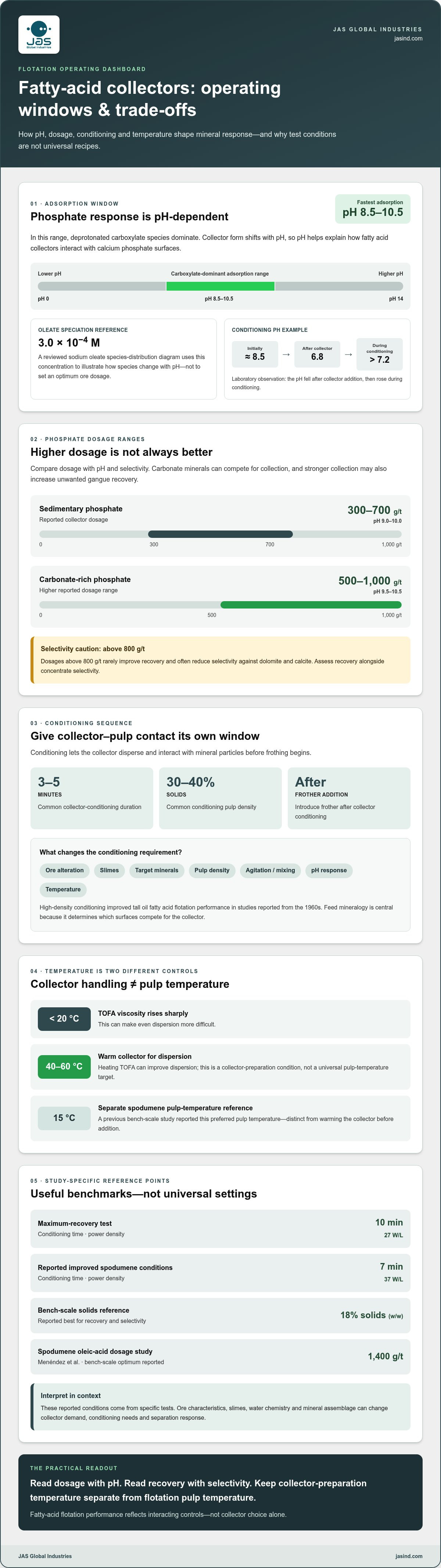
Conditioning gives fatty acid collectors time to disperse through the pulp and interact with mineral particles before frothing begins. The useful duration depends on ore alteration, slimes, and the minerals targeted for separation, so a test result from one feed is not a universal setting. High-density conditioning improved tall oil fatty acid flotation performance in studies reported from the 1960s. That history makes pulp density and mixing conditions important alongside time and temperature.
pH changes can reveal how the collector behaves during conditioning. In laboratory observations of high-density fatty acid conditioning, pulp pH fell from approximately 8.5 to 6.8 after collector addition, then rose above 7.2 during conditioning. This shift matters because pH affects fatty acid speciation. For phosphate minerals, adsorption is fastest at pH 8.5-10.5, where deprotonated carboxylate species dominate. The initial pH alone therefore doesn't describe the full conditioning environment; the change after addition also matters.
Temperature can affect whether a tall oil fatty acid collector disperses evenly. TOFA viscosity rises sharply below 20 °C, and heating the collector to 40-60 °C can improve dispersion. This is a preparation consideration, not a universal pulp-temperature target. A previous bench-scale spodumene flotation study reported a preferred pulp temperature of 15 °C, illustrating that collector handling temperature and flotation pulp temperature are distinct variables. Keep those two conditions separate when interpreting results.
For a common conditioning sequence, fatty acid collectors are conditioned for 3-5 minutes at 30-40% solids before frother addition. The order matters: collector-pulp contact occurs during conditioning, while frother is introduced afterward. Other tests use different combinations. One maximum-recovery test used 10 min of conditioning and 27 W/L power density; reported improved spodumene conditions used 7 minutes and 37 W/L. A previous bench-scale study found 18% solids (w/w) best for recovery and selectivity. These are specific test conditions, not interchangeable prescriptions.
What affects dosage, pH, and flotation performance? Mineral type, ore alteration, slimes, pulp density, temperature, conditioning time, and mixing intensity all affect collector demand and separation. Feed mineralogy is the main consideration because it determines which surfaces compete for the collector and how selectively they respond.
How are collectors prepared, emulsified, and added? Where TOFA viscosity limits dispersion, warming it to 40-60 °C can help; it is then dispersed into the pulp during conditioning. Maintain collector conditioning for 3-5 minutes at 30-40% solids before adding frother, while matching mixing and pH to the test conditions.
Fatty acid collector chemistry and adsorption on calcium phosphate
Fatty acid collectors contain a water-attracting carboxyl group and a water-repelling hydrocarbon chain. In flotation, this structure helps the collector interact with mineral surfaces while supporting particle attachment to air bubbles. For calcium phosphate, the collector’s chemical form matters: pH shifts the balance between protonated fatty acid and deprotonated carboxylate species. Adsorption is fastest at pH 8.5-10.5, where carboxylate species dominate.
Sodium oleate provides a useful example of how concentration and pH relate to collector speciation. A reviewed oleic acid species-distribution diagram uses a concentration of 3.0 × 10⁻⁴ M. Such a diagram helps explain which species may be present in solution as pH changes. It does not, by itself, establish the best operating dosage for a particular ore. Calcium phosphate feed composition, competing minerals, and water chemistry also influence how collector interacts with available surfaces.
Dosage should be interpreted alongside selectivity, not recovery alone. Fatty acid collectors for sedimentary phosphate are used at 300-700 g/t of feed at pH 9.0-10.0. Carbonate-rich phosphate uses 500-1,000 g/t of feed at pH 9.5-10.5. However, dosages above 800 g/t rarely improve recovery and often reduce selectivity against dolomite and calcite. This trade-off matters where calcium-bearing gangue minerals share chemical characteristics with the phosphate target.
Oleate chemistry also provides context for spodumene flotation, but mineral response differs with feed and test conditions. Menéndez et al. reported an optimum oleic acid collector dosage of 1400 g/t in bench-scale spodumene flotation. That result is a study-specific reference, not a direct dosage prescription for every spodumene sample. Surface condition, particle size, water chemistry, and conditioning can affect how much collector reaches the mineral and how selectively it adsorbs.
Adsorption is best understood as an interaction among collector species, pH, mineral surfaces, and competing particles. For calcium phosphate, compare dosage and pH together, then assess whether carbonate gangue reports to the concentrate with the phosphate. For spodumene, evaluate collector dosage against both lithium recovery and concentrate grade. The goal is to achieve sufficient surface coverage for flotation without excessive collection of unwanted minerals.
What are the environmental, health, and handling risks? Risks depend on the formulation, concentration, and exposure route. Follow the reagent’s safety data sheet and site controls for storage, transfer, spill containment, and disposal, and prevent uncontrolled release into water.
Frothing behavior of fatty acid collectors
Froth flotation separates valuable mineral particles from gangue by attaching selected particles to air bubbles. Collector adsorption helps form this attachment, while froth behavior affects which particles reach the concentrate. These functions interact, but they are not the same: a collector can influence bubble-particle attachment without being the circuit’s only control over froth structure or transport.
Sodium oleate tests show how frothing can be examined across solution conditions. Measurements recorded total gas volume over time for 20 mg/L and 70 mg/L sodium oleate solutions, each tested from pH 5 to 10. The comparison varies concentration and pH while tracking gas volume. It offers a way to assess frothing response, but the listed test conditions alone don’t establish which solution produced more persistent froth.
This distinction matters in ore beneficiation. Froth that carries mineral particles can also carry gangue attached to bubbles. Stronger froth transport may therefore increase mass pull without improving selectivity. Assess froth observations alongside concentrate grade and recovery, rather than treating gas volume as a direct measure of separation quality. For example, compare the froth response with the mineral content of collected concentrates across the same pH range.
Collector selectivity depends on adsorption and the relative response of valuable mineral and gangue surfaces. Frothing properties add another layer: bubble attachment, particle loading, and froth drainage influence what leaves the cell. Tall oil fatty acids are used as primary collectors in industrial spodumene flotation and typically contain more than 95% oleic and linoleic acid. That composition describes the collector, but froth performance still needs assessment within the ore and circuit conditions.
Laboratory froth flotation kits are useful as test arrangements, not as proof that a reagent will suit a plant circuit. A controlled comparison should keep the sample preparation and operating conditions consistent, then record froth appearance, collected mass, recovery, and concentrate grade. Sodium oleate tests at 20 mg/L and 70 mg/L illustrate why collector concentration belongs in the test record. Changes in froth can otherwise be wrongly attributed to pH or mineral properties.
How do fatty acid collectors compare with amine and other flotation collectors? Fatty acids and amines are distinct collector classes, and their suitability depends on the mineral surfaces and separation target. Fatty acid collectors, for example, are used in spodumene flotation, while amine collectors are used in potash flotation. Outcomes depend on the full reagent scheme and feed conditions.
Spodumene flotation using tall oil fatty acid collectors
Tall oil fatty acid collectors support spodumene beneficiation, while fatty acids also float phosphate minerals. Their performance depends on collector composition, ore characteristics, and circuit conditions, so grade and recovery must be considered together.
Testing Collectors on Spodumene Ores
Testing collectors on spodumene ores means evaluating their response on a representative mineral sample. Real-ore tests matter because gangue, surface condition, and particle size can change the balance between lithium recovery and concentrate grade. One experimental ore was ground to a P80 of 170 µm before flotation. That preparation provides context for interpreting its results, rather than treating dosage as an isolated variable.
Industrial practice gives useful context. Tall oil fatty acids used as primary collectors typically contain more than 95% oleic and linoleic acid. The King’s Mountain and Greenbushes operations discussed operated at approximately pH 7.0-7.5, while more recent spodumene testwork is commonly performed at approximately pH 8.0-8.5. These conditions show that operating pH can differ across established practice and newer testwork.
Collector composition can influence selectivity as well as flotation response. Tall oil fatty acid collectors with more than 1% rosin impurities reduced spodumene flotation selectivity. Test comparisons should therefore account for composition, addition conditions, and the ore’s mineral associations. Without those controls, changes in concentrate grade or recovery may reflect differences in feed or collector quality, not simply a change in dosage.
Bench-scale results also show why recovery and grade need separate attention. One test achieved a maximum lithium recovery of 90.7% with a concentrate grade of 4.8% Li2O, using a collector dosage of 800 g/t. In another reported test series, rougher concentrate grade improved from 4.9 to 5.3% Li2O while lithium recovery remained at 97%. These examples describe specific tests, not universal plant targets.
Minerals Floated with Fatty Acids
Fatty acid collectors are used to float non-sulphide minerals, including spodumene and phosphate minerals. However, shared collector chemistry does not mean the operating conditions are identical. Calcium phosphate separation depends on mineral surface response, while spodumene testwork tracks lithium recovery and concentrate grade. The target mineral and associated gangue determine how to assess selectivity.
For spodumene, the practical objective is to recover lithium-bearing particles while limiting unwanted minerals in the concentrate. A higher recovery can accompany a lower grade, as the 90.7% recovery and 4.8% Li2O result illustrates. Compare both measures across each test, and interpret increased recovery alongside concentrate quality and collector composition.
Fatty-acid-based flotation collectors
Fatty acid collectors are a family of anionic reagents, not a single standardized product. Their composition, chemical form, and dispersion behavior shape their performance in mineral processing.
Fatty Acid Collector Types
Collector types include oleic acid, sodium oleate, tall oil fatty acids, and oxidized fatty acid products. This distinction matters because formulation influences handling and interaction with mineral surfaces. Tall oil fatty acids typically contain more than 95% oleic and linoleic acid in industrial spodumene flotation. Sodium oleate, by contrast, is a defined fatty acid salt used in speciation and frothing studies.
Oxidation and blending create further formulation differences. Patent descriptions cover oxidized fatty acid products with viscosity ranges of about 1000 to about 6000 cPs at 25 C, alongside narrower product ranges. These values describe specific product compositions, not universal flotation specifications. Increased acid functionality can also increase composition viscosity, affecting how easily a reagent disperses during preparation and addition.
Commercial Collector Products
Commercial collector products include fatty acid blends and modified formulations designed for mineral processing. For example, fuel oil is blended at 20-30% with tall oil fatty acid to improve interfacial tension and bubble-particle attachment. Brazilian igneous phosphate circuits use a TOFA and ether amine blend at a 1:1 mass ratio, with a combined dosage of 400-600 g/t.
These examples show why a trade description alone may not capture collector behavior. The fatty acid source, oxidation, blend components, viscosity, temperature, and water chemistry all affect dispersion and adsorption. In hard recycled water, calcium soaps formed from residual fatty acid collectors can reduce effective collector concentration by 10-30%. Water quality is therefore part of reagent performance, not a separate operating detail.
Product selection also involves balancing collection and frothing. Sodium oleate frothing tests measured total gas volume over time at 20 mg/L and 70 mg/L, across pH 5 to 10. Such measurements help distinguish frothing response from mineral recovery. A collector’s ability to support bubble attachment does not alone establish selectivity or concentrate quality; those outcomes depend on the ore and circuit conditions.
For practical comparison, classify each candidate by fatty acid source, modification, blend, and physical handling properties. Then interpret results against the target mineral and gangue response. That approach makes a tall oil product, sodium oleate, and an oxidized formulation easier to compare without treating them as interchangeable. Discuss flotation collector formulation needs when aligning reagent chemistry with processing objectives.
The patent describes oxidized fatty acid products with a viscosity range of about 1300 to about 5000 cPs at 25 C. It also describes oxidized fatty acid products with a viscosity range of about 3000 to about 4000 cPs at 25 C. Keeping these reported ranges distinct helps avoid treating them as interchangeable descriptions of one formulation. They provide specific viscosity information for oxidized products, while the broader collector category includes different compositions and chemical forms.
The study describes conditioning as essential when fatty acid collectors are used to float non-sulphide minerals. Include conditioning in the assessment of collector use, alongside the product’s stated composition and physical handling properties. Consider these details together when comparing candidates, rather than relying on a fatty-acid label alone. This keeps both product descriptions and flotation procedures in view, without treating a reported viscosity range as a universal specification.
JAS Global Industries: Fertilizer Anti-caking Agents
JAS Global Industries offers specialty chemical solutions for flotation, including Mining Flotation Collectors for mineral separation. Consider this offering when collector chemistry, ore characteristics, and circuit conditions need to be evaluated together. For operations managing fertilizer material handling, Fertilizer Anti-caking Agents address caking concerns, while Fertilizer Dust Suppressants help manage dust.
These are distinct process requirements, but both depend on selecting chemistry suited to the material and its handling conditions. In flotation, the focus is collector performance within the circuit; in fertilizer handling, it is the condition of the finished material. JAS Global Industries also offers Mining Grinding Aids for grinding-stage needs.
Contact JAS Global Industries or visit jasind.com to discuss your processing requirements.
Put Collector Chemistry to Work
The next step is to align reagent selection with your circuit’s operating priorities. Identify the outcome that matters most, then assess how collector behavior, ore characteristics, and process conditions support it. This keeps testing focused on a practical operational decision rather than a single reagent property.
Fatty acid-based flotation collectors can support mineral separation when their chemistry suits the feed and circuit. Turning that understanding into a practical reagent strategy requires a clear view of process needs and performance goals. JAS Global Industries provides specialty chemical solutions for industrial operations, including mining applications.
To discuss your flotation requirements, contact JAS Global Industries. A focused conversation can help define the next steps for your operation. Take a process-led approach and build on the chemistry that best supports your resource objectives.
Frequently Asked Questions
What are fatty acid-based flotation collectors and how do they work?
Fatty acid-based flotation collectors help selected mineral particles attach to air bubbles and separate from gangue. Their carboxyl groups interact with mineral surfaces, while their hydrocarbon chains support attachment to bubbles. Sodium oleate, for example, is a fatty acid salt used in flotation studies. Its effect depends on the mineral being recovered and the surrounding pulp conditions, so assess performance using both concentrate grade and recovery.
What is the typical dosage range for fatty acid flotation collectors?
Dosage depends on the ore and target separation. Fatty acid collectors for sedimentary phosphate are used at 300-700 g/t of feed, while carbonate-rich phosphate uses 500-1,000 g/t of feed. For carbonate-rich feeds, higher dosage can collect unwanted dolomite and calcite as well as phosphate. Compare dosage with both recovery and concentrate selectivity, rather than assuming that adding more collector will improve performance.
What are common problems with fatty acid collectors, such as poor selectivity or hard-water sensitivity?
Two common challenges are reduced selectivity and lower effective collector concentration in hard recycled water. Fatty acid collector dosages above 800 g/t rarely improve recovery and often reduce selectivity against dolomite and calcite. Calcium soaps formed from residual collectors in hard recycled water can reduce effective collector concentration by 10-30%. Track water quality and gangue recovery alongside reagent addition to distinguish these effects during circuit evaluation.
What are the environmental, health, and handling risks of fatty acid flotation reagents?
Risks depend on the formulation, concentration, and exposure route. Follow the reagent’s safety data sheet and site controls for storage, transfer, spill containment, and disposal, and prevent uncontrolled release into water.