

The fastest foam knockdown is not always the best fit for a coating. Trapped air can disrupt application and leave craters, pinholes, or an uneven finish. Effective defoamer selection for water-based coatings depends on matching the chemistry to the resin and the process introducing the air. Polyether defoamers can offer broad compatibility and a lower tendency to cause defects, though they generally break foam more slowly than silicone defoamers.
That trade-off matters: a coating needs foam control without sacrificing surface quality, gloss, or compatibility with other additives. The right choice depends on whether foam develops during pigment dispersion, mixing, transfer, or application, as well as the resin system’s requirements.
This guide explains why water-based coatings foam, how silicone, mineral-oil, and polyether chemistries differ, and how resin type and application process shape selection. It also explains why polyether defoamers can be useful when compatibility and finish quality are priorities, and what to weigh when balancing foam break, persistence, and appearance.
Key Takeaways
- Match defoamer chemistry to the coating’s resin and finish requirements; strong foam knockdown can come with compatibility or surface-quality trade-offs.
- Account for where air enters the process, from pigment dispersion and mixing to transfer and application, when deciding how foam control should work.
- Surfactants can stabilize bubbles in water-based coatings, so the source and persistence of foam matter as much as how quickly it forms.
- Mineral-oil defoamers can suit some high-pigment systems, while fine microfoam and high-gloss finishes may call for a different balance.
- Consider polyether defoamers when compatibility and finish quality are priorities, while weighing their slower foam-breaking action against process needs.
What are the differences between defoamers for water-based and oil-based coatings?
Water-based and oil-based coatings need defoamers suited to their different liquid phases and formulation requirements. In waterborne coatings, silicone, mineral-oil, and polyether options each balance foam control against compatibility and finish quality.
Silicone Defoamer Mechanisms
Silicone defoamers use polydimethylsiloxane (PDMS), sometimes combined with hydrophobic silica, to destabilize foam films. In PDMS-silica antifoams, hydrophobic silica helps droplets enter and disrupt foam; adding roughly 4 wt% hydrophobized silica can sharply lower the droplet’s entry barrier and increase activity.
Hydrophobic silica used in waterborne-coating defoamers has specific surface areas from 50 to 400 m²/g. Droplet size also matters: 2-10 μm droplets are identified as effective, while droplets smaller than 1 μm have little defoaming effect. These formulation details help explain why silicone performance depends on more than the active ingredient alone.
Silicone Use and Incompatibility
Silicone defoamers can suppress foam efficiently in water-based coatings, but poor compatibility can create film defects. Silicone antifoam emulsions are pre-dispersed in water as controlled droplets, and silicone actives can be effective at 30-300 ppm. Correct dispersion helps the droplets act on foam instead of disrupting the coating surface.
At 500 ppm, silicone defoamers can reduce gloss when compatibility isn’t properly controlled. An unsuitable formulation can also contribute to seeding, cratering, color-development or color-acceptance issues, and flocculation. During selection, weigh foam suppression against the required appearance and the resin’s tolerance for silicone. Incorporate the defoamer with sufficient mixing energy; poor distribution can leave concentrated droplets that cause craters.
Comparing Defoamer Types
For water-based coatings, silicone often offers strong foam suppression, mineral oil handles macrofoam, and polyether provides compatibility with a lower tendency to cause defects. Polyether defoamers generally break foam more slowly than silicone, while mineral oil is less effective on fine entrained microfoam. The best balance depends on the coating’s finish and foam-control needs.
Non-silicone options, including mineral oils, polyethers, and specialty polymer systems, can suit formulations where silicone-related surface defects are a concern. High-pigment waterborne coatings may tolerate mineral oil well, while high-gloss coatings often need finer microfoam control. Oil-based coatings use defoamers suited to organic-solvent systems, where solvent resistance and compatibility are key considerations.
For coating defoamers, price depends on the formulation, chemistry, active content, compatibility requirements, and order scope, and is provided after a quote request. A supplier can help align these factors with the coating system and its performance requirements.
Choosing by coating type, resin system, and application process
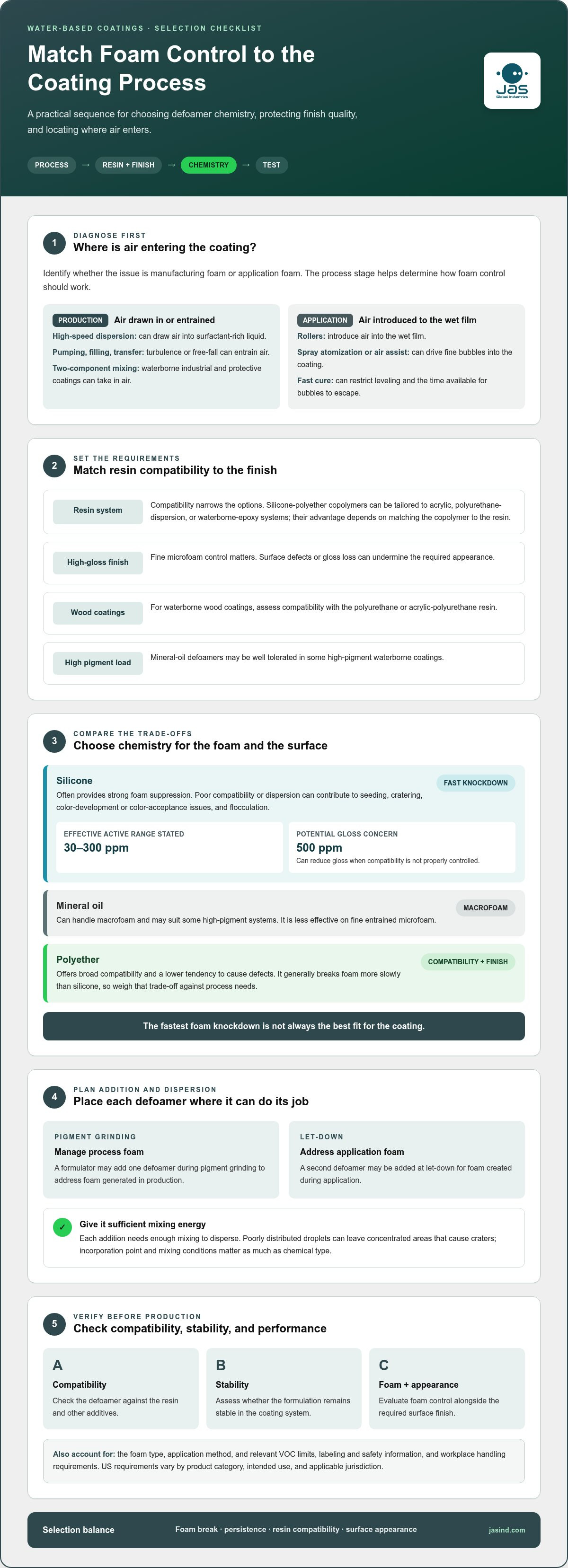
Choose a defoamer based on the foam’s source, the resin, and the finish requirement. An acrylic wall paint, a waterborne wood coating, and a two-component protective coating each place different demands on foam control.
Air enters at several points. High-speed dispersion can draw air into surfactant-rich liquid, while pumping, filling, and transfer can entrain it through turbulence or free-fall. During application, rollers introduce air into the wet film, while spray atomization or air assist can drive fine bubbles into the coating. Identifying the process stage helps distinguish manufacturing foam from application foam.
That distinction can guide where the defoamer enters the formulation. A formulator may add one defoamer during pigment grinding to manage process foam, then another at let-down for application foam. Each addition needs enough mixing energy to disperse it. Poorly distributed droplets can produce craters, so the incorporation point and mixing conditions matter as much as the chemical type.
Resin compatibility narrows the options. Silicone-polyether copolymers can be tailored to acrylic, polyurethane-dispersion, or waterborne-epoxy systems, but their advantage depends on matching the copolymer to the resin. For waterborne wood coatings, assess compatibility with the polyurethane or acrylic-polyurethane resin. High-gloss coatings need fine microfoam control, while surface defects or gloss loss can undermine the finish.
Application conditions change the balance. A roller-applied coating may need control of air released into the wet film; a sprayed coating may need control of fine bubbles created during atomization. Waterborne industrial and protective coatings can also take in air during two-component mixing, while fast cure times restrict leveling. Foam control in these systems must account for both mixing and the limited time available for bubbles to escape.
For US coatings, VOC, regulatory, and safety requirements vary by product category, intended use, and applicable jurisdiction. Formulators should evaluate the defoamer’s chemistry against relevant VOC limits, labeling and safety information, and workplace handling requirements, alongside its performance in the coating.
A technical selection should account for resin, application method, foam type, other additives, and required appearance. Small-scale testing can reveal compatibility, stability, and foam-control performance before production. For example, compare the coating after dispersion and application, noting whether bubbles persist or surface defects appear.
When those variables point toward a coating-specific solution, a focused review of coating foam-control considerations can help connect formulation needs with process conditions.
Foam formation in surfactant-containing coating systems
Water is the dispersion medium in water-based coatings, and surfactants help keep pigment particles distributed. They also stabilize the surface around entrained air, allowing bubbles to persist instead of merging and escaping. A coating can therefore retain foam after mixing stops, especially when its ingredients create a resilient liquid film around each bubble.
The formulation determines how difficult foam is to release. Surfactants, polymers, and other surface-active ingredients can strengthen bubble films, while pigment loading changes the liquid’s structure and behavior. High-pigment-volume-concentration (PVC) primers and masonry paints, for example, generally tolerate mineral-oil defoamers well. A lower-PVC, high-gloss coating has different finish demands and may need finer microfoam control.
Polyether defoamers offer a distinct balance in water-based systems. They are described as compatible with most waterborne coatings, with low defect tendency and longer persistence, but they break foam more slowly than silicone. Glycol and polyglycol types do not reduce gloss and can be compatible with resins, although they are less persistent than oil-based defoamers. That trade-off matters when bubbles form steadily during processing rather than in a brief burst.
The production stage also shapes the choice. During pigment dispersion, the defoamer must withstand the mixing conditions and control foam generated as pigment and liquid are worked together. At let-down, the formulation is closer to its final composition, so the priority may shift to application foam and surface appearance. Waterborne coating defoamers are commonly added at both stages, with chemistry selected for each stage’s distinct demands.
Dosage is formulation-dependent: water-based coating defoamers typically run at 0.05-0.8% of the total formula, and commonly at 0.1-0.5%. Those ranges frame testing, not a universal recipe. A dose that works in a mineral-rich primer may not perform the same way in a glossy acrylic coating, because resin, pigment, surfactant load, and other additives all affect foam stability and compatibility.
Assess the finished film as well as the mixing vessel. Persistent bubbles in a high-PVC primer point to a different control need than fine foam visible in a glossy film. Compare foam release, surface quality, and compatibility after each addition stage. This system-based approach helps match mineral-oil or polyether chemistry to the coating’s pigment level, resin, and production demands, rather than choosing by foam collapse alone.
Mineral-oil defoamers
Mineral-oil defoamers are oil-based additives used in waterborne coatings to destabilize bubbles, especially macrofoam. They are often broadly compatible with latex and can provide persistent foam control. Their main limitation is fine entrained microfoam, which they release less effectively than silicone or silicone-free polymer defoamers. That distinction helps determine whether mineral oil suits the defect seen in the coating.
High-pigment-volume-concentration (PVC) primers and masonry paints are common candidates because these systems generally tolerate mineral-oil defoamers well. A formulator addressing visible foam during pigment dispersion may value their macrofoam control and broad latex compatibility. A high-gloss finish presents a different challenge: fine bubbles can remain, and mineral oil may affect gloss. Judge the result by the dried film’s appearance as well as foam collapse in the vessel.
Production stage matters, too. A mineral-oil defoamer added during pigment dispersion addresses foam generated during grinding; addition at let-down can target foam associated with final blending or application. Some formulations split additions between both stages. In either case, poor distribution can leave concentrated droplets and contribute to craters. Incorporate the additive where there is sufficient mixing energy, then assess the coating after the relevant production step.
Other additives and the resin system can change the outcome. Latex compatibility is a useful starting point, not a substitute for assessing the complete formulation. Surfactants and dispersants influence foam persistence, while pigment loading and the required surface finish shape the performance target. For example, a mineral-oil product that controls macrofoam in a masonry primer may not release microfoam adequately in a glossy coating. The right choice addresses the system’s actual foam problem.
Use small-scale testing to compare foam control, compatibility, and appearance before production. A dose ladder of 0.1%, 0.2%, 0.3%, and 0.5% provides a structured comparison; evaluate the same coating at each level. Check for persistent bubbles, gloss change, craters, and other visible defects after application. If mineral oil handles process foam but leaves microfoam or appearance concerns, compare it with silicone or polymer chemistry for the affected stage.
Mineral-oil defoamers are described as cost-effective and persistent, but persistence does not remove the need to assess gloss and film quality. For industrial coatings, balance macrofoam suppression against the finish specification and application method. A high-PVC primer may favor mineral oil, while a high-gloss coating with fine entrained air may need stronger microfoam control. The formulation, not the additive category alone, determines the right fit.
Polyether defoamers for water-based coatings
Polyether defoamers offer a useful balance when waterborne formulations need foam reduction without sacrificing surface quality. They are described as compatible with most water-based systems, with low defect tendency and longer-lasting persistence. Their key trade-off is speed: compared with silicone, polyethers generally break foam more slowly. That difference matters when production needs rapid foam collapse rather than sustained control.
Glycol and polyglycol defoamers are specific polyether options. They are compatible with resins and do not reduce gloss, making them relevant to coatings where appearance is central. However, their persistence is lower than that of oil-based defoamers, so a formulation that needs lasting foam control may require a different balance. Consider the resin, finish, and time available for bubbles to escape before settling on a chemistry.
Selection also depends on when foam forms. A polyether used during pigment dispersion must manage foam under the production conditions at that stage. At let-down or during application, the focus may shift to remaining bubbles and the dried film. Split additions can address process and application foam separately, but each defoamer must remain compatible with the coating and its other additives.
Dosage ranges provide a starting point for formulation work, not a universal recipe. Water-based coating defoamers typically run at 0.05-0.8% of the total formula, with 0.1-0.5% cited as the more common range. The appropriate level depends on the system and performance target. Too little may leave foam uncontrolled; excessive or poorly dispersed additive can affect compatibility and film appearance.
Mixing conditions matter, too. High-shear addition and media with strong emulsifying properties call for limiting the emulsifier content in the defoamer. Otherwise, the emulsifier can make it harder for the additive to perform as intended. Match the polyether formulation to the coating’s mixing energy, resin, and other additives, then evaluate both foam release and film appearance.
Polyether is a strong candidate when low defect tendency, resin compatibility, and gloss retention matter more than the fastest foam break. It may be less suitable when immediate knockdown or persistence comparable to oil-based defoamers is the priority. Compare those competing needs across the production stage and finished coating. That is the practical core of defoamer selection for water-based coatings.
For support aligning coating foam-control needs with formulation requirements, discuss coating foam-control solutions.
JAS Global Industries: Fertilizer Anti-caking Agents
JAS Global Industries provides specialty chemical solutions for industrial process needs beyond coating foam control. For fertilizer handling, its Fertilizer Anti-caking Agents support product flow, while Fertilizer Dust Suppressants address dust management. In mining operations, Mining Flotation Collectors and Mining Grinding Aids serve distinct process requirements.
These offerings are relevant when your operations span coatings and fertilizer or mining processes. The guidance above helps frame coating defoamer choices around resin, foam source, and finish; fertilizer and mining chemical needs call for their own process-specific considerations. JAS Global Industries can support organizations assessing those wider industrial requirements.
Contact JAS Global Industries to discuss your fertilizer or mining chemical needs.
Turn formulation insight into a practical evaluation
The next step is to turn foam observations into a focused formulation decision. Define the production stage where foam becomes a problem, the finish requirements, and the compatibility limits that matter. Then assess candidate chemistries against those priorities in the coating itself. This keeps defoamer selection for water-based coatings tied to process performance, not just foam collapse in isolation.
For coating-related chemical needs, JAS Global Industries offers paints and coating defoamers. Its wider industrial portfolio also includes Fertilizer Anti-caking Agents, Fertilizer Dust Suppressants, and Mining Flotation Collectors. These products address distinct process needs, so choose the discussion that matches your operation.
Contact JAS Global Industries to discuss your coating formulation needs and the process conditions shaping foam control. A clear starting point can make the next evaluation more productive and help your team move forward with confidence.
Frequently Asked Questions
Why Are Defoamers Important?
Defoamers help prevent trapped air from disrupting coating production and the finished film. Persistent bubbles can leave pinholes, craters, or an uneven appearance after application. For example, foam generated during pigment dispersion can carry through to filling, while bubbles introduced during spraying may remain visible in the dried coating. Foam control supports consistent processing and appearance, but the defoamer must also suit the resin and other additives.
How much defoamer should I add to paint?
Water-based coating defoamers typically run at 0.05-0.8% of the total formula, with 0.1-0.5% commonly used. Treat these ranges as a starting point, not a universal dose. A useful small-scale comparison can include 0.1%, 0.2%, 0.3%, and 0.5%, then assess foam, gloss, and surface defects. The right level depends on chemistry, mixing conditions, and compatibility with the coating.
How to choose the right defoamer?
Choose based on the resin, foam source, application method, and required finish. For example, a high-pigment primer and a waterborne high-gloss coating may need different foam-control behavior. Consider whether bubbles arise during dispersion, transfer, or application, then compare candidate chemistries for foam release and film appearance. Effective defoamer selection for water-based coatings balances performance with compatibility across the complete formulation, including its other additives.
What causes fisheyes and craters from a defoamer?
Fisheyes and craters can appear when a defoamer is incompatible with the coating or poorly dispersed. Concentrated droplets can disrupt the wet film instead of distributing evenly. Silicone defoamers can also reduce gloss if compatibility is not properly controlled. If defects appear, compare the coating before and after defoamer addition, review its incorporation point and mixing energy, and examine whether the resin and other additives affect dispersion.
What is the difference between a silicone defoamer emulsion and neat PDMS?
A silicone defoamer emulsion contains silicone dispersed in water as fine, controlled droplets; neat PDMS is silicone material without that pre-dispersion. The emulsion form is designed to distribute droplets through a water-based coating, where they can act on foam. With either type, performance depends on droplet behavior and compatibility. Poor distribution can leave concentrated areas that affect the film, so assess incorporation and appearance.
Where in the process should I add the defoamer?
Add defoamer where its role matches the foam source. During pigment dispersion, it can address foam generated during grinding; at let-down, it can target foam associated with final blending or application. Some formulations split the addition between these stages. Provide sufficient mixing energy to distribute the additive, since poorly dispersed droplets can contribute to craters. Compare foam and film results at each relevant production stage.
Why does my defoamer work at first but the foam comes back?
Foam can return if the process continues to introduce air after the initial bubbles collapse. Pumping, transfer, high-speed dispersion, and application can each create new bubbles. Surfactants in the coating can stabilize them, so an early foam break may not control later air entrainment. Compare when foam returns with the process stage, and assess whether the defoamer’s persistence and chemistry suit that continuing source.
What types of defoamers are used in water-based coatings?
Common types include silicone, mineral-oil, polyether, and specialty polymer defoamers. Silicone can provide strong foam suppression, while mineral oil is often used for macrofoam and high-pigment systems. Polyether can suit formulations that prioritize resin compatibility and low defect tendency, though foam break may be slower. The best type depends on the resin, pigment level, foam scale, process stage, and required surface appearance.