

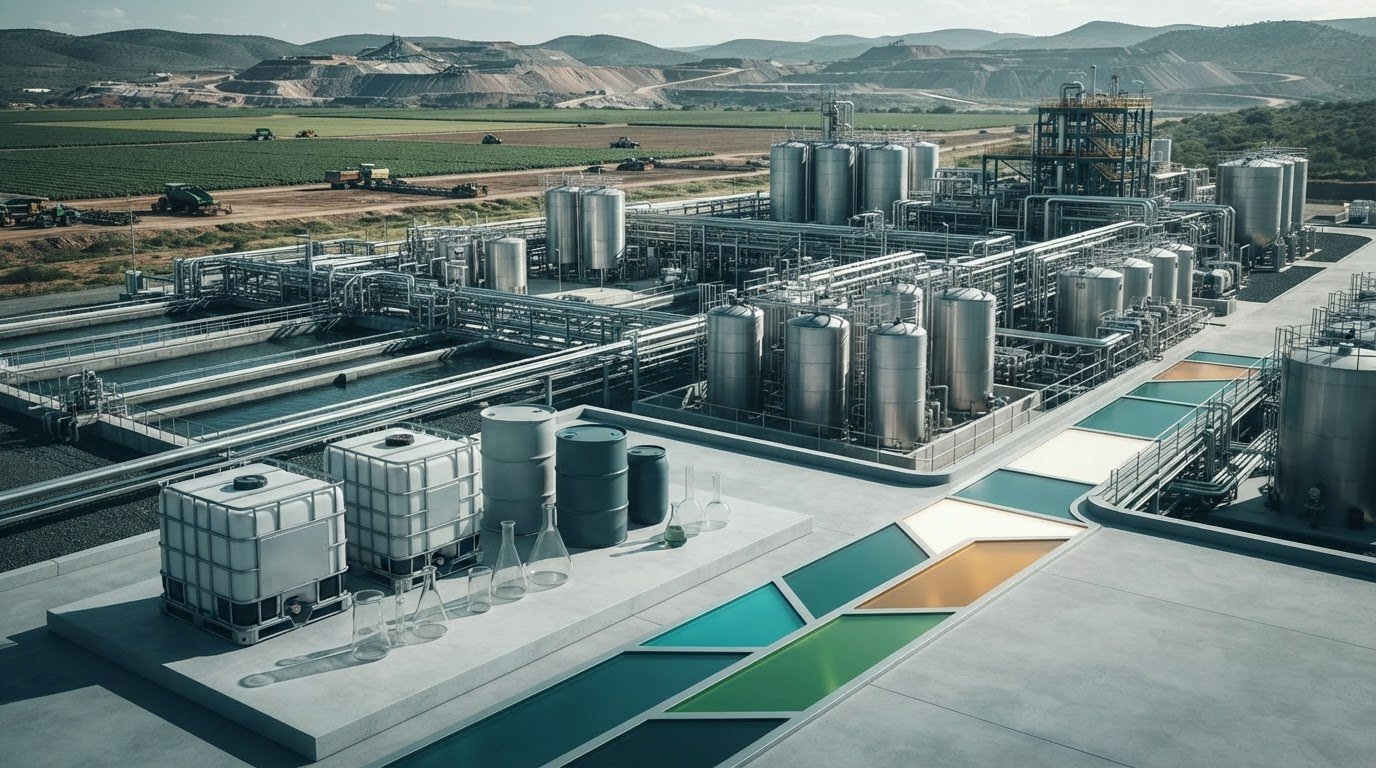
The lowest-priced chemical may not be the best choice for your process. A product label or unit price can’t show how a chemical will perform under your operating conditions, interact with equipment, or affect safety and sustainability. Many common mistakes in choosing industrial chemicals start with comparing products without a consistent, process-based checklist.
Technical specifications can be difficult to compare, and a chemical that works in one application may be unsuitable in another. Start with your process requirements, then weigh technical fit and lifecycle considerations alongside safety and environmental factors.
This article offers a practical checklist for comparing industrial chemicals beyond their labels and purchase prices. You’ll learn what to assess, which documents can inform your decision, and how laboratory development, on-site implementation, and ongoing technical support can help align a chemical solution with your operation.
Key Takeaways
- Common mistakes in choosing industrial chemicals often begin with purchase criteria that don’t reflect the process. Start with the application objective and operating conditions.
- Compare chemicals by function and operating environment. Requirements differ across flotation, scale control, fertilizer handling, and water treatment.
- Look beyond labels and unit prices. Use the same checklist to assess specifications, supporting evidence, safety, sustainability, and technical support.
- Before changing an operating process, define requirements, review relevant documentation, assess compatibility, validate the choice, and plan implementation.
- Laboratory development, on-site implementation, and ongoing technical support can help align a tailored chemical formulation with project needs.
Common mistakes in choosing industrial chemicals start with the wrong selection criteria
Selection mistakes begin when the purchase specification doesn’t reflect the process. A chemical’s name identifies a product category, but it doesn’t establish whether its documented properties suit a particular application or the conditions at a specific site. Process fit is the match between a chemical’s properties and the application’s requirements under actual operating conditions.
A checklist is a decision aid, not a universal standard. Common mistakes in choosing industrial chemicals often arise when teams treat product identity, specification, intended application, and site conditions as interchangeable. Each is a separate part of the decision. The broad Chemical Industry Overview illustrates the variety of chemical types and uses, but selection still depends on the process at hand.
Mistake: choosing by product name or headline specification alone
A shared chemical name or additive category doesn’t mean two products have equivalent specifications or suit the same task. A defoamer, for example, may be considered for different process objectives in paints and coatings or water treatment. The category alone doesn’t explain the role required in either application.
Compare the full documented specification with the intended use. Review relevant supporting documents, such as a Technical Data Sheet or Safety Data Sheet, where applicable. Note what each document establishes, and don’t treat a headline value or familiar product description as proof of suitability.
Mistake: overlooking the process conditions the chemical must handle
A candidate that looks suitable on paper may still be a poor match if actual process conditions differ from the assumptions behind its selection. Record feed characteristics, process stages, and points of chemical addition. Where relevant, include temperature, pressure, contact time, and materials the chemical may encounter, including equipment and other process chemicals.
Separate measured site facts from assumptions. If a value or interaction hasn’t been established, flag it for technical validation instead of building a purchasing decision around an estimate. This gives your team a clearer basis for assessing compatibility and deciding whether further evaluation is needed.
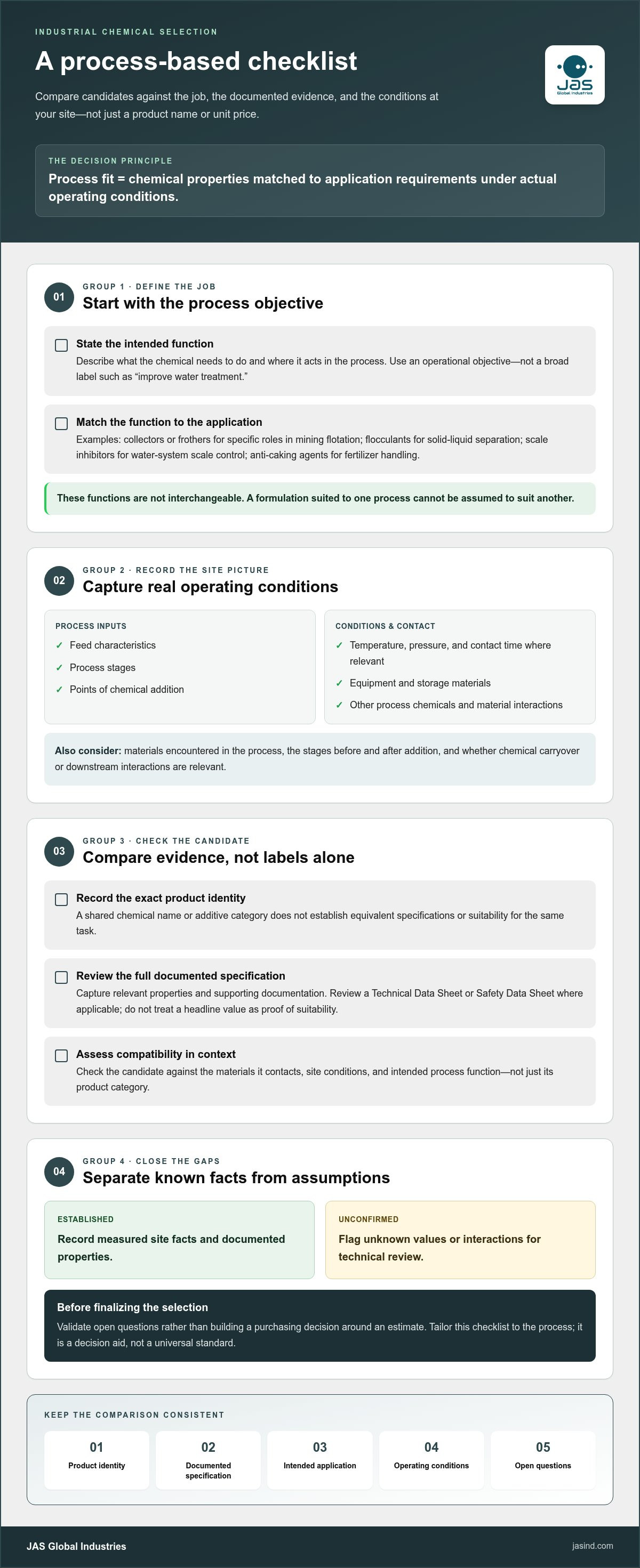
Use the checklist to make comparisons consistent, while tailoring its criteria to the process:
- Product identity: Record the exact chemical or additive category under consideration.
- Documented specification: Capture relevant properties and supporting documentation, not just a headline description.
- Intended application: State the process objective and the chemical’s intended function.
- Operating conditions: Document known feed characteristics, process stages, conditions, and material interactions.
- Open questions: Identify assumptions that need technical review before finalizing the selection.
This first pass helps teams distinguish what a product is from what the operation needs it to do. It also gives technical discussions a shared, process-specific starting point.
Industrial chemical selection depends on application, compatibility, and operating conditions
Application fit means aligning the process objective, the chemical’s function, and the environment where it will be used. Begin with a defined objective and operating envelope. Without both, a familiar formulation may appear suitable by category while missing the needs of the actual process.
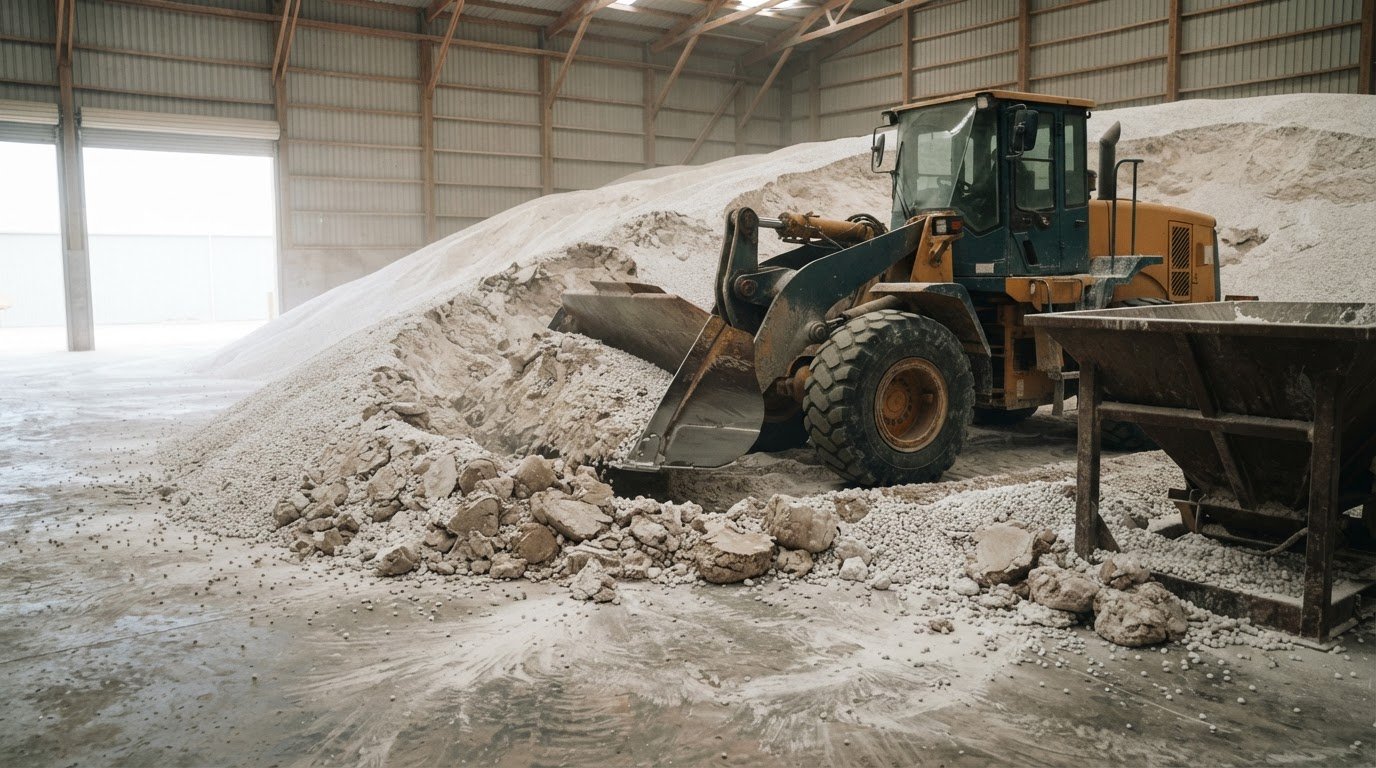
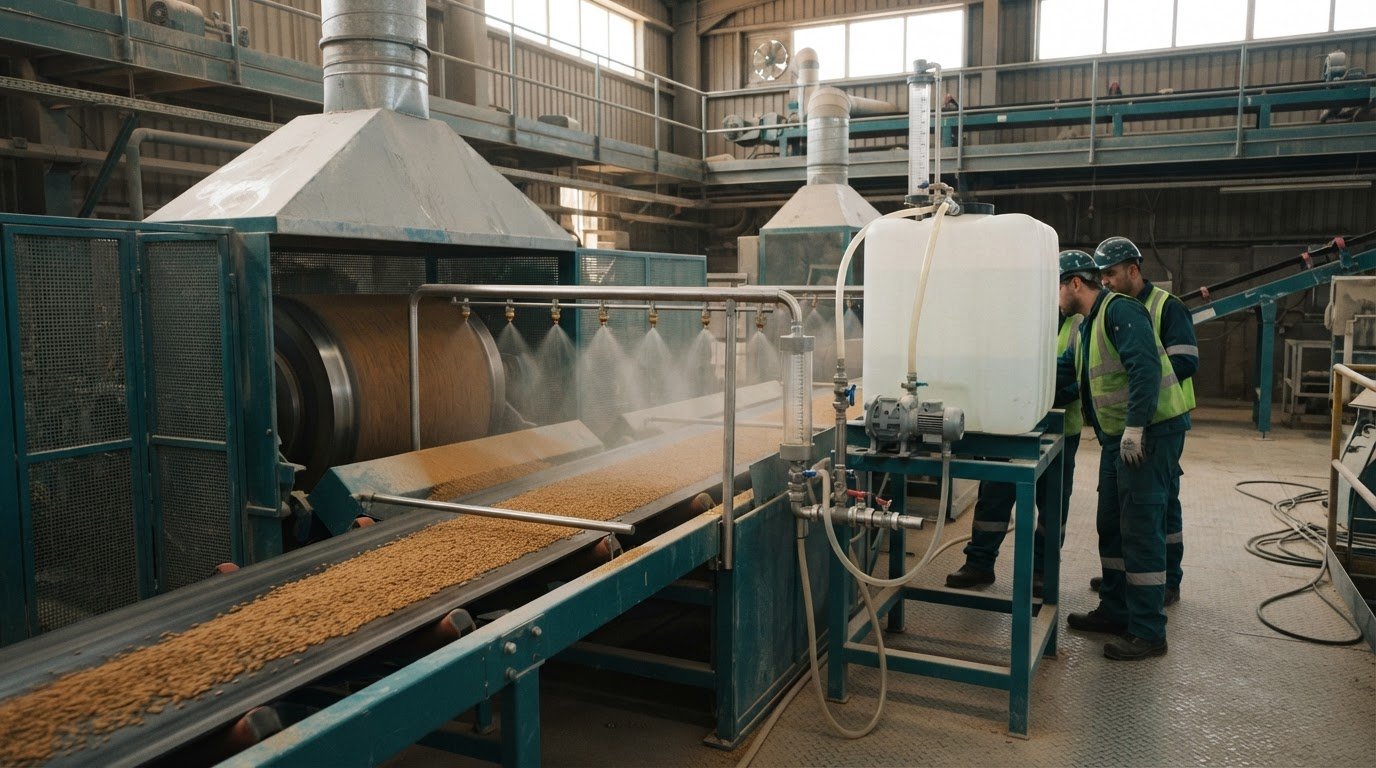
Different operations require different chemical functions. Mining flotation uses collectors or frothers for specific roles in the separation process, while flocculants are considered for solid-liquid separation. Scale inhibitors address scale control in water systems. Fertilizer anti-caking agents support a different handling objective. These categories aren’t interchangeable, and a formulation suited to one process can’t be assumed to suit another. That’s why common mistakes in choosing industrial chemicals often start with comparing products before defining the job they need to do.
Match chemical function to the process objective
State the required process function in operational terms. Is the objective related to flotation, flocculation, scale control, or reducing caking during fertilizer handling? Then identify where the chemical acts, what material it encounters, and which part of the process it is intended to support. This narrows the comparison to candidates with a relevant function without assuming a performance outcome before application evidence is available.
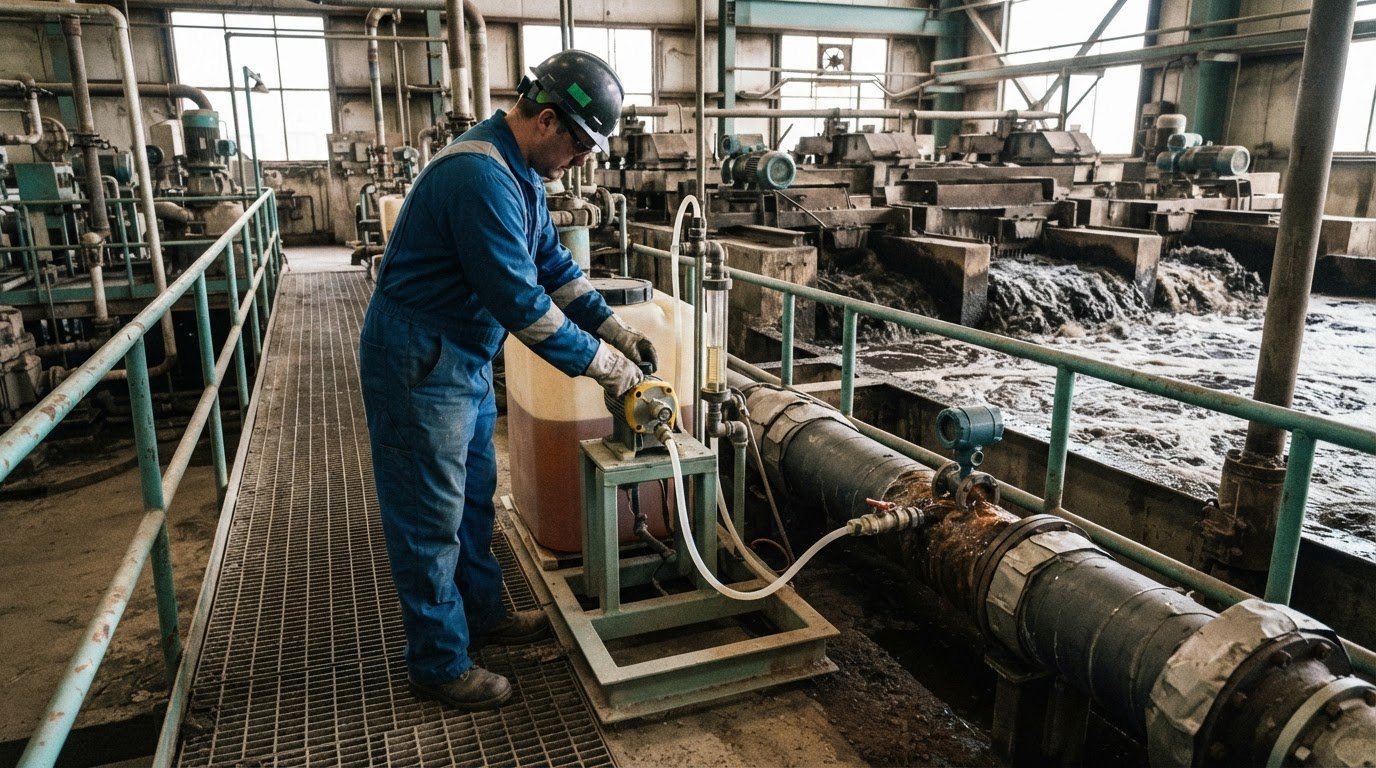
For water treatment, the system’s purpose and process conditions help frame the selection. The industrial water treatment guide provides further context on treatment priorities and water security. Keep the objective specific: “manage scale in this process stage” is more useful than “improve water treatment.”
Check process compatibility and site conditions
A chemical’s role is only part of its fit. Review the materials it contacts, the equipment and storage materials involved, and the process stages before and after addition. Feed characteristics can affect how a candidate behaves in the operating environment. Downstream steps may also matter if chemical carryover or interactions are relevant. Record temperature, pressure, contact time, and other conditions where they affect the application.
Use a practical review list:
- Feed: Record known composition or characteristics that matter to the process.
- Process: Map the stages, addition point, and contact conditions.
- Materials: Identify relevant equipment, surfaces, storage materials, and other chemicals.
- Downstream steps: Note later operations that could influence or be affected by the chemical.
- Unverified details: Flag assumptions for technical assessment rather than treating them as established facts.
Compatibility review should consider safety and environmental factors as well as process function. The American Chemical Society’s Chemical Risk Assessment and Management guidance offers a broader lens for considering chemical hazards. For projects with distinct operating conditions, JAS Global Industries develops formulations tailored to project needs, with technical support that includes laboratory development and on-site implementation. Explore JAS Global Industries’ chemical solutions as part of a process-specific selection discussion.
Compare industrial chemicals by specification, evidence, safety, and lifecycle impact
A consistent comparison makes trade-offs visible. Assess each candidate against the same criteria, using evidence relevant to the application rather than unrelated headline figures. This helps prevent common mistakes in choosing industrial chemicals, such as treating a product label as proof of suitability or overlooking information needed to judge operational and environmental implications.
| Process objective | Specification | Evidence | Safety | Sustainability | Support |
|---|---|---|---|---|---|
| Mineral processing, such as flotation | Properties relevant to the intended process function | Applicable product documentation and test context | Handling and risk information for the site | Relevant resource and waste considerations | Technical guidance for evaluation and implementation |
| Water treatment, such as scale control | Properties relevant to the treatment objective | Documentation that relates to the intended application | Storage, handling, and risk information | Considerations across treatment and disposal stages | Support suited to the process assessment |
| Fertilizer handling, such as anti-caking | Properties relevant to the handling objective | Product identity and applicable supporting records | Information relevant to site procedures | Material use and end-of-process considerations | Guidance for project-specific requirements |
Mistake: comparing labels while ignoring specifications and evidence
Compare documented properties that matter to the intended use. A headline figure may be prominent but irrelevant to the process decision. Check that each document identifies the product under review, note its version, and understand the test context behind any stated values. A Certificate of Analysis (COA), where applicable, relates to a specific batch. A Safety Data Sheet (SDS) provides safety information. Neither is a substitute for application-specific evidence.
If a specification is ambiguous, a document is outdated, or evidence doesn’t address the relevant process condition, record the gap for technical review. Don’t fill it with assumptions. In mineral processing, the mining solutions guide offers sector context, while product suitability still depends on the candidate’s documentation and the application.
Mistake: treating safety and sustainability as afterthoughts
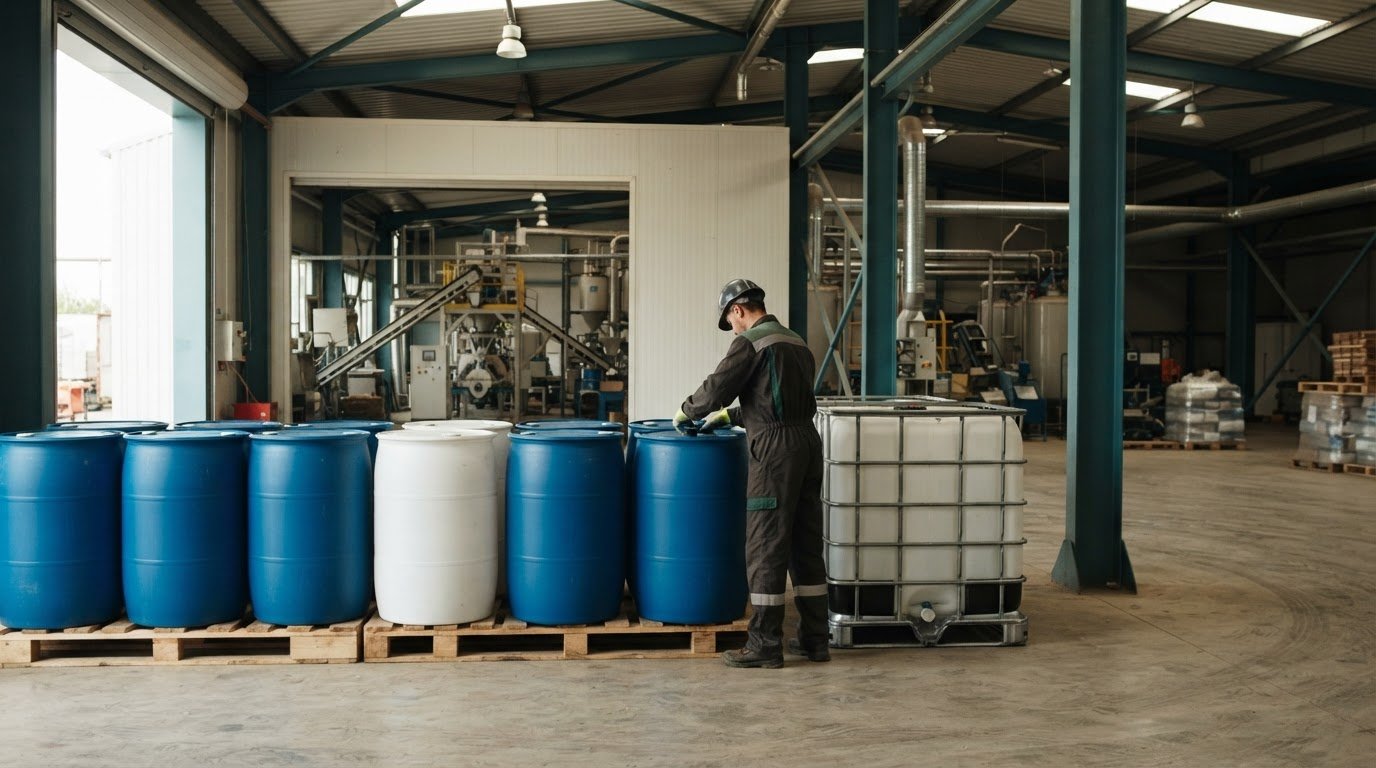
Review applicable product information for handling, storage, hazards, and risk controls, then consider how these align with site procedures. Requirements vary by location and application, so identify the environmental and operational obligations relevant to the specific site instead of assuming one set of requirements applies everywhere.
Lifecycle review should extend beyond purchase and use. Consider resource inputs, process impacts, waste handling, and downstream implications where relevant. A change that addresses one concern may shift impacts elsewhere, so compare the whole operating context without assuming savings or environmental gains. Include the technical support needed to interpret evidence, assess open questions, and carry the selection through implementation.
Validate an industrial chemical choice before changing the operating process
A promising sample result is a reason to continue evaluation, not automatic proof that a chemical will perform the same way across a plant. Differences in feed, equipment, process stages, and operating conditions can affect whether laboratory findings translate to site use. A controlled validation plan helps teams make an evidence-based decision and assign clear responsibilities.
Before changing a process, document the current baseline, define what success means for the application, and assign decision ownership. This makes comparisons more useful and helps distinguish an actual process change from normal operating variation. These steps address common mistakes in choosing industrial chemicals, especially treating a limited test as a final plant-wide answer.
Use a staged validation sequence
- Define requirements. Record the process objective, operating envelope, baseline conditions, and application-specific success criteria. Specify what to observe and what would require stopping or reassessing the evaluation.
- Review documentation. Confirm that product information applies to the candidate and intended use. Identify open questions before testing or implementation.
- Assess compatibility. Review relevant feed characteristics, equipment and contact materials, process stages, and downstream considerations. Separate verified site facts from assumptions.
- Validate the candidate. Use laboratory development to examine relevant questions under controlled conditions. Define what the test can establish and where it cannot reproduce site conditions.
- Plan implementation. If evaluation supports moving forward, set out site responsibilities, change records, monitoring, and criteria for reviewing operational observations.
Mistake: treating a sample result as proof of plant-wide performance
Laboratory evaluation can help compare candidates and investigate application-specific questions. It can’t automatically represent every variation in plant feed, equipment, operating conditions, or process sequence. Set success criteria before testing and make sure they reflect the objective the operation needs to meet. Avoid relying on universal trial durations, dosage rates, or thresholds. Establish these for the particular application and available evidence.
For fertilizer handling, an anti-caking evaluation should relate to the handling objective and material conditions. The fertilizer anti-caking guide provides additional context on this chemical function.
Mistake: changing chemicals without an implementation plan
A site transition involves more than introducing a candidate. Identify who owns technical review, operating decisions, documentation, and monitoring. Plan how observations will be recorded and reviewed, and consider process continuity without assuming production will remain uninterrupted. On-site implementation and ongoing operational monitoring are distinct from laboratory assessment. Each addresses different questions and conditions.
If the operating objective or site conditions differ from those used in evaluation, pause for technical review before extending the decision. JAS Global Industries supports laboratory development, on-site implementation, and ongoing industrial support, with formulations tailored to project needs. Discuss a project-specific chemical evaluation as part of a considered change plan.
Use technical partnership to make industrial chemical selection a managed decision
Choosing a chemical doesn’t have to be a one-time purchasing decision. A technical partnership can connect selection to application needs, evaluation, implementation, and continued operational support. This matters because process conditions vary, and a chemical’s suitability depends on how its documented properties align with a specific use.
JAS Global Industries supports industrial projects through laboratory development, on-site implementation, and ongoing industrial support. These activities address different stages: laboratory development informs evaluation, on-site implementation supports the move into the operating environment, and continued support can help teams address operational questions. The approach is grounded in each project rather than the assumption that one formulation fits every process.
When tailored formulation and technical support can add value
Distinct feeds, process stages, equipment, or operating objectives can call for application-specific technical development. A candidate for mining, water treatment, or fertilizer handling should be assessed against that operation’s requirements, not selected by category alone. Formulations can be tailored to project needs, while technical review connects application details to selection and evaluation. Suitability remains specific to the evidence and operating context.
Responsible selection also considers safe handling, resource use, and the broader effects of chemical use across water and process operations. Reviewing these factors alongside technical fit can support sound operational decisions and lifecycle assessment. It doesn’t establish a guaranteed reduction in cost, resource use, or environmental impact. Those outcomes depend on the application and its evidence.
Turn the checklist into a clear next step
A focused technical discussion starts with a useful summary of the operation. Gather information that frames the application and identifies what still needs evaluation:
- Process objective: Describe the function the chemical needs to support and where it enters the process.
- Operating conditions: Summarize relevant feed characteristics, process stages, equipment, and site conditions.
- Documentation: Provide available product specifications and applicable safety or batch documents for review.
- Evaluation evidence: Share test findings, baseline observations, and application-specific success criteria.
- Open questions: Identify uncertainties, changes under consideration, and who owns operational decisions.
This preparation keeps the conversation anchored in the process rather than product labels. It also clarifies whether laboratory development, on-site implementation, or ongoing industrial support is relevant to the project. With the right information, JAS Global Industries can focus the discussion on the application, operating requirements, and technical considerations that shape a managed chemical selection.
Discuss your industrial chemical application with JAS Global Industries and share the process requirements that will guide the evaluation.
Keep chemical selection aligned as your process evolves
Treat a chemical selection as a decision to revisit when the operation changes. Shifts in feed characteristics, equipment, process stages, or operating objectives can alter the conditions a chemical must meet. Set a review point after significant process changes, and keep a record of why the chemical was selected, what evidence informed the decision, and who owns reassessment. This turns the checklist into a practical safeguard rather than a one-time purchasing exercise.
This discipline helps teams avoid common mistakes in choosing industrial chemicals while preserving the reasoning behind each decision. It also gives technical discussions a stronger foundation: the application, its operating needs, and the evidence available. JAS Global Industries has operated since 1998 and has a global presence with a strong GCC footprint, bringing industrial experience to project-specific chemical considerations.
Take the next step with a clear view of your process requirements. Start a chemical application discussion with JAS Global Industries and move forward with a selection approach shaped around your operation.
Frequently Asked Questions
Is the most concentrated industrial chemical always the best choice?
No. A higher concentration doesn’t by itself show that a chemical is suitable or offers better value for a process. Check how concentration is defined in the product documentation and whether the stated properties address the application’s requirements. Compare candidates on the same basis. Follow applicable product instructions and qualified technical review for concentration or dosage decisions, rather than inferring an operating rate from a headline figure.
Can the same industrial chemical be used at multiple plants?
Sometimes, but don’t transfer a previous selection automatically. A plant processing a different feed or using different equipment may have a different application context, even if the process objective sounds similar. Compare relevant site conditions and documentation before applying an existing selection elsewhere. These checks help prevent common mistakes in choosing industrial chemicals, especially assuming a product name makes two operating environments equivalent.
What is the difference between a Safety Data Sheet and a Certificate of Analysis?
A Safety Data Sheet (SDS) provides information relevant to hazards, handling, storage, and emergency measures. A Certificate of Analysis (COA) records results for a particular product lot against stated specifications. They serve separate purposes: an SDS isn’t evidence of a batch’s test results, and a COA isn’t a handling guide. Review the appropriate documents for the decision at hand, and follow site procedures for chemical handling and risk management.
How often should a plant review its industrial chemical selection?
Review the selection when a change could affect the chemical’s role or suitability, such as a revised process objective, a different feed, equipment changes, or a new product specification. A review is also useful when observed results no longer match expectations for the application. Keep the original selection rationale and relevant records together. That makes it easier for the team to assess whether conditions changed or initial assumptions need reconsideration.
Should an industrial chemical be evaluated in the laboratory before plant implementation?
Laboratory evaluation can help answer defined questions about a candidate, but it can’t necessarily reproduce every plant condition. Treat results as one input alongside current product documentation and site-specific technical assessment. Before testing, record what the evaluation is intended to establish and how findings will inform a decision. If moving toward plant use, determine whether on-site implementation support is appropriate for the process and conditions under review.
How can sustainability be included in industrial chemical selection?
Include sustainability criteria alongside process and safety requirements, and make them specific to the operation. Identify which environmental factors matter at the site, then compare available product information against those criteria. Avoid relying on broad claims without evidence relevant to the application. Consider whether a proposed change shifts impacts to another process stage, and document the basis for the decision so environmental considerations remain part of ongoing operational review.