


What if the scale problem isn’t simply a matter of adding more chemical? Scale can restrict flow, reduce heat transfer, and disrupt equipment operation, but the right response depends on how deposits form under your process conditions. Antiscalants help control scale by interfering with crystal formation, growth, or deposition. Their effectiveness depends on the water chemistry and operating conditions they’re matched to.
Choosing a treatment can be difficult when chemistries and applications vary. This article explains how antiscalants work, where they’re used, and which factors guide selection, including temperature, pH, water composition, concentration, and compatibility with other treatment chemicals.
We’ll look at applications across reverse osmosis, thermal desalination, cooling systems, boilers, wastewater treatment, ion exchange, and mining. Then we’ll outline a practical approach to assessing scale risk and evaluating a treatment program against process needs. JAS Global Industries supplies antiscalants for water treatment and mining, with laboratory development, on-site implementation, and ongoing technical support for process-specific treatment evaluation.
Key Takeaways
- Recognize how supersaturation creates conditions for mineral deposits, and why scale control starts with understanding the water and process.
- Learn how antiscalants may inhibit crystal formation, modify crystals, or help disperse particles, depending on the formulation.
- Compare scale concerns across industrial applications instead of assuming one treatment approach suits every system.
- Use system type, feedwater characteristics, observed deposits, and existing treatment conditions to structure a process-specific evaluation.
- See how laboratory development, on-site implementation, and technical support can inform antiscalant program assessment.
What Are Antiscalants, and What Scale Problem Do They Address?
Antiscalants are water-treatment additives that inhibit mineral scale formation or precipitation under specified process conditions. They help manage the tendency of dissolved minerals to form solid crystals and deposit on surfaces. They aren’t universal solvents for existing deposits, so distinguish their role in preventing or controlling scale from cleaning scale that has already formed.
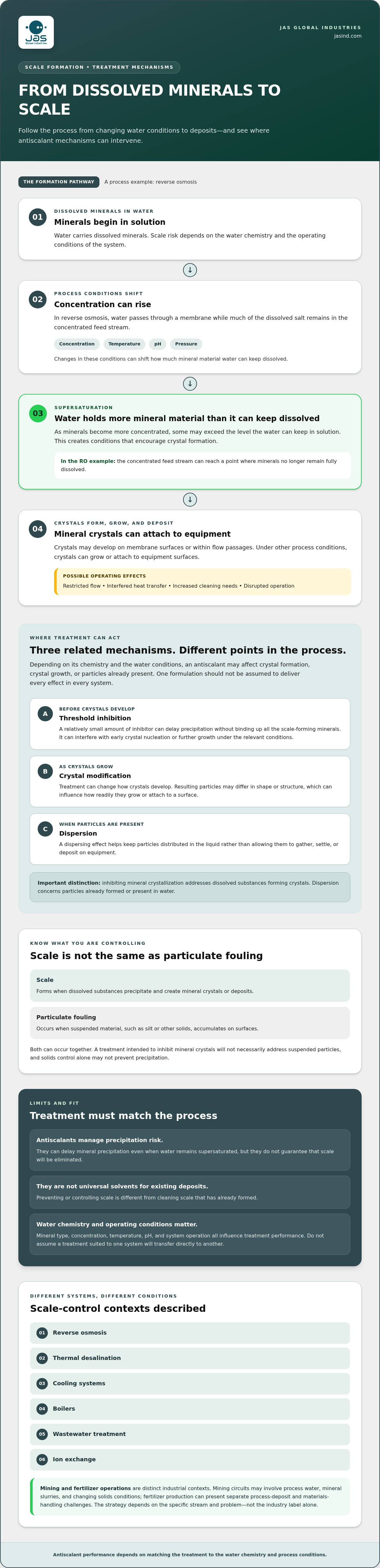
Scale develops when water contains more dissolved mineral material than it can keep in solution under its current conditions. This state is called supersaturation. A simple analogy is adding so much sugar to water that some can no longer dissolve. In an industrial system, changes in concentration, temperature, pH, or pressure can shift the balance and encourage minerals to form crystals. Those crystals may grow or attach to equipment surfaces.
How does scale form in industrial water systems?
Consider a reverse osmosis system. As water passes through a membrane, much of the dissolved salt remains in the concentrated feed stream. Minerals in that stream become more concentrated, and some may exceed the level the water can keep dissolved. Crystals can then develop on membrane surfaces or within flow passages. Depending on the system, scale may restrict flow, interfere with heat transfer, increase cleaning needs, or disrupt operation.
Scale isn’t the same as particulate fouling. Scale forms when dissolved substances precipitate; particulate fouling occurs when suspended material, such as silt or other solids, accumulates on surfaces. Both can occur together, so identifying the deposit matters. A chemical approach intended to inhibit mineral crystals won’t necessarily address suspended particles, while solids control alone may not prevent precipitation. The Antiscalant overview outlines common applications and broad mechanisms, but a specific treatment still needs to match the water and operating conditions.
Where are antiscalants used beyond reverse osmosis?
Scale control is relevant in thermal desalination, where heat and water concentration influence mineral precipitation, and in cooling systems, where recirculating water can concentrate dissolved constituents. Boilers, wastewater treatment, and ion exchange have their own water chemistry and operating conditions. Don’t assume a treatment approach suited to one system will transfer directly to another.
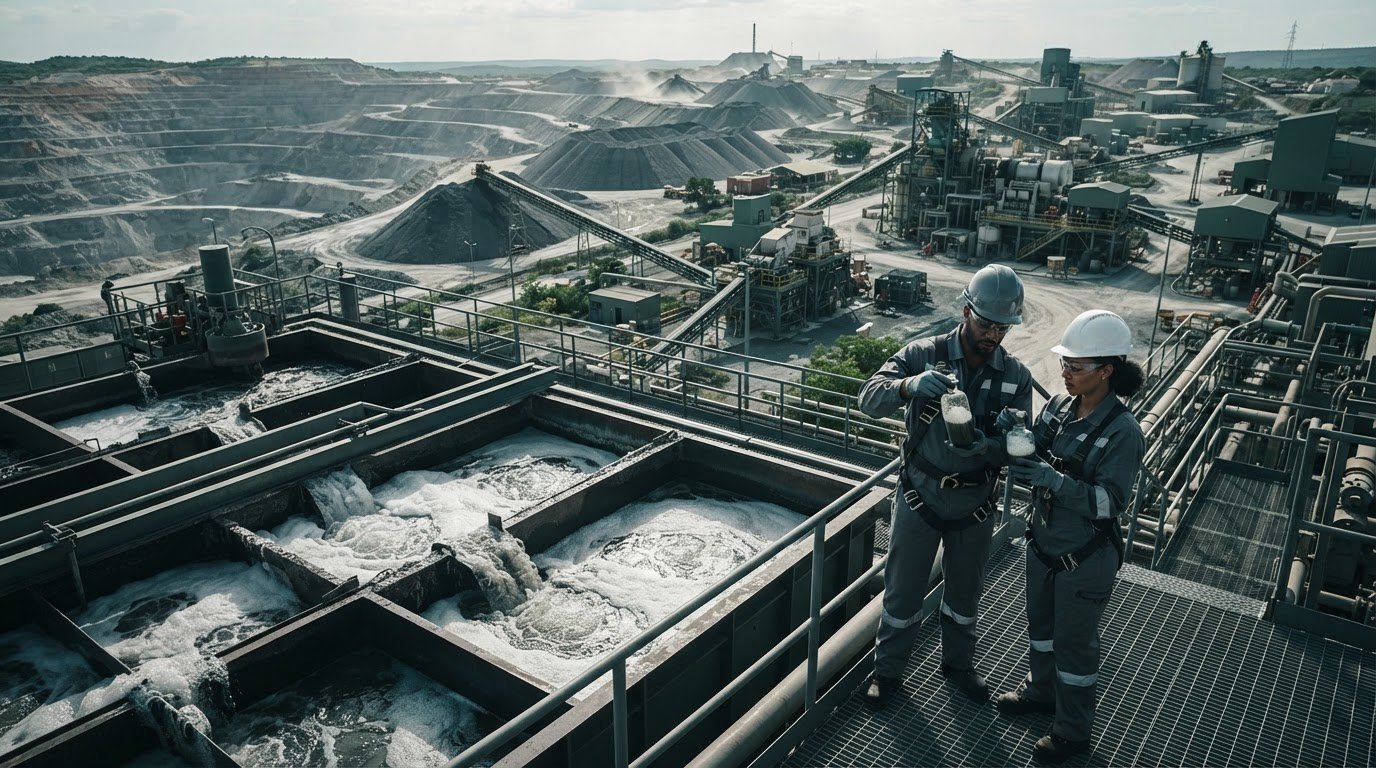
Mining and fertilizer operations are distinct industrial contexts, not interchangeable water-treatment applications. Mining circuits may involve process water, mineral slurries, and changing solids conditions. Fertilizer production can present separate process-deposit and materials-handling challenges. The right control strategy depends on the specific stream and problem, not the industry label alone.
This distinction is part of a broader view of industrial water management. The article “Industrial Water Treatment: A Strategic Guide to Global Water Security” explores how system needs connect to reliable operations and water stewardship.
How Antiscalants Inhibit Crystal Formation and Scale Deposition
Scale control can act at several points between dissolved minerals and a stubborn deposit. Depending on its chemistry and the water conditions, a treatment may delay crystal formation, alter how crystals grow, or help keep small particles dispersed. These are related but distinct effects. Don’t assume that one formulation delivers all of them in every system.
By interfering with crystal formation or growth, an antiscalant can delay mineral precipitation even when water remains supersaturated, but it doesn’t guarantee that scale will be eliminated. Treatment aims to manage precipitation risk within a process. It doesn’t change the underlying mineral content of feedwater or remove every existing deposit.
What do threshold inhibition and crystal modification mean?
Threshold inhibition describes a treatment effect in which a relatively small amount of an inhibitor can delay precipitation without binding up all the scale-forming minerals. At a conceptual level, the additive can interfere with the early steps of crystal nucleation or with further growth, so crystals are less likely to develop at the same rate under those conditions. The term doesn’t mean that any dose works in any water. Chemistry, concentration, temperature, and system operation all matter.
Crystal modification refers to changing the way crystals develop. If a treatment affects crystal growth, the resulting particles may differ in shape or structure from untreated crystals. That can influence how readily they grow or attach to a surface. The specific effect depends on the mineral and formulation. It doesn’t mean deposits will be harmless, easy to remove, or prevented altogether.
How does dispersion relate to antiscalant treatment?
Dispersion concerns particles that have already formed or are present in the water. A dispersing effect helps keep particles distributed through the liquid rather than allowing them to gather, settle, or deposit on equipment. This differs from inhibiting mineral crystallization, which addresses the formation or growth of crystals from dissolved substances. Some treatment programs may address both concerns, but the mechanisms are not interchangeable.
Silica illustrates why these distinctions matter. Depending on water chemistry, silica may contribute to deposits through forms that behave differently from familiar mineral crystals. Suspended foulants, by contrast, are particles already carried in the water. Their presence may call for attention to solids management as well as scale control. Identifying what a deposit contains, and whether the issue is precipitation, particle accumulation, or both, helps frame treatment evaluation.
Antiscalants also don’t replace pretreatment or resolve every cause of membrane fouling. Suspended solids, biological growth, and other contaminants can create separate operating challenges. A sound evaluation considers the full feedwater and treatment train rather than relying on one additive to address every source of fouling. For process-specific assessment, JAS Global Industries’ water-treatment technical support can help connect treatment needs with operating conditions.
How Antiscalant Needs Differ Across Industrial Applications
A treatment approach needs to reflect the process, not just the industry name. Feedwater source, mineral content, concentration changes, temperature, and system operation all shape the scale risk. Process-water analysis helps identify which dissolved constituents and operating conditions matter; system records provide context for evaluating treatment fit. Don’t assume the same chemistry will suit every application.
What changes between membrane, thermal, and cooling-water systems?
Reverse osmosis and nanofiltration concentrate dissolved constituents as water passes through membranes, so evaluation considers feedwater composition and how concentration changes through the system. Thermal desalination involves heating and concentrating water, making temperature and water chemistry relevant. Cooling systems recirculate water, which can also concentrate dissolved material as water is lost. These differences affect which scale concerns to investigate, but they don’t establish a universal product or dosage rule. Readers focused on membrane treatment can explore the dedicated topic “Antiscalants for High-Efficiency Reverse Osmosis.”
The comparison below is a starting point for assessment, not a treatment prescription.
| Process | Scale concerns to assess | Relevant operating context |
|---|---|---|
| Reverse osmosis and nanofiltration | Mineral constituents in feedwater and concentration through the membrane system | Feedwater source, pretreatment, recovery conditions, and operating changes |
| Thermal desalination | Minerals that may precipitate as water is heated and concentrated | Temperature profile, water source, and concentration conditions |
| Cooling systems | Dissolved constituents that may become more concentrated during recirculation | Makeup water, cycles of concentration, and system operation |
| Mining process water | Scale potential in the specific water stream and process equipment | Water chemistry and the conditions of the particular mining circuit |
| Fertilizer production | Process-specific deposit concerns, assessed separately from product handling | Production process and the material being handled |
How do mining and fertilizer processes add different considerations?
Mining operations can involve process water and distinct circuit conditions, so treatment assessment should begin with the actual stream and operating context. JAS supplies antiscalants for water treatment and mining, but that doesn’t mean every mining process has the same scale concern or needs the same approach.
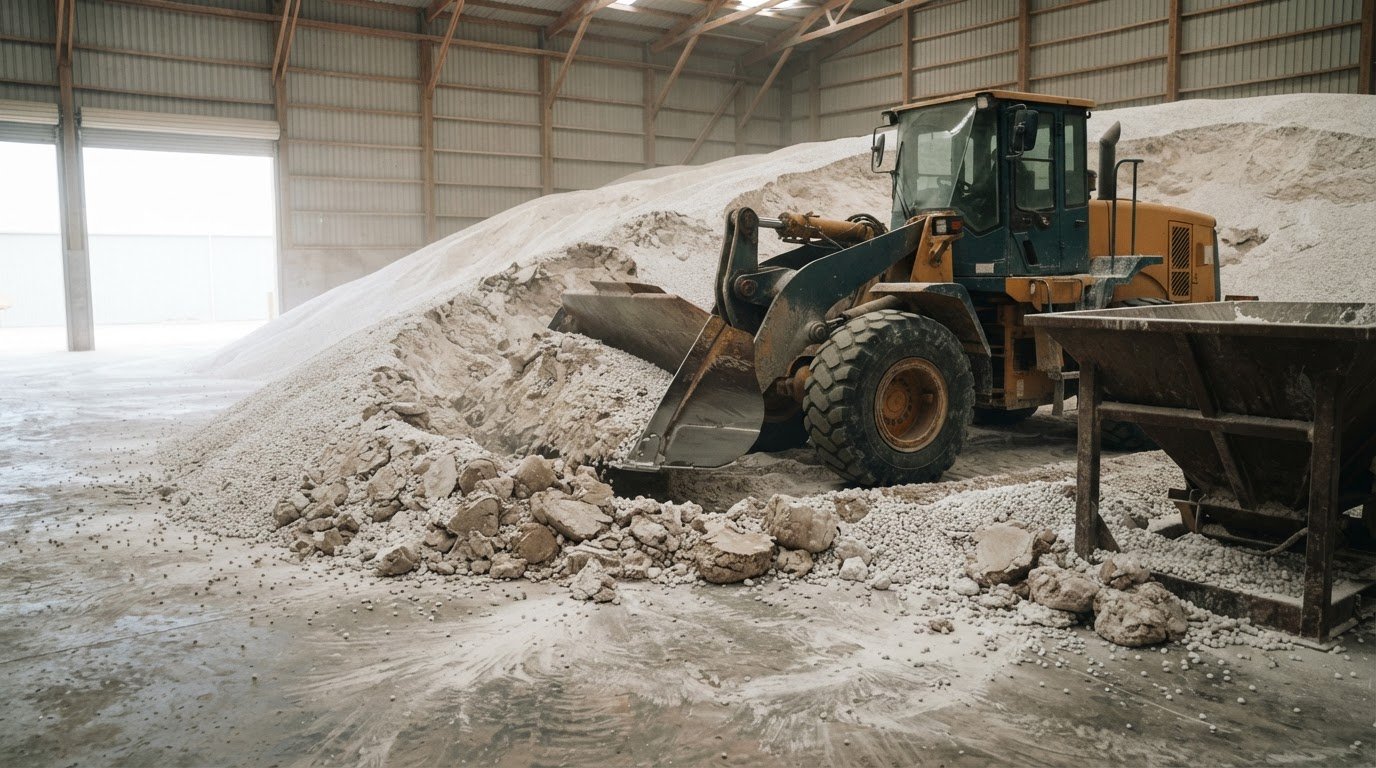
Fertilizer production also calls for precise terminology. Fertilizer anti-caking agents address caking during product handling; they aren’t interchangeable with water-treatment antiscalants. Define the problem first, then consider the relevant chemistry and operating conditions. This keeps treatment decisions grounded in the system’s actual needs.
How to Evaluate an Antiscalant Program for Your Process
A useful evaluation begins with the system, not a generic dosing recipe. Assemble the process type, feedwater characteristics, observed scale, and existing treatment conditions before comparing options. Process data should guide antiscalant selection because water chemistry and operating conditions determine which scale risks a treatment approach must address.
Use a structured review to turn operating observations into questions for technical assessment:
- Define the system and its objective. Record whether the application is reverse osmosis, thermal desalination, cooling, boiler, wastewater, ion exchange, or a mining process. Clarify what the operation needs to protect or maintain, such as stable production, dependable equipment operation, or a particular water-treatment objective.
- Assemble feedwater information. Gather available analyses and note the water source, relevant dissolved constituents, and any known variation in quality. Include sampling context and timing where available, so results can be interpreted alongside actual operation.
- Describe the scale evidence. Record where deposits appear, when they are observed, and any available information about their composition. Include inspection findings and cleaning records. If the deposit is uncertain, flag that uncertainty rather than assuming it is mineral scale.
- Document system conditions. Provide the system configuration and operating records relevant to the process. Note changes in throughput, feedwater source, temperature, concentration, or other conditions that coincide with scale observations.
- Map the existing treatment train. List pretreatment steps and chemicals already in use, along with known changes to the program. This helps technical reviewers assess how a proposed treatment approach fits the wider system rather than viewing it in isolation.
- Set evaluation and monitoring criteria. Agree with qualified technical staff on indicators tied to the process objective. Depending on the system, these might include trends in flow, pressure, heat-transfer performance, deposit observations, or cleaning frequency. Define what will be monitored, how results will be recorded, and which environmental or effluent requirements apply to the operation.
Which process information should teams assemble first?
Start with records already available: water analysis, system diagrams, operating conditions, scale observations, pretreatment details, and relevant operational changes. Mark missing or uncertain information clearly. Data gaps can then be considered for laboratory assessment or further investigation instead of being filled with assumptions.
How should a treatment approach be assessed and monitored?
Establish a baseline before evaluating a treatment change, then review the agreed indicators under documented operating conditions. A change in water source or process settings can affect interpretation, so record those factors alongside results. JAS Global Industries supports process-specific evaluation through laboratory development, on-site implementation, and ongoing technical support. Its approach to water treatment also connects to broader questions of system reliability and Industrial Water Treatment: A Strategic Guide to Global Water Security.
For a process-specific review of your antiscalant needs, discuss your treatment requirements with JAS Global Industries.
JAS Antiscalants and Technical Support for Process Reliability
An antiscalant program is strongest when it reflects the process it serves. The evaluation criteria outlined above, including water chemistry, observed deposits, operating conditions, and treatment objectives, help teams frame the technical discussion. JAS Global Industries supplies antiscalants for water treatment and mining, alongside broader water-treatment solutions for thermal desalination, reverse osmosis, wastewater treatment, boilers, cooling systems, and ion exchange. Each application has its own operating context; a product category alone doesn’t determine treatment fit.
That broader process perspective matters. A scale concern in a membrane system may differ from one in a mining water stream or a thermal process. Reviewing the system and its available data helps technical teams focus on the actual treatment need rather than assume that a general explanation or a single approach applies everywhere.
What does JAS bring to an industrial treatment partnership?
JAS Global Industries has operated for over 25 years. Its stated commitment is to support safe, cost-effective, and efficient water and process operations. For treatment evaluation, the company provides laboratory development, on-site implementation, and ongoing technical support. These capabilities connect assessment to process conditions and keep the review grounded in the system’s requirements rather than unsupported performance promises.
Technical support can be relevant at different stages of the work:
- Laboratory development can contribute to examining process-specific treatment needs.
- On-site implementation connects treatment planning with the operating environment.
- Ongoing technical support provides continuity as teams assess operating information and treatment objectives.
The value lies in a considered process discussion. Water analysis, deposit observations, treatment history, and operating changes can help shape the questions for review. Where records leave gaps, identifying them is more useful than treating assumptions as facts. The resulting assessment can keep operational reliability, water stewardship, and process requirements in view together.
What is a practical next step for evaluating antiscalants?
Prepare a concise overview of the system, feedwater source and available analysis, scale observations, existing treatment conditions, and the outcome the operation is aiming to assess. Include relevant changes in water quality or operation, monitoring priorities, and applicable effluent considerations. This context gives a technical discussion a practical starting point without presuming a universal product, dosage, or result.
JAS technical specialists can discuss those process conditions and treatment objectives as part of an industrial treatment partnership. A clear assessment supports informed decisions, while laboratory development, on-site implementation, and continuing technical support relate the work to the realities of the process. Discuss your industrial antiscalant requirements.
Turn Scale Risk Into a Clearer Process Plan
Make scale control part of routine process review, not a decision made only after deposits disrupt operations. Keep water and operating records current, note changes in feedwater or system conditions, and use observed results to revisit treatment objectives. This gives your team a stronger basis for recognizing when the process has shifted and when its antiscalant approach may need reassessment.
Scale management also supports wider priorities: dependable equipment operation, responsible water use, and continuity of industrial processes. A thoughtful evaluation can connect these priorities to the conditions at your site without assuming one treatment fits every system.
JAS Global Industries works with industrial water-treatment and mining applications. Bring your process context and objectives into the conversation to explore a practical path forward. Start a discussion about your antiscalant requirements, and take the next step toward a treatment approach grounded in your operation.
Frequently Asked Questions
What is an antiscalant, and how does it work?
An antiscalant is a treatment additive used to manage mineral precipitation in water systems. Depending on the formulation and conditions, it may delay crystal formation or influence crystal growth. For a plant team, the practical question is whether the treatment addresses the mineral risk identified in that specific stream. Reviewing water analysis alongside operating records can help distinguish a scale-control need from a separate cleaning or solids-management issue.
Are antiscalants and scale inhibitors the same thing?
In water treatment, the terms often overlap: an antiscalant is a type of scale inhibitor used to control mineral scale formation. “Scale inhibitor” can also be used more broadly across industrial settings and products. Because terminology varies between applications, compare the intended function and process conditions rather than relying on the label alone. For procurement or technical review, describe the water stream, equipment, and scale concern explicitly.
Can antiscalants prevent every type of scale?
No. A treatment’s suitability depends on the scale-forming minerals, water chemistry, and operating conditions. A program considered for one deposit may not address another, and existing deposits may require a separate cleaning assessment. If scale recurs after a process change, such as a new feedwater source, review whether the deposit composition or operating conditions have changed before assuming the original treatment remains appropriate.
How do antiscalants differ from dispersants?
Antiscalants are primarily associated with managing mineral precipitation, while dispersants help keep particles distributed in a liquid rather than allowing them to gather or deposit. The distinction can guide investigation: a crystalline deposit points toward assessing scale risk, while accumulated suspended solids may call for attention to particle control. Since both issues can appear in one system, inspect the material and review operating evidence before deciding which treatment function is relevant.
Are antiscalants used outside reverse osmosis systems?
Yes. Industrial uses may include thermal desalination, cooling systems, boilers, wastewater treatment, ion exchange, and mining-related water processes. These settings differ in water composition, equipment, and operating conditions, so use in one application doesn’t establish suitability in another. For example, a cooling-water assessment considers the recirculating stream and its operation, while a desalination review focuses on conditions specific to that treatment process.
What information is needed to evaluate an antiscalant program?
Start with the system type, available water analysis, observed deposit details, and a record of current treatment. Add sample dates and locations, relevant operating changes, and maintenance or cleaning observations so the information can be interpreted in context. Identify what the team wants to monitor and any effluent considerations. Clear records help technical reviewers distinguish a persistent scale issue from a change in water quality or operation.