
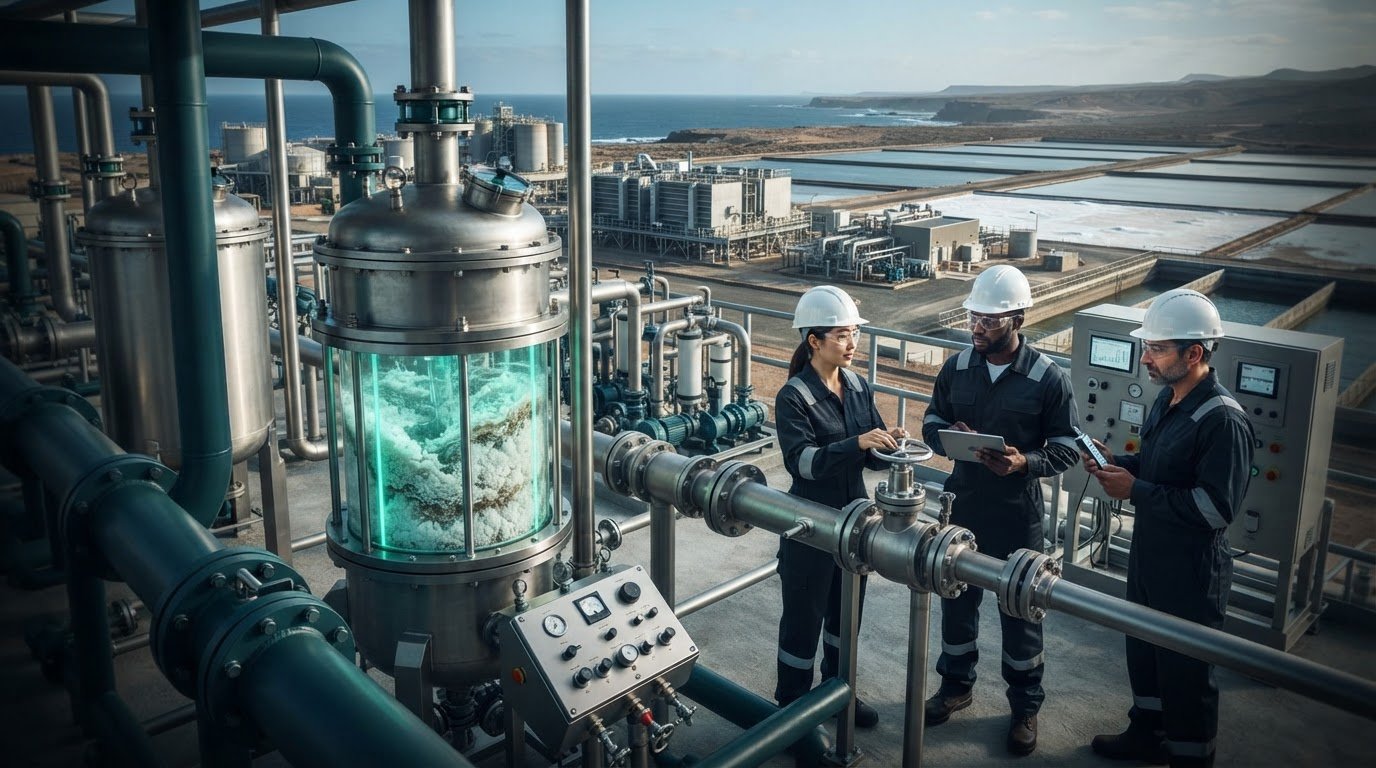
Brine disposal takes more than controlling concentration. Chemical treatment for hypersaline brine disposal can help manage scaling, fouling, and corrosion through measures such as softening, acidity adjustment, and targeted inhibitors. The appropriate disposal route still depends on the brine’s composition and the receiving environment, so treatment must suit both the process and its destination.
That complexity matters because desalination brine can contain pretreatment chemicals, organics, and heavy metals as well as concentrated salts. A treatment that protects membranes or equipment may need to be considered alongside discharge, injection, evaporation, or further concentration. Chemical choices work best as part of an integrated brine-management plan.
This article explains how hypersaline brine forms, which chemical approaches help control fouling, scale, and corrosion, and how treatment technologies affect disposal decisions. You’ll learn what each method can address, where its limitations lie, and how to consider water recovery and residuals while maintaining operational reliability and protecting the environment.
Key Takeaways
- Assess brine composition and the receiving environment together to understand which disposal routes and treatment needs fit the stream.
- Compare disposal options by their environmental effects, energy demands, residuals, and infrastructure requirements.
- Match scale-control and corrosion measures to the specific risks in the process rather than treating every brine stream the same way.
- Consider concentration and recovery technologies alongside final disposal, since each changes the volume and form of residuals to manage.
- Explore adsorption, ion exchange, and sorbents for targeted removal when dissolved contaminants shape the treatment challenge.
Desalination brine characteristics
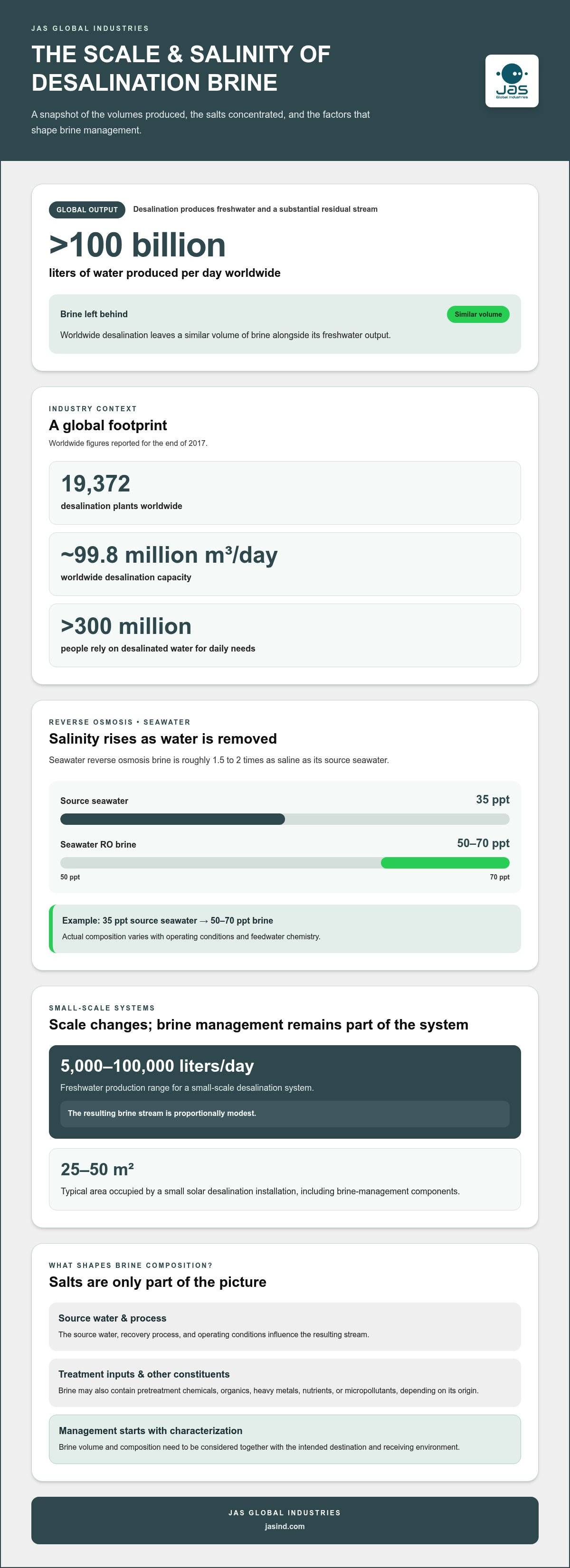
Desalination separates freshwater from a concentrated residual stream. Worldwide, desalination produces more than 100 billion liters of water per day and leaves a similar volume of brine. The stream’s chemistry depends on its source water, treatment chemicals, and recovery process. Those factors shape brine management, including whether discharge or further treatment is practical.
Reverse osmosis removes water through a membrane, concentrating dissolved salts in the remaining stream. Brine from seawater reverse osmosis is roughly 1.5 to 2 times as saline as its source seawater. For example, seawater at 35 ppt may produce brine with salinity between 50 and 70 ppt. Actual composition varies with operating conditions and feedwater chemistry.
Salts are only part of the picture. Desalination brine may also contain pretreatment chemicals, organics, and heavy metals that affect treatment choices and the receiving environment. Brine from municipal wastewater reuse can carry dissolved salts, metals, nutrients, and micropollutants after ultrafiltration, reverse osmosis, and advanced oxidation. Its composition differs from seawater brine, even when both streams have high salinity.
Brine forms beyond seawater plants, too. Brackish-water desalination, mining, geothermal operations, oil and gas production, chemical manufacturing, power generation, and advanced water reuse can all generate hypersaline streams. The source process helps identify likely dissolved constituents. That distinction matters: a treatment suited to seawater salts may not address metals or organics in an industrial wastewater concentrate.
In the United States, state and local requirements can vary by disposal route and site-specific permit conditions. Surface-water discharge, sewer discharge, deep-well injection, evaporation ponds, and land application follow different pathways, so requirements for one destination shouldn’t be assumed to apply to another.
U.S. operators generally need a discharge permit, and some jurisdictions also require an environmental impact assessment before a new system is commissioned. Applicable permit conditions depend on the project’s location and discharge pathway; there is no single nationwide numerical limit for hypersaline brine established here.
Disposal planning starts by characterizing the brine’s volume and composition. Seawater desalination leaves behind roughly an equal volume of high-salinity water for every liter of freshwater produced. That scale makes it important to distinguish a steady discharge stream from a concentrated residual. A reliable assessment connects feedwater, membrane treatment, chemical inputs, and the intended destination before the next brine-management step is selected.
At the end of 2017, there were 19,372 desalination plants worldwide, and worldwide desalination capacity was roughly 99.8 million m3/day. Worldwide, >300 million people rely on desalinated water for their daily needs. These figures provide broader context for considering the volume and composition of residual streams across desalination systems.
A small-scale desalination system producing between 5,000 and 100,000 liters of freshwater per day generates a proportionally modest brine stream. A small solar desalination installation typically occupies around 25 to 50 square meters, including brine management components. Hydrochloric acid is used to clean desalination plant parts and is also used in chemical production and as a source of hydrogen, illustrating that plant operations involve materials beyond the concentrated residual stream itself.
Environmental, techno-economic, and life-cycle assessment
Compare brine strategies across treatment, energy, infrastructure, residuals, and environmental effects. The lowest operating expense alone may not reflect a project’s full life-cycle burden.
Treatment Cost Comparisons
Cost comparisons weigh chemical use against disposal infrastructure and energy requirements. A lower-cost process step can still leave costly residuals or require substantial site works.
This is a disposal range, not a chemical-treatment price.
These figures illustrate how destination and infrastructure shape capital needs. Chemical treatment instead contributes through reagent consumption, process performance, and the residual stream that remains for management. Evaporation ponds depend on land and site conditions; deep-well injection depends on suitable subsurface geology. Zero Liquid Discharge (ZLD) targets elimination of liquid effluent, but concentration and crystallization add energy and solids-handling demands.
- Compare capital works with recurring energy, chemical, maintenance, and residual-management needs.
- Include environmental effects, such as discharge impacts and the handling of concentrated solids.
- Assess feasibility against site constraints, including land, geology, electricity, and the receiving environment.
Per-Volume Treatment Costs
Per-volume treatment costs compare chemical use and process expenses with the quantity of brine handled. This view helps industrial operators assess operating conditions across treatment trains.
Chemical cost per cubic metre depends on the dose required for the brine’s composition and the process objective. Salinity, scaling potential, pretreatment needs, and compatibility with downstream equipment all influence consumption. A chemical stage that reduces fouling may also affect cleaning frequency and membrane operation, so looking at reagent use alone can miss connected process costs.
Life-cycle assessment extends the comparison beyond the treatment unit. It accounts for energy, equipment, chemical transport, water recovery, and final residual management. A crystallizer’s stated energy capacity is greater than 50 KWh/m3, making energy demand central to its evaluation. Producing chemicals locally at the point of use could reduce energy and costs associated with concentration and transport.
- Track chemical dosage alongside brine volume, recovery, and residual production.
- Compare the same treatment boundary across options, including pretreatment and final disposal.
- Include electricity and equipment needs when assessing concentration or crystallization.
For a project-level assessment, connect chemical treatment planning with the process goals, brine profile, and disposal route.
Fouling, scaling, and corrosion mitigation
Fouling, mineral scale, and corrosion can restrict flow, damage equipment, and complicate brine concentration. Controlling them helps protect membranes and supports reliable liquid treatment before discharge or injection.
Chemical Precipitation of Metals and Scale-Forming Ions
Chemical precipitation converts dissolved metals and scale-forming ions into solids that can be separated from brine. Operators adjust water chemistry to form precipitates from targeted constituents, then remove the solids through clarification or filtration. Chemical softening is one option for managing scale. Removing problem ions before further concentration can reduce deposits and limit solids forming inside downstream equipment.
Precipitation also changes what the plant must manage. Captured solids become a residual stream that needs suitable handling, while the treated liquid continues through the process. Effective treatment depends on the brine composition and the ions targeted. For example, a stream containing metals may need a different chemical adjustment from one dominated by hardness-related scale-forming ions.
Concentration raises the importance of this balance. Conventional reverse osmosis can theoretically concentrate brine to a maximum of 80,000 mg/L, although scaling potential may reduce the achievable concentration. Precipitation can remove selected ions, but it doesn’t eliminate every fouling mechanism. Operators must consider both the desired water recovery and the added solids volume when assessing treatment performance.
Fouling and Corrosion Mitigation
Fouling and corrosion control combines chemical treatment with operating strategies that protect process surfaces. Deposits can restrict flow, while corrosive conditions can threaten equipment integrity and interrupt production.
Before reverse osmosis, sodium hydroxide can adjust seawater acidity and help prevent membrane fouling. Chemical softening addresses scale-forming constituents, while scale inhibitors can limit crystal growth in brine-treatment systems. These methods have different roles: softening removes targeted ions, whereas an inhibitor helps keep scale from developing under process conditions.
Electrodialysis reversal offers a nonchemical way to control fouling. The electrode polarity is reversed several times an hour, helping remove fouling and scaling. This changes the process’s cleaning pattern but doesn’t eliminate the need to manage brine chemistry. Corrosion control also depends on the process environment, equipment materials, and chemical conditions. These factors influence inhibitor selection and the protection needed at each treatment stage.
- Track precipitation solids as well as treated-liquid quality.
- Match softening, inhibitors, and cleaning strategy to the specific fouling risk.
- Consider energy, recovery, and residual volume when selecting a concentration target.
Treatment technologies for hypersaline wastewater
Selecting chemical treatment for hypersaline brine disposal means matching pretreatment, concentration, contaminant control, and residual handling to the process. Reverse osmosis, electrodialysis, and thermal processes address different stages.
Pretreatment Chemicals and Toxicity Reduction
Pretreatment chemicals adjust feedwater or remove targeted constituents before later treatment stages. This matters because a chemical that controls membrane fouling doesn’t necessarily remove every toxic constituent.
Sodium hydroxide can pretreat seawater entering desalination by changing its acidity and helping prevent reverse-osmosis membrane fouling. Chemical softening can also manage scale-forming ions. These treatments address process conditions and specific dissolved compounds, rather than serving as universal toxicity-removal steps.
Brine may contain pretreatment chemicals, organics, and heavy metals, so treatment should reflect its composition. For wastewater reuse, the concentrate may also contain metals, nutrients, and micropollutants after ultrafiltration, reverse osmosis, and advanced oxidation. The right pretreatment depends on which constituents affect the next process or discharge destination.
Contaminant Removal Effectiveness
Chemical treatment effectiveness is assessed by the contaminants targeted and the quality of the stream after treatment. This distinction helps operators avoid treating removal as a single result for every dissolved constituent.
Chemical softening can reduce scaling potential by removing selected scale-forming ions. Precipitation can convert targeted dissolved constituents into solids for separation, while the remaining liquid still needs management. Reverse osmosis concentrates dissolved material rather than removing every constituent from the overall waste stream.
Zero Liquid Discharge aims to eliminate liquid effluents by maximizing water recovery and converting dissolved constituents into solid or reusable forms. A treatment train can combine initial nanofiltration to remove undesirable compounds with one or more electrodialysis stages. Results depend on the incoming wastewater and treatment objectives; no single chemical stage addresses all salts, metals, organics, and micropollutants.
Selecting and Operating Treatment Systems
Selecting and operating a chemical treatment system means matching brine composition and treatment goals to the process stages. Concentration, recovery, fouling control, and residual handling affect one another.
- Characterize the stream: distinguish seawater brine from mining wastewater or advanced-reuse concentrate, since their constituents differ.
- Set the treatment objective: identify whether the priority is scale control, contaminant removal, water recovery, or reduced liquid discharge.
- Choose compatible stages: combine chemical pretreatment with membrane, electrochemical, or thermal processes where they address distinct needs.
Chemical treatment for hypersaline brine disposal may combine targeted pretreatment with membrane, electrochemical, or thermal stages. Monitor treated water, process performance, and separated solids during operation. Conventional reverse osmosis may face fouling and scaling as concentration increases; thermal treatment or crystallization adds energy and solids-handling demands. Selection must also account for the disposal route and applicable regulations. Evaporation, discharge, and resource recovery create different residual-management needs, so the operating plan should reflect the intended destination.
Adsorption, ion exchange, and sorbents
Adsorption, ion exchange, and sorbents target selected dissolved constituents rather than removing salinity as a whole. They are most useful when a brine stream contains a contaminant that needs selective capture before discharge, recovery, or further concentration.
Adsorption transfers dissolved compounds from water onto a solid surface. Activated carbon is commonly used to capture some organic compounds, while other sorbents can target specific metals or contaminants. In hypersaline brine, high concentrations of dissolved salts can affect how target compounds interact with a sorbent. Performance therefore depends on the brine composition, the target contaminant, and contact with the sorbent.
Ion exchange uses a resin or other exchange material to swap ions in the liquid for ions held on the material. It can selectively capture certain dissolved ions, but abundant salts in hypersaline streams may compete for exchange sites. That competition can reduce selectivity or shorten the time before the material needs regeneration. Feed chemistry is therefore central to choosing an exchange process.
Sorbent choice depends on the treatment objective. Activated carbon may suit some organic compounds; ion-exchange resins address selected ionic constituents; mineral-based sorbents can be considered for targeted contaminants. These materials aren’t interchangeable. A material that captures one compound may leave salts, metals, or other organics in the liquid, so the treatment train must account for what remains.
High salinity also affects how spent media is managed. Adsorption sites become occupied, and ion-exchange capacity is used as ions accumulate on the material. Regeneration can restore capacity, but it creates a smaller, more concentrated waste stream that still needs management. Without regeneration, spent sorbent becomes a solid residual requiring an appropriate handling route.
These methods can complement reverse osmosis or thermal treatment. For example, a sorbent stage may target an organic contaminant before membrane concentration, while ion exchange may capture a selected ion from a process stream. Neither step alone removes the full dissolved-salt load. Evaporation ponds and other disposal routes still need to be assessed against the resulting liquid and solid residuals.
Evaluate a sorbent against the target compound, competing ions, regeneration needs, residual handling, and the downstream process. A practical assessment compares influent and treated-water chemistry, then tracks media exhaustion and regeneration waste. Those criteria reveal whether selective capture supports desalination operations or adds a residual-management burden. Explore brine-treatment options as you evaluate how selective treatment could fit within a wider process.
JAS Global Industries: Fertilizer Anti-caking Agents
JAS Global Industries offers Fertilizer Anti-caking Agents for fertilizer handling, a separate application from hypersaline brine treatment. They’re relevant when fertilizer materials tend to cake during storage or processing; they don’t remove dissolved salts or replace brine-management processes.
For operations spanning multiple sectors, JAS Global Industries also offers Mining Grinding Aids and Mining Flotation Collectors. These products support mining processes, while the right brine treatment still depends on stream composition, treatment goals, and disposal route. Keeping the applications distinct helps teams match each chemical solution to its process.
If your operation also needs fertilizer or mining process chemicals, contact JAS Global Industries to discuss the relevant application.
Turn treatment priorities into a practical plan
The next step is to connect your brine-management objective with the process constraints that matter most: controlling scale, protecting equipment, managing residuals, or preparing a stream for its final destination. A focused chemical treatment plan for hypersaline brine disposal starts with those priorities and considers how each treatment stage affects the next.
For water-treatment applications, scale and corrosion inhibitors can support process protection. JAS Global Industries also offers Fertilizer Anti-caking Agents, Fertilizer Dust Suppressants, and Mining Flotation Collectors for distinct fertilizer and mining applications. Matching each chemical category to its intended process keeps the operational goal clear.
Discuss your treatment priorities and industrial chemical needs with JAS Global Industries. A well-defined next step can help your team move from process challenges toward a considered treatment approach.
Frequently Asked Questions
How can you treat high salinity/ hypersaline organic wastewater?
Treat high-salinity organic wastewater by addressing organic contaminants and dissolved salts as separate challenges. First, determine whether the organics are dissolved or suspended, then select a compatible removal process, such as adsorption for certain organic compounds. Membrane or thermal processes can then concentrate the remaining stream. For example, wastewater containing both organics and salts may need organic removal before concentration or final disposal.
What are common brine disposal methods?
Common brine disposal methods include surface-water discharge, sewer discharge, deep-well injection, evaporation ponds, and land application. Dilution with another water stream may also take place before release. The appropriate route depends on brine composition, site conditions, available infrastructure, and the receiving environment. For example, an inland facility may assess evaporation or injection, while a coastal plant may evaluate discharge and how the receiving water handles the concentrated stream.
What chemical treatment methods are used for hypersaline brine before disposal?
Chemical treatment for hypersaline brine disposal can include pH adjustment, softening, precipitation, scale inhibition, corrosion inhibition, and biocide treatment when biological growth affects the process. Each method serves a distinct purpose. Precipitation, for example, transfers selected dissolved constituents into solids for separation, while inhibitors help manage deposits or corrosion during treatment. Treatment should also account for residual liquid and separated solids.
What are the environmental and worker-safety risks of treating hypersaline brine with chemicals?
Environmental risks include releasing concentrated salts, metals, organics, or treatment-chemical residues into an unsuitable receiving environment. Workers may face exposure through splashes, incompatible chemical mixtures, or handling during storage and dosing. A process-specific hazard review, compatible storage, controlled dosing, and monitoring of treated liquid and solids help manage these risks. Discharge conditions and site procedures guide safeguards and residual handling, including how separated solids are stored and moved.