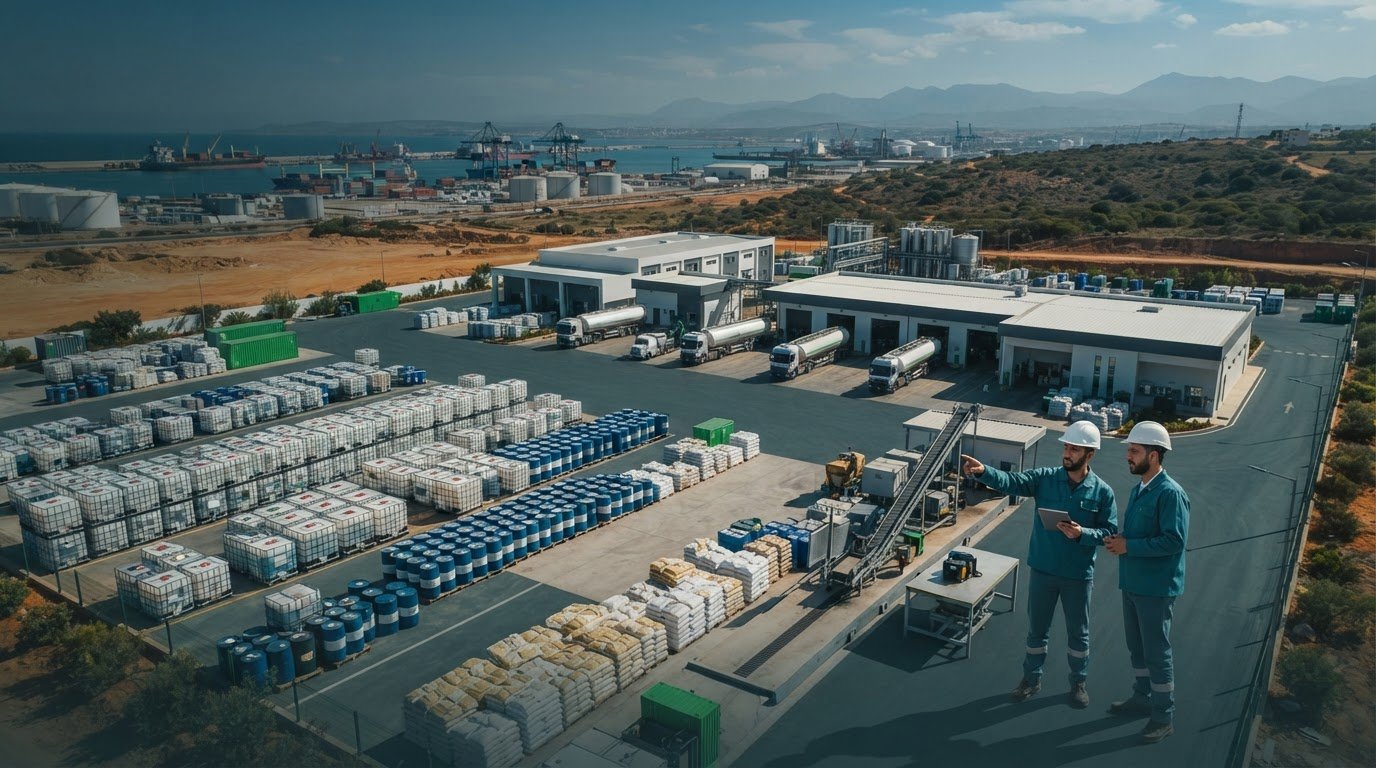


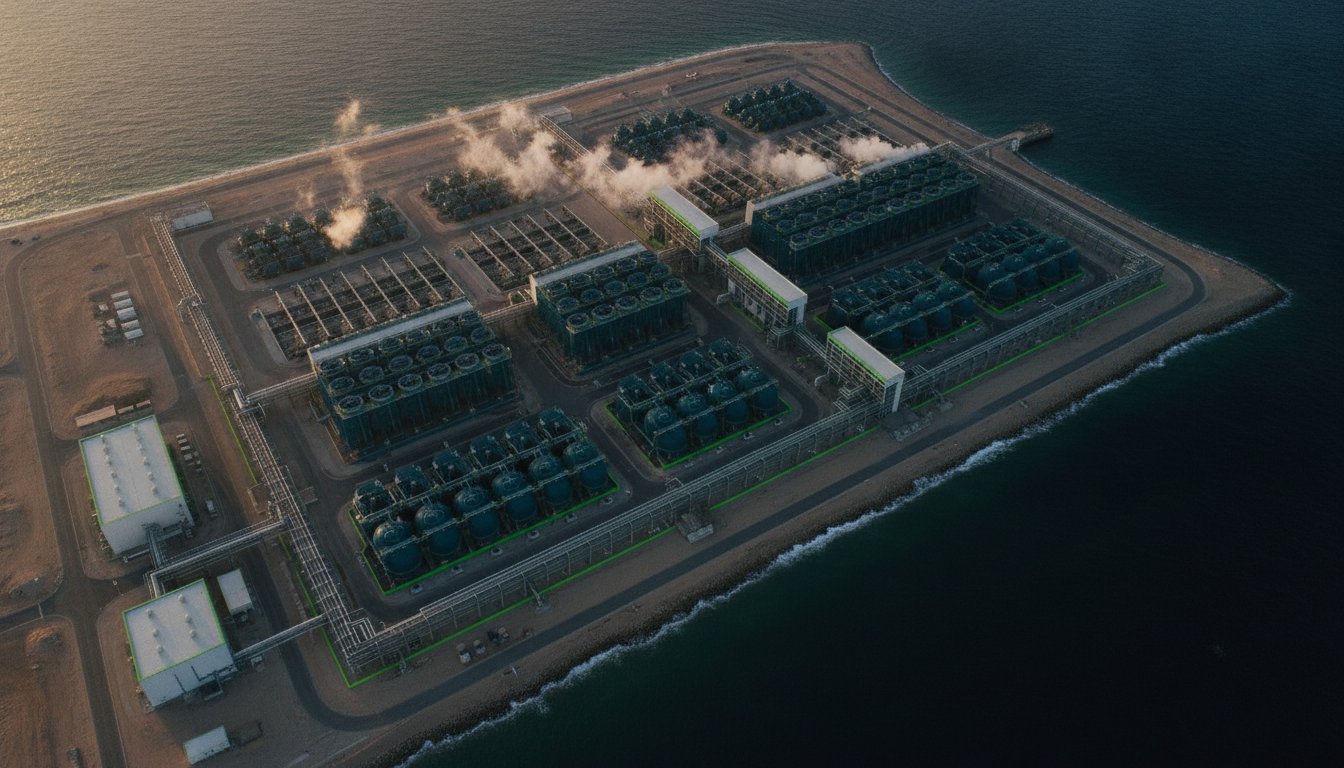
Water security for millions of people relies on industrial assets that are constantly under siege from the very elements they process. You understand the immense pressure of maintaining a Multi-Stage Flash (MSF) or Multi-Effect Distillation (MED) plant where even minor mineral deposits can cripple efficiency. High operational costs from frequent descaling and the looming threat of corrosion-related failure are more than just technical hurdles; they are direct risks to the stability of the communities and industries you serve.
This article demonstrates how advanced Thermal Desalination Chemicals act as a vital guardian for your infrastructure. By utilizing specialized antiscalants and corrosion inhibitors, you can optimize thermal performance and ensure long-term operational reliability. We'll detail how these precise chemical formulations protect your investment, improve your Gained Output Ratio (GOR), and guarantee the stable, high-purity water production required for modern municipal needs. Discover the technical precision required to transform high-maintenance plants into reliable bastions of resource security.
Key Takeaways
- Learn how chemical precision stabilizes MSF and MED systems to maintain high thermal efficiency and Gained Output Ratio (GOR).
- Understand the role of specialized Thermal Desalination Chemicals in preventing scale and corrosion to extend the lifespan of critical infrastructure.
- Identify how Top Brine Temperatures influence scale kinetics and dictate the specific chemical strategy required for operational reliability.
- Master the essential steps of seawater analysis and dosing management to guarantee consistent water quality for municipal or industrial use.
- Discover the advantages of tailor-made formulations over generic commodities in securing the future of global water resources.
The Critical Role of Chemistry in Thermal Desalination
Thermal desalination stands as a cornerstone of global resource stability. It transforms saline water into a life-sustaining resource through thermal energy. These multi-million dollar assets operate in harsh, corrosive environments. Without precise chemical control, their structural integrity and performance decline rapidly. We view chemical intervention as a foundational element of industrial water treatment. It isn't just about routine maintenance. It's about protecting the infrastructure that supports entire cities. Chemical precision ensures these plants remain reliable pillars of modern society.
Understanding MSF and MED Processes
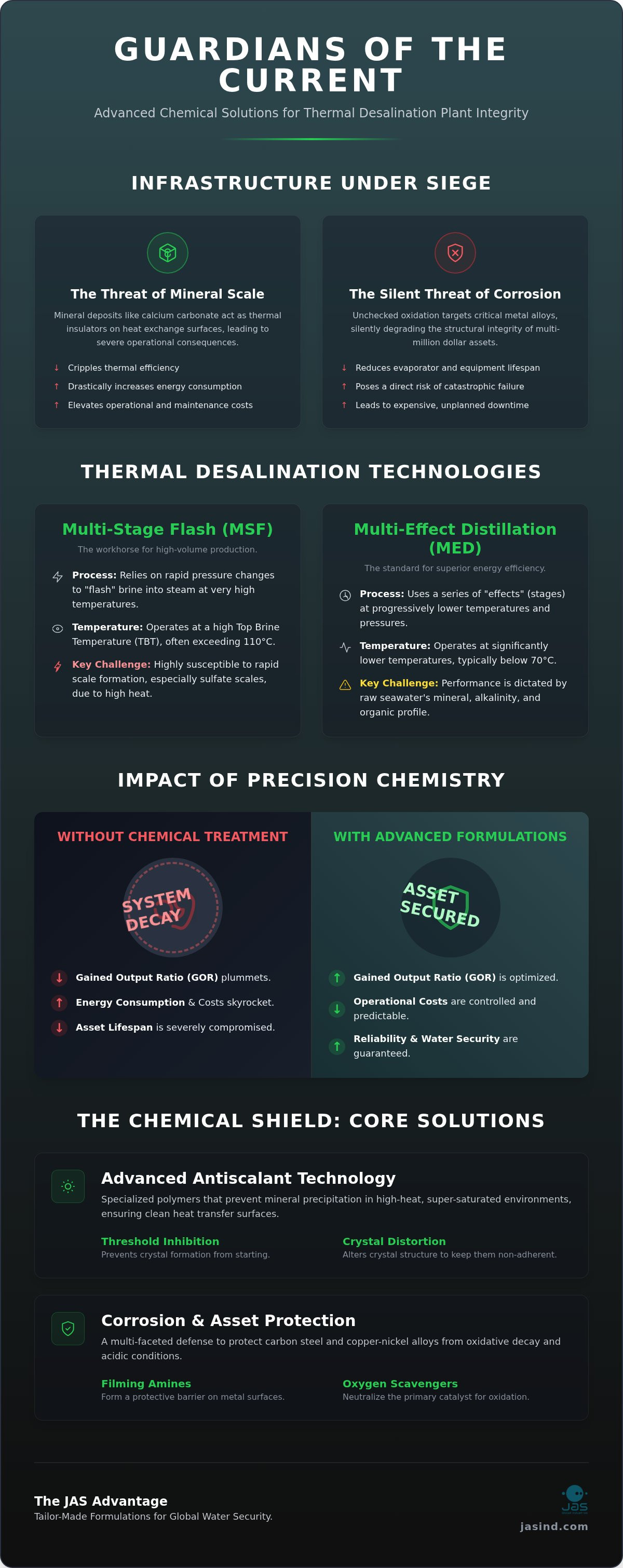
Thermal systems primarily utilize two distinct desalination processes to achieve high-purity output. Multi-Stage Flash (MSF) systems remain the standard for high-volume production. They rely on rapid pressure changes to boil water at high temperatures, often exceeding 110 degrees Celsius. Conversely, Multi-Effect Distillation (MED) offers superior energy efficiency by operating at lower temperatures through successive stages. Both methods are inherently vulnerable to the raw seawater's mineral profile. Variations in salinity levels, alkalinity, and organic content dictate the specific chemical intervention strategy required to maintain operational stability. High-performance Thermal Desalination Chemicals must be tailored to these specific thermal kinetics to be effective.
The Cost of Chemical Neglect
Scale formation acts as a thermal insulator. When calcium carbonate or sulfate deposits build up on heat exchange surfaces, the Gained Output Ratio (GOR) drops. This forces the plant to consume significantly more energy to produce the same volume of water. This inefficiency compounds operational costs and strains the facility's environmental footprint. Beyond efficiency, corrosion represents a silent threat to evaporator longevity. Unchecked oxidation targets carbon steel and copper-nickel alloys. This leads to catastrophic equipment failure and expensive downtime. Thermal desalination chemicals are specialized reagents designed to prevent mineral precipitation and metal oxidation in high-heat environments. By deploying these formulations, operators establish an invisible shield that preserves asset value. This proactive protection ensures that water production remains stable, predictable, and secure for years to come.
Core Chemical Solutions for Thermal Desalination Plants
The operational reliability of a desalination facility depends on the chemical synergy within its thermal circuits. Maintaining a multi-million dollar asset requires more than generic additives. It demands a suite of high-performance Thermal Desalination Chemicals engineered for extreme environments. These solutions act as the primary defense against the physical and chemical stressors that threaten to degrade heat exchange surfaces and compromise water purity. By implementing a targeted chemical regime, operators transition from reactive maintenance to a state of strategic asset protection.
Advanced Antiscalant Technology
Thermal stability is the most critical criteria for any antiscalant used in Multi-Stage Flash (MSF) systems. Scale formation occurs rapidly as seawater is heated toward the Top Brine Temperature (TBT). Advanced formulations utilize threshold inhibition to prevent mineral precipitation even at high levels of super-saturation. These chemicals also employ crystal distortion. This mechanism alters the structure of developing crystals, ensuring they remain non-adherent and easily dispersed in the brine flow. While phosphonate-based products offer robust calcium carbonate control, modern polymer-based formulations provide superior performance against sulfate scales at higher temperatures. Selecting the correct chemistry is essential for maintaining the heat transfer coefficients required for peak efficiency.
Corrosion Protection and Asset Integrity
Protecting the complex metallurgy of a thermal plant requires a multi-faceted approach. Evaporators often utilize a mix of carbon steel and copper-nickel alloys, each with unique vulnerabilities to oxygen and acidic conditions. Integrating specialized corrosion inhibitors into a management plan is non-negotiable for long-term security. Filming amines provide a protective barrier on metal surfaces, while oxygen scavengers neutralize the primary catalyst for oxidative decay. It's equally important to protect the vapor space and distillate collection systems where non-condensable gases can accumulate. For plant managers seeking to validate their current protection levels, specialized chemical audits can identify hidden vulnerabilities in the system's metallurgy.
Beyond scale and corrosion, operational stability requires managing the physical behavior of the brine. Antifoams are essential for controlling surface tension. They prevent brine carry-over, which would otherwise contaminate the high-purity distillate. Finally, non-oxidizing biocides are deployed in the intake systems. These agents control biofouling without introducing the aggressive oxidative stress associated with chlorine. This comprehensive chemical strategy ensures that every stage of the process is shielded from degradation. It transforms the plant into a resilient pillar of water security.
Comparing Chemical Strategies: MSF vs. MED Requirements
Operational reliability in thermal desalination requires a nuanced understanding of process thermodynamics. Multi-Stage Flash (MSF) and Multi-Effect Distillation (MED) systems utilize different mechanisms to produce high-purity water. Consequently, the application of Thermal Desalination Chemicals must be tailored to the specific kinetics of each method. A universal approach risks asset degradation and thermal efficiency loss. The primary differentiator remains the Top Brine Temperature (TBT). This variable fundamentally alters how minerals precipitate and how chemicals react within the internal environment.
Chemical Challenges in Multi-Stage Flash (MSF)
MSF plants are the high-volume workhorses of the industry. They often operate at TBTs exceeding 110°C. At these extreme temperatures, calcium sulfate scaling becomes a critical threat to the heat recovery sections. High-performance polymer dispersants are essential here. These reagents must possess exceptional thermal stability to prevent chemical decomposition under intense heat. MSF systems also involve high-velocity brine flow. This creates a dual challenge of scaling and erosion-corrosion. Chemical programs must account for these mechanical stressors to ensure the structural integrity of the flash chambers. Managing the brine concentration factor is vital to prevent the saturation limits of dissolved salts from being exceeded during the flashing process.
Chemical Optimization for Multi-Effect Distillation (MED)
MED systems operate at lower temperatures, typically between 65°C and 70°C. While this reduces the risk of certain high-temperature scales, it introduces a different precipitation profile. Scaling in MED often involves calcium carbonate and magnesium hydroxide. The thin-film heat transfer surfaces in MED are highly sensitive to even minor fouling. A microscopic layer of scale can drastically reduce the Gained Output Ratio (GOR). There's a significant synergy between surfactant chemistry and heat transfer efficiency in these units. Surfactants improve the wetting of the heat exchanger tubes. This ensures a uniform brine film and prevents "dry spots" where scale nuclei typically form.
Non-condensable gases (NCGs) such as oxygen and carbon dioxide also influence chemical performance. In MSF, NCGs are often released in the initial stages, requiring robust vapor-space protection. In MED, the vacuum conditions make NCG removal and the subsequent corrosion inhibition even more critical. Effective Thermal Desalination Chemicals must remain active across these varying pressure and temperature gradients to provide total system security. By matching the chemical strategy to the specific evaporator design, operators can maintain the stability of their water production infrastructure.
Operational Best Practices for Chemical Dosing and Monitoring
Precision defines the boundary between asset protection and operational waste. Even the most advanced Thermal Desalination Chemicals cannot perform without a rigorous dosing framework. Establishing a baseline begins with a comprehensive seawater analysis. This isn't a one-time event. It's a continuous process of understanding the seasonal shifts in salinity, organics, and mineral content. Implementing a robust chemicals management plan ensures that every reagent is handled safely and applied with surgical accuracy across the plant. Monitoring heat transfer resistance and GOR in real-time allows operators to adjust dosing before scaling becomes irreversible.
5 Steps to an Optimized Dosing Strategy
A systematic approach to chemical application prevents the scaling and corrosion discussed in previous chapters. Follow these steps to secure your infrastructure:
- Step 1: Conduct a seasonal seawater chemistry profile to account for temperature and salinity fluctuations.
- Step 2: Perform a thermodynamic simulation of scale potential to predict mineral behavior at your specific Top Brine Temperature.
- Step 3: Select thermally stable antiscalants that won't degrade under high-heat conditions.
- Step 4: Calibrate dosing pumps regularly to ensure precise ppm delivery and prevent chemical over-dosing.
- Step 5: Monitor distillate conductivity and brine chemistry daily to catch performance drifts early.
Troubleshooting Performance Declines
Sudden drops in the Gained Output Ratio (GOR) often signal a chemical imbalance. Heat transfer resistance increases when scaling occurs, necessitating immediate intervention. One common issue is 'Carry-over', where brine droplets contaminate the high-purity distillate. This often stems from improper antifoam dosing or fluctuating surface tension. Specialized Thermal Desalination Chemicals ensure that surface tension remains stable even under vacuum conditions. When performance reaches a critical threshold, a chemical 'Clean-In-Place' (CIP) becomes necessary to restore the thermal units. Technical audits play a vital role here. They identify dosing inefficiencies that are often invisible to standard monitoring equipment. A 1% increase in thermal efficiency through chemical optimization can save large-scale plants millions in annual energy costs. To validate your current dosing precision and identify potential savings, request a technical audit from our specialized consulting team.
The JAS Advantage: Tailor-Made Formulations for Global Security
The long-term survival of desalination infrastructure depends on the chemical partner chosen to defend it. While engineering firms design the hardware, the operational life of that asset is dictated by the chemistry flowing through it. Generic commodities often fail to address the specific mineral kinetics of a local site. JAS Global Industries provides specialized Thermal Desalination Chemicals that are engineered for specific plant profiles. We don't just supply reagents; we provide the invisible shield that ensures multi-million dollar assets operate at peak efficiency for decades. This commitment to precision transforms a mere supplier relationship into a vital global partnership.
Our deep expertise in mining solutions allows us to solve complex water chemistry challenges that others find insurmountable. The same principles of mineral separation and crystal inhibition used in the world's most demanding extraction environments are refined here to protect desalination evaporators. By leveraging this cross-industry knowledge, we develop formulations that handle high-salinity and high-temperature environments with unparalleled reliability. This technical synergy is what allows us to act as a foundational industry presence, focused on the fundamental needs of society.
R&I Centers: The Heart of Chemical Innovation
Innovation at JAS happens within our dedicated Research and Innovation centers. We don't rely on theoretical models. We simulate the exact operating conditions of your facility, including Top Brine Temperature and salinity gradients, to test chemical efficacy before it reaches your site. This is particularly vital in regions like the Arabian Gulf, where seawater salinity and temperatures reach extreme levels. Our R&I focus includes:
- Sustainable Formulations: Developing the next generation of phosphorus-free and eco-friendly antiscalants to meet evolving environmental standards.
- Plant Simulation: Testing chemical performance against specific seawater chemistry profiles to ensure maximum GOR stability.
- High-Salinity Success: Proven success in maintaining heat transfer coefficients in the most challenging maritime environments in the world.
Partnering for Long-Term Reliability
Resource security is a global responsibility. We act as an experienced, wise, and deeply integrated leader by providing the technical expertise required to keep water flowing. From our headquarters in Dubai, the global hub for thermal desalination, we offer more than just logistics. We provide technical consulting and on-site process optimization that ensures your chemical program evolves with your plant's changing needs. This "Global Guardian" approach prioritizes the stability of your infrastructure above all else. Our technical audits identify the precise point where chemistry meets mechanical efficiency, ensuring that your facility remains a resilient pillar of water security.
Contact JAS Global Industries for a Technical Audit of your Desalination Plant to ensure your infrastructure is performing at its maximum potential and remains protected for the long term.
Securing the Future of Global Water Infrastructure
Thermal desalination remains a vital pillar for society's most basic needs. Ensuring its reliability requires more than just high-quality hardware; it demands a strategic commitment to chemical precision. By matching specialized Thermal Desalination Chemicals to the unique kinetics of your plant, you protect multi-million dollar assets from scaling and corrosion while maximizing thermal efficiency. This transition from reactive maintenance to proactive protection is the foundation of long-term resource security.
We've explored how tailor-made formulations and rigorous dosing protocols prevent degradation and preserve the Gained Output Ratio (GOR). Whether managing high-temperature MSF units or sensitive MED thin-films, the right chemistry acts as a vital guardian of your production capacity. Since 1998, our team has partnered with global leaders to optimize plant yields through our Dubai-based technical support and custom-formulated antiscalants designed for extreme TBT. Optimize Your Desalination Performance with JAS Technical Consulting and secure the operational reliability of your facility today. Your commitment to industrial excellence ensures a stable future for the communities you serve.
Frequently Asked Questions
What are the primary types of scale found in thermal desalination plants?
Calcium carbonate and calcium sulfate are the primary mineral scales that threaten thermal units. Magnesium hydroxide also precipitates when brine temperatures exceed certain thresholds. These deposits act as thermal insulators on heat exchange tubes, forcing the system to consume more energy. Our specialized Thermal Desalination Chemicals utilize threshold inhibition to keep these minerals in solution. This prevents the hard crystallization that leads to catastrophic equipment failure and expensive descaling procedures.
How do thermal desalination antiscalants differ from RO antiscalants?
Thermal antiscalants are specifically engineered to remain chemically active at temperatures exceeding 110 degrees Celsius. RO antiscalants are designed for ambient pressure-driven systems and often degrade under the intense heat of an MSF or MED evaporator. Using the wrong formulation leads to rapid scale formation and asset damage. We develop high-temperature stable polymers that maintain their crystal distortion properties even in the most aggressive thermal environments.
Can chemical optimization really improve the Gained Output Ratio (GOR)?
Chemical optimization is the most cost-effective way to sustain a high Gained Output Ratio (GOR). When heat transfer surfaces remain free of mineral deposits, the system requires less steam to produce the same volume of distillate. This direct link between chemical precision and energy efficiency is why we prioritize technical audits. Even a minor improvement in thermal performance translates into significant annual savings for large-scale municipal and industrial facilities.
Is it necessary to use biocides in the thermal desalination process?
Biocides are essential for protecting the intake and pre-treatment infrastructure from biofouling. While the high temperatures inside the evaporators eventually kill most organisms, the initial stages of the plant are vulnerable to algae and bacteria. These organisms create biofilms that restrict flow and promote localized corrosion. We provide non-oxidizing biocides that control biological growth without introducing the aggressive oxidative stress associated with traditional chlorine treatments.
What is the impact of Top Brine Temperature (TBT) on chemical selection?
Top Brine Temperature (TBT) dictates the kinetics of mineral precipitation and the thermal stability requirements of the inhibitors. Systems operating at high TBT, such as MSF, require robust polymer dispersants that don't break down under heat. Lower TBT systems like MED have different scaling profiles, often favoring calcium carbonate. We tailor our Thermal Desalination Chemicals to these specific temperature gradients to ensure consistent protection and operational reliability across all evaporator stages.
How often should a thermal desalination plant undergo a technical chemical audit?
We recommend a comprehensive technical chemical audit at least once per year or whenever significant performance shifts occur. These audits identify hidden dosing inefficiencies and metallurgical vulnerabilities before they lead to failure. Since seawater chemistry and plant conditions change over time, regular assessments ensure your chemical regime remains optimized. Our team provides these professional audits as part of our commitment to being a foundational partner in your water security.
Are JAS thermal desalination chemicals compatible with all evaporator materials?
Our formulations are meticulously tested for compatibility with all standard evaporator materials, including carbon steel and copper-nickel alloys. We recognize that thermal plants utilize complex metallurgy that is sensitive to specific chemical environments. Our corrosion inhibitors create a protective barrier that preserves the structural integrity of these diverse metals. This holistic approach ensures that every component of your infrastructure is shielded from both scaling and oxidative decay.
What is the environmental impact of thermal desalination chemical discharge?
Modern chemical strategies focus on minimizing the environmental footprint of brine discharge. We are dedicated to developing the next generation of eco-friendly and phosphorus-free antiscalants that meet strict regulatory standards. These formulations provide high performance while ensuring that the discharge remains compatible with local maritime ecosystems. Protecting global water resources means securing both the production of fresh water and the health of the surrounding environment.