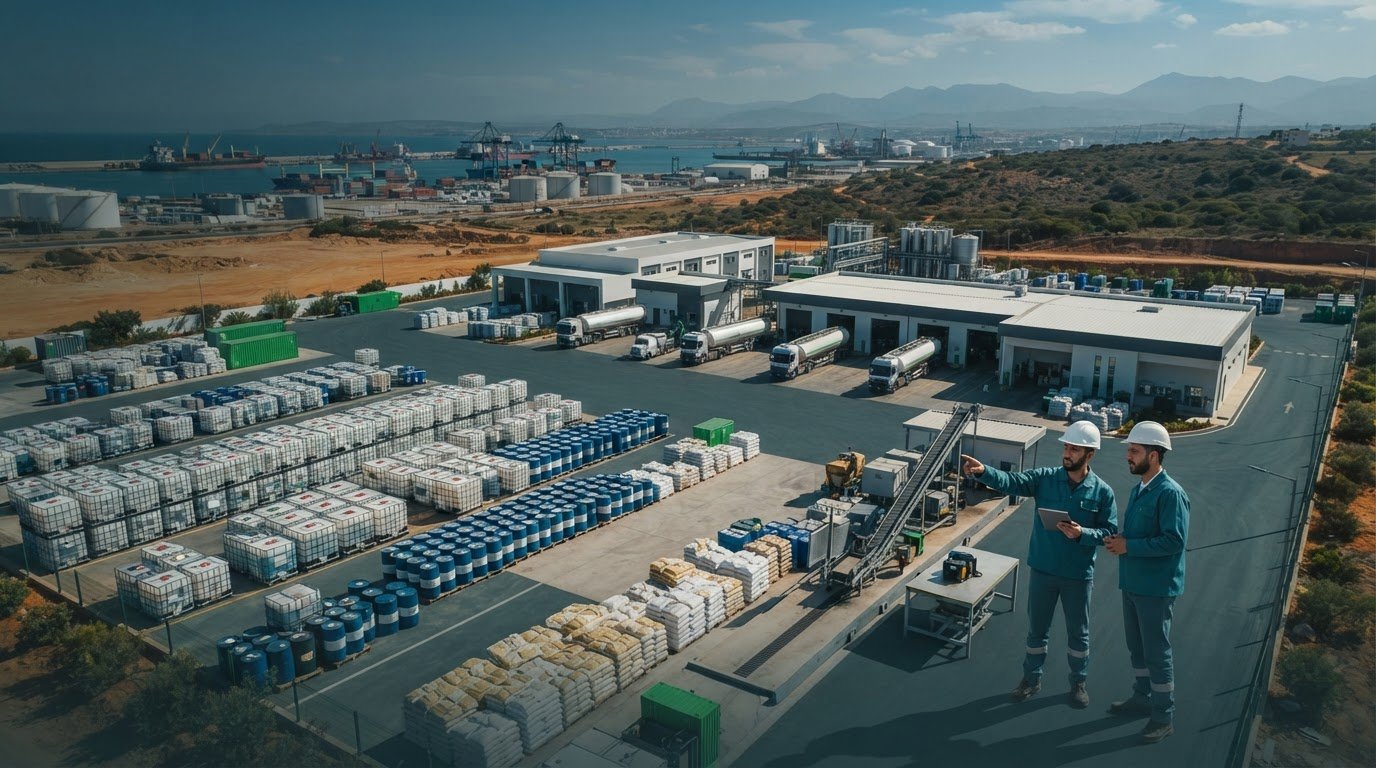


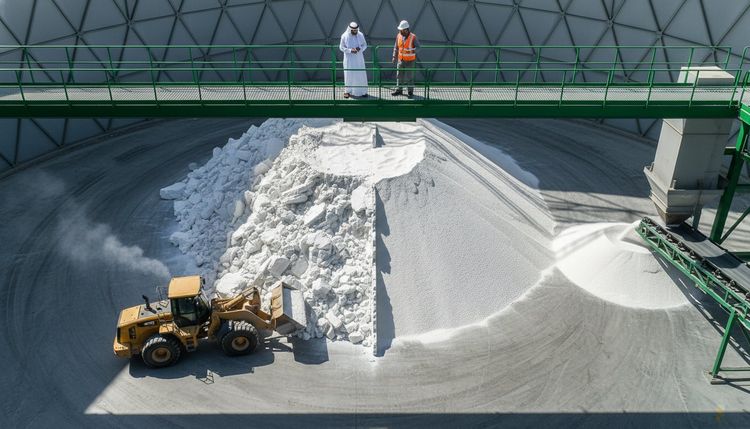
Fertilizer caking is no longer just a warehouse nuisance; it's a silent tax on global food security that drains millions from industrial margins in a year defined by record volatility. We understand that in a market where retail urea prices hit $826 per ton in March 2026, every lost ton compromises your ability to support global agricultural stability. In this high-stakes environment, unplanned downtime from equipment blockages or customer rejections due to "lumpy" product isn't just frustrating; it's financially devastating. Understanding the full economic impact of fertilizer caking is the first step toward reclaiming your operational profitability.
We'll show you how to move beyond viewing chemical additives as a simple cost center and instead treat them as a vital safeguard for your supply chain. You'll discover a clear framework for calculating caking-related losses and see evidence of how custom anti-caking formulations improve long-term margins. We'll also explore strategies to ensure product flowability during maritime export, helping you navigate the strict new ISO 10249:2026 standards while protecting your bottom line and your reputation as a reliable global partner.
Key Takeaways
- Quantify the three pillars of loss—direct waste, manual labor, and reputational damage—to reveal the true economic impact of fertilizer caking on your bottom line.
- Understand the science of crystal bridging and hygroscopicity to prevent product degradation during long-term storage and volatile temperature shifts.
- Mitigate maritime logistics risks by identifying the high-humidity factors that lead to costly port penalties and discharge delays during export.
- Evaluate the ROI of advanced anti-caking formulations versus commodity oils using a precise framework for measuring additive efficiency.
- Align your operational excellence with the broader mission of global food security through sustainable chemical solutions and the JAS Cares initiative.
The Hidden Bill: Quantifying the Economic Impact of Fertilizer Caking
Fertilizer caking is the physical-chemical bonding of individual granules into a solid mass. This occurs when moisture, pressure, and temperature fluctuations trigger The Mechanism of Caking, creating solid bridges between particles during storage or transit. For a global supplier, this isn't a minor technical inconvenience; it's a structural failure in the supply chain. The economic impact of fertilizer caking manifests as a hidden bill that erodes margins long before the product reaches the farmer's field.
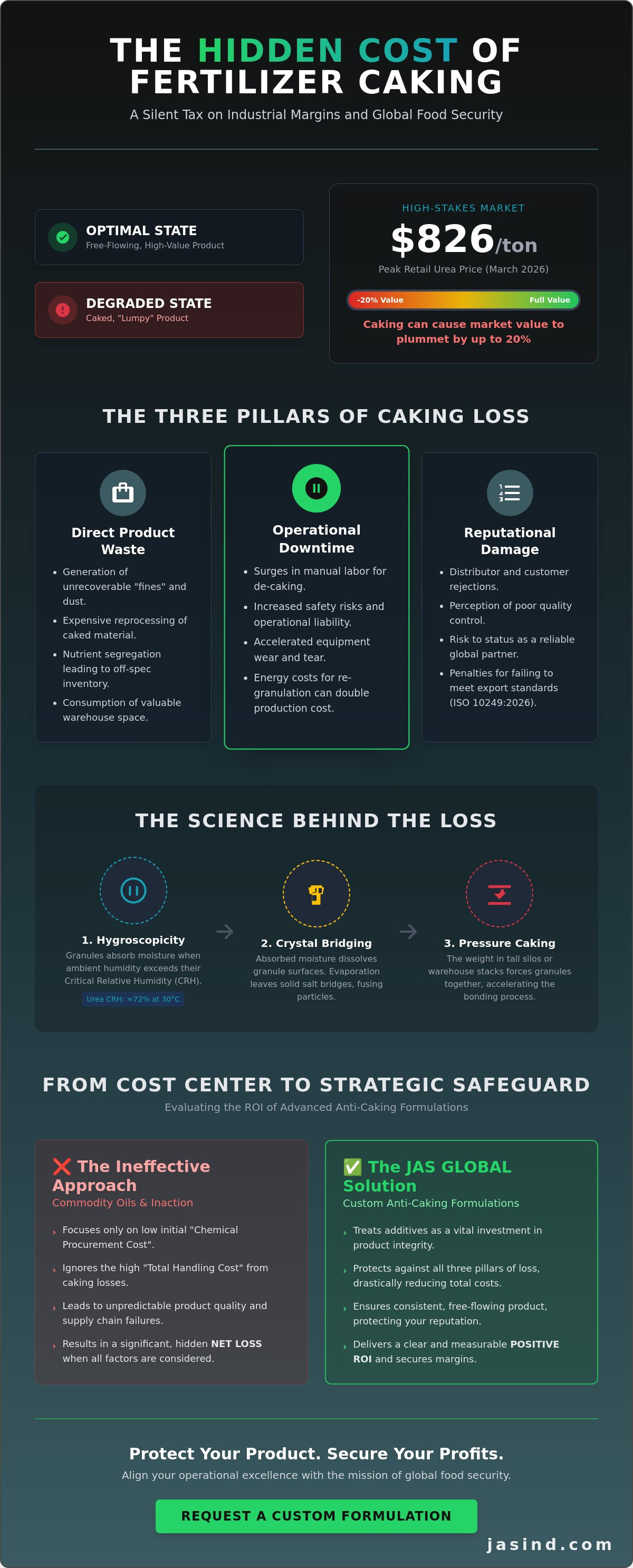
We identify three primary pillars of caking loss: direct product waste, surges in manual labor, and lasting reputational damage with distributors. When NPK (Nitrogen, Phosphorus, Potassium) blends lose their free-flowing properties, their market value can plummet by up to 20%. Buyers expect precision and reliability. A lumpy product suggests poor quality control and creates application nightmares for the end-user. To mitigate these risks, industry leaders must look beyond the simple "Chemical Procurement Cost" of anti-caking agents and instead analyze the "Total Handling Cost" of the entire product lifecycle.
Direct Product Loss and Nutrient Degradation
Breaking up caked batches inevitably generates "fines" and dust. This fine material is often unrecoverable or requires expensive reprocessing, representing a direct loss of high-value raw materials. Beyond volume, caking causes nutrient segregation. In a blended product, specific nutrients may clump together while others remain loose. This leads to inconsistent application rates that fail to meet guaranteed analysis standards. Ultimately, severe caking leads to unsellable "off-spec" inventory that sits idle in warehouses, consuming valuable space and devaluing your assets.
Operational Downtime and Labor Surges
Operational efficiency disappears the moment equipment stops. Manual de-caking requires significant labor hours, often involving hazardous conditions that increase safety risks and operational liability. When caked material enters industrial blenders or spreaders, it causes accelerated equipment wear and tear, leading to premature component failure and unplanned maintenance. If the material is too degraded to sell in its current state, the energy costs associated with re-granulation effectively double the production cost per ton. These hidden expenses turn a theoretically profitable batch into a net loss for the facility.
The Mechanism of Loss: Why Moisture and Temperature Erode Profits
Chemical volatility is a direct threat to industrial margins. The economic impact of fertilizer caking is most aggressive when environmental variables are left unmanaged. While the previous section detailed the visible "bill" of caking, the root cause lies in the delicate relationship between fertilizer chemistry and the atmosphere. Every granule possesses a unique level of hygroscopicity, its tendency to absorb moisture from the air. When ambient humidity exceeds a grade's Critical Relative Humidity (CRH), the granule begins to actively pull water from the air, initiating a chain reaction of degradation.
Hygroscopicity and the Critical Relative Humidity (CRH)
Crossing the CRH threshold triggers immediate financial risk. For instance, Urea has a CRH of approximately 72% at 30°C, but when blended with Ammonium Nitrate, that threshold can drop significantly, making the mixture far more sensitive to moisture. This sensitivity creates a binary choice for operators: invest heavily in climate-controlled storage or deploy high-performance anti-caking agents that provide a protective barrier. While climate control requires massive capital expenditure and ongoing energy costs, chemical additives offer a scalable, cost-effective alternative to maintain product integrity in non-ideal environments.
Once moisture is absorbed, the "Crystal Bridging" phenomenon begins. As temperatures fluctuate, the absorbed moisture dissolves a small portion of the granule surface. When the moisture subsequently evaporates, it leaves behind solid salt bridges that fuse granules together. In tall silos or high warehouse stacks, "Pressure Caking" exacerbates this. The sheer weight of the pile forces these granules into closer contact, accelerating the bonding process. Utilizing Coating as a preventative measure during the manufacturing phase is essential to disrupt these physical-chemical bonds before they solidify.
Thermal Cycling and Phase Transitions
Temperature fluctuations during transport lead to repeated recrystallization. In regions like Riyadh or Cairo, diurnal temperature cycles are extreme. The intense heat of the day followed by rapid cooling at night causes the fertilizer to "breathe." This cycle forces moisture in and out of the granules, strengthening crystal bridges with every transition. This is particularly dangerous for Ammonium Nitrate, which undergoes specific phase transitions at common storage temperatures. These internal structural shifts can cause the granule to swell and eventually shatter into dust, destroying the product's physical quality and market value. Protecting these global export volumes requires thermal-stable agents that maintain a consistent coating regardless of the external environment.
Supply Chain Disruption: Maritime Logistics and Export Risks
Global trade routes are the arteries of food security. When fertilizer is shipped in bulk across high-humidity maritime corridors, the chemical stability of the cargo determines its economic viability. The economic impact of fertilizer caking is amplified during these long-duration voyages where temperature and moisture are impossible to control completely. If a shipment arrives at its destination as a solidified mass rather than free-flowing granules, the logistics chain breaks down. This failure causes material loss and imposes additional costs that can erase the profit margin of an entire maritime contract.
Maintaining "free-flowing" status isn't just a preference; it's a standard requirement for international fertilizer tenders. Failure to meet this specification often triggers heavy financial penalties or outright rejection of the cargo. In a market constrained by 2026 export restrictions from major producers like China and Russia, every ton must arrive in optimal condition. Systemic delays caused by caked cargo ripple through the global market, disrupting the Just-In-Time (JIT) delivery schedules that farmers depend on for seasonal planting windows.
The Cost of Port Congestion and Demurrage
Unloading caked fertilizer is a slow, labor-intensive process that creates significant port congestion. When cargo is "hard-to-discharge," vessels remain at the berth far longer than scheduled. This triggers vessel demurrage fees, which often range from $15,000 to $30,000 per day. Critical logistical hubs like Dubai and Alexandria are particularly sensitive to these delays. A single caked shipment can block a berth, causing a backlog of other vessels and leading to contract cancellations from buyers who can't wait for the re-processing of damaged material.
Cross-Continental Storage Challenges
Long-term storage in tropical climates across Africa and Southeast Asia poses a constant threat to product integrity. High ambient humidity combined with "Stack Pressure" in high-volume export warehouses creates a perfect environment for caking. In these facilities, the weight of the fertilizer pile compresses the bottom layers, forcing granules together. To protect these assets, operators should explore our resources on anti-caking agents and study our guides on "Best Practices for Bulk Fertilizer Storage" and "Mitigating Stack Pressure in Tropical Warehousing" to ensure product flowability.
ROI Analysis: Custom Formulations vs. Commodity Coatings
Procurement teams often face the temptation of low-cost commodity oils. However, viewing chemical additives as a simple expense rather than a strategic investment is a costly oversight. The true economic impact of fertilizer caking is best mitigated through a rigorous ROI analysis that weighs the cost-per-ton against actual performance. While generic coatings might appear cheaper on a purchase order, their lack of specificity often leads to higher dosage requirements and inconsistent protection. In a market where retail urea prices averaged $826 per ton in March 2026, the cost of product failure far outweighs any marginal savings on chemicals.
To evaluate these solutions accurately, we recommend a framework centered on "Additive Efficiency." This metric measures the grams of additive required per ton of fertilizer to achieve a target flowability score. Advanced surfactants and polymer-based agents from JAS Global Industries frequently achieve superior results at significantly lower dosage rates than generic alternatives. Beyond flowability, these high-performance agents often integrate dust suppression capabilities. This dual-functionality provides additional economic benefits by reducing material loss and lowering the costs associated with environmental and safety compliance.
The Myth of the 'Cheap' Coating
Lower-quality agents often fail to provide uniform coverage. This forces operators to increase dosage rates to compensate for poor performance, which paradoxically drives up the total cost of production. Excessively high dosages of commodity oils can leave an "oily" residue on the granules. This residue interferes with downstream blending and can even damage plastic packaging or conveyor belts. In 2026, the breakthrough in tailormade formulation ROI lies in the ability to achieve total surface protection with minimal chemical footprint.
Custom Chemistry and Plant Efficiency
We believe that every fertilizer plant is unique. Our Research and Innovation (R&I) centers develop site-specific formulations that account for your specific NPK grades, local humidity levels, and storage durations. This customized approach contrasts sharply with "off-the-shelf" solutions that ignore the specific chemical nuances of your product. The long-term value of our technical consulting and process optimization services lies in preventing systemic failures before they manifest as financial losses. By optimizing the application process, our experts help you reduce equipment downtime and minimize the risk of product rejection. To secure your supply chain and maximize your operational margins, we invite you to explore our advanced anti-caking solutions today.
Securing Global Food Chains: The JAS Global Philosophy
JAS Global Industries views fertilizer flowability as a foundational pillar of Global Food Security. When products remain free-flowing, they reach the soil exactly as intended, ensuring maximum yield for farmers facing the highest production costs in years. In 2026, the economic impact of fertilizer caking extends far beyond a corporate balance sheet; it directly affects the availability of food on a global scale. We don't treat our chemical solutions as mere commodities. Instead, we operate as a Global Visionary Partner, integrating technical expertise with a sense of ethical purpose to protect the world's most critical supply chains.
Our business philosophy is captured in our core signature: "Manufacturing Relationships. Distributing Quality." This means we don't just sign contracts; we build long-term trust. Every partnership begins with a comprehensive technical audit where we examine your specific production environment, from granulation aids to storage humidity. This macro-to-micro approach ensures that our anti-caking agents are perfectly calibrated for your facility. Through the "JAS Cares" initiative, we prioritize sustainable chemical management, ensuring our industrial contributions support both corporate profitability and planetary health.
Sustainable Additives for a Green Future
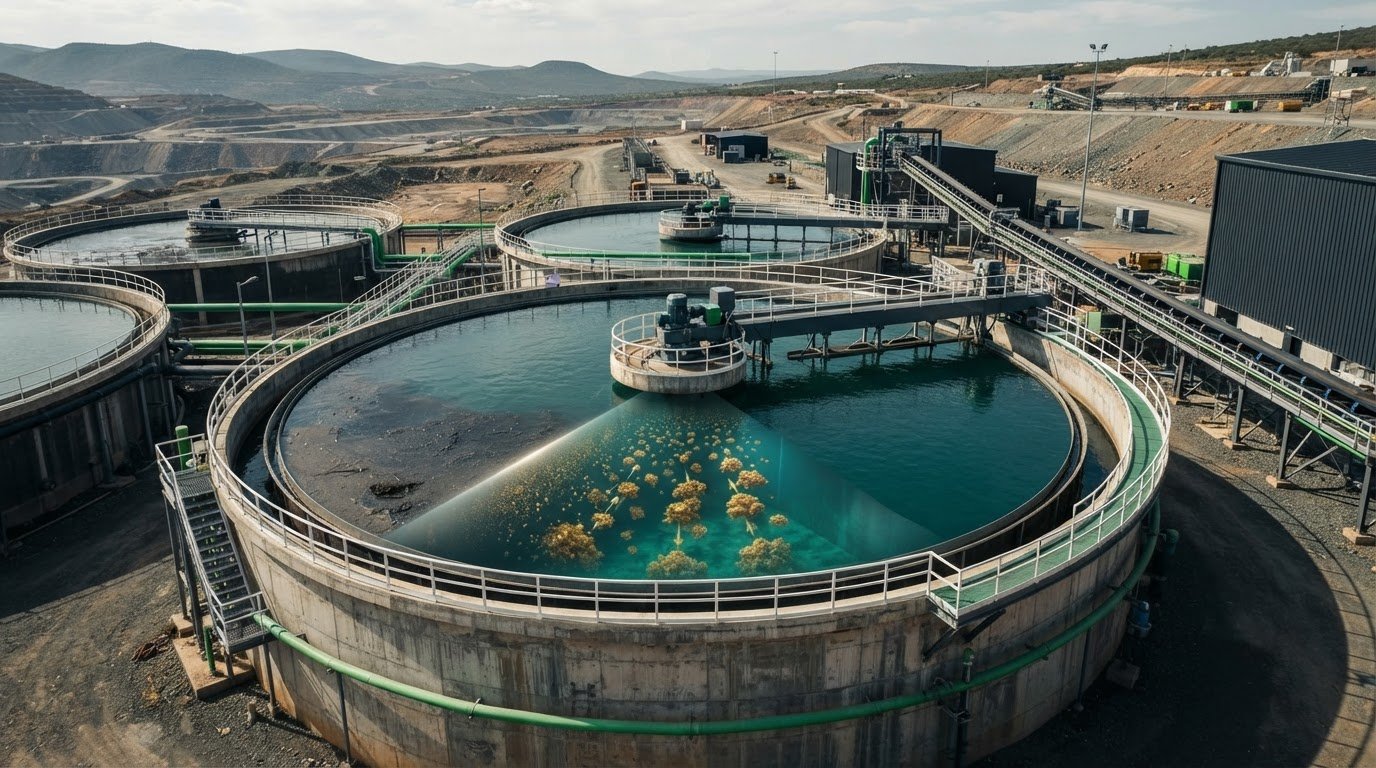
The industry is moving toward a more conscientious future. We've developed biodegradable and eco-friendly anti-caking formulations that meet the strict environmental standards of 2026. Optimized fertilizers don't just flow better; they reduce the environmental footprint of agriculture by preventing product waste and ensuring precise nutrient delivery. This commitment to sustainability isn't limited to the agricultural sector. Our work in other critical industries, such as developing Mining Flocculants for Sustainable Tailings Management, demonstrates our holistic approach to protecting natural resources while maintaining industrial efficiency.
Global Reach, Local Expertise
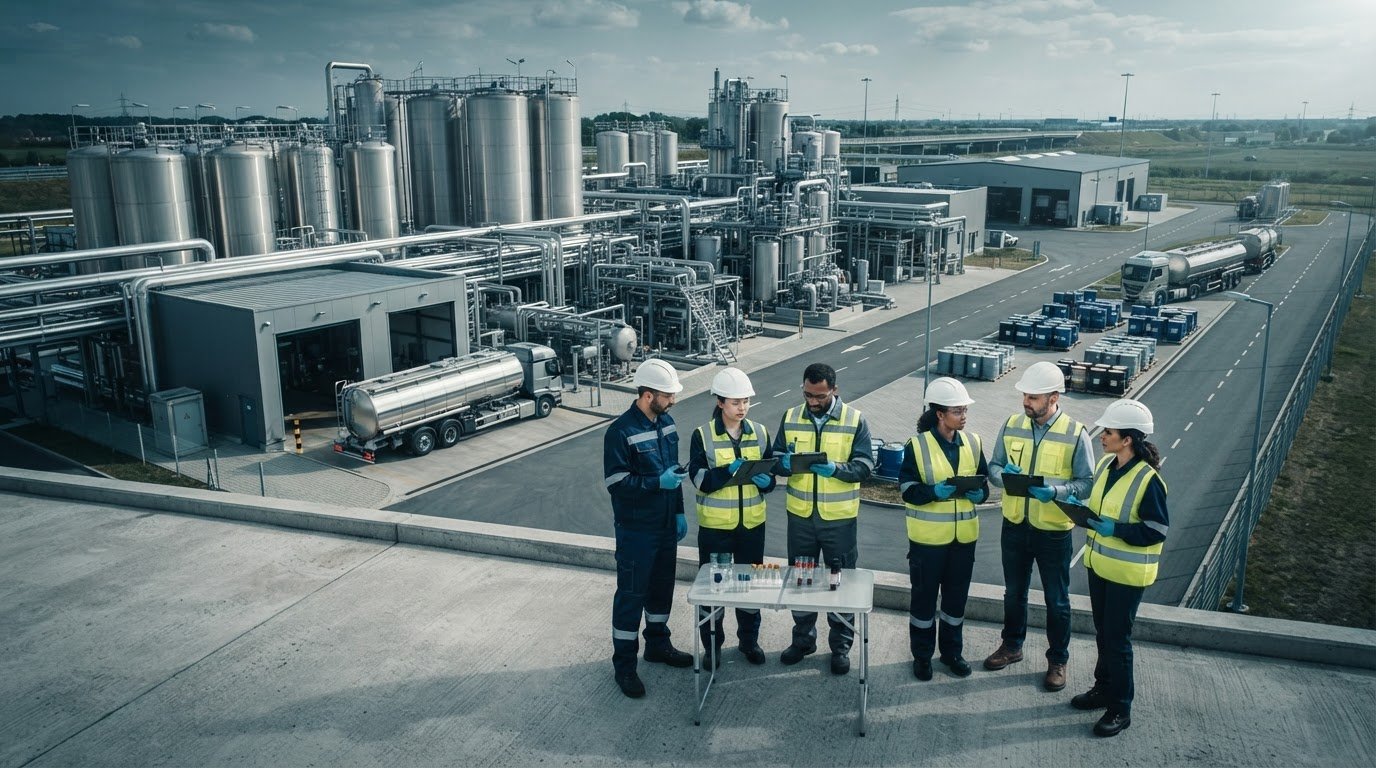
Reliability requires presence. With strategic hubs in Dubai, Riyadh, and Amman, we provide immediate regional support to our partners across the Middle East and beyond. Our local expertise is grounded in global standards. We offer on-site laboratory testing and rigorous technical audits to identify the root causes of supply chain instability. This hands-on approach allows us to deliver formulated solutions that address the unique challenges of your specific NPK grades. We invite you to move beyond temporary fixes and invest in a partnership that secures your future. Partner with JAS Global to optimize your fertilizer flowability and protect your operational margins in an increasingly volatile market.
Safeguarding Industrial Margins and Global Food Security
We've analyzed how the economic impact of fertilizer caking erodes margins from the warehouse to the port. Success in 2026 demands more than generic coatings. It requires a partner who understands the delicate intersection of chemistry and global logistics. By prioritizing custom formulations, you ensure your product remains free-flowing and market-ready regardless of environmental volatility. Reliability is built on technical precision.
JAS Global Industries brings over 25 years of proven reliability to your operation. Our specialized R&I centers in Dubai, Europe, and Egypt focus on the critical mission of global food and water security. We don't just sell additives; we manufacture relationships based on technical excellence and shared responsibility. It's time to transform your anti-caking strategy from an operational burden into a strategic advantage that secures your place in the global market.
Request a Technical Audit and Custom Formulation Quote from JAS Global to optimize your facility today. We're ready to help you build a more resilient and profitable future.
Frequently Asked Questions
What is the primary cause of fertilizer caking in maritime transport?
High humidity and extreme temperature fluctuations during long-duration voyages are the leading causes. These environmental variables often force the cargo to cross its Critical Relative Humidity threshold, causing granules to absorb moisture. This moisture later evaporates, leaving behind solid salt bridges that fuse the product into a hard, unmanageable mass during transit.
How much does caking typically cost a fertilizer production plant annually?
While exact figures depend on production volume, the economic impact of fertilizer caking can reduce the market value of affected NPK batches by up to 20%. These losses stem from a combination of direct material waste, surges in manual labor for de-caking, and expensive energy costs required for re-granulating "off-spec" inventory.
Can anti-caking agents also help with dust suppression?
Yes, many advanced anti-caking formulations are engineered to provide dual-action protection. These agents create a uniform film that prevents crystal bridging while simultaneously acting as dust suppressants. This prevents the formation of fine particles during handling, which protects worker health and minimizes material loss during bulk transfers.
Are custom-formulated anti-caking agents significantly more expensive than generic oils?
Custom formulations may have a higher initial price per unit, but they typically offer a superior ROI. Because they're tailored to specific chemical grades, they require lower dosage rates and reduce the "Total Handling Cost." Generic oils often fail in extreme conditions, leading to product rejections that far outweigh the savings on chemical procurement.
How does temperature fluctuation in the Middle East affect fertilizer storage?
Extreme diurnal temperature cycles in regions like Riyadh or Cairo cause a phenomenon known as "granule breathing." As temperatures rise and fall, moisture is repeatedly pulled into and pushed out of the granules. This cycle accelerates the recrystallization process, creating dense, hardened cakes that are difficult to break without specialized equipment.
What are the environmental impacts of modern anti-caking chemicals?
The industry is shifting toward biodegradable and eco-friendly formulations that align with global sustainability goals. Modern additives, particularly those developed under the JAS Cares initiative, focus on reducing the environmental footprint of agriculture. These sustainable chemicals ensure product flowability without compromising soil health or violating increasingly strict international environmental regulations.
Is it possible to reverse fertilizer caking once it has occurred?
Caking is physically reversible through mechanical crushing, but it's rarely economically viable. The process of breaking up caked material shatters the granules, creating excessive dust and nutrient segregation. This degradation often leaves the product "off-spec," meaning it can no longer be sold at premium prices or used in precision application equipment.
How do I choose the right anti-caking agent for my specific NPK blend?
Choosing the correct agent requires a technical audit and laboratory testing of your specific NPK blend. Factors such as hygroscopicity, granule hardness, and intended storage duration must be analyzed. We recommend a formulated solution that accounts for these variables to ensure long-term stability and flowability throughout the global supply chain.