

A single microscopic failure in your cooling system isn't just a maintenance headache; it's a direct threat to the stability of your operational security. You've likely seen how rapid infrastructure degradation leads to unplanned downtime and the staggering costs of asset replacement. It's a constant pressure, especially with the ECHA REACH Candidate List now reaching 253 substances as of February 2026. Protecting your critical assets requires a shift from reactive repairs to proactive, strategic chemistry.
We believe that industrial maintenance is a vital pillar of global stability. This guide empowers you to master the technical and commercial criteria for selecting high-performance corrosion inhibitors that protect your infrastructure while ensuring strict environmental compliance. You'll learn how to navigate the shift toward organic, water-based formulations and how to optimize chemical dosing for maximum efficiency. We'll show you how to build a reliable partnership with a global supplier that prioritizes your equipment's lifespan and your facility's reliability. It's time to transform your corrosion management from a recurring expense into a long-term investment in your brand's future.
- Understand how high-performance corrosion inhibitors serve as a critical safeguard for global water and food security by protecting essential industrial infrastructure.
- Master the technical distinctions between anodic and cathodic mechanisms to ensure your chemical additives form the most effective protective barrier for your specific metal assets.
- Identify specialized formulations for thermal desalination and reverse osmosis systems that manage high-temperature environments while protecting sensitive membrane integrity.
- Learn the essential criteria for bulk dosing contracts, including why on-site technical audits are vital for ensuring long-term operational reliability and dosing efficiency.
- Discover how the JAS Global Industries philosophy of "Manufacturing Relationships. Distributing Quality" translates into 25 years of stable, mission-oriented industrial protection.
The Strategic Role of Corrosion Inhibitors in 2026 Infrastructure
Corrosion Inhibitors are not merely maintenance supplies. They are specialized chemical additives designed to form protective barriers on metal surfaces at the molecular level. These barriers arrest the electrochemical processes that lead to material degradation and eventual structural failure. In 2026, the strategic value of these chemicals has reached a critical peak. They've become the silent guardians of Global Water Security and Global Food Security. When a desalination plant or a fertilizer manufacturing facility remains operational under extreme conditions, it's often due to the invisible protection of advanced chemistry.
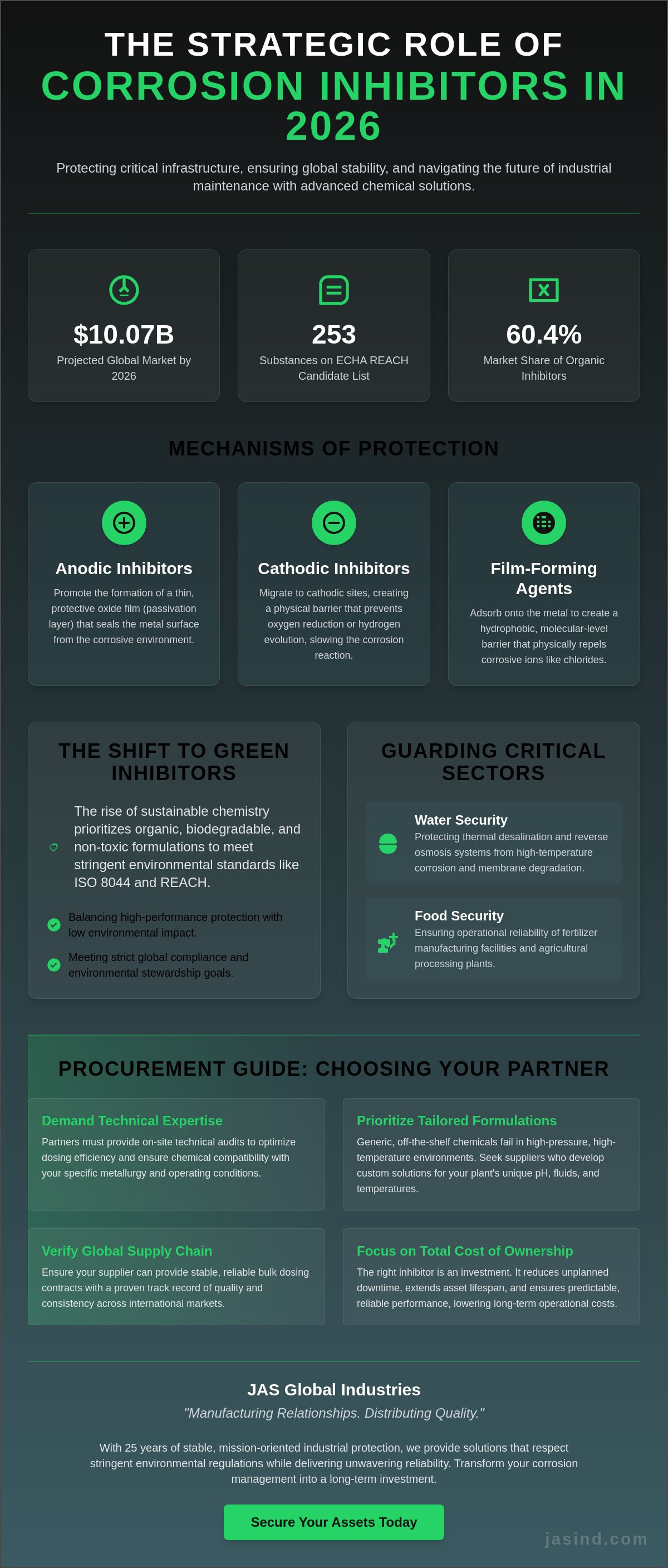
The global market for these solutions is projected to reach between USD 9.79 billion and USD 10.075 billion in 2026. This growth reflects a harsh reality. Unchecked corrosion in sectors like mining and thermal desalination leads to massive financial losses and significant safety risks. Industry leaders no longer accept generic, off-the-shelf chemicals. They demand tailor-made formulations optimized for their specific plant environments, pH levels, and fluid velocities. This shift ensures that every liter of additive delivers maximum value and protection for the asset's specific metallurgy.
Why Asset Longevity Depends on Chemical Precision
High-pressure systems and extreme temperatures define modern industrial operations. In these environments, generic solutions fail to provide the necessary film stability. Precision-engineered inhibitors prevent structural failure by maintaining the integrity of heat exchangers, process vents, and complex piping networks. This technical accuracy directly reduces the Total Cost of Ownership for large-scale plants by extending service intervals and preventing unplanned shutdowns. It's about more than avoiding repairs; it's about ensuring predictable, reliable performance in the world's most demanding environments. Advanced inhibitors protect the foundational infrastructure of society to ensure the stable distribution of global resources.
Sustainability and the Shift to Green Inhibitors
Mechanisms of Protection: Anodic, Cathodic, and Film-Forming
Selecting the right corrosion inhibitors requires a deep understanding of the electrochemical interactions at the metal-fluid interface. Protection isn't a one-size-fits-all solution; it's a precise science. Anodic inhibitors function by shifting the electrochemical potential of the metal into the passivation range. This promotes the formation of a thin, protective oxide film that effectively "seals" the metal surface from the environment. These are highly effective but demand careful monitoring to maintain the protective layer.
Cathodic inhibitors take a different approach. They migrate to the cathodic sites on the metal surface to provide a physical barrier that prevents oxygen reduction or hydrogen evolution. In many complex industrial settings, such as mining or power generation, mixed inhibitors are the preferred choice. These dual-action agents provide comprehensive protection by addressing both anodic and cathodic reactions simultaneously. This versatility is why organic corrosion inhibitors now account for an estimated 60.4% of the global market share in 2026.
Film-forming agents represent another critical category. These molecules adsorb onto the metal surface to create a hydrophobic, molecular-level barrier. This barrier repels corrosive ions, such as chlorides, which are particularly aggressive in marine and desalination environments. Research into advanced inhibitors for desalination highlights how these film-forming mechanisms are evolving to meet the needs of high-efficiency reverse osmosis (RO) and thermal systems. This evolution is essential for maintaining the integrity of infrastructure that supports global water security.
Passivation and the Science of Surface Protection
Passivation is a dynamic process where the inhibitor interacts with the metal to stop oxidation. However, this process demands extreme dosage precision. If the concentration of an anodic inhibitor falls below a critical threshold, it can lead to "pitting." This is a dangerous form of localized corrosion that penetrates the metal deeply and rapidly. While a permanent coating is a physical layer applied during manufacturing, a passivation layer is a dynamic chemical barrier that requires continuous maintenance through precise dosing. If you're looking to optimize your dosing strategy, our team at JAS Global Industries can help you select the ideal chemical additives for your specific metallurgy.
Vapour Phase Inhibitors (VPI) for Enclosed Systems
Protection shouldn't stop where the liquid ends. Vapour Phase Inhibitors (VPI) are essential for enclosed systems like storage tanks and pipeline networks. These volatile compounds evaporate and then condense on all exposed metal surfaces, including those not in direct contact with the liquid phase. This makes VPIs indispensable for protecting critical assets during long-distance maritime transport or seasonal mothballing. They ensure that your infrastructure remains secure from the inside out, regardless of the internal atmosphere.
Selecting Inhibitors for Desalination and High-Efficiency RO
Large-scale desalination is the lifeblood of arid regions. Protecting these assets is a matter of national security. In thermal systems like Multi-Stage Flash (MSF), corrosion inhibitors must withstand extreme heat and high salinity. These environments are notoriously aggressive toward carbon steel and copper alloys. The sheer volume of water processed means that even minor dosing errors can lead to widespread degradation across the entire facility.
Chemical Challenges in Thermal Desalination
High temperatures accelerate electrochemical reactions. Dissolved oxygen and carbon dioxide levels fluctuate, creating a volatile environment for metal surfaces. Inhibitors in these systems must remain thermally stable to prevent breakdown products from causing secondary issues. Effective management ensures that the infrastructure remains a reliable pillar of Advanced Water Technologies, securing the water supply for millions. Without this chemical precision, the risk of structural failure in high-pressure steam systems increases significantly.
Reverse Osmosis and Membrane-Safe Formulations
Reverse Osmosis (RO) presents a different set of challenges. Traditional inhibitors can often lead to irreversible membrane fouling. This reduces plant yield and increases the frequency of costly chemical cleanings. Procurement teams must prioritize non-reactive, low-dosage chemical strategies. These formulations protect downstream piping without compromising the sensitive polyamide layers of the RO membranes. It's a delicate balance between protecting the distribution network and preserving the filtration media.
Integrated treatment is the key to operational excellence. In brackish water treatment, there is a powerful synergy between scale inhibitors and corrosion inhibitors. When these chemicals are correctly balanced, they provide a comprehensive shield that prevents both mineral deposition and oxidative damage. This integrated approach is what allows facilities in water-scarce regions like Riyadh and Dubai to maintain continuous output despite the harsh raw water conditions. These cities rely on the uninterrupted flow of desalinated water for their very survival.
Maintaining these systems requires more than just chemicals; it requires a partnership focused on long-term asset health. By selecting membrane-safe formulations, operators avoid the "Total Cost of Ownership" traps associated with frequent membrane replacements. We focus on providing solutions that ensure these critical water assets serve their communities for decades. Our role as a global visionary partner is to ensure that every drop of water produced is protected by the highest standards of industrial chemistry.
Procurement Guide: Industrial Criteria for Bulk Dosing Contracts
Procuring bulk chemical additives for large-scale infrastructure requires a shift from transactional thinking to strategic partnership. Volume-based procurement for corrosion inhibitors isn't simply about securing the lowest price per kiloliter. It's about ensuring supply chain resilience and chemical consistency over multi-year contracts. For facilities operating in Africa and Asia, logistics reliability is a non-negotiable factor. A supplier's global presence ensures that local infrastructure remains protected despite shifting international trade dynamics. Reliability in these regions is the difference between operational continuity and catastrophic asset failure.
Long-term supply agreements must account for the specific metallurgical and environmental conditions of the site. While off-the-shelf products offer a quick fix, they often lack the precision required for high-pressure systems. Investing in bespoke, custom formulations allows for optimized dosing that aligns with the unique fluid chemistry of your plant. This precision reduces waste and ensures that every drop of additive contributes to the asset's security. When you manufacture relationships as deeply as you distribute quality, the chemistry becomes a secondary benefit to the trust established between partners.
Evaluating Chemical Stability and Dosing Efficiency
Effective procurement involves verifying how an inhibitor performs in a live industrial loop. Theoretical data sheets aren't enough. Technical consulting plays a vital role in optimizing chemical consumption and proving ROI. Procurement teams should demand verification of ASTM G15-2008 standards in all supplier documentation. This standard provides a rigorous benchmark for evaluating the effectiveness of chemicals in real-world scenarios. Measuring these outcomes ensures that the Total Cost of Ownership remains low while asset protection remains high. Efficiency isn't just a metric; it's a commitment to resource stewardship.
The Value of On-Site Laboratory Support
Relying on theoretical models for water treatment is a risk no operator should take. Real-world water analysis is superior because it captures the daily fluctuations in pH, temperature, and salinity that a lab in a different hemisphere might miss. On-site laboratory support allows for rapid chemical auditing and troubleshooting of operational failures before they lead to downtime. Proactive dosing strategies, informed by local data, significantly reduce maintenance fees and prevent the structural failures discussed earlier in this guide. If you're ready to secure your facility's future, you can consult with our technical specialists to develop a tailored procurement strategy.
A visionary partner doesn't just deliver a product; they provide a moral compass for industrial operations. This means being present where the work happens and understanding the broader human impact of water and food security. When your supplier is deeply integrated into your industry, they become an indispensable pillar of your operations. This approach ensures that your bulk dosing contracts deliver more than just chemicals. They deliver the stability required to support a growing global population.
JAS Global Industries: Manufacturing Relationships and Quality
JAS Global Industries operates at the intersection of technical excellence and global responsibility. We don't just supply chemical additives; we protect the foundational infrastructure of modern society. Our philosophy is built on a simple, powerful duality: Manufacturing Relationships. Distributing Quality. This approach has guided our growth for twenty-five years, establishing us as a reliable guardian of industrial assets across the globe. From our strategic hubs in Dubai to our presence in Lisbon, we provide local expertise backed by international scale. We're the "quiet giant" of the industry, focused on the foundational needs of society like water and food.
Through our "JAS Cares" initiative, we ensure every solution meets the highest ethical and environmental standards. We understand that our corrosion inhibitors are vital to maintaining Global Water Security and Global Food Security. This sense of purpose drives our innovation and defines our role as a global visionary partner. We don't just fulfill contracts; we build long-term value through stable and sustainable partnerships. Our history is rooted in trust, and our future is dedicated to the continued protection of critical global infrastructure.
Tailor-Made Formulations for Global Partners
Generic chemistry can't solve the unique challenges of a modern mining site or a high-pressure water treatment plant. Our Research and Innovation (R&I) centers develop custom formulations that address specific metallurgical needs and environmental conditions. By focusing on fertilizer additive innovation, we directly support the stability of the global food supply chain. We've successfully optimized corrosion control for major Middle Eastern desalination plants, ensuring that critical water supplies remain uninterrupted despite harsh raw water conditions. This bespoke approach ensures that our corrosion inhibitors deliver maximum protection with optimized dosing efficiency, reducing waste and protecting your bottom line.
Partnering for Operational Reliability
Operational reliability requires more than a steady supply of chemicals. It requires a partnership rooted in technical consulting and process optimization. We move beyond the transaction to understand the micro-details of your facility. Our specialized departments conduct site-specific audits to identify vulnerabilities and improve performance in real-time. This proactive engagement reduces maintenance fees and extends the life of your most valuable assets. Reliability is built on trust, and trust is built on a quarter-century of proven results in the world's most demanding industries. It's time to move beyond simple supply and embrace a partnership focused on your long-term success.
Optimize your infrastructure with JAS Global Industries to ensure the long-term security and operational continuity of your industrial operations.
Securing the Future of Global Infrastructure
Protecting the world's most critical assets requires a shift from transactional procurement to visionary partnership. You've seen how specialized chemistry prevents structural failure in high-pressure systems and ensures the stability of global water and food security. Success in 2026 depends on moving beyond off-the-shelf products toward tailor-made formulations optimized for your facility's specific metallurgy and environment. Precision dosing is no longer optional; it's a strategic necessity for operational continuity.
JAS Global Industries has been a pillar of industrial reliability since 1998. Headquartered in Dubai with service offices worldwide, we operate specialized R&I centers dedicated to developing high-performance corrosion inhibitors. We don't just supply additives; we manufacture relationships and distribute quality. Our technical specialists are ready to help you optimize your dosing efficiency and extend your equipment's lifespan through proactive, data-driven strategies. Operational continuity is a choice. By prioritizing chemical precision and on-site expertise, you secure your facility's future and contribute to global resource stability. Let's build a more resilient infrastructure together.
Request a Technical Audit from JAS Global Industries
Frequently Asked Questions
What is the difference between an anodic and a cathodic corrosion inhibitor?
Anodic inhibitors function by promoting the formation of a protective oxide film on the metal's anodic sites. This effectively "plugs" the areas where metal loss occurs. Cathodic inhibitors migrate to the cathodic sites to create a physical barrier that blocks oxygen reduction or hydrogen evolution. While both are effective, anodic types require precise dosing because under-dosing can lead to localized pitting. Cathodic types are generally more forgiving in systems with fluctuating chemical concentrations.
How do I choose a corrosion inhibitor for a reverse osmosis (RO) system?
Selecting for Reverse Osmosis requires non-reactive formulations that won't foul the sensitive polyamide membrane layers. You must prioritize low-dosage strategies that protect downstream piping without compromising filtration efficiency. It's vital to ensure compatibility between your antiscalants and your chosen corrosion inhibitors to prevent chemical precipitation within the membrane housing. This balance preserves your plant's yield while securing the distribution network's integrity.
Are there environmentally friendly corrosion inhibitors for water treatment?
Yes, the 2026 market is shifting toward organic, biodegradable formulations that comply with the latest ECHA REACH standards. These "green" inhibitors use plant-based extracts or non-toxic organic acids to provide high-performance protection without the environmental toxicity of traditional heavy metals. These solutions are essential for facilities committed to sustainable water security and ethical chemical discharge. They allow you to meet stringent regulations without sacrificing the longevity of your industrial assets.
What standards should I look for in industrial corrosion inhibitor procurement?
Procurement teams should prioritize ASTM G15-2008 for standardized terminology and ISO 8044 for environmental compliance benchmarks. Additionally, NACE/AMPP standards like SP0775 are critical for monitoring chemical effectiveness in water treatment or oil and gas systems. Verifying these standards in your supplier's documentation ensures that the additives meet globally recognized benchmarks for quality and reliability. It's a foundational step in building a trustworthy, long-term supply relationship.
Can corrosion inhibitors be used in high-temperature thermal desalination?
Thermal desalination systems like Multi-Stage Flash (MSF) require specialized inhibitors that remain thermally stable above 100°C. These formulations must manage dissolved oxygen and carbon dioxide in high-salinity brine without breaking down into corrosive byproducts. Using high-performance corrosion inhibitors in these environments is a critical factor in maintaining the operational lifespan of expensive heat exchange infrastructure. They ensure that your facility continues to provide water security for the communities it serves.
How often should I audit my chemical dosing strategy for maximum efficiency?
You should audit your chemical dosing strategy at least quarterly or whenever there's a significant change in raw water quality. Regular audits help you adjust for seasonal fluctuations in pH, temperature, and microbial activity. This proactive approach prevents the Total Cost of Ownership from rising due to over-dosing or unexpected asset degradation. It's a vital part of maintaining operational reliability and ensuring your infrastructure remains a stable pillar of your industry.
What is the shelf life of bulk industrial corrosion inhibitors?
Most bulk industrial inhibitors have a shelf life of 12 to 24 months when stored in original, sealed containers. It's important to keep these chemicals in a temperature-controlled environment to prevent phase separation or the degradation of active ingredients. Always check the supplier's Certificate of Analysis for specific storage requirements to ensure the product's long-term stability. Proper storage protects your investment and ensures the chemistry remains effective when it's finally deployed.
How do vapour phase inhibitors (VPI) protect stored equipment?
Vapour Phase Inhibitors (VPI) work by releasing volatile compounds that condense on all metal surfaces within an enclosed space. This creates a molecular barrier on areas that aren't in direct contact with liquid, such as the top of storage tanks or internal pipeline walls. They're an indispensable tool for protecting critical assets during long-distance shipping or seasonal mothballing. This internal protection ensures your equipment remains ready for immediate operation once it reaches its destination.