
The broadest catalogue isn’t always the right fit for an industrial operation. An industrial chemical supplier Morocco businesses rely on should match products to the process, provide useful technical documentation, and support a clear supply plan. A mismatch in any of these areas can affect performance and procurement planning.
Product specifications and delivery arrangements matter, but reliable sourcing also depends on how a chemical performs under actual operating conditions, what evidence supports its intended use, and how supply arrangements are planned across borders.
This guide explains how to assess product fit, technical support, documentation, logistics, and supply continuity for industrial operations in Morocco. It also offers practical criteria procurement and operations teams can use when evaluating a supplier relationship. JAS Global Industries serves fertilizer, mining, water treatment, and other industrial applications with specialty chemical solutions. Fertilizer anti-caking agents are a primary focus, alongside tailored formulations and technical consulting to support process needs.
Key Takeaways
- Start with the process challenge and performance goals, then identify chemical functions that suit your operating conditions.
- Compare an industrial chemical supplier Morocco businesses are considering on application fit, technical support, documentation, supply planning, and communication.
- Use consistent technical and procurement criteria to assess suppliers beyond catalogue breadth or broad claims.
- Build a shipment plan around demand, technical review, required documentation, and destination-specific transport and handling needs.
- Consider how tailored formulations and technical consulting can support process fit, including fertilizer anti-caking needs and material-handling objectives.
Why choosing an industrial chemical supplier in Morocco matters
Chemical performance can affect process consistency, product handling, and production continuity. In fertilizer production, anti-caking agents and dust suppressants can support the handling characteristics of finished material. Mining and water treatment use chemicals for different purposes, so products need to suit the process they are intended to support. A mismatch can require additional adjustments or lead to less consistent results. Choosing a supplier is therefore an operational decision, not just a purchasing task.
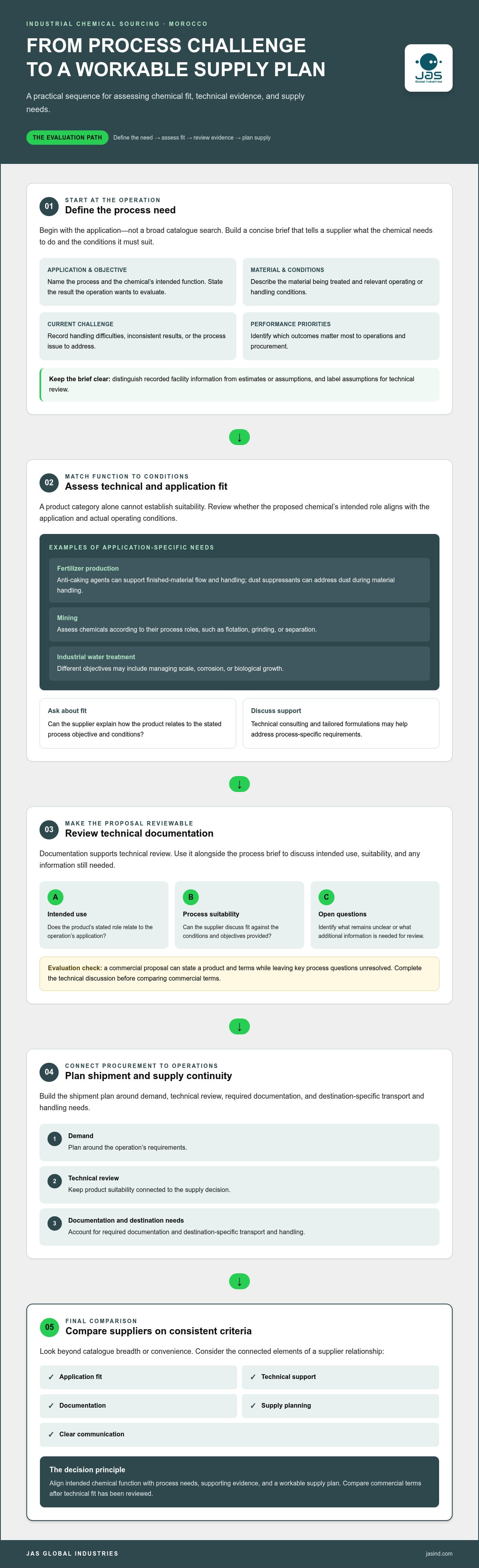
Begin with the facility’s application rather than a broad catalogue search. Define the process objective, relevant operating conditions, and current challenge. Then assess whether the supplier can explain how a product fits, provide technical documentation for review, discuss process suitability, and plan supply around the operation’s needs. These considerations are connected: documentation supports technical review, while supply planning helps procurement consider continuity alongside performance.
A specialty chemical supplier is not the same as a fertilizer manufacturer or a general commodity seller. It provides chemicals that support industrial processes, rather than necessarily producing the fertilizer, mined material, or treated water itself. Morocco’s Economy of Morocco offers broader context for the industrial environment. For buyers, the practical focus is the specific application and the evidence behind a proposed chemical solution.
Supplier fit means aligning a chemical’s intended function with process needs, supporting evidence, and a workable supply plan. This gives procurement and operations teams a consistent way to assess an industrial chemical supplier Morocco facilities may consider, without letting catalogue size or convenience stand in for suitability.
Which Moroccan industrial buyers need specialty chemicals?
Fertilizer producers may evaluate anti-caking agents to support product flow and handling, or dust suppressants to address dust during material handling. Mining operations assess chemicals according to their roles in processes such as flotation, grinding, or separation. Industrial water-treatment teams have different objectives, including managing scale, corrosion, or biological growth. Because operating conditions and desired outcomes vary, start with a brief that records the application, relevant process conditions, existing challenge, and performance objective. Don’t assume one formulation will suit every operation.
Why is the lowest-friction supply option not always the best fit?
A familiar purchasing route or quick catalogue match may take less effort at the outset. But convenience alone says little about product consistency, technical support, or how clearly the chemical’s intended use is documented. If the chemistry doesn’t suit the process, teams may need to revisit operating settings or reassess their selection, disrupting routine work even without a major failure. A considered evaluation weighs procurement effort against the value of suitable performance and clear technical discussion.
A long-term supply relationship should support reliability, safe handling, and defined process objectives. JAS Global Industries provides specialty chemical solutions and technical consulting across fertilizer, mining, water treatment, and other applications. For fertilizer buyers, discussing anti-caking requirements in relation to material-handling objectives keeps the evaluation focused on process fit rather than a generic product search.
Match industrial chemicals to your process and technical requirements
Process fit means matching a chemical’s intended function to the conditions in which it will be used and to a measurable operating objective. A product category alone can’t establish suitability. Describe the application, material being treated, relevant process conditions, current challenge, and the performance you want to assess. This context gives technical discussions a practical starting point.
Share these details before requesting a commercial proposal. A technical review can clarify whether the product’s role aligns with the application and identify information still needed to assess suitability. A proposal without that groundwork may set out a product and commercial terms while leaving key process questions unresolved. For buyers assessing an industrial chemical supplier Morocco operations can work with, use a clear sequence: define the need, review technical fit, then compare commercial terms.
What information helps determine chemical suitability?
Prepare a concise process brief. Include the objective, material characteristics, handling conditions, and performance priorities. Add available process data and relevant operating observations, such as handling difficulties or inconsistent results. Separate recorded facility information from estimates or assumptions, and label the latter clearly for technical review.
- Process objective: State the chemical’s intended function and the result the operation wants to evaluate.
- Material characteristics: Describe the material being treated using the information your team already has.
- Operating and handling conditions: Share relevant process details that could affect use or performance.
- Performance priorities: Identify which outcomes matter most to operations and procurement.
For fertilizer anti-caking agents, explain the material-handling challenge and the desired handling outcome. Avoid assuming a particular formulation or product specification is suitable before technical review. Broader trade context, such as the Observatory of Economic Complexity’s Morocco chemical trade data, can inform sourcing research, but it can’t replace application-specific evaluation.
How do tailored formulations support process needs?
Tailored formulations can help align a chemical solution with application-specific requirements. JAS Global Industries develops specialty chemical solutions and provides technical consulting and process optimization. A process brief gives the technical discussion a basis for examining product fit and, where relevant, a dosing strategy. The appropriate approach depends on the material and operating conditions, so assess performance against defined objectives rather than assuming suitability from a product description.
Keep the evaluation structured. Record the starting conditions, the outcome being monitored, and any assumptions that need review. This makes technical discussions more useful and gives operations and procurement a shared basis for assessing potential fit. Buyers considering fertilizer anti-caking requirements can explore JAS specialty chemical solutions in relation to their material-handling objectives.
Compare industrial chemical suppliers serving Morocco
A useful comparison makes evidence visible. Apply the same criteria and questions to each supplier, then record what information is provided, what remains unclear, and how the response relates to your facility’s application. A broad catalogue or confident claim can introduce options, but neither proves that a chemical suits a particular process or that supply planning supports continuity.
The table below provides a consistent starting framework for assessing an industrial chemical supplier Morocco operations are considering. Adapt the evidence column to your application and procurement process.
| Comparison area | Evidence to review | What to assess |
|---|---|---|
| Application fit | Product’s stated use and relevant technical information | Does the intended function align with your application and defined process objectives? |
| Technical support | Access to application discussion, troubleshooting, and process optimization | Can technical questions be addressed clearly and in context? |
| Documentation | Available product data and safety documentation | Is the information relevant, complete for your review, and applicable to the product and intended use? |
| Supply planning | Order-planning information and communication about continuity | Can procurement discuss demand planning and potential supply constraints transparently? |
| Communication | Clarity and consistency of written responses | Are technical, documentation, and procurement questions answered directly? |
Which technical and service capabilities deserve comparison?
Look beyond years in business alone. Consider relevant sector experience, understanding of the application, and access to technical consultation. Compare how suppliers explain a chemical’s intended function, what process information informs that explanation, and how they approach troubleshooting when operating observations change.
Review product data and safety documentation for relevance and completeness. The existence of a document does not prove product fit. For fertilizer applications, consider how an anti-caking solution relates to the material-handling objective. The fertilizer anti-caking guide provides further context on the application.
How can buyers assess evidence without relying on sales claims?
Separate specific, reviewable information from broad statements such as “high performance” or “reliable supply.” Give more weight to documentation that describes intended use and supports a technical review. If a supplier refers to certifications or compliance, assess whether each claim applies to the specific product, destination, and application. Don’t assume a credential applies universally.
Keep a shared comparison record. For each supplier, note the evidence received, questions answered, and unresolved technical points. Clarify vague statements before making a final selection. This helps operations and procurement compare responses on the same basis.
Reliability also depends on what happens after product review. Compare how clearly a supplier discusses continuity planning, communicates procurement details, and responds to technical questions. JAS Global Industries brings specialty chemical experience across fertilizer, mining, and water treatment, with technical consulting and tailored formulations to support application-focused evaluation. A measured comparison connects product fit with the communication and planning needed for a durable supply relationship.
Plan chemical procurement, documentation, and delivery for Morocco
A sound procurement plan connects technical approval with shipment readiness. For a chemical order bound for Morocco, verify destination-specific import, transport, and handling requirements for each shipment instead of relying on assumptions from a previous purchase. Documentation and handling steps can depend on the product, intended use, and shipment circumstances. Coordinate procurement, operations, and qualified local advisers early.
What should a Morocco-focused procurement brief include?
Give the supplier a clear picture of demand and destination. Identify the application, expected demand pattern, delivery destination, and technical contact. List the product, safety, and transport documents your team needs to review. Mark destination-specific customs or regulatory questions for verification with relevant local authorities or qualified advisers.
Keep the brief practical and consistent. One document helps technical and procurement teams work from the same assumptions and makes missing information easier to identify before order planning.
Build an ordered procurement workflow
- Define demand. Estimate expected use from facility consumption and planned operating schedules. Note changes that could affect demand, such as a planned operating adjustment.
- Complete technical review. Align the intended application and product requirements with available technical information before moving to commercial planning.
- Map documentation. Identify required product, safety, and transport documents. Assign destination-specific regulatory or customs questions for verification rather than treating assumptions as confirmed requirements.
- Clarify delivery responsibilities. Use Incoterms 2020 as a framework for defining responsibilities between buyer and seller. Agree on the applicable delivery arrangement and ensure each party understands its role. Don’t assume a term without considering the transaction.
- Plan order timing. Coordinate the shipment plan with expected consumption, storage capacity, and the facility’s need for operational continuity.
How can supply planning protect operational continuity?
Demand estimates are most useful when grounded in actual facility consumption and operating schedules. Compare the expected order pattern with available storage and handling capacity, then discuss shipment coordination and contingency planning with the supplier. This helps teams anticipate practical constraints without relying on unverified lead times, routes, shipment sizes, or delivery guarantees.
Clear communication matters throughout the process. Keep technical contacts, procurement owners, and receiving teams aligned on document status, delivery responsibilities, and changes to the plan. For facilities reviewing water-treatment requirements, JAS’s industrial water-treatment guide provides relevant application context. Buyers planning specialty chemical procurement can also discuss their requirements with JAS Global Industries, connecting process needs with technical and supply planning.
Work with JAS Global Industries on specialty chemical requirements
Industrial operations need more than a product match. They need technical understanding and supply discussions grounded in the demands of the process. JAS Global Industries serves fertilizer, mining, water treatment, and other industrial applications with specialty chemical solutions. The work begins with practical questions: define the operating objective, consider application fit, and align procurement planning with the facility’s needs.
For buyers evaluating an industrial chemical supplier Morocco operations can depend on, a useful discussion is specific to the process. A clear brief connects technical questions with relevant products and gives both teams a foundation for considering a durable supply relationship.
Where does JAS’s portfolio align with industrial procurement?
Fertilizer anti-caking agents are JAS’s primary business focus. Fertilizer buyers can frame a discussion around the material-handling challenge, the application, and the desired outcome. This gives technical consulting and tailored formulations a defined purpose: supporting an evaluation of process fit and potential optimization, rather than choosing by product category alone.
JAS also serves mining and water-treatment applications. Mining buyers can focus the discussion on the relevant operation and the chemical’s intended role. Water-treatment teams can describe their treatment process and operational objectives. These application areas call for distinct technical discussions; products for one should not be treated as substitutes for another. Across sectors, process conditions and evaluation determine what is relevant.
Tailored formulations and technical consulting help shape discussions around buyer requirements. They support consideration of process optimization, while actual performance depends on the application and operating conditions. Clear objectives and available process information make the review more useful.
What should buyers prepare before discussing a supply relationship?
Bring the information that helps technical and procurement teams understand the requirement. It doesn’t need to be a lengthy report. A concise, organized brief can focus the conversation and surface open questions early.
- Application and objective: Explain where the chemical will be used, its intended function, and the outcome the facility wants to assess.
- Process context: Summarize relevant operating conditions, material characteristics, current challenges, and known constraints.
- Technical information: Gather available product or process documents and list questions about documentation, safety information, and application fit.
- Demand planning: Describe expected consumption patterns, order-planning considerations, and the delivery destination.
- Open procurement questions: Flag destination-specific documentation or shipment matters that need review with appropriate local authorities or qualified advisers.
Fertilizer buyers can begin with the anti-caking challenge and the handling objective they want to support. Mining and water-treatment teams can identify their application and process priorities in the same way. From there, technical discussion can connect the requirement with relevant specialty chemical capabilities and supply planning.
Prepare your process details, documentation questions, and demand context, then discuss your industrial chemical requirements with JAS Global Industries.
Turn sourcing priorities into a lasting partnership
A supplier relationship can create value beyond the first order. Set a shared baseline for what the chemical needs to support, who owns technical and procurement communication, and how the operation will review performance over time. This gives teams a practical reference as processes, demand, or operating priorities change. It also keeps future decisions grounded in facility needs rather than assumptions carried forward from an earlier purchase.
Choose an industrial chemical supplier Morocco operations can build an ongoing relationship with, and make clarity a priority. Bring relevant teams together around a defined application, intended outcomes, and questions that still need answers. A focused conversation can turn those priorities into a constructive technical and supply discussion, with next steps shaped around your operation.
Start a technical conversation with JAS Global Industries about your industrial chemical requirements. A clear brief is a practical first step toward a dependable partnership and more confident planning for your facility.
Frequently Asked Questions
What does an industrial chemical supplier provide?
An industrial chemical supplier provides chemicals intended to support manufacturing, processing, or resource-management operations. Depending on its portfolio, it may also provide technical information and consultation related to product use. For example, a fertilizer operation could source an anti-caking agent to address handling objectives, while a water-treatment team might need a chemical for scale management. The supplier provides process inputs, not necessarily the finished goods made or treated by the facility.
How do I choose an industrial chemical supplier in Morocco?
Choose an industrial chemical supplier Morocco operations can work with by comparing relevant application experience, technical communication, documentation, and supply planning. Start with a clearly defined use case, then assess how well the supplier explains product suitability for that application. Ask your internal technical and procurement teams to record unresolved questions and weigh them alongside commercial terms, rather than selecting on price or catalogue size alone.
What documents should I request when sourcing industrial chemicals?
Request documentation that helps your team identify and handle the specific chemical under consideration. Depending on the product and shipment, this may include a technical data sheet, safety data sheet, and batch or quality documentation where applicable. Procurement teams should also identify any transport paperwork or destination-specific documents relevant to the shipment. Treat this as a review checklist, not a universal legal requirement, and verify local import questions with qualified advisers.
Can a chemical supplier develop a formulation for a specific industrial process?
Yes. JAS Global Industries develops tailored formulations for industrial applications. A useful formulation discussion begins with the process objective, material characteristics, operating context, and constraints your team can describe. Technical consultation can help assess how a formulation may fit and what factors require evaluation. Suitability and results depend on actual process conditions, so define how your team will assess performance rather than assuming a formulation guarantees a particular outcome.
How can I evaluate a supplier’s chemical quality claims?
Evaluate quality claims by asking what evidence supports them and whether it relates to the specific product and intended application. Review available technical and safety documents for product identity, stated use, and relevant handling information. If a claim refers to a standard, certificate, or test, distinguish verifiable documentation from general promotional wording. Keep a written record of the evidence reviewed and outstanding questions so technical and procurement teams can make a consistent assessment.
How much does it cost to source industrial chemicals for Morocco?
There isn’t one reliable figure for sourcing industrial chemicals for Morocco. A commercial proposal depends on the selected chemical, order requirements, packaging and delivery arrangements, and shipment-specific costs or charges. Compare proposals on the same product basis and clarify what each includes, such as delivery responsibilities and applicable logistics elements. For budgeting, use supplier proposals and qualified import or logistics advice for the actual shipment, rather than relying on generic market estimates.
What is the difference between a chemical supplier and a fertilizer manufacturer?
A chemical supplier provides chemical inputs used in industrial processes, while a fertilizer manufacturer produces fertilizer as a finished product. The roles can serve the same value chain but are not interchangeable. For example, JAS Global Industries supplies fertilizer anti-caking agents that support handling objectives; it does not sell fertilizer. Describe whether you need a process chemical or finished material so sourcing discussions stay focused on the right category.