
What if a competitive quote still leaves your operation exposed to inconsistent product quality or uncertain supply? Finding peace of mind with reliable chemical supply takes more than comparing prices. Buyers need confidence that a supplier can meet technical requirements, coordinate supply clearly, and understand operational needs.
That’s a practical concern. Product variation can disrupt established processes, while logistics uncertainty can complicate planning. This guide offers a clear framework for evaluating chemical supply relationships in 2026, so you can reduce avoidable sourcing risks and make decisions with greater confidence.
We’ll look at application fit, formulation expertise, quality controls, manufacturing capability, supply planning, and commercial terms. For application-specific products such as fertilizer anti-caking agents, technical performance and procurement requirements need to align. JAS Global Industries serves specialty chemical sectors with tailored formulations, research and innovation centers, manufacturing plants, and technical consulting. Use the framework ahead to assess what matters for your process and build a supply relationship designed for long-term operational stability.
Key Takeaways
- Define what dependable supply means for your operation, from product fit to coordination and continuity planning.
- Assess how a supplier’s technical and manufacturing capabilities align with your process conditions and handling needs.
- Compare suppliers using consistent criteria, and separate essential requirements from preferences before reviewing proposals.
- Build peace of mind with reliable chemical supply by documenting operational dependencies and clarifying coordination responsibilities.
- See how tailored formulations and technical consulting can connect chemical performance with procurement and operational priorities.
Why Reliable Chemical Supply Matters to Industrial Operations
Industrial production depends on more than having a chemical order in motion. The material must suit its intended application, coordination must be clear, and supply planning must reflect operational needs. Reliable chemical supply means a fit-for-purpose product, dependable coordination, and continuity planning that helps operations prepare for change without promising uninterrupted availability.
When supply becomes uncertain, production teams may need to revise schedules, procurement may adjust inventory decisions, and operations may have to adapt established routines. These effects are connected: a delayed or unsuitable material can change when a process runs, how much stock a site holds, and whether teams can maintain consistent conditions. Building peace of mind with reliable chemical supply starts with understanding those connections, not relying on reassurance alone.
What Does Peace of Mind Mean in Chemical Procurement?
Peace of mind means reduced uncertainty, not a guarantee that disruption cannot happen. It comes from knowing that a supplier understands the application, communicates clearly about coordination, and can discuss how potential changes will be handled. These are practical foundations for planning, especially when several teams depend on the same material.
Distinguish evidence from broad claims by looking for specifics: documented product requirements, a clear explanation of how the material fits the application, and defined communication and response responsibilities. A positive reputation can provide context, but it doesn’t show how a product will perform in a particular process or how supply needs will be coordinated. Understanding Supply Chains also helps frame the issue: supply depends on connected activities and organizations, so buyers should consider dependencies beyond the immediate supplier relationship.
How Supply Uncertainty Reaches the Production Line
A product specification is useful only if it reflects the conditions in which the chemical will be handled and used. If a material differs from established requirements, teams may need to review handling routines or assess its fit before normal operations can continue. Even without a major interruption, uncertainty about product suitability can make process consistency harder to maintain.
Fertilizer anti-caking agents illustrate why application-specific fit matters. The question isn’t simply whether a chemical belongs to a particular category. Buyers need to align the product with the intended fertilizer application and the operational requirements surrounding its use. A mismatch can leave technical and production teams with avoidable questions about suitability.
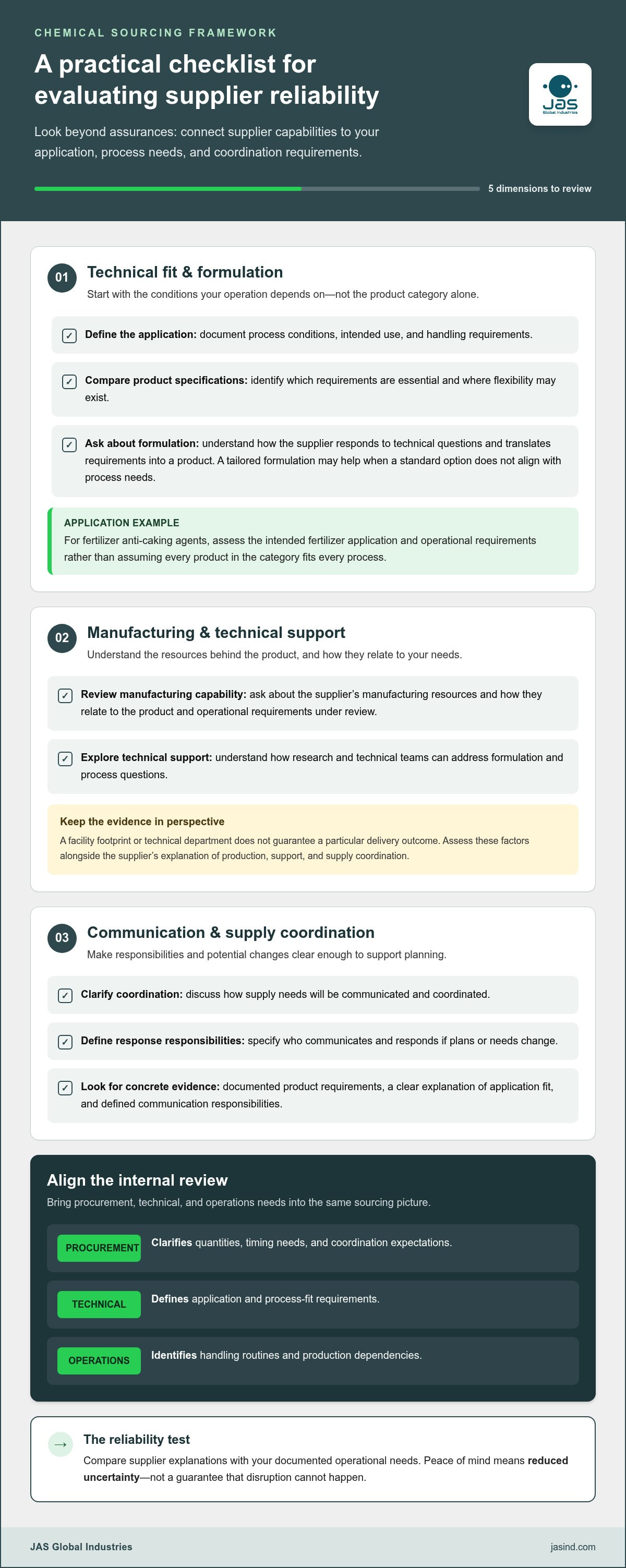
Procurement, technical, and operations teams should agree on requirements before finalizing sourcing decisions. Document the intended application, essential product characteristics, handling needs, expected coordination, and internal responsibilities if plans change. This shared view helps prevent procurement terms from overlooking process needs, or technical decisions from overlooking inventory and scheduling realities.
- Procurement clarifies quantities, timing needs, and coordination expectations.
- Technical teams define application and process-fit requirements.
- Operations identifies handling routines and production dependencies.
When requirements are visible and aligned, buyers can assess supplier responses against operational evidence. That creates a stronger basis for decisions than reassurance alone.
How to Evaluate a Chemical Supplier’s Reliability
A supplier’s assurances matter, but they’re only a starting point. A useful review connects what a supplier says to evidence of technical fit, formulation capability, manufacturing resources, technical support, and clear supply coordination. A supplier reliability review should assess application understanding, product suitability, manufacturing capability, technical support, and communication practices. These dimensions help procurement teams compare capabilities with operational needs instead of relying on reputation or price alone.
Check Technical Fit and Formulation Capability
Start by documenting the application, process conditions, and handling requirements your operation depends on. Compare those needs with the proposed product specifications, and note where an exact match is essential versus where there may be flexibility. Ask how the supplier approaches technical questions and translates product requirements into a formulation. A tailored formulation may be useful when a standard option doesn’t align with process needs.
Fertilizer anti-caking agents are a useful example: assess the intended application and your requirements rather than assuming every product in a category suits every process. For background on this application, see the anti-caking agents guide.
Assess Manufacturing and Technical Support
Manufacturing resources help buyers understand a supplier’s operating capabilities, while research and technical teams can provide context for formulation and process questions. Neither a facility footprint nor a technical department guarantees a particular delivery outcome. Assess these factors alongside the supplier’s explanation of how production, technical support, and supply coordination relate to your requirements.
JAS Global Industries serves specialty chemical sectors and operates multiple research and innovation centers and manufacturing plants. Its global sales and service offices span the Middle East, Africa, Asia, and Europe. These resources provide context for evaluating the company’s capabilities, alongside how they align with your application and coordination needs. JAS also provides technical consulting for process optimization.
To make the review practical, compare suppliers against the same questions and record evidence, not just claims:
- Application: Can the supplier explain how the product relates to your process and handling requirements?
- Formulation: How are technical requirements reflected in the proposed product?
- Manufacturing: What facilities and resources support the supplier’s manufacturing capability?
- Support: What technical consultation is available for process questions?
- Coordination: Are communication channels, responsibilities, and supply-planning discussions clear?
This structured review turns peace of mind with reliable chemical supply into an evidence-led procurement decision. For buyers assessing application-specific chemicals, JAS’s specialty chemical capabilities provide a starting point for understanding its technical and manufacturing context.
How to Compare Chemical Supply Options Beyond the Product Specification
A product specification is necessary, but it doesn’t show the full operational picture. Two proposals may appear technically similar while differing in manufacturing capability, access to technical support, communication practices, or continuity planning. Compare them against the same criteria and record what each response demonstrates. This makes trade-offs visible without relying on invented benchmarks or treating a persuasive claim as proof.
Before reviewing proposals, divide requirements into two groups. Essential requirements are those the product and supply relationship must meet for your operation to proceed. Preferences are useful advantages, but they shouldn’t outweigh a failure to meet a critical technical or operational need. This distinction keeps the review focused and gives procurement, technical, and operations teams a shared basis for discussion.
Build a Practical Supplier Comparison Scorecard
Use a consistent scorecard for every option. Rate each dimension separately, then add a short evidence note explaining the assessment. If a requirement remains unclear, flag it for internal review instead of automatically treating it as a supplier failure. Separate scores help teams identify whether a concern relates to product fit, support, or coordination.
| Dimension | What to compare | Evidence note |
|---|---|---|
| Technical fit | Alignment with application and process requirements | Record the requirement and the proposal detail that addresses it |
| Manufacturing capability | Relevant facilities and production resources | Note the capability described and any open questions |
| Technical support | Access to expertise for formulation or process questions | Document the support approach and responsibilities |
| Communication | Clarity of contacts, updates, and coordination | Capture agreed channels and points of contact |
| Continuity planning | How supply needs and potential changes are discussed | Record planning assumptions and unresolved dependencies |
Review evidence alongside each rating. A supplier’s stated capability is useful context, but connect it to your specific requirements. Mark unresolved items clearly so the relevant internal teams can discuss them before a decision is made.
Compare Standard Supply with Application-Tailored Support
A defined standard product may suit an established process when its specifications align with documented needs. If process requirements call for a different fit, formulation development or technical consulting may help address them. Consider the full operational fit, including how technical discussions and support relate to procurement and production, rather than comparing product specifications alone.
For buyers managing sourcing across fertilizer and mineral-processing operations, the mining solutions guide provides relevant context across these application areas. JAS Global Industries develops tailored formulations and provides technical consulting. Its research and innovation centers and manufacturing plants add useful context to a supplier review, but do not guarantee a particular outcome.
A disciplined comparison makes trade-offs explicit and builds peace of mind with reliable chemical supply around evidence, fit, and clear responsibilities. To understand how these capabilities connect to specialty chemical applications, explore JAS Global Industries’ chemical solutions.
How to Reduce Chemical Supply Risk Before Signing a Long-Term Agreement
A long-term supply relationship works best when expectations are defined before commitments are made. Preparation helps teams identify dependencies, clarify responsibilities, and shape commercial terms around actual operational requirements. It can reduce uncertainty, but external disruptions remain possible. Risk preparation helps organizations respond to disruption; it cannot guarantee uninterrupted chemical supply.
Use a clear sequence before finalizing an agreement:
- Document needs: Record product requirements, intended application, handling needs, and supply assumptions that affect operations.
- Align stakeholders: Bring procurement, technical, and operations teams together to confirm priorities and approval responsibilities.
- Assess fit: Review whether the proposed product and supplier capabilities align with documented needs.
- Plan coordination: Define communication routes, decision owners, and internal escalation responsibilities.
- Review performance: Set a process for assessing supply coordination and revisiting requirements as operations change.
Qualify Requirements Before Procurement Decisions
Qualification starts with a shared record of what the operation needs. Include relevant product specifications, application context, handling requirements, and internal approval steps. Operations and technical stakeholders can identify process dependencies that may not appear in a purchasing request alone. Agree how technical questions and proposed product changes will be communicated, who reviews them, and how the relevant teams will document decisions.
This preparation also helps shape commercial terms. Supply arrangements should reflect the buyer’s requirements, responsibilities, and planning assumptions rather than rely on generic expectations. Clarify which details are essential, which can be adjusted, and which internal approvals are needed before a change is accepted. Clear ownership reduces ambiguity during routine coordination and when plans need review.
Plan for Review, Escalation, and Continuity
Before signing, establish internal review points to consider supply performance and changes in process needs. Define how concerns move from day-to-day contacts to the people responsible for procurement, technical decisions, and operations. The goal is to make responsibilities visible, not to assume a particular supplier response or outcome.
Consider alternative planning scenarios that matter to your operation, such as a change in demand or a revised application requirement. Identify dependencies, decision-makers, and the information teams would need to reassess plans. A continuity plan is useful when it supports timely internal decisions; it shouldn’t be treated as protection from every external event.
This preparation can build peace of mind with reliable chemical supply by making expectations and responsibilities clearer before a long-term commitment. JAS Global Industries’ specialty chemical capabilities and technical consulting can support discussions about your operational needs.
How JAS Global Industries Supports More Confident Chemical Sourcing
Supplier confidence comes from matching technical capability to the buyer’s application and operational requirements. JAS Global Industries serves specialty chemical sectors with chemical solutions and technical expertise. Its work includes tailored formulations, multiple research and innovation centers, manufacturing plants, and technical consulting. These capabilities give buyers concrete factors to consider as they assess how a supply relationship may fit their needs, without implying that any supplier can prevent every disruption.
For procurement teams, the value lies in bringing the technical and commercial discussion together. Define what the process requires, identify the questions that need technical input, and consider how supply arrangements should reflect the project’s needs. JAS also provides bulk chemical supply contracts, creating a basis for discussing supply requirements alongside formulation and operational considerations.
Connect Fertilizer Anti-Caking Supply with Application Needs
Fertilizer anti-caking agents are an example of application-specific chemical supply. Define the intended fertilizer handling and storage context, the product requirements, and the process conditions that shape the choice. This keeps a technical discussion grounded in the actual application rather than assuming that a product category alone determines suitability.
JAS’s primary offering is fertilizer anti-caking agents, and its tailored formulation capabilities support discussions centered on buyer-defined needs. The buyer’s technical and operations teams remain important in identifying requirements and assessing how a proposed formulation aligns with their process. For a broader introduction to the application, the fertilizer anti-caking guide provides additional context without replacing project-specific evaluation.
Move from Supplier Assessment to a Technical Discussion
Before a technical conversation, procurement, technical, and operations stakeholders can prepare a concise brief. Include the application, product specifications, handling requirements, supply assumptions, and questions about formulation or process optimization. Procurement can outline commercial and coordination needs; technical teams can explain the application; operations can identify the routines and dependencies the chemical must fit.
JAS’s research and innovation centers, manufacturing plants, and technical consulting are relevant resources to discuss in relation to those defined needs. Its global sales and service presence across the Middle East, Africa, Asia, and Europe provides further context for buyers considering a long-term relationship, without constituting a specific delivery commitment.
More peace of mind with reliable chemical supply begins with a clear exchange of requirements and capabilities. Bring your application needs and operational priorities to the discussion, then assess how the technical and supply arrangements align. Discuss your chemical supply requirements with JAS Global Industries to begin a focused conversation about application fit and supply needs.
Make Your Next Sourcing Decision a Stronger One
A dependable supply relationship should evolve alongside your operation. As production priorities, processes, or demand change, revisit whether the chemical and the way it is supplied still fit your needs. This keeps sourcing connected to real operating conditions instead of treating an agreement as the end of the work.
Build peace of mind with reliable chemical supply by making each decision part of a longer-term partnership grounded in shared understanding, practical communication, and attention to changing requirements. The next step is to turn your priorities into a focused conversation about the technical and operational fit your business needs.
Explore a supply partnership with JAS Global Industries and take the next step toward chemical sourcing aligned with your operation. With a clear direction and the right technical dialogue, you can move forward with greater confidence.
Frequently Asked Questions
What makes a chemical supplier reliable?
A reliable chemical supplier supports its claims with evidence relevant to your application. Look at how clearly it explains product requirements, manages technical questions, and documents changes that could affect your process. Peace of mind with reliable chemical supply comes from evaluating those details alongside your own acceptance procedures. For example, compare incoming material records with the specifications your team uses, and document how discrepancies are handled before they affect production.
How can I reduce the risk of chemical supply disruption?
Reduce exposure by identifying where your operation depends on a particular chemical, delivery schedule, or approval decision. Map what teams would need to do if supply plans changed, and identify any internal restrictions on substitutions. A backup option should not be treated as interchangeable until the technical team has reviewed its suitability. Assign an owner to update the plan as production needs or sourcing assumptions change.
What should I compare when choosing an industrial chemical supplier?
Compare proposals using consistent assumptions, not just headline specifications. Check whether each offer describes the same application, product scope, supply arrangement, and support responsibilities. Record what is included, what needs further discussion, and what your team must provide. This makes differences easier to interpret. A commercial term that appears favorable may not fit if it depends on operating assumptions your site cannot meet, so have relevant stakeholders review those assumptions.
Why does application-specific formulation matter in chemical supply?
Application-specific formulation matters because a product must be assessed in the context of how it will be used. Explain process conditions, handling practices, and the issue you want the chemical to address, then evaluate a proposed formulation through your organization’s technical qualification process. For example, consider fertilizer anti-caking requirements in relation to the intended fertilizer handling context. Tailoring can inform the discussion, but it doesn’t establish a performance result by itself.
How do I qualify a chemical supplier before a long-term agreement?
Qualify a supplier by documenting acceptance criteria and decision ownership before formalizing a long-term arrangement. Define how proposed products will be reviewed, how deviations will be recorded, and who approves changes to the application or specification. Where appropriate, establish an evaluation stage with agreed objectives and review findings before expanding the commitment. This creates a traceable basis for decisions and helps distinguish unresolved technical questions from commercial preferences.
Can a chemical supplier help optimize an industrial process?
Yes. JAS Global Industries provides technical consulting, on-site laboratory testing, and tailored dosing strategies to help address defined process questions. To make a discussion useful, prepare the process issue, relevant operating context, and the question you want to investigate. Agree on the scope of the technical work and how your team will evaluate findings; consulting does not guarantee a specific operational result.
What information should I prepare before discussing chemical supply requirements?
Prepare enough context for a supplier to understand the application and the decision your team needs to make. Useful materials can include the current product specification, where and how the chemical is used, handling constraints, purchasing expectations, and a clear description of the operational concern. Identify who can answer technical and procurement questions. Share sensitive process details through appropriate business channels and follow your organization’s information-handling policies.