

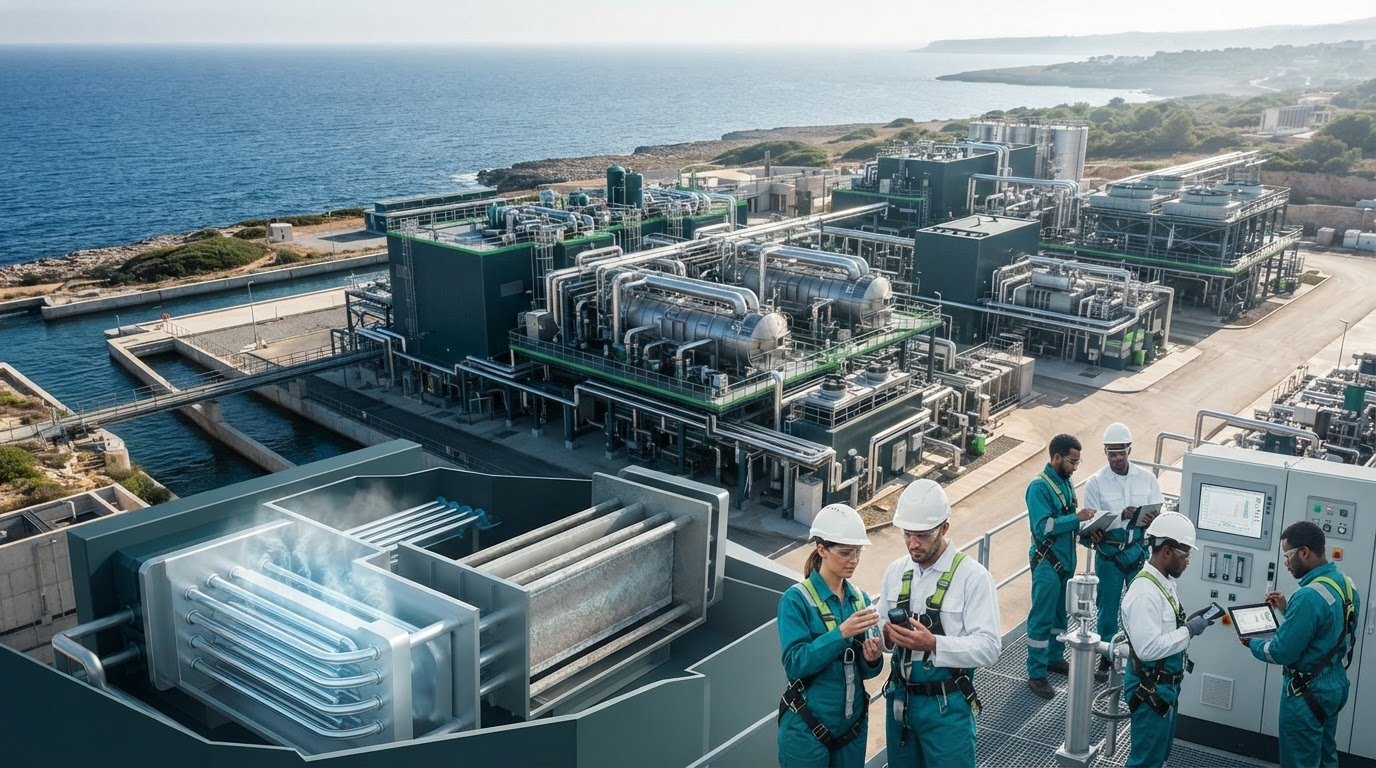
What if protecting an MSF plant from scale takes more than adding antiscalant? Preventing scale in multi-stage flash distillation depends on matching chemical treatment to water chemistry, temperature, and operating conditions. As seawater heats and concentrates, dissolved minerals can precipitate on heat-transfer surfaces, reducing performance and increasing maintenance demands. If a treatment strategy overlooks changes in feedwater or process conditions, it may miss the cause of the problem.
Scale can threaten reliable production, but separating chemistry-related causes from the effects of temperature and operating changes takes a clear view of plant data. This guide explains the main scale-forming mechanisms in MSF and how chemical treatment can work alongside operating controls. It also provides a practical framework for comparing prevention measures with feedwater quality and the plant’s operating envelope, then monitoring results and adjusting as conditions change. JAS Global Industries supports plant-specific chemical strategies and process optimization informed by feedwater and operating data. The aim is a measured approach to scale management, not a one-size-fits-all dose.
Key Takeaways
- Understand how process changes can encourage mineral deposits across MSF stages and affect heat transfer and plant operation.
- Compare chemical treatment, feedwater pretreatment, and operating controls against plant conditions and available data.
- Build a monitoring-led approach to preventing scale in multi-stage flash distillation by establishing a baseline, tracking changes, and adjusting based on evidence.
- Review water-quality and operating records together to help distinguish chemistry-related causes from process changes.
- See how tailored chemical strategies, technical audits, and on-site testing can inform plant-specific scale management and process optimization.
Why preventing scale in multi-stage flash distillation protects plant performance
In an MSF plant, scale is a deposit of mineral crystals that forms when dissolved constituents precipitate under process conditions. It can build up on heat-transfer surfaces, restricting the transfer of heat between condensing vapor and brine. Deposits may also narrow brine flow paths or interfere with a stage’s intended operation. The impact depends on where the deposits form and how they develop over time.
Scale is one type of fouling, not a catch-all term for every deposit. Suspended solids are particles carried in the water, while corrosion products result from material degradation. Organic matter and biological growth can also foul surfaces. These issues may occur together, but they have different causes and may need different responses. Treating every deposit as scale can lead operators to misread the evidence and choose an unsuitable control strategy.
How the MSF process creates conditions for deposition
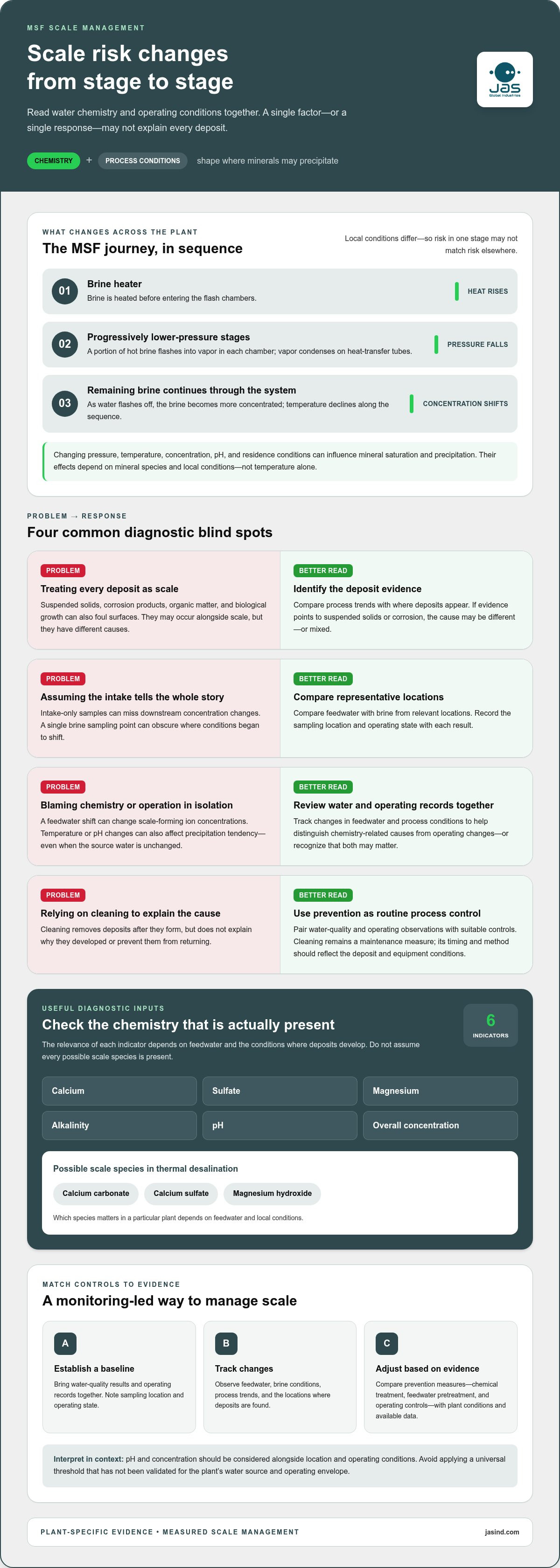
MSF begins by heating brine, then passing it through a sequence of chambers at progressively lower pressures. A portion of the hot brine flashes into vapor in each stage. The vapor condenses on heat-transfer tubes, while the remaining brine continues through the system and becomes more concentrated. The Multi-stage flash distillation process therefore exposes water to changing pressure, temperature, and concentration conditions.
These changes can alter the saturation state of dissolved minerals and their tendency to precipitate. The direction and severity of the risk depend on the mineral species and local conditions, not temperature alone. Feedwater composition, plant design, and the operating envelope all matter. Conditions in one stage may not have the same effect elsewhere.
Why scale prevention is more than a cleaning issue
Deposits add resistance to heat transfer. They can also affect flow and stage behavior, making performance harder to interpret and maintain. Controlling deposits helps protect heat-transfer reliability and support steady stage operation. That is why preventing scale in multi-stage flash distillation belongs in routine process control, not only in maintenance planning.
Cleaning removes deposits after they form, but it doesn’t explain why they developed or prevent them from returning. A preventive approach pairs operating and water-quality observations with suitable controls, helping teams identify changes before cleaning becomes the primary response. Cleaning remains an important maintenance measure, but its timing and method should reflect the deposit and equipment conditions.
Start by comparing process trends with the locations where deposits are observed. If heat-transfer performance changes alongside brine conditions, that pattern can guide investigation. If deposits coincide with evidence of suspended solids or corrosion, the cause may be different or mixed. Distinguishing among these possibilities helps direct follow-up toward the underlying mechanism without assuming every deposit has the same remedy.
What drives scale formation across MSF stages?
Scale risk changes as brine moves through an MSF plant. Dissolved mineral content, temperature, pH, and the time water spends under particular conditions all influence whether minerals remain in solution or precipitate. No single factor explains every deposit. Scale risk depends on water chemistry and process conditions working together.
Feedwater sets the initial chemical inventory. Operating conditions then change the environment in which that inventory behaves. For example, a feedwater shift may raise the concentration of scale-forming ions, while a change in temperature or pH can alter precipitation tendency even if the source water is unchanged. This distinction helps operators investigate whether a trend began with incoming water, plant operation, or both.
Which water-chemistry indicators matter?
Useful diagnostic inputs include dissolved calcium, sulfate, magnesium, alkalinity, pH, and overall concentration. Calcium carbonate, calcium sulfate, and magnesium hydroxide are possible scale species in thermal desalination, as described in the reference on scale control in thermal desalination processes. Their relevance in a particular plant depends on the feedwater and conditions where deposits develop, so don’t assume every species on a generic checklist is present.
Compare representative feedwater samples with brine samples from relevant locations. Sampling only at the intake can miss concentration changes downstream; sampling at just one brine point can obscure where conditions began to shift. Record the sampling location and operating state with each result. Interpret pH and concentration in context, and avoid applying a universal threshold that hasn’t been validated for the plant’s water source and operating envelope.
How temperature and concentration change through the stages
Brine is heated before entering the flash chambers. As pressure falls from stage to stage, some water flashes to vapor, leaving the remaining brine more concentrated. Temperature also declines along the sequence. The resulting profile is not uniform: local temperature, concentration, pH, and residence conditions can differ across the plant and influence where precipitation is more likely.
- Brine heater: heated feed approaches the plant’s operating temperature.
- Earlier stages: pressure reduction causes flashing, and the remaining brine concentrates.
- Later stages: brine continues through lower-temperature conditions, with chemistry shaped by prior water removal and stage operation.
Residence time matters because precipitation and crystal growth take time; the effect depends on the mineral and local conditions. A plant-wide average can hide a stage-specific combination that favors deposits. Make diagnosis more precise by matching sample results to stage temperature, pressure, brine flow, and observed deposit location.
For preventing scale in multi-stage flash distillation, connect feedwater and stage data before changing treatment or operating settings. A plant-specific review of feedwater chemistry and operating records can inform that assessment, alongside thermal desalination chemical strategies.
Comparing MSF scale-prevention approaches: chemistry, pretreatment, and operating controls
No single control addresses every scale risk. Chemical treatment, feedwater pretreatment, and operating-condition management act on different parts of the problem. Choose an approach by first identifying the suspected scale mechanism, then reviewing feedwater characteristics and plant operating data. These options can complement one another, but they are not interchangeable.
| Approach | Role | Data and operational considerations | Limitations |
|---|---|---|---|
| Chemical treatment | Scale inhibitors may help manage precipitation under defined process conditions. | Evaluate feedwater and brine chemistry, temperature profile, dosing location, and existing treatment practices. Dosing strategy should fit the plant’s operating conditions. | It won’t correct an unrecognized cause, unsuitable operating conditions, or every type of deposit. One chemistry or dose doesn’t suit every plant. |
| Feedwater pretreatment | Can manage constituents or suspended material entering the process, depending on the treatment objective. | Review feedwater quality, variability, pretreatment performance, and downstream process requirements. Check changes against plant data. | Pretreatment may not address minerals that remain dissolved and precipitate later as brine conditions change. |
| Operating controls | Help keep process conditions within the plant’s validated operating envelope. | Trend relevant temperatures, pressures, flows, concentration indicators, and stage performance. Assess any adjustment alongside water chemistry. | Operating changes alone may not manage risks driven by feedwater composition or deposits already present. |
Use this comparison as a starting point, not a prescription. For broader treatment context, the industrial water treatment strategic guide places plant-level decisions within the wider water-treatment framework.
When chemical scale inhibitors may support MSF operation
Evaluate inhibitors against the water chemistry and conditions where scale risk occurs. A dosing strategy needs to account for the plant’s process, treatment objectives, and operating data. Don’t select chemistry or set a dose by copying another plant’s practice. Differences in feedwater composition and thermal operating conditions can change what is appropriate.
Antiscalants can support scale management, but they don’t replace sound operation or diagnosis. If deposits persist, review the suspected scale, sampling results, dosing records, and stage conditions before increasing chemical feed. Changing the dose without a clear basis can obscure the underlying issue.
How pretreatment and operating controls complement chemical treatment
Pretreatment targets relevant feedwater constituents before they enter the thermal process; operating controls manage conditions within the plant’s validated envelope. When used with inhibitors, these measures need coordinated monitoring. For example, a feedwater change and an operating adjustment can affect the same downstream trend, so assess each alongside dosing and water-quality records. This integrated approach makes preventing scale in multi-stage flash distillation a data-led operating discipline rather than a chemical-only response.
How to build a monitoring-led plan for preventing MSF scale
A useful monitoring plan turns scattered readings into a repeatable operating picture. It should help the team see what changed, where it changed, and whether the change points to water chemistry, process conditions, instrumentation, or a combination. For preventing scale in multi-stage flash distillation, follow a consistent sequence and make each adjustment traceable to evidence.
- Establish a baseline. Record normal feedwater and brine quality alongside stage temperatures, pressures, flows, and relevant heat-transfer indicators under stable operation.
- Sample consistently. Collect representative samples at defined locations and record the operating state, sample point, and time. Include chemistry indicators relevant to the plant’s suspected scale mechanisms.
- Trend results. Compare readings over time and across stages. Add chemical dosing records, feedwater changes, operating adjustments, maintenance, and cleaning events to the same timeline.
- Assess the signal. Look for related changes, such as a shift in brine chemistry that coincides with a stage-specific performance change. Check whether the timing and location make the proposed cause plausible.
- Adjust in a controlled way. Follow plant procedures, document the rationale, and obtain required operational approvals before changing treatment or settings.
- Review the response. Monitor the change against the baseline, then record whether the evidence supports keeping, refining, or reversing the intervention.
Establish a reliable baseline and monitoring routine
Build the baseline from comparable operating conditions, not isolated readings taken during unusual operation. Pair feedwater and brine chemistry with stage-by-stage temperature and operating records so trends can be interpreted in context. Set sampling frequency, review responsibilities, and alarm criteria through plant procedures and validated operating limits. Consistent locations and methods make changes easier to distinguish from sampling variation.
Useful records include feedwater source or quality changes, brine chemistry, pH, relevant dissolved ions, temperature, pressure, flow, concentration indicators, chemical feed rate, instrument checks, and maintenance history. Preserve units and timestamps. A trend is useful only when operators can compare like with like.
Respond to early signs without overcorrecting
A change in heat-transfer performance or pressure may warrant investigation, but it doesn’t prove scale is the cause. Check brine chemistry, stage conditions, sample handling, and instrument status. Compare the timing with recent operating or feedwater changes. If results conflict, verify the measurement before changing dosing or operating settings.
Document each intervention: what was observed, what evidence supported the response, who approved it, what changed, and what happened afterward. Avoid making several adjustments at once, since that can make the outcome difficult to interpret. A controlled sequence helps separate cause from coincidence and supports consistent decisions.
JAS Global Industries’ technical audits, on-site laboratory testing, and dosing-strategy development can help teams assess plant data and support process optimization. Discuss a plant-specific scale management approach informed by feedwater and operating conditions.
How JAS supports tailored scale management in thermal desalination
MSF scale management works best when chemical planning reflects the plant’s actual water quality and operating conditions. JAS Global Industries supplies thermal desalination chemicals and water-treatment scale inhibitors, supported by technical consulting and process optimization. The focus is a plant-specific strategy, not a universal formulation or one-time dosing change.
Feedwater composition, stage conditions, treatment practices, and observed performance all shape the scale-control challenge. Connecting these factors helps operators make informed decisions with process reliability at the center of the plan.
What a plant-specific assessment can consider
A technical review can bring together available feedwater and brine data, operating records, and performance observations. JAS process audits and on-site laboratory testing can help characterize conditions and investigate trends where operating records and water-quality results need to be considered together.
The review can also consider treatment compatibility and the conditions under which a chemical strategy must operate. Findings inform the approach, but don’t guarantee a particular outcome. This keeps chemical planning aligned with the plant’s process and treatment objectives.
- Water quality: available feedwater and brine analyses, including changes over time.
- Process conditions: relevant stage operating records and known changes in operation.
- Performance observations: trends or locations that may help focus investigation.
- Treatment context: current dosing practices and compatibility considerations.
From technical findings to a coordinated treatment strategy
Once the available evidence is assessed, it can inform chemical selection, a dosing approach, and monitoring priorities. JAS develops chemical dosing strategies with plant-specific conditions in view. The operating team can then track relevant water-quality and process indicators to evaluate how the strategy performs under actual plant conditions.
Follow-up matters. A single dosing adjustment cannot replace continued review of trends, operating changes, and treatment results. A coordinated strategy gives operators a basis for evaluating whether the approach remains suitable as feedwater or process conditions change. It also helps distinguish a treatment question from an operating or diagnostic issue, supporting decisions based on evidence rather than assumptions.
For teams focused on preventing scale in multi-stage flash distillation, tailored chemical planning and process review can support a disciplined approach to reliability and water-resource stewardship. JAS Global Industries has served industrial sectors since 1998, bringing thermal desalination chemical expertise together with technical evaluation and process optimization.
If your plant is reviewing scale patterns, feedwater changes, or dosing strategy, discuss the process challenge with JAS. A technical conversation can help identify which operating and water-quality information will best inform the next step.
Make the next scale-control decision more informed
Choose one unresolved question from current operations: does a change in performance reflect feedwater variation, stage conditions, or treatment response? Framing the issue clearly can focus the next review and help teams use plant evidence before changing established practice. That discipline is central to preventing scale in multi-stage flash distillation, where dependable decisions matter as much as chemical selection.
Scale-control decisions aren’t static. Feedwater and operating priorities can evolve, so recording assumptions and review points gives teams a sound basis for future adjustments. A measured approach helps protect continuity while leaving room for evidence-led improvement.
Start a focused technical discussion with the operating records, water-quality trends, and priorities already in view. Discuss a tailored thermal desalination approach with JAS Global Industries and identify a practical next step for your plant.
Frequently Asked Questions
What types of scale can form in a multi-stage flash distillation plant?
Calcium carbonate, calcium sulfate, and magnesium hydroxide are possible scale deposits in MSF systems. Which species is relevant depends on water chemistry and conditions at the deposit location. Visual appearance alone may not identify a deposit’s composition reliably. Comparing a deposit analysis with feedwater and brine chemistry can help distinguish mineral scale from corrosion products or carried-in solids and guide a suitable response.
Can antiscalants prevent scale in every stage of an MSF plant?
No antiscalant should be assumed to prevent scale in every stage under all conditions. Effectiveness depends on the scale-forming chemistry, treatment compatibility, dosing approach, and conditions across the stages. For example, a change in feedwater composition may alter the treatment challenge even if the plant’s dosing practice hasn’t changed. Assess stage-specific observations and data rather than treating antiscalant use as a substitute for diagnosis or operating control.
How does brine temperature affect scale formation in MSF distillation?
Temperature can change mineral solubility and the likelihood of precipitation, but its effect depends on the minerals present and the surrounding chemistry. As brine moves through an MSF plant, local temperature and concentration change together, so a temperature reading alone can’t establish scale risk. Compare stage-level temperature records with brine chemistry and deposit location. A temperature shift may be a useful clue, but it isn’t proof that scale has formed.
Does feedwater pretreatment reduce the risk of scale in MSF systems?
It can, if the pretreatment step targets feedwater constituents that contribute to the specific plant’s scale risk. Its value depends on what enters with the feed and what remains in solution as brine conditions change. Review pretreatment performance alongside downstream water-quality results; a change upstream may not resolve precipitation driven later in the process. Pretreatment is one part of a coordinated control plan, not a guarantee that deposits won’t form.
What happens if scale is allowed to build up on MSF heat-transfer surfaces?
Scale adds resistance between the brine and heat-transfer surface, which can impair heat transfer. Operators may observe changes in relevant performance or operating indicators, though the pattern depends on deposit location and extent. Don’t assume every performance change is scale-related: instrument error, corrosion products, or other fouling can cause different problems. Timely investigation helps identify the cause and determine whether the plant’s approved maintenance or operating response is needed.
How often should operators monitor water chemistry in an MSF plant?
There isn’t one sampling frequency that fits every MSF plant. Set the routine through plant procedures, validated operating limits, and the stability of the feedwater and process. A source-water change, unusual operating condition, or unexpected trend may justify closer review under site procedures. Keep sample locations and methods consistent, and log operating conditions with each result. This context makes comparisons more useful than isolated chemistry readings.
Can an MSF plant continue operating while scale is being cleaned?
It depends on the cleaning method, equipment arrangement, deposit location, and the plant’s approved procedures. Some maintenance work may be possible on isolated equipment, while other cleaning methods may require an affected section or unit to be taken out of service. Don’t assume cleaning can safely occur during normal operation. Operations and maintenance teams should follow site-specific isolation, safety, and process requirements before work begins.