
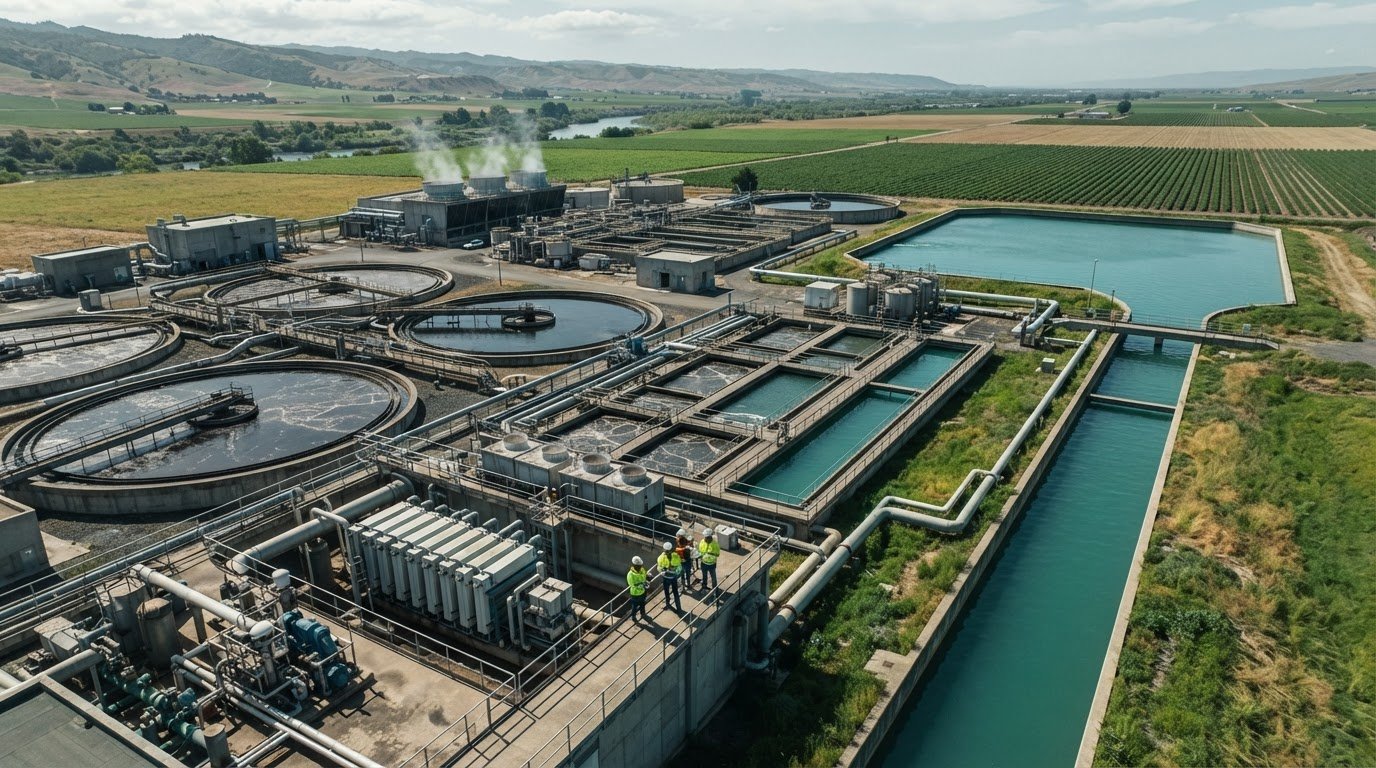
An advanced treatment train doesn’t guarantee reliable reuse. The challenges in industrial water reuse often begin before equipment is selected: feedwater quality shifts, process demands vary, and discharge obligations remain. A solution that performs well under one set of conditions may need adjustment when the water or intended use changes.
Reuse can reduce the need for fresh water, but it also adds operational demands. More treatment can mean additional monitoring, maintenance, and decisions about scaling, corrosion, and biological control. The right approach must protect process reliability while meeting the quality requirements of the reuse application.
This article explains the technical, operational, and economic factors that shape reuse decisions. Learn how to compare treatment approaches against end-use needs, where chemical treatment can support a broader treatment train, and how site-specific water data can guide a staged evaluation. Use these steps to decide what to test, monitor, and optimize before committing to a reuse strategy.
Key Takeaways
- The challenges in industrial water reuse depend on how water quality varies and what the receiving process requires.
- Scaling, corrosion, and biological growth are distinct risks, so each calls for controls suited to the water and treatment train.
- Compare filtration, biological treatment, membranes, and reverse osmosis against target quality, residuals, and operating needs.
- Build a staged feasibility assessment: define the end use, characterize water streams across operating conditions, set targets, compare options, and evaluate performance.
- Chemical treatment can support reuse by managing scale, corrosion, and biological control as part of a broader process strategy.
What makes industrial water reuse challenging for a plant?
Industrial water reuse means treating process water or wastewater and returning it to a suitable use within a facility. Suitability depends on the receiving process, the water’s quality, and the reliability that operation requires. Water suitable for equipment washing may not meet the needs of process makeup or a cooling system. The main challenges include changing feedwater, treatment complexity, residuals management, ongoing monitoring, and clear operational ownership.
These barriers are connected. A change in production or cleaning can alter incoming water and affect treatment performance. Additional treatment steps may help address those changes, but they also require maintenance, monitoring, and a plan for the residuals they produce. Assign responsibility for tracking water quality, responding to operating changes, and confirming that the reclaimed stream remains suitable for its use. Industrial water treatment involves managing scaling, corrosion, and microbiological growth, using technologies to prepare water for reuse or disposal.
Why does water quality vary across industrial operations?
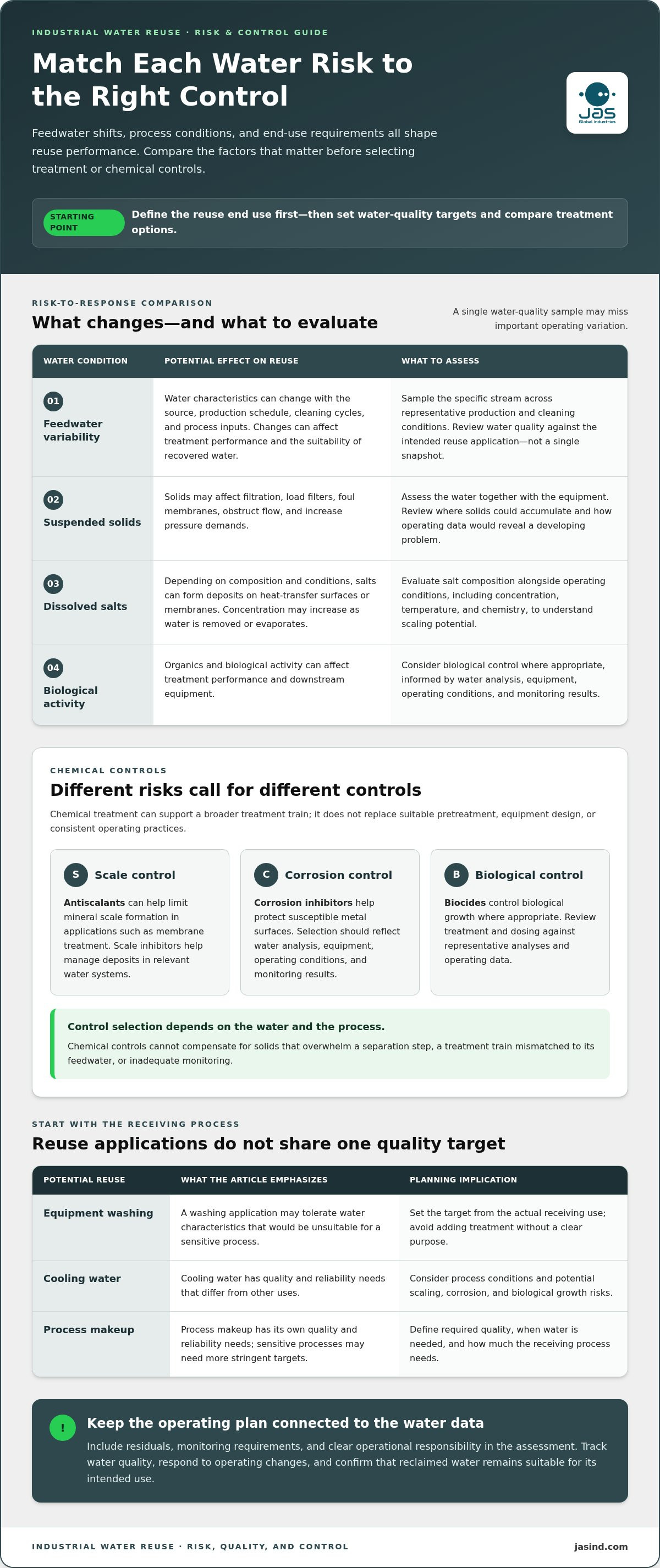
Water characteristics can change with the source, production schedule, cleaning cycles, and process inputs. Suspended solids may affect filtration, while dissolved salts can influence scaling potential. Organics and biological activity can also affect treatment performance and downstream equipment. A single sample may miss these variations. Sample the specific stream across representative production and cleaning conditions to understand its range and identify when quality changes.
Why is the intended reuse application the starting point?
Cooling water, washing water, and process makeup have different quality and reliability needs. A washing application may tolerate characteristics that would be unsuitable for a sensitive process. More stringent targets can require additional treatment and closer monitoring, so define the end use before comparing technologies. Also consider when and how much water the receiving process needs, since supply and demand may not coincide.
Define the reuse target before selecting treatment technologies. This keeps system choices grounded in the quality the receiving process actually needs, rather than adding treatment without a clear purpose. Include residuals, monitoring requirements, and operating responsibilities in the initial assessment. For broader context on treatment planning and water security, read this industrial water treatment strategic guide.
How feedwater variability, scaling, and biological growth affect reuse
Feedwater changes can affect treatment performance and the suitability of recovered water for its next use. Suspended solids may load filters or foul membranes, increasing cleaning needs or disrupting separation. Dissolved salts create a different concern: depending on their composition and process conditions, they can form deposits on heat-transfer surfaces or membranes. As water is removed during treatment or evaporates in a process such as cooling, some dissolved constituents become more concentrated. Their impact can grow even when the incoming stream initially appears manageable.
Characterize a reuse stream against its intended end use, not from a single water-quality snapshot. Equipment limits and process requirements determine which constituents matter; there is no universal threshold for every plant.
How do salts and suspended solids create treatment constraints?
Solids can obstruct flow, increase pressure demands, and contribute to fouling in separation equipment. Dissolved salts may become a scaling risk when operating conditions favor precipitation, such as changes in concentration, temperature, or chemistry. Assess the water and the equipment together. A constituent that is manageable in one process may constrain another. Review where deposits or solids could accumulate and how the system’s operating data would reveal a developing problem.
How can chemical control support a reuse treatment train?
Chemical controls address different risks. Antiscalants can help limit mineral scale formation in applications such as membrane treatment; scale inhibitors help manage deposits in relevant water systems. Corrosion inhibitors help protect susceptible metal surfaces, while biocides control biological growth where appropriate. Select and dose products in light of water analysis, equipment, operating conditions, and monitoring results.
These controls work alongside suitable pretreatment, equipment design, and consistent operating practices. They can’t compensate for solids that overwhelm a separation step, a treatment train mismatched to its feedwater, or inadequate monitoring. For a facility-wide view, the U.S. Department of Energy’s source-to-sink approach to industrial water reuse frames water sources in relation to potential reuse applications and their quality needs.
Because feedwater and process conditions can shift, review treatment and dosing against representative analyses and operating data. JAS Global Industries provides water treatment chemicals, including scale inhibitors, corrosion inhibitors, biocides, and antiscalants, as well as process optimization support. Its water treatment chemical expertise can form part of a broader reuse-control strategy.
Which industrial water reuse treatment approaches should you compare?
Compare treatment options against four practical considerations: the water entering the system, the quality required at the point of reuse, the residuals each process creates, and the work needed to operate and monitor it. The challenges in industrial water reuse rarely have a single-technology answer. A treatment train may combine processes, with each step addressing a specific water-quality need.
| Approach | Purpose | Suitable conditions | Constraints | Monitoring considerations |
|---|---|---|---|---|
| Filtration | Removes targeted suspended particles. | Feedwater contains solids that the selected filtration design can capture. | Solids loading, fouling, filter maintenance, and management of backwash or other residuals. | Track relevant water-quality changes and filter operating conditions. |
| Biological treatment | Reduces suitable biodegradable constituents. | Water characteristics and operating conditions support the selected biological process. | Performance can respond to changes in feedwater and operating conditions; residuals require consideration. | Monitor process conditions and indicators relevant to treatment performance. |
| Membrane processes | Separates selected constituents to meet a defined quality target. | Feedwater and intended reuse justify membrane separation. | Fouling, scaling, pretreatment needs, cleaning, and concentrate handling. | Monitor feedwater, system operation, cleaning needs, and treated-water quality. |
| Reverse osmosis | Produces lower-salinity water when the target requires it. | Water analysis and reuse requirements support this treatment step. | Requires suitable pretreatment and a plan for scaling control, cleaning, and concentrate management. | Track operating conditions, feed and product water quality, and signs of fouling or scaling. |
When might filtration or biological treatment be considered?
Filtration may be appropriate when suspended particles burden downstream equipment. Biological treatment may suit streams containing biodegradable material when process conditions support stable operation. Compare expected performance alongside residual handling, sensitivity to feedwater variation, maintenance, and monitoring needs. Neither option is a default choice for every stream. For filtration, consider the type and quantity of solids; for biological treatment, consider whether operating conditions support the process over the facility’s normal range.
When might membrane treatment or reverse osmosis be considered?
Membrane separation can be considered when the required reuse quality and feedwater characteristics justify it. Reverse osmosis is one membrane option, not a universal requirement. Evaluate pretreatment, fouling and scaling risks, cleaning demands, concentrate handling, and ongoing monitoring as part of the complete system design. Antiscalants may support a properly designed reverse osmosis chemical program, but they don’t replace appropriate pretreatment or operating controls.
Chemical conditioning can help manage particular scale, corrosion, or biological risks within a treatment train. It can’t correct a process design that doesn’t match the feedwater or end use. Compare complete process configurations, including equipment, operating requirements, and residuals, before selecting a technology.
How can a facility assess reuse feasibility and reduce implementation risk?
A staged assessment turns the challenges in industrial water reuse into questions a facility can investigate before committing to a full-scale system. Examine the water balance as well as treatment: how much water is available, when it is available, where it could go, and what happens to residual streams.
- Define the end use. Identify the receiving process, required water quality, demand pattern, and reliability needs.
- Characterize each candidate stream. Record flow rates and sample across relevant production schedules, cleaning cycles, and other operating conditions. Don’t base the design on one isolated sample.
- Set measurable targets. Specify water-quality criteria for the application, along with monitoring needs and any applicable local requirements.
- Compare treatment options. Assess potential treatment trains against feedwater, target quality, residuals, energy and chemical needs, maintenance, and operator capacity.
- Evaluate performance. Where appropriate, use a pilot or phased implementation to test assumptions and refine the design before wider deployment.
What data should a reuse feasibility assessment include?
Bring together flow and demand data, process variability, existing treatment, and intended reuse volumes. Analyze physical, chemical, and biological parameters relevant to the end use. Then account for the full mass balance: treated water, residuals, energy and chemical inputs, monitoring tasks, and operator requirements. This gives teams a basis for comparing options under actual site conditions and spotting gaps between available supply and reuse demand.
How can a pilot or phased approach expose operational risks?
Set performance criteria tied to the intended application before testing begins. Track treated-water quality, process stability, chemical dosing, maintenance, and residual generation across relevant operating conditions. Review results against the targets, then adjust treatment stages and operating controls as needed. A pilot can help reveal whether the process performs consistently, not just under ideal conditions.
Technical feasibility is not the same as reliable day-to-day operation. A sound evaluation considers whether the treatment train can meet its target while the facility can monitor, maintain, and operate it consistently. JAS Global Industries supports site-specific assessment through technical consulting, process optimization, and on-site laboratory testing. Information about this work is available through JAS Global Industries.
How JAS Global Industries supports industrial water reuse programs
Industrial water reuse depends on the fit between the water stream, treatment train, and receiving process. JAS Global Industries supports that evaluation with water treatment chemicals and process optimization. The aim is to address site-specific operating needs, not to position chemical treatment as a substitute for sound system design.
Where can water treatment chemistry support reuse?
Chemical programs can help manage particular risks within a broader treatment and monitoring strategy. Antiscalants may help limit scale formation in membrane applications such as reverse osmosis. Scale inhibitors can help control deposits in relevant water systems, while corrosion inhibitors are selected to help protect susceptible equipment surfaces. Biocides may be used where biological control is required and appropriate to the process.
Product selection and dosing depend on water analysis, equipment, operating conditions, and the quality requirements of the intended reuse application. For example, a membrane system’s scaling concerns differ from corrosion risks in a reuse-water circuit. A tailored chemical program should complement appropriate pretreatment, equipment design, operating controls, and monitoring. It cannot resolve a treatment train that is mismatched to the stream.
What should a technical collaboration deliver?
A useful assessment begins with the facility’s water data and operating context. Technical audits and on-site laboratory testing can help clarify process conditions, water characteristics, operational issues, and treatment objectives. From there, custom dosing strategies and process optimization can be developed around the specific system and its monitoring needs.
This approach helps teams examine the practical challenges in industrial water reuse, including changing water quality and the need to manage scale, corrosion, or biological growth without losing sight of the intended end use. JAS Global Industries has worked in specialty chemicals since 1998, with research and innovation centers and manufacturing plants supporting its industrial applications. Assess a proposed treatment strategy against site data and evaluate it under relevant operating conditions. Outcomes depend on the facility, its water, and the treatment design.
For information about industrial water treatment and reuse support, visit JAS Global Industries.
Build a Reuse Strategy Around Your Facility
The challenges in industrial water reuse are best addressed with a plan grounded in site-specific data. Define the intended use first, characterize water quality across operating conditions, then compare treatment options against quality targets, residuals, monitoring, and day-to-day operating needs.
Reliable reuse also depends on matching controls to the risks. Filtration, biological treatment, membranes, and reverse osmosis may each have a role, while chemical treatment can support scale, corrosion, or biological control as part of an integrated system. No single approach fits every stream, and a staged evaluation can help test assumptions before broader implementation.
JAS Global Industries provides specialty chemical solutions, technical audits, on-site laboratory testing, custom dosing strategies, and process optimization. These capabilities can help inform a treatment approach tailored to your facility and its operating conditions.
Discuss industrial water treatment challenges with JAS Global Industries to take the next step toward a reuse strategy built for your process. Define clear targets and evaluate the treatment train against actual operating conditions.
Frequently Asked Questions
What are the biggest challenges in industrial water reuse?
The biggest challenges in industrial water reuse include variable feedwater, fouling and scaling, corrosion, biological growth, residuals management, and monitoring. A technically suitable process can still be difficult to operate without trained staff, planned maintenance, clear control limits, and ownership of response actions. Which risks matter most depends on the water source, target use, equipment, and applicable local requirements. Assess these factors together before selecting treatment.
How does water quality affect industrial water reuse?
Water quality determines which treatment steps may be needed and whether the treated stream is suitable for its intended use. Suspended solids can burden separation processes, dissolved salts may contribute to scaling under certain conditions, and organics or biological activity can affect treatment performance. Since production schedules and cleaning cycles can change stream characteristics, collect representative samples across relevant operating conditions instead of relying on a single measurement.
Which treatment technologies are used for industrial water reuse?
Industrial reuse may use filtration, biological treatment, membrane separation, or reverse osmosis, either alone or in a combined treatment train. The right option depends on feedwater characteristics, target quality, residual handling, and operating requirements. Compare pretreatment, monitoring, maintenance, and chemical conditioning as part of the full system. No technology suits every stream, so base selection on the facility’s end use and site-specific water data.
Can industrial wastewater be reused without reverse osmosis?
Yes, some reuse applications may be served by treatment trains that don’t include reverse osmosis. The required treatment depends on the wastewater characteristics and the quality needed by the receiving process. Assess relevant contaminants, equipment constraints, residuals, and operating controls before choosing an approach. Reverse osmosis is one possible treatment step, not a universal requirement. The goal is to meet the reuse target with a system suited to actual site conditions.
How can scaling be managed in industrial water reuse systems?
Manage scaling by identifying the water chemistry and operating conditions that may promote deposits in the specific system. The control plan may combine suitable pretreatment, operating adjustments, monitoring, and chemical treatment. Antiscalants can support some membrane applications, while scale inhibitors may suit other water systems. Selection and dosing depend on water analysis, equipment, and operating conditions. Chemical treatment should complement appropriate design and monitoring, not replace them.
What should be monitored in an industrial water reuse system?
Monitor parameters relevant to the incoming water, treatment process, and intended end use. Depending on the system, this may include water quality, flow, operating conditions, treatment performance, and indicators of fouling, scaling, corrosion, or biological activity. Set sampling frequency and response actions according to process variability and risk. Establish facility-specific limits and monitoring requirements, including any applicable local requirements, as part of the treatment plan.
How can a plant reduce the risks of adopting water reuse?
Reduce implementation risk by defining the intended use, characterizing source streams across representative operating conditions, and setting measurable water-quality targets. Compare treatment options against residual management, energy and chemical needs, maintenance, monitoring, and operator capacity. Where appropriate, use a pilot or phased implementation to test assumptions and refine controls. This staged approach can reveal operational constraints before broader deployment and help align system design with real facility conditions.