
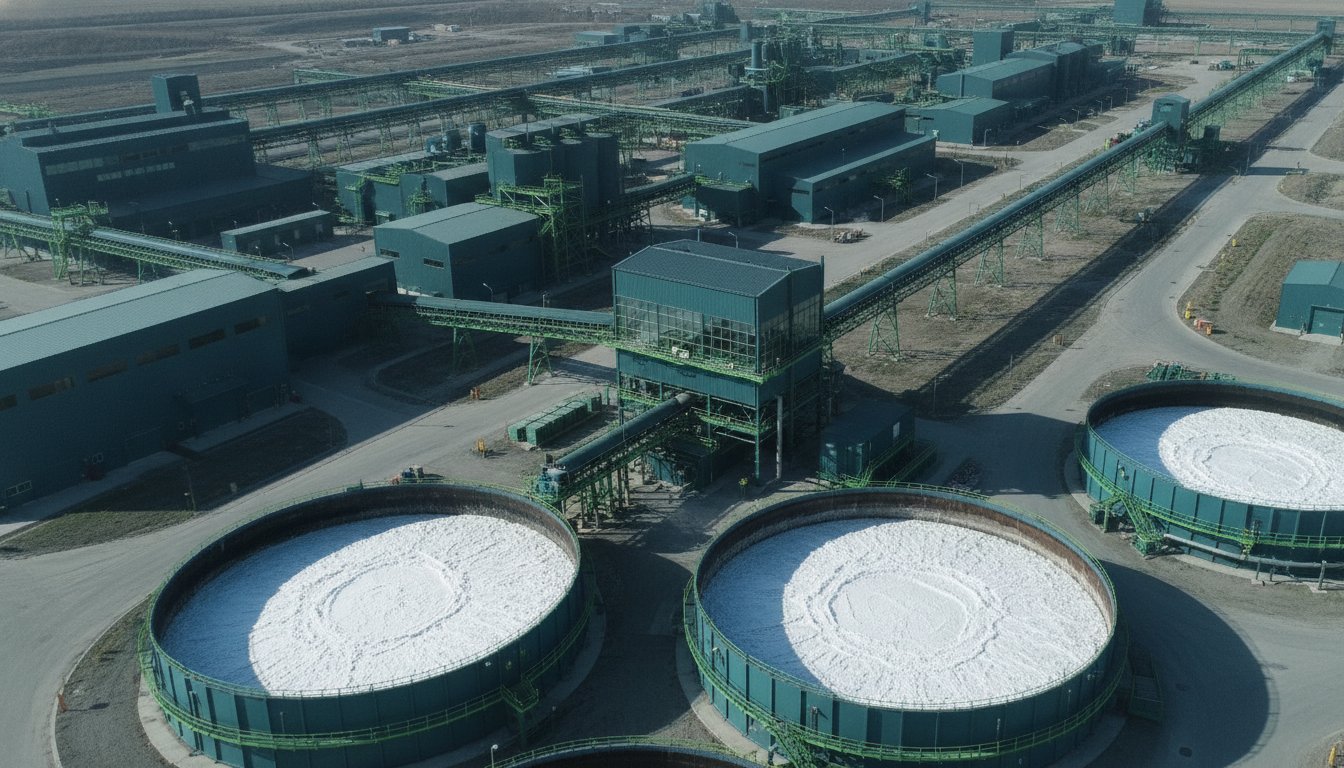
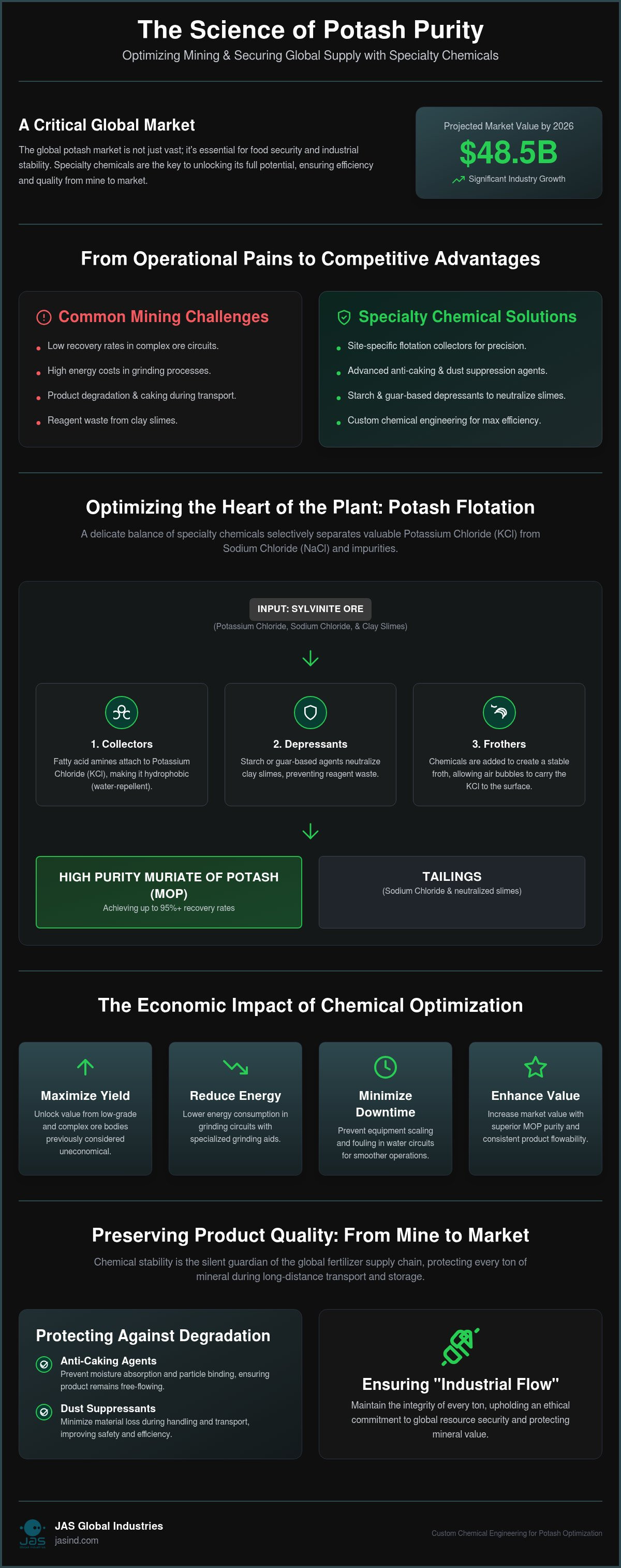
Did you know that the global potash mining and trade market is projected to reach $48.5 billion by the end of 2026? This massive scale underscores the vital role of Potash Mining Chemicals in securing the world’s food supply and industrial stability. You're likely facing the persistent challenges of low recovery rates in complex ores and the high energy costs associated with grinding circuits. It's frustrating when product degrades or cakes during long maritime transport, threatening the integrity of your export and your reputation for reliability.
We've developed this comprehensive technical guide to show you how specialty chemical reagents can transform these operational pains into competitive advantages. You'll learn about site-specific flotation collectors, advanced anti-caking agents, and the impact of the new ISO 10249:2026 standard on process optimization. We're moving beyond generic solutions to focus on the custom chemical engineering that ensures your Muriate of Potash purity remains uncompromised from the mine to the final destination. This is about more than just yield; it's about the security and protection of a critical global resource.
Key Takeaways
- Master the selective flotation process by balancing fatty acid amine collectors and frothers to optimize the separation of potassium chloride from sodium chloride.
- Identify how starch-based and guar-based depressants neutralize clay slimes, preventing reagent waste and improving overall recovery in complex ore circuits.
- Evaluate the specific chemical mechanisms of Potash Mining Chemicals that prevent product degradation and caking during critical storage and export phases.
- Transition from generic chemical usage to a custom engineering model that uses site-specific audits to refine your reagent suite for maximum efficiency.
- Align your production goals with global resource security by achieving higher Muriate of Potash purity through advanced granulation aids and dust suppressants.
The Strategic Role of Specialty Chemicals in Global Potash Production
Potash mining chemicals are the enablers of mineral liberation and product longevity. These specialty reagents aren't just industrial additives; they're essential tools that drive the entire value chain from the initial ore extraction to the moment a farmer applies fertilizer to the soil. In 2026, as the U.S. government prioritizes potash as a critical mineral, the industry's focus has shifted significantly. It's no longer just about raw volume. It's about precision, purity, and the security of the global food supply.
The technical nuances of Potash mining and processing demand a tailored reagent strategy. Operations typically deal with either sylvinite or carnallite ores, and each presents unique chemical hurdles. Sylvinite requires highly selective flotation to separate potassium chloride from sodium chloride. Carnallite processing involves complex decomposition and crystallization phases. Standard commodity chemicals lack the specificity to handle the shifting mineralogy of these ore bodies. When purity standards for Muriate of Potash (MOP) are non-negotiable, specialized Potash Mining Chemicals become the only viable path forward.
Securing the Global Fertilizer Supply Chain
Chemical stability is the silent guardian of global resource security. During long-distance maritime transport, potash is susceptible to moisture absorption and physical degradation. Our mission at JAS Global Industries is to maintain "industrial flow" by ensuring that every ton of mineral retains its integrity across oceans. We view this as a form of resource protection. By using tailored anti-caking agents and dust suppressants, we prevent the loss of critical nutrients. This upholds an ethical commitment to global resource stability and protects the hard-earned value of the mineral resource.
Economic Impact of Chemical Optimization
Process optimization changes the balance sheet. By improving recovery rates in the grinding and flotation circuits, mines can significantly reduce their cost-per-ton. This requires moving away from transactional supply models toward strategic technical partnerships. When we optimize the chemical suite, we're not just selling a product; we're protecting the mine's operational future.
Key economic drivers of optimization include:
- Maximizing yield from complex or low-grade ore bodies that were previously considered uneconomical.
- Reducing energy consumption in grinding circuits through specialized grinding aids.
- Minimizing operational downtime caused by equipment scaling or fouling in the water circuits.
- Enhancing market value of the final product through superior MOP purity and consistent flowability.
Optimizing Potash Flotation: The Synergy of Collectors and Frothers
Flotation is the heart of the mineral processing plant. It's a delicate chemical balance that relies on the precise interaction between air, brine, and mineral surfaces. Potash Mining Chemicals like collectors selectively target potassium chloride crystals. This process renders the target mineral hydrophobic, allowing it to attach to air bubbles and rise to the surface. Without high-selectivity reagents, the separation of sylvite from halite becomes inefficient, leading to significant product loss and reduced MOP purity.
Primary collectors, typically fatty acid amines, serve as the workhorses of this circuit. They attach to the KCl crystal lattice while leaving sodium chloride hydrophilic. This separation is often complicated by the presence of flocculated insoluble slimes. These clay minerals can coat the potash crystals or consume reagents, effectively "poisoning" the flotation process. Successfully managing these interactions requires a holistic reagent suite where each component supports the next.
Advanced Flotation Collectors for Sylvinite Ores
Amine chains must be tailored to specific site conditions. Variations in brine temperature and salinity directly impact collector solubility and attachment rates. A collector that performs well in a laboratory setting might fail in a high-salinity industrial circuit. We focus on high-selectivity formulas that reduce total reagent consumption. By refining the chemical chain, operators can often achieve 95% recovery rates or higher. This precision protects the economic value of the ore body and ensures maximum resource utilization.
Frothers and Process Control
Frothers are essential for mineral transport. They control bubble size distribution and ensure the froth remains stable enough to carry the mineral load to the launder. However, the interaction between frothers and existing brine chemistry is complex. Brine with high magnesium or calcium content can alter bubble stability. If the frother isn't balanced with the collector, the plant may experience "over-frothing." This leads to messy overflows and costly operational downtime. Controlling bubble size is critical for maintaining a steady, manageable mineralized froth.
Achieving this level of process control requires more than off-the-shelf products. It demands a deep understanding of how reagents behave in real-time mining environments. Reviewing your site's mineralogy to develop a customized reagent suite is the most effective way to stabilize these variables and secure your production targets. The strategic selection of Potash Mining Chemicals is ultimately a commitment to both operational efficiency and global resource security.
Enhancing Recovery with Tailored Depressants and Flocculants
Recovery optimization hinges on the successful management of insoluble slimes. These clay minerals are the primary disruptors in potash circuits. They act as reagent thieves; they coat mineral surfaces and consume collectors meant for potassium chloride. Without a robust strategy for clay suppression, chemical costs rise while recovery rates plummet. Potash Mining Chemicals must include highly selective depressants to neutralize these gangue minerals before they can compromise the flotation stage.
Starch and guar-based depressants are the industry standard for this task. These natural polymers possess specific molecular weights that allow them to adsorb onto clay surfaces. This creates a protective barrier that prevents collector attachment. By effectively "blinding" the clay, these reagents ensure that the collectors remain available for mineral liberation. It's a critical step in maintaining the stability of the global fertilizer supply chain.
Clay Management and Depressant Strategy
The chemical battle against gangue minerals requires a deep understanding of deposit mineralogy. Not all clays are the same. Some deposits contain high levels of montmorillonite, while others are rich in illite or kaolinite. Customizing the depressant molecular weight is essential for achieving maximum suppression. For a broader look at how these technical solutions protect critical resources, see our guide on Mining Solutions: Advanced Chemistry for Global Resource Security. We focus on protecting the mineral value through precise chemical intervention.
Water and Brine Treatment in Potash Plants
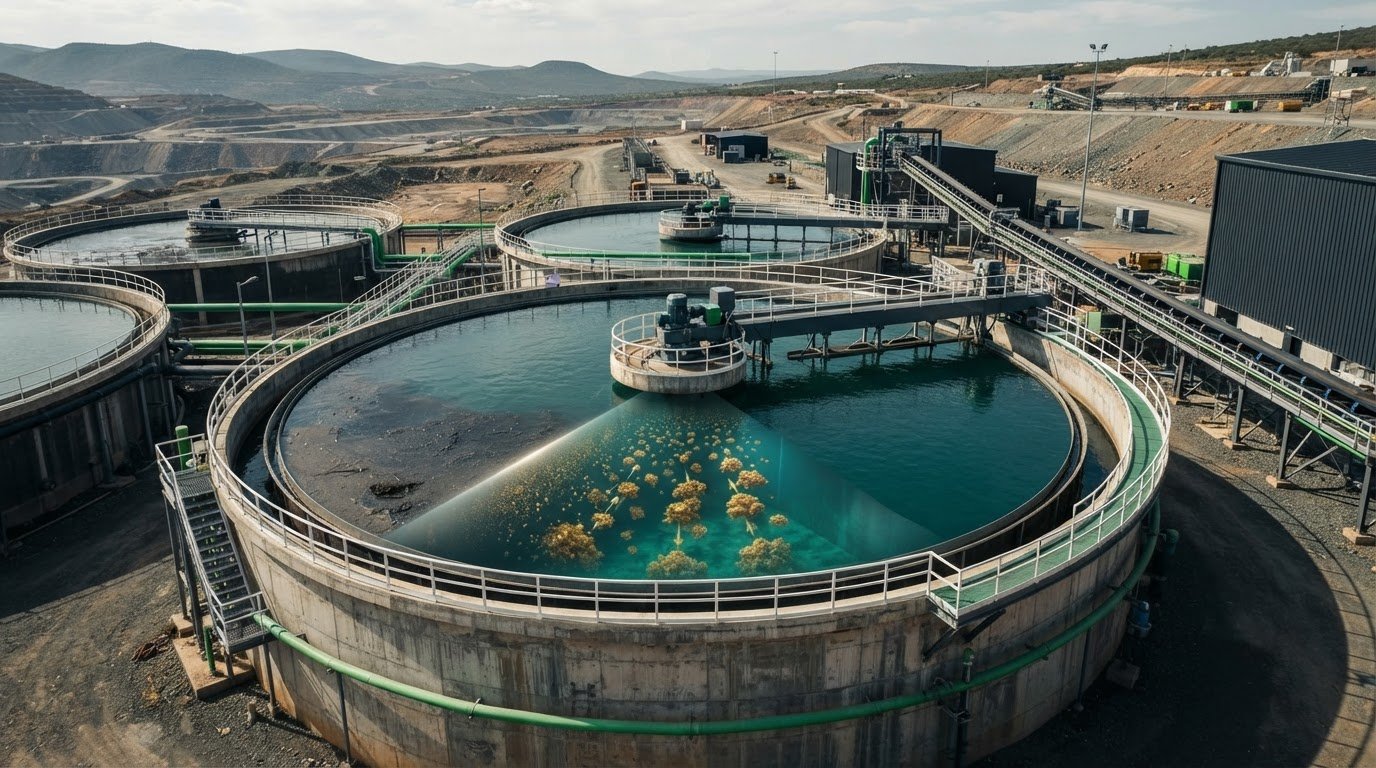
Water management is equally vital for plant efficiency. High-salinity mining environments are prone to scale and corrosion, which can lead to equipment failure and unplanned downtime. Scale inhibitors and biocides are necessary to protect the industrial infrastructure. Additionally, flocculants play a dual role in brine clarification and tailings management. They accelerate the settling of solids in thickeners, allowing for rapid brine recycling and cleaner overflow. This is especially important for operations following U.S. Potash Production and Use standards, where resource efficiency is a top priority.
Tailings management has evolved from a waste concern to an environmental mission. Efficient flocculation reduces the footprint of tailings ponds and improves water recovery. For detailed insights into managing high-salinity water circuits, explore Industrial Water Treatment: A Strategic Guide to Global Water Security. By integrating advanced Potash Mining Chemicals into the water cycle, we ensure that mining operations remain both profitable and responsible guardians of the environment.
Preserving Product Quality: Anti-caking and Dust Suppression
Potash is inherently hygroscopic. It attracts atmospheric moisture with aggressive efficiency. When moisture levels fluctuate during storage or maritime transport, the crystals undergo a process of dissolution and recrystallization. This creates "bridges" between particles, resulting in severe caking that can turn a bulk shipment into a solid mass. Solving this requires sophisticated Potash Mining Chemicals designed to modify the physical behavior of the crystal surface and preserve the integrity of the supply chain.
Anti-caking agents function through two primary mechanisms: surface tension reduction and crystal habit modification. By reducing the surface tension of the moisture film surrounding the crystal, these reagents prevent the formation of strong crystalline bridges. Simultaneously, they alter the shape of any new crystals that do form, making them fragile and easily broken. This ensures the material remains free-flowing from the mine to the final destination, maintaining the "industrial flow" that defines a reliable global supplier.
Advanced Anti-caking Formulations
The choice between oil-based and water-soluble coatings depends heavily on the destination climate and the duration of storage. For shipments traveling through high-humidity tropical zones, oil-based barriers provide a robust hydrophobic shield. In contrast, water-soluble formulations may be preferred for specific downstream agricultural applications where rapid dissolution is required. Maintaining flowability after 6 months in a silo is a benchmark for quality in the export market. You can explore the technical details of these interactions in Anti-caking Agents: The Science of Maintaining Industrial Flow.
Dust Suppression and Environmental Safety
Dust suppression is a matter of both worker safety and economic protection. Fine potash dust is a respiratory hazard and represents a direct loss of sellable product. Applying dust suppressants at transfer points and load-outs creates a cohesive surface layer that keeps particles grounded. For operations in environmentally sensitive regions, we offer biodegradable options that meet strict compliance standards. Effective coating preserves the total volume of the resource and prevents the environmental contamination associated with fugitive dust.
Exporters also utilize fertilizer coloring agents to distinguish their products in a crowded global market. This adds brand value while simplifying product identification during complex logistics maneuvers. Protecting the integrity of the final product is the ultimate goal of any post-production chemical strategy. If you're looking to stabilize your export quality, request a technical audit of your anti-caking circuit to identify potential efficiency gains.
Custom Chemical Engineering: The JAS Approach to Potash Optimization
Potash recovery is not a product purchase; it's a chemical engineering strategy. Generic, catalog-based reagents often fail to account for the mineralogical shifts within a single mine. At JAS Global Industries, we've spent decades refining a laboratory-to-site approach that prioritizes precision over volume. Our Potash Mining Chemicals are never off-the-shelf. Instead, they're the result of rigorous analysis designed to solve site-specific challenges like high clay content or temperature-sensitive brine circuits.
Operational since 1998, our organization leverages a global network of R&I centers and manufacturing plants to deliver rapid formulations. Headquartered in Dubai, our logistics reach ensures that specialized reagents are available wherever critical minerals are extracted. In 2026, the industry demands more than just efficiency. It requires sustainable, high-efficiency reagents that reduce environmental impact while maximizing MOP purity. We're meeting this need through advanced chemistry that balances performance with global responsibility.
Technical Consulting and Process Audits
We begin every partnership with a comprehensive technical audit. Our engineers identify bottlenecks in existing flotation and filtration circuits that lead to mineral loss. By testing site-specific ore samples in our labs, we develop custom dosing strategies that adapt to real-time operational variables. This isn't a transactional relationship; it's a long-term technical collaboration. We focus on identifying dosing adjustments that ensure operational reliability and prevent the reagent poisoning often seen in complex sylvinite deposits.
A Global Partner for Resource Security
Our commitment extends beyond the mine gate. We view our role as a guardian of the global fertilizer supply chain. By providing stable, high-quality chemicals, we protect the security of food resources across the Middle East, Africa, and Asia. Our global manufacturing footprint ensures that supply remains consistent even in volatile market conditions. We don't just supply chemicals; we provide the protection and stability necessary for modern infrastructure. This mission-oriented approach is what distinguishes us as an indispensable pillar of the industry. Partner with JAS Global Industries for tailor-made potash solutions to secure your production future and optimize your recovery rates through custom chemical engineering.
Securing the Future of Global Potash Production
The landscape of potash extraction in 2026 demands a shift from commodity usage to strategic chemical engineering. We've explored how the synergy between collectors and frothers dictates recovery rates, while tailored depressants shield your process from clay interference. Maintaining the "industrial flow" of Muriate of Potash requires more than off-the-shelf solutions. It necessitates specialized Potash Mining Chemicals that preserve product integrity from the mine site to the global market.
JAS Global Industries has been a foundational industry presence since 1998. We leverage our global R&I centers and manufacturing network to provide custom-formulated industrial reagents that address your specific ore mineralogy. Our mission is to act as a vital guardian of your resources, ensuring stability and long-term value in every ton produced. We invite you to Request a Technical Audit for Your Potash Operation today. Together, we can optimize your recovery and protect the global fertilizer supply chain. It's time to transform your operational challenges into sustainable competitive advantages.
Frequently Asked Questions
What are the primary types of potash mining chemicals used today?
Primary categories include flotation collectors, frothers, and depressants for the beneficiation stage. Post-processing requires anti-caking agents and dust suppressants to maintain product integrity during storage. Flocculants are also critical for brine clarification and tailings management. These Potash Mining Chemicals ensure that every stage of production, from mineral liberation to final export, operates with maximum efficiency. We focus on providing a holistic reagent suite that protects the resource value.
How do flotation collectors improve MOP recovery rates?
Flotation collectors, specifically fatty acid amines, selectively attach to the surface of potassium chloride crystals. This chemical attachment changes the mineral's surface property from hydrophilic to hydrophobic. As air is introduced into the flotation cell, the hydrophobic potash particles cling to bubbles and rise to the surface. This mechanism allows for the precise separation of potash from halite, which significantly increases recovery rates even in complex sylvinite ores with varying grades.
Why is anti-caking essential for potash exporters?
Potash is highly hygroscopic and absorbs moisture from the air, which leads to crystal bridging and severe caking. For exporters, this results in solid blocks of material that are nearly impossible to unload at the destination. Anti-caking agents modify the crystal habit and reduce surface tension, ensuring the product remains free-flowing. This protection is vital for maintaining the stability of the global fertilizer supply chain during long-distance maritime transport across different climates.
Can specialty chemicals reduce the energy consumption of potash grinding?
Specialty mining grinding aids reduce the energy consumption of grinding circuits by preventing the agglomeration of fine particles. These chemicals coat the mineral surfaces and the grinding media, which improves mill throughput and reduces the cushioning effect of fine dust. By optimizing the grinding process, mines can achieve the target particle size much faster. This leads to lower power costs and reduced wear on expensive industrial equipment over the long term.
How does JAS Global Industries customize reagents for different ore bodies?
JAS Global Industries uses a lab-to-site approach that begins with a detailed technical audit of the mine's specific mineralogy. We analyze ore samples at our global R&I centers to identify the exact clay content and brine chemistry. Our engineers then develop tailor-made formulations, adjusting molecular weights or chemical chains to match site-specific conditions. This custom engineering ensures that our reagents provide peak performance where standardized, off-the-shelf products typically fail to meet purity standards.
Are there environmentally friendly options for potash tailings flocculation?
Modern tailings management relies on high-efficiency mining flocculants that accelerate the settling of solids and improve brine recovery. We offer formulations designed to reduce the environmental footprint of tailings ponds by ensuring rapid water recycling. These biodegradable options help operations comply with strict environmental standards while maintaining process efficiency. It's a key part of our mission to provide industrial solutions that are both powerful and ecologically responsible for the communities we serve.
What is the role of frothers in potash flotation circuits?
Frothers are essential for controlling bubble size and ensuring the stability of the mineralized froth. They lower the surface tension of the brine, allowing for the creation of a consistent bubble distribution that can carry the mineral load to the launder. Without the correct frother balance, the circuit may suffer from bubble coalescence or over-frothing. Proper frother selection ensures a steady, manageable froth that optimizes mineral transport and prevents costly operational downtime.
How do dust suppressants improve safety in mining operations?
Dust suppressants create a cohesive layer on the surface of the potash, preventing fine particles from becoming airborne at transfer points and load-outs. This significantly improves visibility and respiratory safety for workers in the mining environment. Beyond safety, these chemicals prevent material loss and environmental contamination. By keeping the product grounded, suppressants protect both the health of the workforce and the economic value of the mineral resource during handling and transport.