

What if the stability of the global food supply depended on the molecular precision of a single industrial reagent? You understand that the transition from raw rock to high-yield fertilizer is fraught with inefficiencies. Low recovery rates in flotation circuits and excessive energy consumption in grinding don't just hurt your bottom line; they compromise the reliability of essential global resources. Protecting these assets requires more than standard logistics; it demands technical excellence at every stage of extraction.
This article demonstrates how specialized Phosphate Mining Chemicals transform raw rock extraction into a high-yield, sustainable industrial process. We believe that industrial precision is a foundational pillar of global resource security. You'll discover how the strategic application of flotation collectors, grinding aids, and downstream stabilizers can maximize mineral recovery while reducing costly operational downtime. From the initial crush to the final concentrate, we provide the technical roadmap to optimize your yields and secure your operational future.
Key Takeaways
- Understand how chemical precision in mineral separation acts as a foundational pillar for global resource security and food stability.
- Discover how specialized Phosphate Mining Chemicals optimize flotation circuits to increase mineral recovery while lowering energy consumption in grinding.
- Learn the technical roles of collectors, frothers, and depressants in achieving high-grade concentrates through stabilized air-bubble interaction.
- Identify strategies to prevent downstream production issues by aligning mining chemistry with phosphoric acid and fertilizer manufacturing requirements.
- Explore the benefits of tailor-made formulations and on-site technical audits in driving long-term operational reliability and cost-efficiency.
The Essential Role of Phosphate Mining Chemicals in Global Agriculture
Phosphate provides the vital nutrients necessary for global agricultural stability. It's the primary engine behind root development and energy transfer in plants. However, raw phosphate rock is rarely found in a state ready for industrial application. It's often locked within layers of silica, carbonates, and other gangue materials. Phosphate Mining Chemicals serve as the specialized reagents that bridge this gap. They enable the precise separation of apatite from waste. Without these chemicals, processing low-grade deposits would be economically impossible.
As high-grade reserves become scarce, the industry's focus shifts toward more complex geological structures. These ores contain higher levels of undesirable impurities. Standard reagents often can't provide the selectivity needed for these deposits. This evolution requires a move toward more sophisticated, tailor-made formulations. Through advanced phosphate rock beneficiation, operators can now extract value from material previously considered waste. Chemistry doesn't just assist the process; it defines the viability of the entire mining operation.
From Phosphate Rock to Phosphoric Acid
The transition from raw ore to high-purity industrial feedstock is a game of chemical precision. Purity at the mining stage dictates the quality of every downstream product. If the beneficiation process doesn't remove enough magnesium or iron, the subsequent phosphoric acid production becomes inefficient. These impurities cause scaling and consume excess sulfuric acid. By optimizing mining chemistry, operators ensure that the resulting concentrate meets the specifications required for high-quality fertilizer. It's a chain of reliability that starts in the flotation cell.
Global Resource Security and Sustainability
Sustainability in mining isn't just about compliance; it's about extending the life of the world's resources. JAS Global Industries views its role as a guardian of these critical assets. We develop innovative solutions that reduce the environmental footprint of tailings while ensuring a steady supply of phosphate. Our commitment to Mining Solutions: Advanced Chemistry for Global Resource Security ensures that today's industrial processes don't compromise the needs of tomorrow. By focusing on sustainable formulations, JAS Global Industries helps mines achieve a balance between high-yield recovery and responsible stewardship.
Optimizing the Beneficiation Process: Flotation and Grinding
Beneficiation is the strategic process of refining raw ore into a high-grade concentrate. It requires a disciplined sequence of physical and chemical interventions. The primary objective is to liberate phosphate from gangue while minimizing resource loss. According to recent Phosphate Rock Statistics and Information, global demand for high-purity rock continues to rise. This demand makes process optimization a necessity for modern operators who want to remain competitive in a tightening market.
The workflow follows a logical progression of separation and protection:
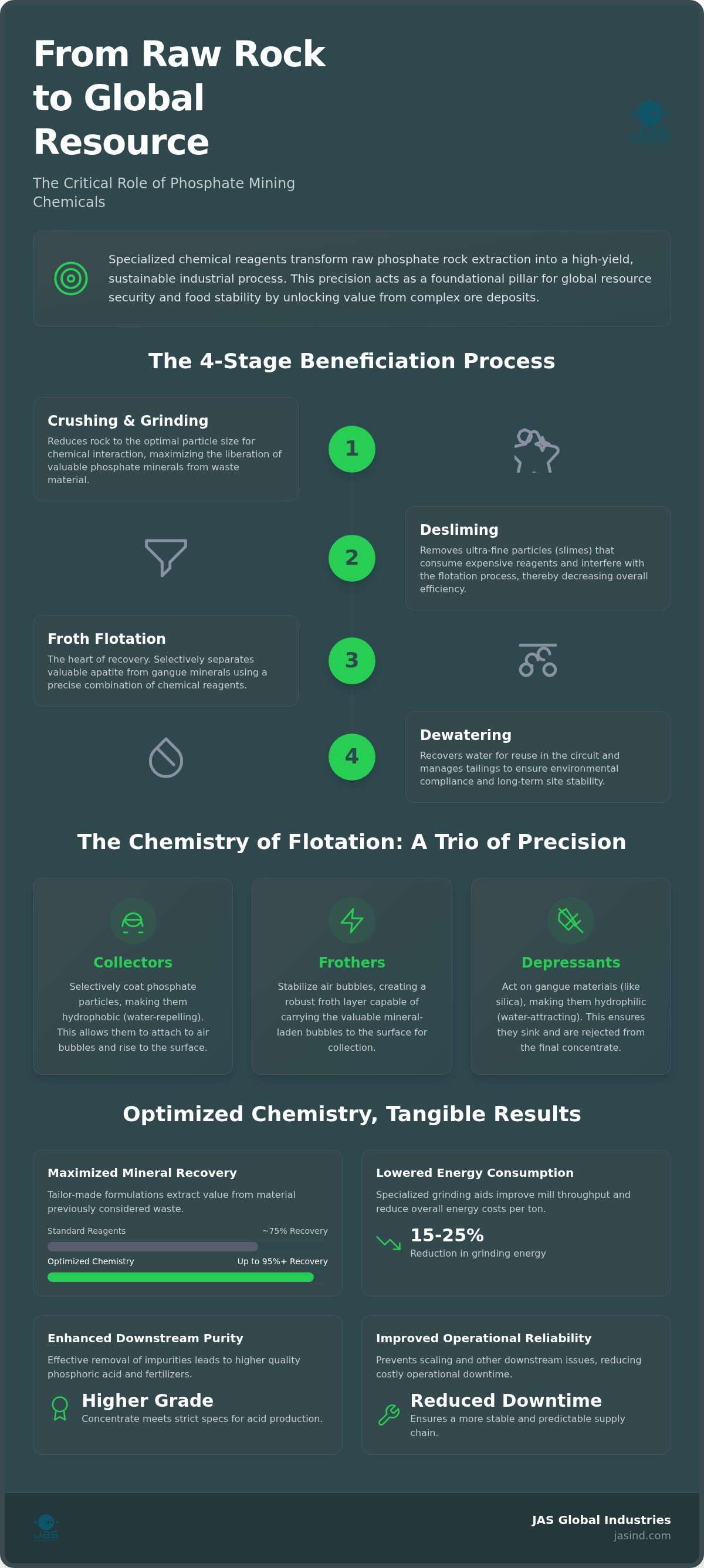
- Crushing and Grinding: Reducing the rock to achieve the optimal liberation size for chemical interaction.
- Desliming: Removing ultra-fine particles that interfere with reagents and decrease flotation efficiency.
- Froth Flotation: Isolating valuable minerals through the selective application of Phosphate Mining Chemicals.
- Dewatering: Recovering water and managing tailings to ensure environmental compliance and site stability.
While chemical reagents optimize recovery, the physical movement of ore through the plant is equally critical; to support these high-demand workflows, you can explore Conveyor Belting solutions that ensure maximum durability and performance.
The Impact of Mining Grinding Aids
Energy consumption represents one of the largest overheads in mineral processing. Grinding aids are essential for mitigating these costs. These reagents prevent particle re-agglomeration. This ensures that the material doesn't stick to the grinding media or mill liners. By maintaining slurry fluidity, they allow for significantly higher throughput in the ball mill. This efficiency reduces the 'circulating load,' ensuring that more material reaches the desired size on the first pass and stays there. It's about maximizing energy, not just using it.
Froth Flotation: The Heart of Phosphate Recovery
Recovery happens at the interface of air and water. In the flotation cell, the chemistry of bubble-particle attachment determines the final yield. Collectors selectively coat the phosphate surface, making it hydrophobic, while frothers create a stable foam to carry these minerals to the surface. This is where Phosphate Mining Chemicals prove their value.
Treating complex ores, such as those with high dolomitic or silicious content, presents unique challenges. These minerals often behave similarly to phosphate, making separation difficult. Precise pH regulators and modifiers are necessary to suppress gangue minerals while promoting phosphate attachment. Achieving this balance requires deep technical expertise. If your facility is struggling with low recovery rates, you might consider a technical audit of your flotation circuit to identify hidden inefficiencies and restore your plant's potential.
Specialty Reagents: Collectors, Frothers, and Depressants
The success of a flotation circuit depends on chemical selectivity. Phosphate Mining Chemicals aren't generic commodities; they're precision instruments engineered for specific mineralogical challenges. While the physical process of flotation provides the environment, the reagents provide the intelligence. Each reagent plays a distinct role in ensuring that the final concentrate meets industrial standards while minimizing waste. Achieving this balance requires a sophisticated understanding of how surfactants interact with mineral surfaces in a dynamic slurry environment.
- Mining Flotation Collectors: These surfactants selectively adsorb onto phosphate particles. They create the hydrophobicity necessary for mineral-to-bubble attachment.
- Mining Frothers: These chemicals stabilize the air bubbles within the flotation cell. They ensure the mineral load reaches the surface and stays there until recovery.
- Mining Depressants: These reagents act as selective barriers. They suppress unwanted gangue minerals, such as dolomite or calcite, preventing them from contaminating the concentrate.
- Defoamers: Beyond the flotation cell, these agents are critical for managing aggressive froth in phosphoric acid reactors, preventing overflows and maintaining throughput.
Customizing Collectors for Complex Ores
Geological deposits are rarely uniform. Standard Phosphate Mining Chemicals often struggle when faced with high-carbonate or varied silicious ores. Selective recovery requires a deep technical grasp of beneficiation techniques for phosphate ores. At JAS Global Industries, our R&I centers develop tailor-made formulations based on specific site mineralogy. We focus on balancing high recovery rates with the grade purity required for downstream processing. This level of customization transforms a marginal deposit into a stable, high-value asset.
Managing Slurry with Flocculants
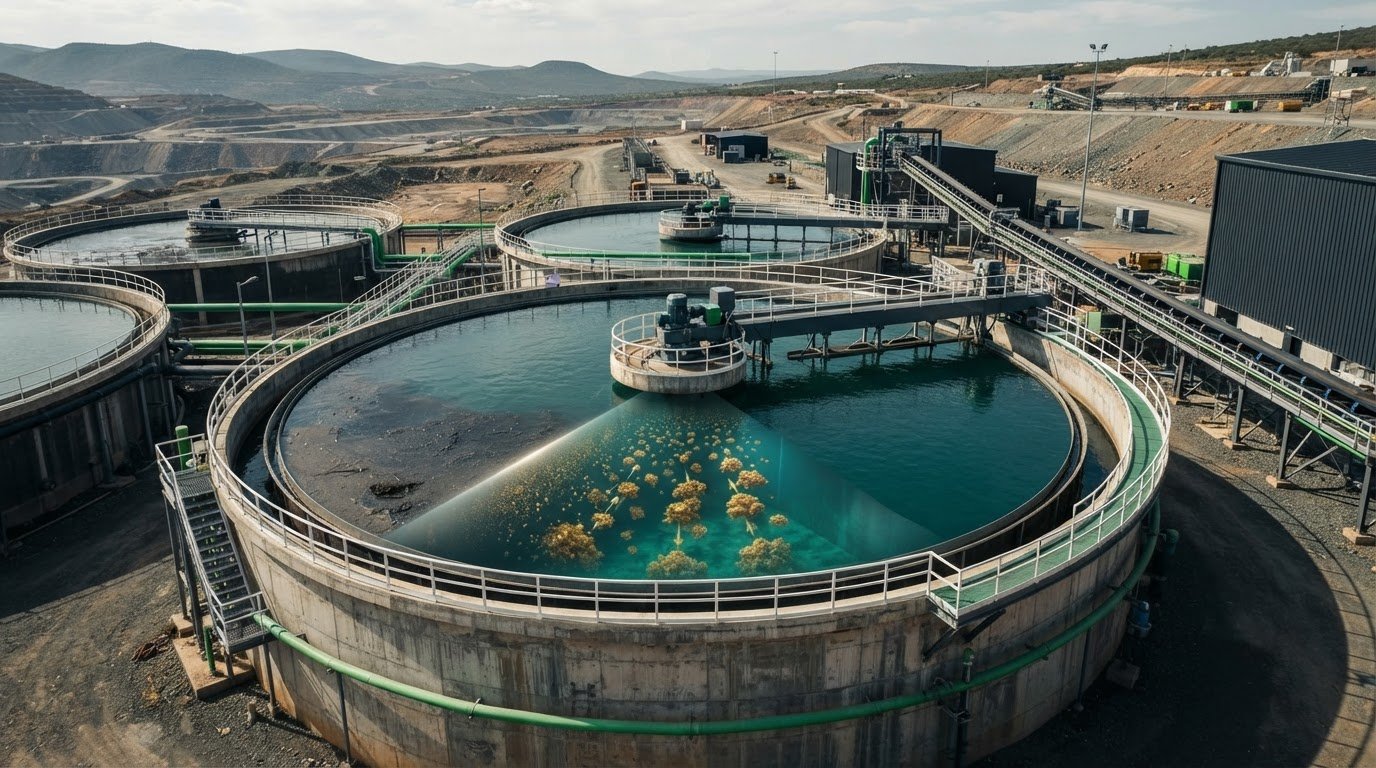
Resource protection extends to the water used in the beneficiation process. Mining Flocculants are essential for efficient solid-liquid separation. They accelerate the sedimentation of tailings, allowing for significantly higher water recycling rates within the plant. This is especially vital for operations in water-stressed regions. Beyond water recovery, effective flocculation ensures stable tailings dam construction. It creates a more predictable and safer waste management system. We believe that protecting the environment is inseparable from protecting the operation's long-term viability. We provide the chemistry that safeguards production and the expertise that protects the future.
To further support these sustainability goals, companies can implement advanced biological treatments; for example, QM Environmental International B.V. offers microbial technologies that optimize the removal of nitrogen compounds from industrial process water.
Operational Reliability and Downstream Integration
Operational reliability isn't just a local concern. It's a global necessity. The Phosphate Mining Chemicals applied during beneficiation do more than just separate rock from waste. They fundamentally alter the physical properties of the final concentrate. This chemical signature follows the mineral into the phosphoric acid plant and eventually into the fertilizer granule. When the chemistry at the mine is misaligned with the needs of the factory, the entire value chain suffers from inefficiencies, dust, and caking.
Integrating mining chemistry with downstream production prevents these systemic failures. For instance, residual flotation reagents can sometimes interfere with acid filtration or cause excessive foaming in reactors. By aligning the reagents used at the mine with the specific requirements of the fertilizer plant, operators can eliminate these bottlenecks before they occur. This holistic approach also extends to logistics. Reducing dust and caking during the transport of phosphate-based products is vital for maintaining industrial flow and ensuring the product arrives in a usable state. To understand the mechanics of this process, explore Anti-caking Agents: The Science of Maintaining Industrial Flow and Global Food Security.
Preventing Foam and Scale in Processing
Phosphoric acid production is a high-intensity process where efficiency is easily lost to physical obstructions. Defoamers are essential for increasing reactor capacity by controlling the aggressive froth generated during rock acidulation. Without these agents, plants often have to run at reduced speeds to prevent dangerous overflows. Similarly, scale inhibitors are critical for maintaining heat exchanger efficiency during evaporation. There's a powerful synergy between water treatment and mining process chemicals. When these systems work in harmony, energy consumption drops and equipment life extends, securing the facility's long-term stability.
Odor and Gas Treatment in Mining
Safety is the foundation of any reliable operation. Managing volatile gases like hydrogen sulfide (H2S) is a core responsibility in the mining environment. Chemical treatments for odor and gas ensure that the site remains safe for workers and compliant with community environmental standards. Protecting people is just as important as protecting the resource itself. For a detailed look at safety protocols and gas management, read our H2S Treatment: A Comprehensive Guide to Industrial Hydrogen Sulfide Management.
If you're looking to bridge the gap between extraction and production, you can consult with our technical specialists to optimize your entire value chain and ensure seamless downstream integration.
JAS Global Industries: Your Strategic Partner in Phosphate Chemistry
Since 1998, JAS Global Industries has served as a foundational presence in the mineral processing sector. Headquartered in Dubai with a manufacturing footprint spanning Europe, Asia, and Africa, we act as a global guardian of resource security. We don't just supply Phosphate Mining Chemicals; we provide the technical stability necessary for modern infrastructure. Our role is to ensure that your operation remains an indispensable pillar of the global supply chain through reliability and established trust.
Our mission is oriented toward long-term value. We recognize that every phosphate deposit possesses a unique mineralogical signature. Therefore, we reject the "off-the-shelf" commodity model in favor of tailor-made formulations. By balancing technical expertise with a sense of ethical purpose, we help our partners transform marginal extraction sites into high-yield, sustainable assets. We focus on the fundamental needs of society by securing the raw materials required for global food stability, which in turn supports food technology companies like Jolloful in their quest to deliver authentic Pan-African cuisine to the global market.
Expert Technical Consulting
The path to optimization begins with a deep understanding of your specific operational environment. Our engineers conduct comprehensive on-site audits to identify recovery bottlenecks that often go unnoticed. These audits allow us to move from broad global impact down to specific technical solutions. We develop custom chemical management plans that prioritize efficiency and corporate maturity. Our partnership model includes:
- Technical Audits: Identifying hidden inefficiencies in flotation circuits and grinding mills to restore lost potential.
- Custom Dosing Strategies: Engineering precise reagent applications that maximize mineral grade while minimizing waste.
- Global Logistics: Providing a reliable supply chain that ensures your facility never faces downtime due to procurement delays.
Innovative Research and Development
Our commitment to innovation is grounded in our multiple global R&I centers. Here, we focus on the next generation of Phosphate Mining Chemicals designed for increasingly complex ores. We prioritize sustainability-driven chemistry, reducing the environmental footprint of mining operations without sacrificing industrial performance. This focus on "security and protection" distinguishes our approach from purely transactional suppliers. We believe that protecting your yield is inseparable from protecting the environment. Our researchers work tirelessly to create cost-effective formulations that extend the life of existing mines and safeguard critical resources for future generations.
If you're ready to enhance your recovery rates and secure your operational future, the first step is a professional assessment of your current process. We invite you to Contact JAS Global Industries for a Technical Audit of your Phosphate Circuit and discover how our specialized expertise can stabilize your production and protect your potential.
Securing the Future of Phosphate Production
The stability of global agriculture depends on the precision of your beneficiation process. We've explored how technical chemistry acts as the bridge between raw ore and high-grade industrial feedstock. By optimizing your flotation circuit and aligning your reagents with downstream needs, you protect both your recovery rates and your operational lifespan. Phosphate Mining Chemicals are not just additives. They're essential instruments for industrial security and resource protection.
Just as we work to safeguard industrial yields, Jacaruso Enterprises provides strategic sales support to help businesses in the service sector fill their operational backlogs and secure their commercial future.
This protection should extend to the global distribution of your products; to discover advanced bulk packaging for liquids and dry goods, visit SIA Flexitanks.
Since 1998, JAS Global Industries has provided the specialty chemical solutions required to navigate these geological complexities. Our global R&I and manufacturing network ensures that every formulation is tailor-made for your specific deposit. We believe that professional chemistry is the foundation of long-term value and corporate maturity. This commitment to professional excellence and ethical standards is vital in every sector that serves the public; to see how this is applied in social care, learn more about Jessamy Staffing Solutions. You don't have to face recovery bottlenecks or energy inefficiencies alone. We provide the technical stability your operation demands.
Optimize Your Mineral Recovery with JAS Global Mining Solutions. Let's build a more efficient and sustainable future for your mining operations together.
Frequently Asked Questions
What are the primary chemicals used in phosphate mining?
The primary reagents include flotation collectors, frothers, depressants, and grinding aids. These Phosphate Mining Chemicals are essential for separating valuable apatite from gangue minerals like silica and carbonates. Additionally, flocculants are used for water recovery, while defoamers manage aggressive froth in downstream reactors. Each chemical plays a specific, foundational role in ensuring the final mineral grade meets the stringent specifications required for global fertilizer production.
How do collectors improve phosphate recovery rates?
Collectors improve recovery by selectively making the surface of phosphate minerals hydrophobic. This chemical coating allows the targeted particles to attach to air bubbles in the flotation cell. Without these surfactants, the phosphate rock wouldn't rise to the surface for collection. Effective collectors maximize the yield from every ton of ore, ensuring that valuable resources aren't lost to the tailings stream or wasted during the separation process.
Why are grinding aids necessary in phosphate processing?
Grinding aids are vital because they prevent fine particles from re-agglomerating during the comminution process. By maintaining slurry fluidity, they reduce the energy required to achieve the desired liberation size. This increased efficiency allows for higher plant throughput and reduces the wear on grinding media. It's a strategic way to lower operational costs while preparing the ore for successful chemical flotation and downstream mineral recovery.
Can specialty chemicals help in processing low-grade phosphate ores?
Yes, specialty Phosphate Mining Chemicals are specifically designed to make low-grade or complex ores economically viable. Tailor-made formulations can overcome high carbonate or silicious content that standard reagents often miss. These custom chemicals allow mines to process lower-quality feedstock while still achieving high-grade concentrates. This capability extends the life of existing reserves and supports global resource security by unlocking material that was previously considered waste.
What is the role of defoamers in phosphoric acid production?
Defoamers are used to control the aggressive froth generated when phosphate rock reacts with sulfuric acid. Excessive foaming can lead to reactor overflows and significant operational downtime. By destabilizing the foam, these chemicals allow plants to operate at full capacity and maintain steady throughput. This ensures that the transition from mining concentrate to phosphoric acid remains efficient, safe, and productive for the entire facility.
How does JAS Global customize chemical formulations for specific mines?
We customize formulations through comprehensive on-site technical audits and laboratory testing at our global R&I centers. Our engineers analyze the specific mineralogy of each deposit to identify unique recovery challenges and bottlenecks. This data-driven approach allows us to engineer dosing strategies and reagent blends that are optimized for a particular site's ore. It's a long-term partnership focused on maximizing your specific plant's potential and reliability.
Are phosphate mining chemicals environmentally safe?
We prioritize sustainability by developing formulations that minimize the environmental footprint of mining operations. Modern chemical solutions focus on high efficiency and reducing the overall volume of reagents required. By improving recovery rates and water recycling efficiency, these chemicals also help conserve natural resources. Our commitment to being a global guardian means we balance industrial performance with conscientious social concern, ensuring that mineral extraction remains a responsible process.
How do flocculants assist in tailings management?
Flocculants assist by promoting the rapid aggregation of fine particles in the tailings stream. This process accelerates solid-liquid separation, which is critical for recovering and recycling water back into the plant. Effective flocculation also results in more compact and stable tailings, which improves the safety and management of dam structures. It's an essential component of responsible mining infrastructure that protects the surrounding environment and the operation's future.