
What if the difference between a successful harvest and a broken global supply chain was a microscopic chemical barrier? You likely understand the frustration of opening a warehouse to find tons of high-value fertilizer transformed into a solid, unusable block. It's a logistical nightmare that leads to significant product loss, clogged application machinery, and the grueling, expensive labor of manual de-caking. Maintaining the integrity of these nutrients is essential for both your bottom line and global food security.
A high-performance NPK fertilizer anti-caking agent is no longer just a technical additive; it's a strategic necessity for resource protection. This article explains how advanced formulations act as a vital guardian of your inventory, ensuring every granule remains free-flowing from the production plant to the final end-user. We'll explore how specialized coatings optimize maritime logistics, reduce customer complaints, and safeguard the stability of global agricultural supply chains. By the end, you'll see how precision chemistry transforms industrial efficiency into long-term resource security.
Key Takeaways
- Understand the scientific drivers behind solidification, including hygroscopicity and crystal bridging, to better protect your inventory from degradation.
- Identify the most effective NPK fertilizer anti-caking agent for your specific blend by comparing the performance of internal additives against external surface coatings.
- Discover strategic logistics techniques to mitigate caking pressure and temperature fluctuations during long-term storage and challenging maritime transport.
- Learn how technical audits and custom formulations can reduce product loss while significantly optimizing dosing efficiency in your production plant.
Defining the NPK Fertilizer Anti-caking Agent in Global Supply Chains
An NPK fertilizer anti-caking agent is a precision-engineered specialty chemical formulation designed to inhibit the physical and chemical adhesion between fertilizer granules. These agents create a protective barrier on the surface of each particle, preventing the formation of solid crystalline bonds. Without this intervention, individual granules fuse together into large, unmanageable masses. This phenomenon, known as Caking, compromises the integrity of the product and disrupts the entire agricultural value chain. In the context of global resource security, these agents are not optional additives; they are essential guardians of nutrient stability.
The economic impact of solidified product is staggering. When NPK blends lose their flowability during maritime transport or bulk storage, the financial repercussions extend far beyond the cost of the chemical itself. Port authorities face significant delays in unloading throughput, while warehouse operators must invest in expensive manual de-caking processes. By maintaining granular separation, an NPK fertilizer anti-caking agent serves as a critical bridge between a plant's production yield and the end-user's operational reliability.
The Vital Importance of Flowability in Industrial Logistics
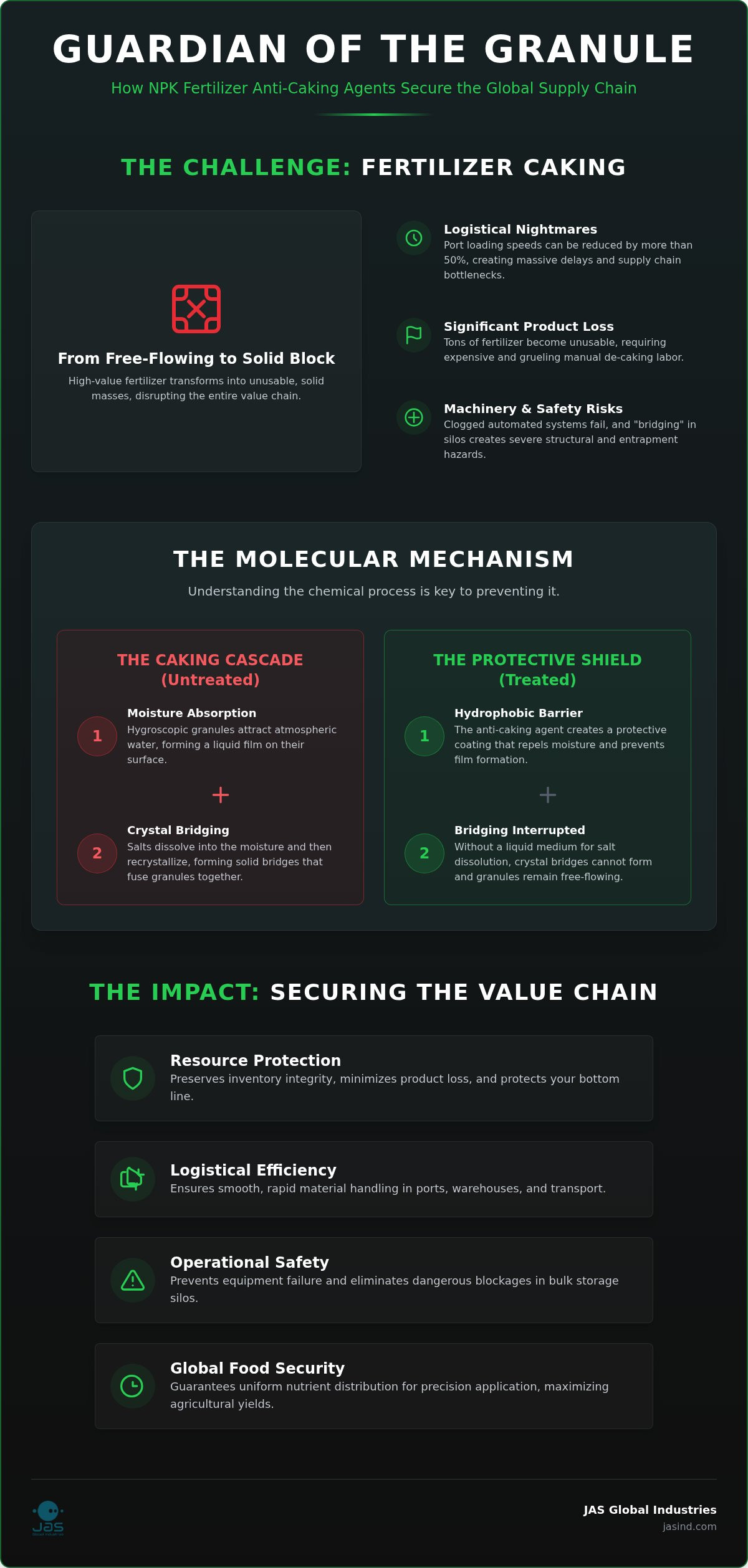
Free-flowing granules are the lifeblood of modern agricultural infrastructure. Automated dosing systems and precision application machinery require consistent particle movement to function correctly. If the fertilizer has clumped, these systems fail, leading to uneven application and wasted resources. In major ports, the solidification of bulk cargo can reduce loading speeds by more than half, creating bottlenecks that ripple through global trade routes. Furthermore, caking presents severe safety risks. The formation of "bridges" or "arches" in industrial silos and bulk warehouses can lead to sudden structural collapses or entrapment hazards for workers tasked with clearing blockages.
From Agricultural Yields to Mining Process Efficiency
Uniform nutrient distribution is the foundation of high agricultural yields. When fertilizer flows freely, farmers can ensure that every square meter of soil receives the exact NPK ratio required for optimal growth. This consistency directly supports global food security by maximizing the efficiency of every ton produced. This focus on flowability extends into related industrial sectors as well. Many of the same principles used to stabilize fertilizers are applied to maintaining mineral recovery rates through optimized reagent handling in mining solutions. Whether in the field or the processing plant, the intersection of chemical stability and operational safety is paramount. High-performance formulations ensure that hazardous materials remain stable and predictable throughout their lifecycle, protecting both the workforce and the environment.
The Chemical Mechanism: How Formulated Solutions Prevent Compaction
Compaction in granular fertilizer isn't merely a result of physical weight; it's a complex chemical process driven by environmental interaction. An effective NPK fertilizer anti-caking agent addresses the root causes of solidification at the molecular level. By understanding these mechanisms, plant managers can better protect their product during the long journey from production to the field. Stabilizing these chemical interactions is the first step toward ensuring global resource security and operational efficiency.
Neutralizing Moisture Absorption and Hygroscopicity
Many fertilizer components are naturally hygroscopic, meaning they aggressively attract water from the air. Critical Relative Humidity (CRH) is the specific atmospheric humidity level above which a fertilizer salt begins to absorb moisture from the surrounding environment. Once this threshold is crossed, a liquid film forms on the granule surface, initiating the caking cycle. Advanced surfactant technology creates a molecular shield that raises the effective resistance to this moisture uptake. These hydrophobic barriers are essential in humid maritime climates where atmospheric water vapor is constant and unavoidable.
Interrupting Crystal Bridging in Granular Solids
When moisture on the surface of a granule dissolves a small amount of salt, a concentrated brine forms. As the environment dries or temperatures drop during diurnal cycles, this brine recrystallizes at the contact points between particles. These "crystal bridges" create a rigid network that transforms a pile of granules into a solid block. A high-quality NPK fertilizer anti-caking agent provides physical and chemical separation by modifying surface energy. This prevents the salts from bonding, ensuring long-term stability even throughout extended 6-12 month storage cycles. Producers often find that customized technical audits are the most effective way to identify the exact formulation needed for their specific climate and storage duration.
Beyond crystal growth, capillary adhesion plays a significant role in early-stage clumping. Surface tension pulls damp granules together, increasing the contact area where bridges can eventually form. Formulated coatings reduce this surface tension, causing moisture to bead and shed rather than spread. This proactive approach to surface chemistry prevents the initial "stickiness" that leads to total solidification. By neutralizing these microscopic forces, industrial facilities maintain the free-flowing characteristics required for automated dosing and precision agricultural application.
Selecting the Right NPK Fertilizer Anti-caking Agent for Your Process
Choosing an NPK fertilizer anti-caking agent is a strategic decision that directly impacts operational safety and global supply chain stability. It isn't simply about finding the lowest price per ton. Instead, plant managers must match the chemical formulation to the specific mineral profile of their product and the environmental stressors it will face. A successful selection ensures that high-value nutrients reach the field in optimal condition, fulfilling our collective responsibility to global food security.
Evaluation criteria for these specialty chemicals include cost-efficiency, required dosage rates, and compatibility with secondary additives like coloring agents or micronutrients. We're also seeing a significant industry shift toward sustainable and biodegradable chemical technologies. Producers are increasingly prioritizing eco-friendly formulations that maintain industrial flow without compromising environmental stewardship. Achieving this balance requires a move away from generic solutions toward precision chemistry.
Internal vs. External Anti-caking Treatments
The distinction between internal and external treatments is critical for process optimization. Internal modifiers are implemented during the granulation or prilling phase. These chemicals integrate into the fertilizer's structure to alter the internal crystal lattice, increasing the physical strength of the granule. This is particularly effective for highly hygroscopic materials that are prone to internal moisture migration.
Post-production surface coatings serve a different but equally vital purpose. These external agents provide a hydrophobic barrier that is essential for long-distance maritime transport. In humid climates, this surface protection is the only thing preventing total solidification. For high-value specialty NPK fertilizers, many producers now utilize hybrid strategies. By combining internal modifiers with advanced surface coatings, they create a dual-layer defense that ensures stability throughout even the most challenging logistics cycles.
Evaluating Tailor-made vs. Generic Chemical Formulations
Generic, "one-size-fits-all" agents often fail when applied to complex NPK blends, especially those with high urea or ammonium nitrate content. These reactive components demand specific surfactant ratios to remain stable. Relying on a generic NPK fertilizer anti-caking agent can lead to inconsistent performance and costly product rework at the warehouse level. Custom-engineered solutions address these specific chemical sensitivities, providing a higher level of protection than mineral-based coatings alone.
The most effective way to optimize dosing is through technical audits and on-site laboratory testing. This collaborative approach allows for the adjustment of formulations based on real-world variables like ambient temperature and storage pressure. Utilizing custom anti-caking agents significantly improves ROI by reducing the volume of chemical required while maximizing the percentage of free-flowing product delivered to the end-user. This precision isn't just a technical advantage; it's a commitment to industrial efficiency and resource protection.
Strategic Logistics: Optimizing Storage and Transport in Humid Climates
Logistics is the stage where theoretical chemical stability meets real-world environmental volatility. Even the highest quality product can fail if the NPK fertilizer anti-caking agent isn't optimized for the specific stresses of the global supply chain. In high-stack warehouse environments, "caking pressure" becomes a primary adversary. The sheer physical weight of the material accelerates the contact between granules, forcing them to fuse under load. Managing this pressure requires a combination of structural warehouse management and high-performance chemical coatings that maintain their integrity under extreme compression.
Total quality control also depends on the synergy between anti-caking agents and dust suppressants. While the anti-caking agent prevents clumping, dust suppressants ensure that fine particles don't fill the voids between larger granules. When these voids remain clear, airflow is improved and the number of contact points where crystal bridges can form is significantly reduced. This dual-action approach is essential for maintaining product value in logistics hubs like Dubai and Riyadh, where environmental conditions are particularly unforgiving.
Mitigating Environmental Factors in Bulk Storage
Large-scale industrial silos and warehouses must actively control humidity and airflow to prevent moisture migration. In desert climates, extreme diurnal temperature variations cause the air inside storage facilities to expand and contract, drawing in moisture-laden air during the night. This cycle triggers the recrystallization process discussed in previous sections. Middle Eastern fertilizer hubs require specialized hydrophobic formulations to combat the aggressive moisture uptake caused by the unique combination of coastal humidity and extreme desert heat cycles. Maintaining a stable internal environment is a matter of both engineering and advanced surface chemistry.
Best Practices for Maritime Fertilizer Logistics
Cross-continental sea voyages, often lasting 30-45 days, subject fertilizer to multiple climate zones and varying levels of humidity. As a ship moves from tropical regions to cooler northern ports, "ship sweat" or condensation can form on the cargo, leading to rapid surface caking. Ensuring flowability throughout these transitions requires a robust NPK fertilizer anti-caking agent that remains effective despite temperature fluctuations. Efficiency at transfer points and ports is also critical; degraded granules create dust that clogs conveyor systems and reduces loading throughput.
Producers should also consider the broader process environment. Integrating industrial water treatment principles helps manage process water within the plant, ensuring that the moisture content of the granules is minimized before they ever reach the shipping terminal. To ensure your logistics chain is fully protected against these environmental stressors, you can consult with our technical specialists to audit your current storage and transport protocols.
JAS Global Industries: Advanced Chemical Technologies for Process Reliability
JAS Global Industries has operated as a foundational presence in specialty chemicals since 1998. We don't view ourselves as a mere vendor. Instead, we act as a vital global guardian, ensuring that essential agricultural resources move from production to the field without compromise. Our expertise in formulating the ideal NPK fertilizer anti-caking agent is rooted in a deep understanding of chemical stability and industrial efficiency. By prioritizing long-term partnerships over transactional agreements, we provide the technical infrastructure needed for global food security. This commitment to reliability is what defines our corporate history and our mission-oriented future.
Our approach is built on the principle of protection. We protect your product from degradation, your machinery from clumping, and your supply chain from volatility. This perspective elevates our industrial solutions from simple additives to essential contributors to global stability. By balancing technical expertise with ethical purpose, we ensure that every ton of fertilizer remains a high-value asset for the end-user.
Tailor-made Formulations and R&I Excellence
Our Research and Innovation centers specialize in the complex chemistry of diverse nutrient profiles. Every NPK, Urea, or Ammonium Nitrate blend presents unique challenges in hygroscopicity and crystal bridging. The JAS approach begins with a comprehensive technical audit of your production line. We identify specific yield-loss bottlenecks where moisture uptake or pressure caking occurs. This data-driven strategy allows us to develop tailor-made formulations that optimize dosing efficiency and reduce chemical waste. We also assist partners in future-proofing their facilities by integrating advanced additive technologies, including specialized Ceramics Chemicals, into their broader industrial processes. This holistic view of chemical processing ensures that every stage of production remains stable and predictable.
Global Service Excellence from Dubai to the World
Headquartered in Dubai, JAS Global Industries leverages a strategic logistics hub to serve the Middle East, Africa, and Asia. This location provides a unique advantage for rapid response troubleshooting and on-site technical support. We understand the environmental stressors of these regions because we operate within them daily. Our technical teams provide more than just products; they deliver dosing strategies and innovative chemical management that enhance operational safety. Our global reach is matched by a commitment to local excellence, ensuring that international partners receive high-level expertise regardless of their location. A vision for the future of industrial safety requires this level of integrated, conscientious leadership. By focusing on the fundamental needs of society, we ensure that industrial flow translates directly into global resource protection.
Securing the Future of Global Agricultural Distribution
Maintaining granular flow is a fundamental pillar of modern industrial infrastructure. It ensures that critical nutrients reach their destination in optimal condition, ready for precision application. By addressing the chemical drivers of solidification and the physical stresses of long-distance logistics, producers safeguard both their commercial yield and the stability of the global food supply. A high-performance NPK fertilizer anti-caking agent acts as an indispensable barrier against environmental volatility, particularly in challenging maritime climates. Precision chemistry is the only way to ensure that these vital resources remain stable from the production plant to the end-user.
Since 1998, JAS Global Industries has supported industrial leaders through dedicated R&I centers and custom chemical formulations. Our expert technical audits identify process bottlenecks, transforming your plant's efficiency into long-term resource security. We remain committed to providing the technical expertise and protective solutions required for a stable agricultural future. Optimize your fertilizer flowability with JAS Global Industries' tailored chemical solutions. We look forward to partnering with you to enhance your operational reliability.
Frequently Asked Questions
What is an NPK fertilizer anti-caking agent and why is it necessary?
An NPK fertilizer anti-caking agent is a specialty chemical formulation designed to preserve the free-flowing nature of granular nutrients. It's necessary because most NPK blends naturally absorb moisture from the atmosphere, leading to the formation of solid blocks. This solidification disrupts the entire supply chain, making automated application impossible. By applying a protective coating, producers ensure that their product remains manageable and ready for use in the field.
How do anti-caking agents prevent fertilizers from hardening in storage?
These agents function by creating a hydrophobic barrier on the surface of each granule. This barrier prevents atmospheric moisture from dissolving the salts on the particle surface. It also reduces the surface tension between damp granules, which inhibits the formation of crystal bridges. By interrupting these chemical bonds, the formulation ensures that particles remain separate even under the high pressure found in large-scale industrial storage silos.
Can anti-caking agents be customized for specific NPK nutrient ratios?
Customization is essential because every NPK ratio presents unique chemical sensitivities. A blend with high urea content behaves differently than one rich in ammonium nitrate. Specialized R&I centers develop specific surfactant balances to match these unique profiles. This tailor-made approach prevents the chemical reactions that cause solidification, ensuring that the agent remains effective throughout the product's entire lifecycle from production to final end-user application.
What is the difference between an anti-caking agent and a dust suppressant?
While both are surface treatments, they serve distinct functions in resource protection. An NPK fertilizer anti-caking agent focuses on preventing the adhesion between granules to stop clumping. In contrast, a dust suppressant binds fine particles to the larger granules to prevent material loss and inhalation hazards. Using these solutions in tandem provides total quality control, maintaining both the physical integrity and the safety of the bulk material.
Are industrial anti-caking agents safe for the environment and soil health?
Modern formulations prioritize sustainability and environmental stewardship. Many agents are designed to be biodegradable and compatible with soil microbiology. They break down naturally after application, ensuring that no harmful residues persist in the agricultural ecosystem. This commitment to safety reflects a broader mission to protect global resources while maintaining the high performance required for modern industrial agriculture.
How much anti-caking agent is typically required for bulk fertilizer treatment?
Dosage rates are typically low, often measured in kilograms per ton of treated fertilizer. The exact requirement depends on factors like granule porosity, ambient humidity, and intended storage duration. Achieving optimal dosing efficiency requires a technical audit to identify the minimum effective concentration. This precision reduces chemical costs while providing maximum protection, ensuring that the plant operates at peak economic and operational efficiency.
What are the consequences of not using anti-caking agents in maritime transport?
Skipping these agents during maritime transport often results in the total solidification of bulk cargo. As ships pass through varying climate zones, condensation triggers rapid caking. This leads to broken conveyor systems at ports and significant product loss. The financial impact includes high de-caking costs and severe delays in global nutrient distribution, directly threatening the stability of international agricultural supply chains.
How do I choose the right chemical supplier for my fertilizer plant's needs?
Choose a supplier that acts as a technical consultant rather than a simple vendor. Look for a partner with a long corporate history and dedicated R&I centers capable of performing on-site audits. A reliable supplier should offer tailor-made solutions that address your specific plant's process bottlenecks. This level of integrated support ensures long-term process reliability and a stable partnership rooted in a shared commitment to global resource security.