
Could the long-term stability of our global resource infrastructure depend on a few grams of high-performance chemistry? As mineral grades decline and energy prices soar, the efficiency of your comminution circuit is no longer just an operational metric; it's a matter of resource security. You understand the frustration of mill bottlenecks and the unpredictable nature of ore hardness that disrupts your final grind. These challenges don't just impact your daily targets. They threaten the very sustainability of your plant.
This guide reveals how advanced Mining Grinding Aids transform industrial milling from a costly hurdle into a streamlined asset. We'll show you how specialized chemical formulations reduce specific energy consumption and maximize throughput without expensive capital investment. You'll learn the technical mechanics of rheology modification and how these tools ensure a consistent particle size distribution for superior downstream recovery. From custom dosing strategies to global logistics, discover how protecting your process protects your bottom line. We'll examine the specific chemical innovations that allow for higher mineral recovery and stable operations in the face of variable ore hardness.
Key Takeaways
- Understand how chemical reagents modify mineral surface energy to prevent re-agglomeration and significantly reduce slurry cohesion.
- Learn why custom-formulated Mining Grinding Aids outperform generic solutions when processing complex phosphate, potash, and metallic ores.
- Discover the strategic connection between optimized comminution and global energy security as mineral grades continue to decline in 2026.
- Recognize the necessity of technical audits and tailored dosing strategies to achieve sustainable mill capacity increases without additional capital expenditure.
- Position your operation as a responsible resource guardian by integrating advanced chemical solutions that prioritize long-term stability and efficiency.
The Strategic Role of Grinding Aids in Modern Mineral Processing
In the high-stakes environment of 2026 mineral extraction, Mining Grinding Aids are no longer optional additives. They're essential rheology modifiers. At their core, these chemical reagents function by altering the surface energy of ore particles. By reducing the attractive forces between mineral surfaces, they prevent the re-agglomeration that often plagues industrial milling circuits. This isn't just about chemistry; it's about global resource security. As ore grades decline worldwide, operators must process more material to extract the same volume of metal. This reality creates an "Energy-Security" nexus where the stability of modern infrastructure depends directly on the efficiency of comminution.
The primary goal is clear. We must reduce the specific energy required for particle size reduction. For decades, the industry relied solely on mechanical advancements like larger mills or harder grinding media. Today, the focus has shifted. Chemical-enhanced efficiency allows plants to push beyond mechanical limits. It's a strategic pivot from brute force to precision chemistry. By integrating chemical solutions, mines can achieve a level of stability that mechanical upgrades alone cannot provide.
Addressing the Comminution Energy Challenge
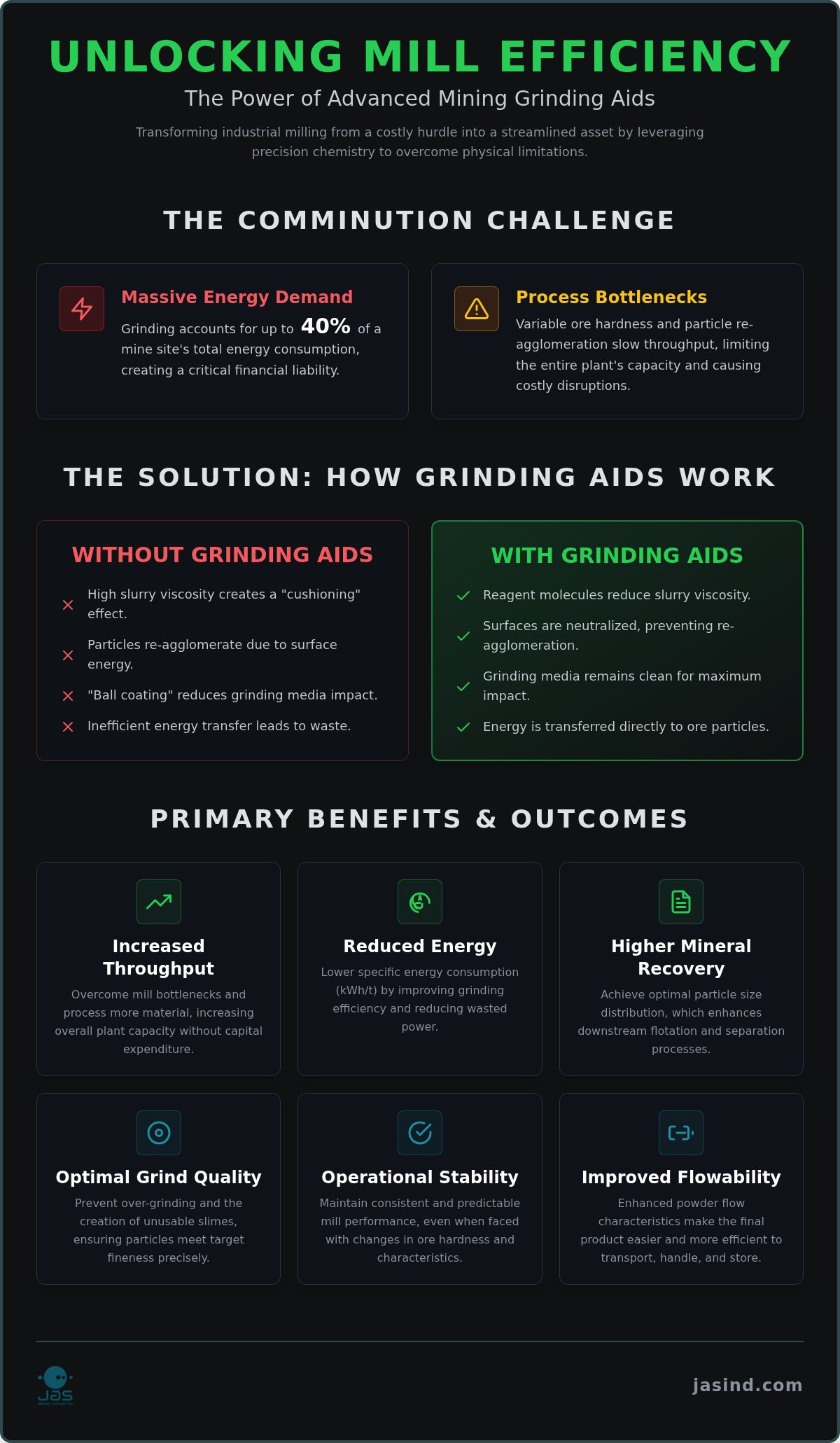
Comminution is notoriously energy intensive. Industry data from the Coalition for Energy Efficient Comminution (CEEC) suggests that grinding can account for up to 40% of a mine site's total energy consumption. When energy prices fluctuate, this massive demand becomes a critical liability. Ore hardness variability further complicates the issue. Harder ores slow down throughput and create mill bottlenecks that limit the entire plant's capacity. Mining Grinding Aids mitigate these effects by lowering the slurry viscosity. This improvement allows for a more efficient transfer of energy from the media to the ore, maintaining steady throughput even when mineral characteristics change.
Beyond Throughput: The Quality of the Grind
Efficiency isn't just about speed. It's about precision. Achieving the optimal particle size distribution (PSD) is critical for downstream flotation and recovery. When mills operate without chemical assistance, they often suffer from "over-grinding." This process creates unusable slimes that interfere with mineral separation and waste valuable energy. Advanced aids stabilize the slurry rheology, ensuring particles are ground to the target fineness without being pulverized into waste. Additionally, these chemicals improve powder flowability. This makes the final product easier to transport, store, and handle, protecting the value of the mineral from the mill to the market.
The Chemical Mechanism: How Grinding Aids Reduce Slurry Cohesion
The effectiveness of Mining Grinding Aids lies in their ability to manipulate microscopic interactions at the mineral surface. When these reagents enter the mill, the molecules rapidly adsorb onto the freshly created surfaces of the ore. This isn't a passive coating. It's an active chemical intervention that neutralizes the residual electrical charges generated during the fracture process. By stabilizing these surfaces, surfactants prevent the immediate re-agglomeration of fine particles. Without this protection, particles often fuse back together under the intense pressure of the grinding media. This forces the mill to perform the same work twice, wasting energy and reducing overall throughput efficiency.
Surface Energy and Particle Interaction
Effective grinding requires the constant creation of new surfaces. Chemical molecules facilitate this by migrating into the micro-cracks of the ore as they form. This process reduces the energy required to propagate fractures. In 2026 mineralogy, the Rebinder effect describes the reduction in a solid's structural strength caused by the adsorption of surfactants at the crack tips during fracture. This mechanism also prevents "ball coating" where fine, sticky particles adhere to the grinding media. When media remains clean, it strikes the ore with maximum precision.
Slurry Rheology and Mill Dynamics
Beyond individual particles, these aids act as high-performance rheology modifiers for the entire slurry. High-density ore slurries often become excessively viscous, creating a "cushioning" effect that absorbs the impact energy of the media. By decreasing this viscosity, chemical aids restore the ideal cascading and cataracting motion of the balls. This allows for higher pulp densities without sacrificing flow rates. To understand how these mechanisms apply to your specific ore body, you might explore custom-formulated mining chemicals designed for complex mineral matrices.
The result is a more responsive mill environment. When the slurry flows with less resistance, the power drawn by the mill motor is utilized more effectively for grinding rather than overcoming internal friction. This chemical stability is the foundation of energy security in modern comminution circuits. It ensures that the mill operates at peak performance, even when faced with inconsistent ore hardness. By managing the rheology of the system, operators gain greater control over the final product quality and the total cost of production.
Selecting the Right Formulation for Specific Ore Types
Universal, off-the-shelf solutions are a liability in complex mining environments. These generic products often ignore the specific mineralogical fingerprint of an ore body, leading to suboptimal adsorption rates and wasted reagent. When a chemical aid fails to bond correctly with the mineral surface, it cannot neutralize surface charges or prevent re-agglomeration. This inefficiency doesn't just waste money; it compromises the stability of the entire milling circuit. Tailoring the chemistry for specific extractions, such as phosphate, potash, or metallic minerals, is the only way to ensure Mining Grinding Aids provide a measurable return on investment.
Mineralogy dictates how reagents interact with the ore. For example, the presence of clay minerals or high-porosity ores can drastically increase the required dosage if the formulation isn't precise. Operators must also balance pH requirements and water quality. High salinity or extreme pH levels in recycled process water can destabilize chemical bonds, rendering standard additives ineffective. Achieving a stable, high-performance environment requires a deep understanding of these site-specific variables.
Grinding Aids for Metallic vs. Non-Metallic Ores
Gold and copper leaching circuits demand different chemical characteristics than phosphate beneficiation. In metallic extractions, downstream compatibility is the primary concern. You must ensure that your grinding chemistry doesn't interfere with flotation collectors or frothers. A poorly selected aid can coat mineral surfaces, preventing collectors from attaching and leading to significant recovery losses. Our mining solutions pillar offers a detailed look at how these specialized chemistries protect your yield while optimizing throughput.
Environmental and Sustainability Considerations
Responsible resource management requires a commitment to social and environmental protection. Modern Mining Grinding Aids must be biodegradable and non-toxic to ensure safe tailings management and long-term ecosystem stability. By reducing the energy required for comminution, these chemicals directly lower the carbon footprint of the mine. This alignment with global environmental standards isn't just about compliance. It's about positioning your operation as a sustainable leader in a resource-constrained world. Choosing the right formulation protects your operational license and the communities where you operate.
Operational Integration: From Technical Audit to Dosing Strategy
A superior chemical formula remains a dormant asset without a precise implementation strategy. The true value of Mining Grinding Aids is unlocked through operational discipline and technical rigor. You shouldn't expect transformative results by simply adding chemistry to a mill circuit. Success requires a deep alignment between the reagent's molecular properties and the mechanical realities of the comminution circuit. This integration ensures that every gram of chemical contributes to the stability of the plant and the security of the resource. It's a shift from transactional chemical supply to a partnership in process optimization.
The Technical Audit Process
Effective integration begins with a comprehensive technical audit. This isn't a superficial walkthrough; it's a data-driven analysis of current mill performance and energy benchmarks. We use laboratory-scale testing to determine the optimal reagent dosage for your specific ore body. This phase identifies mechanical bottlenecks that chemicals can help overcome, such as pump capacity limits or cyclone inefficiencies. By establishing a clear baseline for Specific Energy Consumption (SEC), operators can measure the exact impact of the intervention. A structured audit ensures that the chemical solution addresses the root causes of inefficiency rather than just the symptoms.
Precision Dosing and Automation
Precision is the hallmark of modern mineral processing. Implementing automated dosing systems allows for real-time adjustments based on fluctuating ore hardness and feed rates. The selection of the dosing point is equally critical. Whether applying the reagent on the feed belt or directly at the mill inlet, the goal is to maximize contact time and dispersion. Training site personnel on reagent handling and system maintenance ensures long-term reliability. To start optimizing your circuit, you can request an on-site technical audit to develop a tailored dosing strategy.
Operational excellence is a continuous journey. As you move deeper into an ore body, mineral characteristics inevitably shift. Consistent monitoring of KPIs, specifically throughput (tph) and particle fineness, allows for proactive adjustments to the dosing strategy. This agile approach prevents mill overloads and maintains a stable particle size distribution for downstream recovery. By treating Mining Grinding Aids as a dynamic component of the mill's mechanical system, you protect the efficiency of the entire operation. This commitment to ongoing optimization is what separates world-class facilities from standard operations.
JAS Global Industries: Advanced Chemical Solutions for Sustainable Mining
Operational excellence requires a foundation of trust and technical mastery. Since 1998, JAS Global Industries has served as a vital guardian of industrial resources. We don't just provide chemicals; we deliver the stability required for modern infrastructure. Our Dubai headquarters serves as a strategic hub, ensuring seamless global logistics across four continents. This central location allows us to respond rapidly to the needs of mining operations in the Middle East, Africa, Asia, and Europe. By combining a long-standing corporate history with cutting-edge R&I, we position ourselves as an indispensable pillar of the global mining industry. We understand that in 2026, your mill's efficiency is the bedrock of your company's energy security.
A Global Partner for Resource Protection
Resource protection is a global mission that requires a local presence. Our international footprint ensures that expert technical consulting is always within reach of your site. We believe that Mining Grinding Aids must be validated in the field, not just in a distant laboratory. That's why we emphasize on-site technical audits and custom laboratory testing as a core value-add. This hands-on approach allows our teams to develop dosing strategies that reflect the unique mineralogy of your specific ore body. For plants seeking comprehensive resource management, our expertise extends into industrial water treatment, providing a holistic approach to site stability. We protect your water, your energy, and your minerals through integrated chemical stewardship.
Innovation in Grinding Chemistry
The challenges of 2026 require specialized answers rather than generic products. Our global R&I centers focus on creating tailor-made formulations for complex ores that standard, off-the-shelf products simply can't handle. We prioritize cost-effective, sustainable chemistry that doesn't compromise on performance or recovery rates. Safety and stability are the core of our logistics philosophy. We ensure that every shipment of Mining Grinding Aids meets rigorous safety standards, protecting both your personnel and the local environment. This commitment to reliability ensures that your mill remains operational and your throughput targets stay secure. It's about delivering long-term value and fostering partnerships that last for decades.
Your operation deserves a partner focused on the fundamental needs of society and the practicalities of industrial success. We invite you to leverage our 25 years of industrial expertise to secure your production future. Our team is ready to help you move from mechanical limitations to chemical-enhanced efficiency. Contact JAS Global Industries today to schedule a comprehensive process optimization audit and discover how our custom chemistry can transform your comminution circuit and protect your operational license.
Securing the Future of Global Mineral Production
The landscape of 2026 demands a shift from mechanical brute force to strategic chemical precision. You've seen how managing slurry rheology doesn't just increase throughput; it protects the energy security of your entire operation. By preventing re-agglomeration and optimizing particle size distribution, you ensure that every ton of ore processed contributes to global resource stability. Precision chemistry is the essential bridge between declining ore grades and sustainable production targets.
Implementing advanced Mining Grinding Aids requires more than a supplier relationship. It demands a partnership rooted in technical rigor and global responsibility. JAS Global Industries provides the expert technical audits and R&I capabilities needed to develop tailor-made formulations for your most complex mineralogies. Our global manufacturing network ensures your supply chain remains stable and secure. We don't just sell chemicals; we protect your operational future.
Optimize Your Mining Operations with JAS Global Industries. We're ready to help you transform your comminution circuit into a model of modern efficiency. Let's build a more resilient mining future together.
Frequently Asked Questions
What are mining grinding aids and how do they work?
Mining Grinding Aids are specialized chemical reagents that modify the surface energy of ore particles to prevent re-agglomeration. They work by adsorbing onto mineral surfaces during the fracture process, neutralizing electrical charges that cause particles to stick together. This reduction in slurry cohesion lowers viscosity and allows the grinding media to strike the ore more effectively. By managing the rheology of the mill environment, these aids ensure a more efficient transfer of energy.
Can grinding aids improve the recovery rate of minerals in flotation?
Yes, these aids improve flotation recovery by ensuring a more consistent particle size distribution and preventing over-grinding. By reaching the target liberation size without creating excessive slimes, they prepare the ore for more efficient mineral separation. It's critical to select formulations that are chemically compatible with downstream collectors. This synergy protects the mineral surfaces, allowing flotation reagents to attach more effectively to the target minerals for higher overall yield.
How much energy can a mine save by using chemical grinding aids?
Specific energy consumption can be reduced significantly when chemical aids are properly integrated into a comminution circuit. While exact figures depend on ore hardness and mill configuration, industry professionals report that optimized circuits often see measurable energy savings per ton of ore processed. These chemicals mitigate the cushioning effect of viscous slurries, ensuring that mill power is used for grinding rather than overcoming internal friction. This efficiency is a cornerstone of energy security.
Do grinding aids affect the quality of the final mineral product?
Grinding aids improve product quality by enhancing the flowability and consistency of the final mineral powder. They help maintain a precise particle size distribution, which is essential for industrial applications requiring specific fineness. Because these chemicals prevent the formation of unusable ultrafine particles, the final product remains more stable during transport and storage. This stability ensures that the mineral retains its value and performance characteristics throughout the entire supply chain.
Are JAS Global Industries grinding aids compatible with all mill types?
Our formulations are designed for compatibility with a wide range of industrial milling equipment, including ball mills, rod mills, and SAG mills. JAS Global Industries specializes in tailor-made chemistry that adapts to different mechanical environments and slurry densities. Whether your operation uses open or closed-circuit grinding, we develop dosing strategies that align with your specific hardware. This flexibility ensures that our chemical solutions provide reliable performance across diverse global mining infrastructures.
What is the typical ROI for implementing a grinding aid dosing strategy?
The return on investment typically comes from increased throughput and reduced energy costs without the need for capital expenditure. By pushing the mill beyond its mechanical bottlenecks, operators can process more ore per hour using existing equipment. Additional value is realized through improved downstream recovery rates and reduced wear on grinding media. A structured dosing strategy ensures that the cost of the reagent is outweighed by the gains in plant capacity and stability.
How do I determine the correct dosage for my specific ore type?
Determining the correct dosage requires a comprehensive technical audit and laboratory-scale testing. Since every ore body has a unique mineralogical fingerprint, generic dosages often lead to inefficiency or waste. Our technical teams analyze variables like ore hardness, moisture content, and target fineness to establish a precise baseline. This data-driven approach allows us to develop an automated dosing strategy that adjusts in real-time to changing feed characteristics, ensuring long-term operational reliability.
Are these chemicals environmentally safe for tailings disposal?
We prioritize the development of biodegradable and non-toxic formulations to ensure safety in tailings management. JAS Global Industries is committed to global environmental standards, recognizing that responsible chemical use is essential for a mine's operational license. Our R&I centers focus on creating reagents that provide high performance while remaining stable and safe for long-term disposal. This commitment to sustainability helps protect the surrounding ecosystems and supports the ethical extraction of critical global resources.