

Could your mill’s greatest efficiency leak be invisible to the naked eye? In the high-stakes world of mineral processing, comminution remains the most energy-intensive stage, often accounting for a massive portion of a site's total power draw. You're likely facing the relentless pressure of mill throughput bottlenecks and the frustrating agglomeration of fine particles that stalls production. It's a constant struggle to balance high tonnage with the precise particle size distribution required for successful downstream recovery.
Optimizing this critical process requires more than mechanical adjustments; it demands sophisticated chemical intervention. Advanced Mining Grinding Aids act as strategic tools for energy security, preventing particle coating and significantly reducing specific energy consumption. By integrating these specialized formulations, you'll secure higher mineral yields and transform your comminution circuit into a high-performance asset. This guide explores the evolving landscape of grinding chemistry for 2026. We'll examine how tailored dosing strategies unlock latent mill capacity, stabilize your process, and protect your operation's long-term resource efficiency.
Key Takeaways
- Understand why stabilizing comminution circuits is essential for mitigating the high energy demands of modern industrial grinding.
- Explore how specialized Mining Grinding Aids prevent particle agglomeration to ensure a more uniform particle size distribution.
- Learn to quantify operational gains by reducing specific energy consumption and unlocking latent mill capacity.
- Discover the necessity of technical audits and custom dosing strategies in optimizing recovery for complex ore mineralogy.
- Gain insights into how technical partnerships and global R&I centers drive sustainability through advanced chemical formulations.
What are Mining Grinding Aids and Why are They Essential?
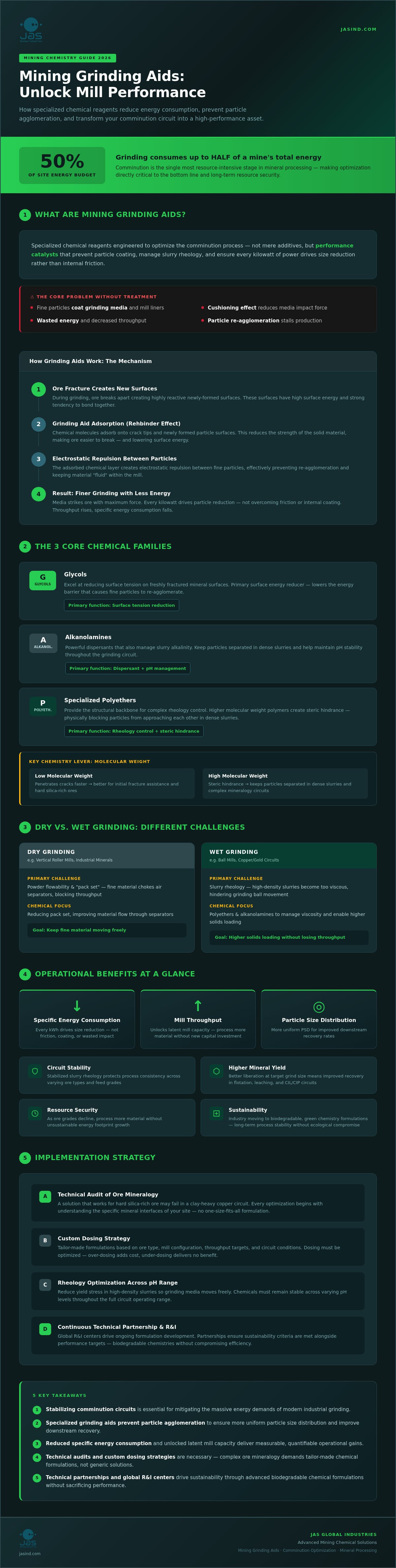
Mining Grinding Aids are specialized chemical reagents engineered to optimize the comminution process. They aren't just additives; they're performance catalysts. Comminution is the most resource-intensive stage of mineral processing. It's estimated that grinding can consume up to 50% of a mine site's total energy budget. This creates a significant operational burden that directly impacts the bottom line.
When ore is crushed, new surfaces are created. These surfaces are highly reactive. Without intervention, fine particles tend to "coat" the grinding media and mill liners. This cushioning effect reduces the impact force of the media, leading to wasted energy and decreased throughput. By preventing this coating, Mining Grinding Aids maintain the mechanical efficiency of the circuit. They ensure that every kilowatt of power contributes to particle size reduction rather than overcoming internal friction.
Efficient extraction is a matter of global resource security. As ore grades decline worldwide, operations must process more material to secure the same volume of metal. Advanced chemical solutions ensure that this increased volume doesn't lead to an unsustainable energy footprint. We see these aids as essential contributors to the stability of critical global resources.
The Mechanism of Surface Energy Reduction
The primary function of these additives is to lower the surface energy of mineral particles. During fracture, grinding aids adsorb onto the newly formed surfaces. This creates electrostatic repulsion between particles, effectively preventing re-agglomeration. It keeps the material "fluid" within the mill environment. In mineral processing, the Rehbinder effect refers to the reduction in the strength of a solid material caused by the adsorption of surfactants at the crack tips, making the ore easier to break. This chemical assistance allows for finer grinding with less mechanical force.
Dry vs. Wet Grinding Applications
Chemical requirements differ significantly based on the mill type. In dry circuits, such as vertical roller mills used for industrial minerals, grinding aids focus on powder flowability. They reduce the "pack set" of the material, ensuring it moves through the air separators efficiently. This prevents the mill from becoming choked by fine material.
In wet grinding, the focus shifts to slurry rheology. High-density slurries can become too viscous, hindering the movement of the grinding balls. Specialized polyethers and alkanolamines help manage this viscosity. This optimization allows for higher solids loading without sacrificing throughput or particle size distribution. It's about protecting the stability of the process while maximizing output.
The Chemistry Behind High-Performance Grinding Additives
High-performance chemistry transforms raw energy into precise mineral liberation. Modern Mining Grinding Aids rely on a sophisticated blend of organic compounds. These formulations typically center on three core chemical families: glycols, alkanolamines, and specialized polyethers. Each plays a distinct role. Glycols excel at reducing surface tension. Alkanolamines act as powerful dispersants while managing slurry alkalinity. Specialized polyethers provide the structural backbone for complex rheology control.
Ore mineralogy is never uniform. A chemical solution that works for a hard silica-rich ore might fail in a clay-heavy copper circuit. This is why tailor-made formulations are essential. We focus on the specific mineral interfaces of your site. Molecular weight is a critical lever here. Lower molecular weight compounds often penetrate cracks faster. Higher molecular weight polymers provide the steric hindrance needed to keep particles separated in dense slurries. For operations dealing with complex mineralogy, you can explore tailor-made chemical formulations designed for precise extraction.
Sustainability isn't an afterthought. It's a core operational requirement. The industry is moving toward biodegradable and sustainable chemical solutions that minimize downstream environmental impact. Developing these green chemistries ensures long-term process stability without compromising ecological safety. Protecting the environment. Securing the resource. Optimizing the yield.
Rheology Modifiers and Slurry Stability
Effective rheology modification targets yield stress. In high-density mineral slurries, high yield stress prevents the grinding media from moving freely. This creates a cushioning effect that absorbs impact energy. By reducing this stress, additives ensure the media strikes the impact zone with maximum force. These chemicals must remain stable across varying pH levels and fluctuating water qualities. Reliability in the face of recycled process water is a hallmark of a robust formulation.
Surface Activity and Fracture Propagation
Chemistry facilitates fracture. Additives penetrate micro-cracks at the particle surface, preventing them from healing under the intense pressure of the mill. This adsorption lowers the fracture toughness of the mineral. By lowering the interfacial tension at the solid-liquid boundary, surfactants reduce the specific surface energy required for new surface creation. This makes the ore inherently easier to break, which protects the lifespan of your grinding media and liners.
Operational Benefits: Energy Savings and Recovery Optimization
The primary metric of success in any comminution circuit is the reduction of Specific Energy Consumption (SEC). Mining Grinding Aids deliver this by ensuring that mechanical energy is directed toward mineral fracture rather than overcoming internal friction or slurry viscosity. This efficiency translates into a tangible boost in mill capacity. Industry benchmarks often show a 5-15% increase in throughput without a corresponding rise in power draw. This capacity surge directly impacts the bottom line, allowing operations to process higher volumes of ore through existing infrastructure.
Precision in grinding extends the life of your equipment. By preventing the "cushioning" effect caused by particle coating, these chemicals ensure more direct media-to-ore contact. This reduces the abrasive wear on grinding media and mill liners. Lower maintenance frequency means higher operational availability. It's a cycle of reliability: less wear, fewer shutdowns, and more consistent output. Protecting the hardware is as vital as optimizing the process.
Synergy with Downstream Flotation Reagents
Downstream efficiency begins in the mill. A common concern for metallurgists is whether grinding chemistry will interfere with recovery. Advanced formulations are designed for compatibility with Mining Flotation Collectors. When particles are liberated with a cleaner surface and a more uniform size, collectors can adsorb more effectively. This leads to higher grade concentrates and lower tailing losses. Balancing throughput and recovery is no longer a trade-off; it's a coordinated chemical strategy. Improved liberation ensures that valuable minerals are accessible, not trapped in middlings or lost as over-ground slimes.
Economic Impact and Operational Reliability
ROI is measured by more than just power savings. While reducing kWh/t is the initial goal, the true value lies in the stability of the entire circuit. Mining Grinding Aids help eliminate "over-grinding," which often produces ultra-fine slimes that are notoriously difficult to recover. By maintaining an optimal Particle Size Distribution (PSD), the process remains predictable and steady. This reliability contributes significantly to corporate sustainability goals. Reducing energy waste and maximizing mineral recovery directly lowers the carbon footprint of each ton produced. Efficiency is the cornerstone of responsible resource management. It secures the future of the operation while honoring environmental commitments.
Implementation Strategy: How to Optimize Your Grinding Circuit
Successful optimization begins with data, not just delivery. Implementing Mining Grinding Aids is a systematic engineering process that requires a deep understanding of your specific circuit's dynamics. A comprehensive technical audit serves as the indispensable foundation. Without it, chemical application is merely guesswork. You'll need to establish rigorous baseline performance metrics, including Specific Energy Consumption (SEC), mill throughput, and the current Particle Size Distribution (PSD). These benchmarks allow you to quantify the exact value delivered by the chemical intervention. Identifying the bottleneck. Optimizing the flow.
Strategic dosing is the next pillar. While the mill feed is the conventional entry point for ball mills, complex circuits might require alternative strategies. In regrind applications, dosing into the cyclone underflow can sometimes yield better results by targeting the high-density slurry where rheology modification is most needed. Continuous monitoring is essential because ore hardness isn't static. Your dosing strategy must be agile enough to adapt to mineralogical variability in real-time. For sites looking to maximize their operational stability, you can request a specialized technical audit to identify latent capacity in your circuit.
Laboratory Testing and Benchmarking
Precision starts in the lab. We conduct Bond Ball Mill Work Index (BBMWI) tests to compare ore grindability with and without additives. This data reveals the potential energy savings per ton. We also analyze the relationship between the Blaine surface area and energy input. This helps us develop custom dosing curves tailored to your specific ore. These curves ensure that the chemical concentration is optimized for the desired fineness without wasting reagent. It's a scientific approach to resource protection.
On-Site Dosing and Control Systems
Modern operations require automated dosing systems. Integration with your site's Distributed Control System (DCS) or PLC allows for precise, flow-proportional chemical addition. This prevents the common pitfalls of over-dosing, which can lead to excessive slurry thinning, or under-dosing, which fails to break the throughput bottleneck. Technical consulting plays a vital role here. Regular site visits and system calibrations ensure the circuit remains optimized as conditions change. We act as a technical partner, not just a supplier, to maintain long-term stability and performance.
Advanced Mining Solutions from JAS Global Industries
JAS Global Industries operates as a vital technical partner rather than a simple reagent supplier. Since 1998, we've developed a reputation for reliability and technical excellence across the world's most critical mining sectors. Our commitment to custom-formulated chemical technologies means we don't offer off-the-shelf products. Instead, we leverage our global R&I centers to engineer solutions for your site's specific mineralogy. This is the "Global Guardian" approach. We secure the stability of global resources by ensuring your extraction process remains efficient and predictable. Our high-performance Mining Grinding Aids integrate seamlessly with our broader suite of Mining Solutions, creating a synergy that optimizes the entire value chain from the mill to the final concentrate. Protecting resources. Optimizing yields.
Tailor-Made Formulations for Complex Ores
Phosphate and Potash mining present unique rheological hurdles that generic chemicals cannot clear. These ores frequently contain high clay concentrations, which can cause slurry viscosity to spike and stall production. We develop specialized additives that target these high-clay environments, ensuring that the mill remains fluid and productive. Our technical teams conduct on-site audits to identify specific bottlenecks in your circuit. These audits have historically led to documented yield improvements by tailoring the chemical response to the ore's specific fracture characteristics. We solve the energy-recovery paradox by ensuring that finer grinding doesn't lead to downstream losses. Custom chemistry. Proven results.
Global Logistics and Technical Support
Operational stability depends on a secure and responsive supply chain. With a strategic presence across the Middle East, Africa, Asia, and Europe, we ensure the consistent availability of critical industrial reagents. We understand that a delay in chemical supply can compromise an entire site's output. Therefore, we prioritize supply chain security and logistics precision. Our involvement goes beyond transactional delivery. We partner with you for long-term stability, providing custom dosing strategies and continuous technical support. This collaborative model supports sustainable mining practices by reducing waste and maximizing resource utilization. We act as a foundational presence for the industry. Global reach. Local expertise.
Securing the Future of Mineral Processing Efficiency
The transition toward more sustainable and energy-efficient mining is no longer optional; it's a strategic necessity. High-performance Mining Grinding Aids represent a critical bridge between mechanical capacity and chemical precision. By stabilizing slurry rheology and preventing particle agglomeration, these additives protect your equipment and unlock latent mill throughput. We've seen how the right formulation can reduce specific energy consumption while ensuring your downstream recovery remains uncompromised. It's about more than just throughput. It's about global resource security and operational reliability.
JAS Global Industries has been a foundational presence in this sector since 1998. We don't just supply chemicals; we provide long-term stability through specialized technical audits and custom dosing strategies. Our global manufacturing footprint and dedicated R&I centers ensure that even the most complex ores receive the precise chemical response they require. You can optimize your mining operations with JAS Global Grinding Aids to secure higher yields and a lower carbon footprint. Let's build a more resilient and efficient extraction process together.
Frequently Asked Questions
Do mining grinding aids affect the downstream flotation process?
Advanced formulations are engineered to be fully compatible with downstream reagents. They often enhance flotation by providing cleaner mineral surfaces and a more uniform particle size distribution. This chemical synergy ensures that increased mill throughput doesn't compromise recovery grades or concentrate quality. We prioritize formulations that protect the integrity of the entire value chain.
What is the typical dosage rate for a ball mill grinding aid?
Dosage rates vary based on ore mineralogy and slurry density, but they typically range between 100 and 500 grams per ton of dry ore. Establishing the precise requirement requires a technical audit and laboratory benchmarking. Correct dosing prevents reagent waste and ensures the rheology modification is optimized for your specific circuit's mechanical limits.
Can grinding aids reduce the wear rate of grinding balls and liners?
Yes, they reduce wear by preventing the cushioning effect caused by fine particle coating on the grinding media. When Mining Grinding Aids keep the media surfaces clean, the impact energy is directed at the ore rather than being absorbed by a layer of sludge. This leads to longer component lifespans and significantly reduced maintenance downtime.
How do grinding aids help in processing high-clay or sticky ores?
These chemicals act as powerful dispersants that lower the yield stress and viscosity of high-clay slurries. By neutralizing the attractive forces between clay particles, the aids prevent the material from becoming sticky or stalling the mill. This maintains a steady flow and prevents throughput bottlenecks even in the most difficult mineralogical conditions.
Are grinding aids environmentally safe for tailings management?
Modern formulations prioritize environmental stability and are frequently biodegradable. Because they're used in low concentrations and typically adsorb onto mineral surfaces, their impact on tailings water chemistry remains minimal. We focus on developing sustainable solutions that protect local ecosystems while securing industrial resource efficiency and process stability.
What is the difference between a grinding aid and a rheology modifier?
A grinding aid is a broad category of chemicals used to improve comminution, while a rheology modifier specifically targets the flow characteristics of the slurry. Many high-performance Mining Grinding Aids function as rheology modifiers by reducing viscosity. This dual action facilitates both easier particle fracture and more efficient material transport through the mill environment.
How do I calculate the ROI of using a grinding aid in my circuit?
Calculate ROI by balancing the reagent cost against the reduction in specific energy consumption and the increase in daily tonnage. You should also factor in the value of improved mineral recovery and reduced liner wear. A comprehensive technical audit provides the baseline data needed for an accurate and reliable financial projection.
Can these chemicals be used in both dry and wet grinding circuits?
Yes, though the chemistry differs significantly between the two applications. In dry grinding, the focus is on preventing pack-set and improving powder flowability. In wet grinding, the chemicals manage slurry viscosity and surface energy. Each circuit requires a tailored formulation to ensure the specific mechanical challenges of the site are addressed effectively.