

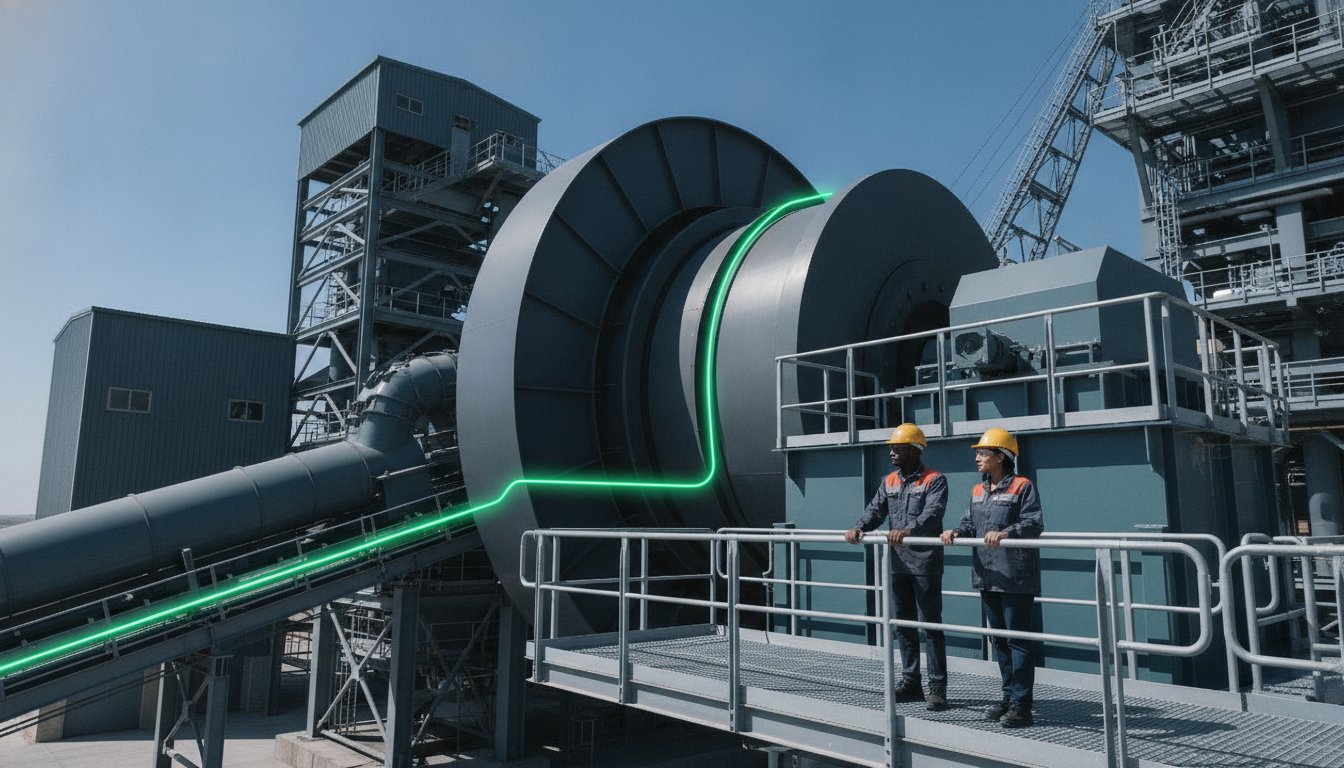
Comminution is the most energy-intensive stage of mineral processing, often consuming the largest portion of a site's operational budget. It's a silent drain on your margins when power is lost to the physical resistance of fine particle agglomeration. You've likely seen how "sticky" ores and fine buildup can choke mill throughput, forcing a difficult choice between energy efficiency and recovery targets. Implementing specialized Mining Grinding Aids isn't just a technical adjustment; it's a strategic move to stabilize your entire mineral processing circuit and protect your bottom line.
We understand that maximizing every ton is essential for global resource security. This article explores how advanced chemical aids reduce specific energy consumption and improve particle size distribution for better downstream results. We'll look at the synergy between grinding performance and flotation recovery, showing you how to increase throughput while protecting your chemical ecosystem. From on-site audits to custom dosing strategies, learn how to transform your grinding mill into a pillar of operational stability and long-term value.
Key Takeaways
- Understand how chemical stabilization addresses the energy intensive nature of comminution, which accounts for a significant portion of global electricity consumption.
- Learn how Mining Grinding Aids utilize the Rehbinder Effect to reduce surface energy and prevent material coating on grinding media.
- Discover the importance of ore-specific formulations for minerals like phosphate and potash to maintain circuit stability and secure resource yields.
- Identify the primary metrics for measuring ROI, focusing on Specific Energy Consumption (SEC) and measurable gains in mill throughput.
- Recognize the value of on-site audits and lab-scale testing in developing custom dosing strategies that resolve specific circuit bottlenecks.
The Critical Role of Grinding Aids in Global Resource Security
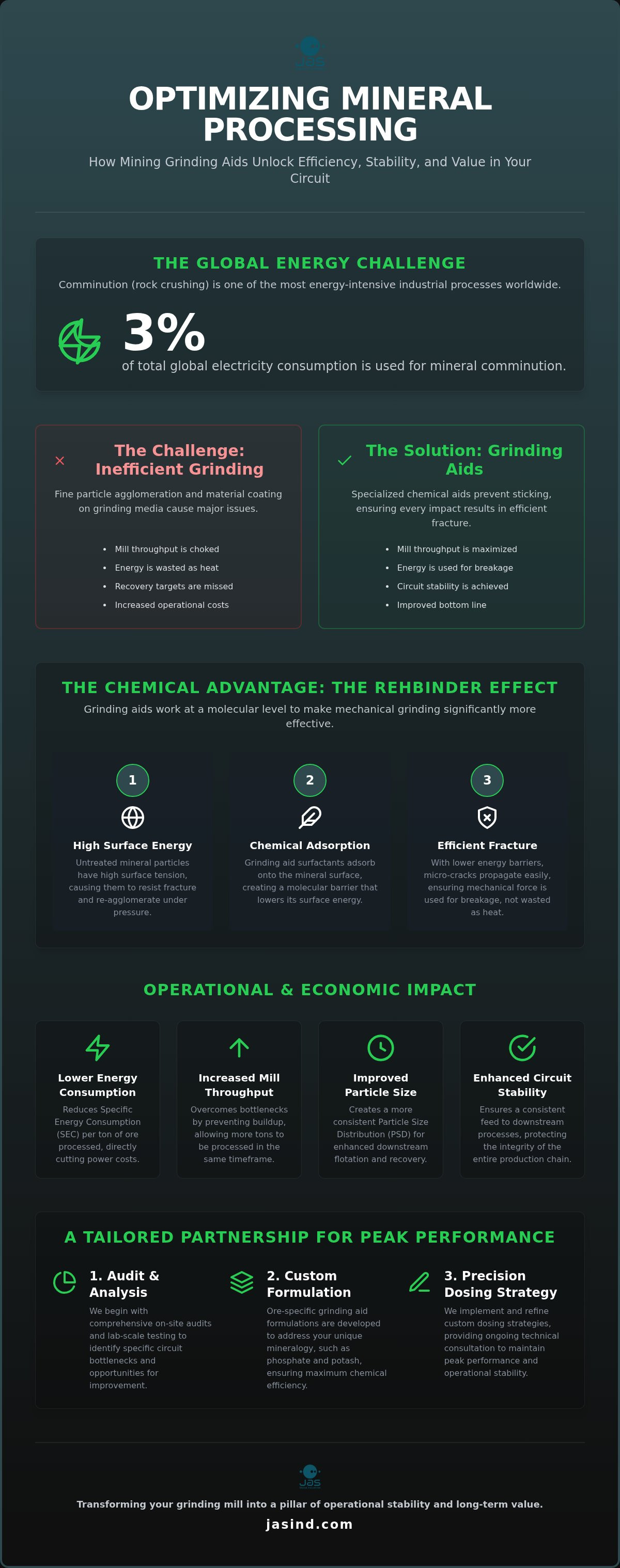
Comminution represents the most energy intensive phase of modern mineral processing. It's the foundational stage where raw ore is transformed into recoverable value. However, the physical toll of breaking rock is immense. Global data suggests that comminution alone accounts for up to 3% of total global electricity consumption. This massive energy demand places a heavy burden on both operational budgets and the environment, making efficiency a matter of global necessity.
In the 2026 mining landscape, the industry is shifting away from simple reagent supply toward comprehensive process optimization. Stability in the grinding circuit is no longer a luxury; it's the bedrock of successful mineral recovery. Mining Grinding Aids serve as the primary tool to achieve this stability by addressing the physical and chemical barriers that hinder mill performance and throughput. By ensuring a consistent feed to downstream processes, these aids protect the integrity of the entire production chain.
Defining Grinding Aids: Beyond Simple Additives
These chemicals are more than just lubricants for the mill. Mining Grinding Aids are specialized chemical reagents that reduce the energy required for comminution by interacting directly with mineral surfaces. They work by lowering the surface energy of particles, which effectively prevents the common problem of re-agglomeration. When fine particles stick together or coat the grinding media, impact efficiency drops and energy is wasted. These aids keep surfaces clean and particles separate, ensuring that every strike of the media results in fracture rather than deformation.
Formulations are typically categorized into wet and dry applications, each designed to manage specific rheological challenges. Wet grinding aids manage slurry viscosity and flow, while dry formulations prevent the buildup of "cushioning" layers on liners and media. Ultimately, these chemicals act as catalysts for operational stability and energy reduction.
The Link Between Comminution and Global Sustainability
Reducing the carbon footprint of a mine begins with chemical efficiency. By lowering the Specific Energy Consumption (SEC) per ton of ore, operators can significantly decrease their greenhouse gas emissions. This isn't just about cost savings; it's about responsible resource management in an era of increasing scarcity. Improved grinding performance leads to a more consistent particle size distribution (PSD), which directly enhances recovery rates in downstream flotation circuits.
At JAS Global Industries, we frame these solutions through the lens of "resource protection." We don't just provide chemicals; we secure the yields that the world depends on for modern infrastructure. By optimizing the very start of the mineral processing chain, we ensure that critical resources are extracted with the highest possible efficiency and the lowest possible environmental impact.
Chemical Mechanisms: How Grinding Aids Optimize Particle Size Reduction
The efficiency of a comminution circuit depends on more than just mechanical force. It relies on the precise chemical environment inside the mill. Mining Grinding Aids act as molecular tools that alter the physical properties of the ore and the surrounding slurry. By manipulating these properties, operators can achieve finer grinds with less energy input, directly impacting the profitability of the operation.
Surface Energy and Fracture Mechanics
At the core of chemical grinding optimization is the Rehbinder Effect. This phenomenon occurs when specialized surfactants adsorb onto the mineral surface, lowering its surface energy. In a high-energy mill environment, this reduction in surface tension makes it significantly easier for micro-cracks to propagate. Instead of the mineral absorbing impact energy through elastic deformation, it fractures more readily.
These surfactants provide a critical service by stabilizing new surfaces as they're created. Without this chemical intervention, freshly fractured particles often re-weld under the intense pressure of the grinding media. By lowering the energy barrier for crack growth, these aids ensure that mechanical energy is used for breakage rather than being wasted as heat. You can explore our broader range of specialty chemical solutions to see how these principles apply across the entire processing plant.
Rheology Control and Agglomeration Prevention
As ore particles become finer, their surface area increases exponentially. This often leads to the "cushioning effect," where fine particles coat the grinding balls and liners. This layer of fines acts as a shock absorber, dampening the impact and drastically reducing grinding efficiency. Mining Grinding Aids neutralize this effect by preventing the electrostatic and physical attraction between particles.
Managing slurry rheology is equally vital. High-clay ores or high-density slurries can become overly viscous, which slows down the movement of grinding media and hinders throughput. Chemical additives maintain an optimal pulp density and fluid flow. This ensures that the balls strike the ore directly rather than being slowed by a thick, sluggish slurry. By preventing media fouling and managing viscosity, these formulations ensure that energy transfer remains at peak levels throughout the grinding cycle.
Ore-Specific Strategies: Tailoring Solutions for Phosphate and Potash
Generic chemical reagents often fail to address the specific mineralogical nuances of industrial minerals. For operations processing phosphate or potash, a one-size-fits-all approach typically results in wasted energy and compromised recovery. These ores require Mining Grinding Aids that are engineered for their unique physical and chemical characteristics. Precision in formulation is the difference between a struggling circuit and a high-yield operation.
Tailor-made solutions outperform off-the-shelf products because they account for local water chemistry and complex mineral associations. In polymetallic ores, the wrong grinding aid can interfere with downstream flotation collectors, leading to significant losses. By customizing the reagent to the specific ore body, we ensure that the chemical environment remains stable from the mill to the final concentrate.
Optimizing Phosphate Mineral Processing
Phosphate mining involves ores that are relatively soft yet surprisingly abrasive. This combination creates a specific challenge for plant managers: preventing mill wear while ensuring the fine liberation required for fertilizer production. Custom dispersants within the grinding aid formulation prevent "sliming," a common issue where ultra-fine particles coat the larger grains and hinder processing.
By reducing the energy intensity of the comminution stage, we directly improve the efficiency of producing fertilizer raw materials. There's a vital synergy between these aids and the subsequent flotation stage. JAS Global Industries utilizes its extensive fertilizer expertise to ensure that the mineral surfaces are properly conditioned during grinding. This preparation allows flotation collectors to work more effectively, securing higher yields for global agriculture.
Potash Comminution in Brine Environments
Potash processing presents a unique set of chemical variables. Because these minerals are highly soluble, grinding must take place in saturated brine rather than fresh water. This high-salinity environment can quickly destabilize standard chemical reagents, rendering them useless. Specialized Mining Grinding Aids for potash are designed to maintain total chemical stability in these extreme conditions.
These formulations prevent particle degradation and ensure that evaporite minerals are fractured cleanly. Avoiding excessive fines is critical in potash circuits to prevent loss during the crystallization and drying phases. In Middle Eastern potash operations, where brine chemistry is particularly aggressive, these custom solutions have become essential for maintaining operational stability. This localized approach protects the resource and ensures the long-term viability of the extraction site.
Operational and Economic Impact: Measuring ROI in the Grinding Circuit
Measuring the value of chemical additives requires looking beyond the price per kilogram. In the demanding environment of modern mineral processing, the true return on investment (ROI) is found in the reduction of total operational costs. Specific Energy Consumption (SEC) stands as the primary metric for this efficiency. By tracking the kilowatt-hours (kWh) required to process each ton of ore, operators can quantify the direct impact of Mining Grinding Aids on their energy budget. A lower SEC doesn't just mean a smaller utility bill; it signals a circuit that's running at peak mechanical and chemical harmony.
Adopting a Total Cost of Ownership (TCO) approach to chemical procurement shifts the focus from transactional spend to long-term value. This perspective accounts for energy savings, increased throughput, and reduced mechanical wear. When chemicals are treated as strategic assets rather than simple consumables, the stability of the entire operation improves. Request a technical audit of your grinding circuit to identify how these economic drivers can be optimized for your specific site.
Quantifying Energy Savings and Throughput Increases
When Mining Grinding Aids prevent media fouling and neutralize the "cushioning effect" of fines, the impact on throughput is immediate. Field data often shows a 5% to 10% increase in feed rate while maintaining the target grind size. For a high-capacity mill, this translates into a significant boost in annual metal production without the need for additional capital expenditure. SEC reduction directly correlates to operational reliability.
Beyond energy, the mechanical benefits are substantial. Efficient grinding reduces the time media spent in "dead" cycles where rock isn't being fractured effectively. This efficiency extends the service life of mill liners and grinding media. Reducing the frequency of relining shutdowns keeps the plant operational for more days per year, protecting the resource yield and the bottom line.
The Downstream Dividend: Recovery and Quality
The benefits of optimized grinding extend far beyond the mill discharge. One of the most critical economic drains in mining is "over-grinding," which produces ultra-fine particles known as slimes. These slimes are often unrecoverable in flotation circuits and consume excessive amounts of reagents. By stabilizing the Particle Size Distribution (PSD), grinding aids ensure that more of the ore stays within the ideal size range for recovery.
This precision leads to higher flotation grades and lower reagent consumption in the next stage of the process. Chemical compatibility is also vital; the right grinding aid will not interfere with the performance of frothers or collectors. Finally, a consistent PSD improves the efficiency of tailings management. When the particle size is controlled, Mining Flocculants can perform more predictably, leading to better water recovery and more stable tailings dams.
Strategic Partnership: Custom Dosing and Technical Consulting
Success in mineral processing isn't found in a drum of chemicals. It's found in the integration of those chemicals into a live, fluctuating circuit. We move beyond the "Black Box" model of reagent supply. We focus on a deep understanding of your specific mill geometry and ore characteristics. This collaborative approach ensures that Mining Grinding Aids are applied with surgical precision. It's a move from being a mere vendor to becoming an indispensable pillar of your site's infrastructure and a vital guardian of your production targets.
We believe that long-term value is built through partnerships rather than simple transactions. By aligning our technical expertise with your operational goals, we create a stable environment where efficiency is the standard. This isn't just about providing a product; it's about securing the fundamental needs of your operation through consistent, reliable performance. We act as a foundational industry presence, focused on the long-term human impact of the resources you extract.
The Technical Audit: From Lab to Plant
Our process begins with a comprehensive on-site audit. We don't guess; we measure. By identifying specific circuit bottlenecks, we can tailor formulations in our R&I centers to address your unique challenges. These centers are the heart of our innovation, where we develop tailor-made solutions that reflect the specific mineralogy of your ore body. JAS Global Industries provides technical consulting and process optimization fees that translate directly into operational stability and resource protection.
We move from lab-scale testing to rigorous industrial-scale trials. This transition validates the chemical performance under real-world stress. Real-time monitoring allows for dynamic dosing adjustments. This ensures that reagent efficiency remains high even as ore grades or hardness fluctuate throughout the production cycle. It's about protecting the yield at every stage and ensuring that every drop of chemical contributes to your bottom line.
Securing the Supply Chain: A Global Guardian Approach
Reliability is the cornerstone of resource security. For remote mining operations in Africa, Asia, and Europe, logistical delays aren't just inconvenient; they're catastrophic. Operating from our Dubai headquarters, we manage complex supply chains with the focus of a global leader. We ensure that critical Mining Grinding Aids arrive on time and in spec, regardless of the geographic challenge or infrastructure limitations.
Long-term bulk chemical supply contracts provide the stability needed for multi-year extraction projects. This protection of the supply chain allows you to focus on production targets without the fear of chemical shortages. We view our role as an essential contributor to the stability of critical global resources. To secure your operation's future and optimize your recovery, Partner with JAS Global Industries for tailor-made mining solutions.
Securing Future Resource Stability Through Optimization
Achieving peak performance in comminution requires a fundamental shift from viewing chemicals as simple consumables to recognizing them as strategic stabilizers. We've explored how Mining Grinding Aids bridge the gap between energy efficiency and mineral recovery by addressing surface energy and slurry rheology. These solutions don't just lower costs; they protect the global supply of essential minerals like phosphate and potash. By tailoring formulations to specific ore bodies, operators can secure higher yields while reducing their carbon footprint.
JAS Global Industries has been a trusted partner in this mission since 1998. With specialized R&I centers and a manufacturing reach that spans the globe, we provide the technical expertise needed to transform industrial challenges into sustainable advantages. Our focus remains on long-term value and the broader human impact of technical excellence. Let us help you stabilize your circuit and maximize your resource potential. Contact JAS Global Industries for a Technical Audit of Your Grinding Circuit to begin your journey toward optimized recovery today. We look forward to building a more efficient and secure future together.
Frequently Asked Questions
What are the primary benefits of using mining grinding aids?
The primary benefits include increased mill throughput, reduced specific energy consumption (SEC), and improved particle size distribution (PSD). These chemical reagents prevent the re-agglomeration of fine particles and the coating of grinding media. By maintaining clean surfaces, the mechanical impact of the balls becomes more effective. This leads to higher mineral recovery rates in downstream circuits and a more stable, predictable production environment for the entire plant.
How do grinding aids affect downstream flotation and leaching processes?
Advanced formulations are designed to be chemically compatible with flotation collectors and frothers. Unlike generic chemicals, specialized Mining Grinding Aids don't interfere with the hydrophobicity of target minerals. By preventing "over-grinding" and the creation of unrecoverable slimes, they often enhance flotation kinetics. In leaching environments, a more consistent PSD ensures better solution contact and higher extraction rates, protecting the overall yield of the operation.
Can grinding aids help reduce the wear rate of mill liners and balls?
Yes, by improving grinding efficiency, these aids reduce the time media spends in "dead" cycles where energy is wasted as heat or friction. When the mill is optimized, the grinding media strikes the ore directly rather than being cushioned by a thick layer of fine buildup. This reduction in parasitic energy consumption directly translates to slower wear rates for both liners and balls, extending maintenance intervals and lowering the total cost of ownership.
What is the typical dosage range for mining grinding aids in wet circuits?
Dosage typically ranges between 100 and 500 grams per ton of dry ore feed, though this varies based on mineralogy and slurry density. Factors like clay content and water salinity play a significant role in determining the ideal concentration. Precision is vital; over-dosing can lead to excessive foaming or unnecessary costs. We recommend starting with a technical audit to establish a site-specific dosing strategy that maximizes reagent efficiency without compromising recovery.
How do I determine if my ore requires a custom grinding aid formulation?
Custom formulations are essential if your ore body contains complex mineral associations, high clay content, or if you're operating in high-salinity brine environments. If "off-the-shelf" products fail to reduce your specific energy consumption or if they interfere with flotation, a tailor-made reagent is required. Our R&I centers specialize in developing these site-specific solutions through lab-scale testing and industrial trials to ensure total compatibility with your unique process water and mineralogy.
Are mining grinding aids environmentally safe for tailings disposal?
We prioritize the development of biodegradable and low-toxicity formulations to ensure the stability of tailings management systems. Most modern aids are designed to adsorb onto the mineral surfaces or degrade during the process, leaving minimal residue in the discharge water. This protective approach ensures that your operation remains compliant with global environmental standards while maintaining the integrity of local ecosystems and community well-being through responsible chemical management.
What is the difference between a dispersant and a grinding aid in mineral processing?
While both manage particle interaction, a grinding aid specifically focuses on reducing the energy required for fracture and preventing media coating. A dispersant primarily manages slurry viscosity and prevents the settling of solids. However, many high-performance Mining Grinding Aids incorporate dispersant properties to manage the rheology of high-density slurries. This dual action ensures that the ore remains fluid and the grinding media maintains maximum impact velocity throughout the cycle.
How much energy can a mine expect to save by implementing a chemical grinding strategy?
Most operations can expect a reduction in specific energy consumption (SEC) ranging from 5% to 15% depending on the ore type and circuit configuration. While these percentages vary, the cumulative impact on a site's electricity bill is substantial given that comminution consumes a significant portion of global power. These savings are often accompanied by a 5% to 10% increase in throughput, providing a dual economic benefit that strengthens the operation's financial stability.