

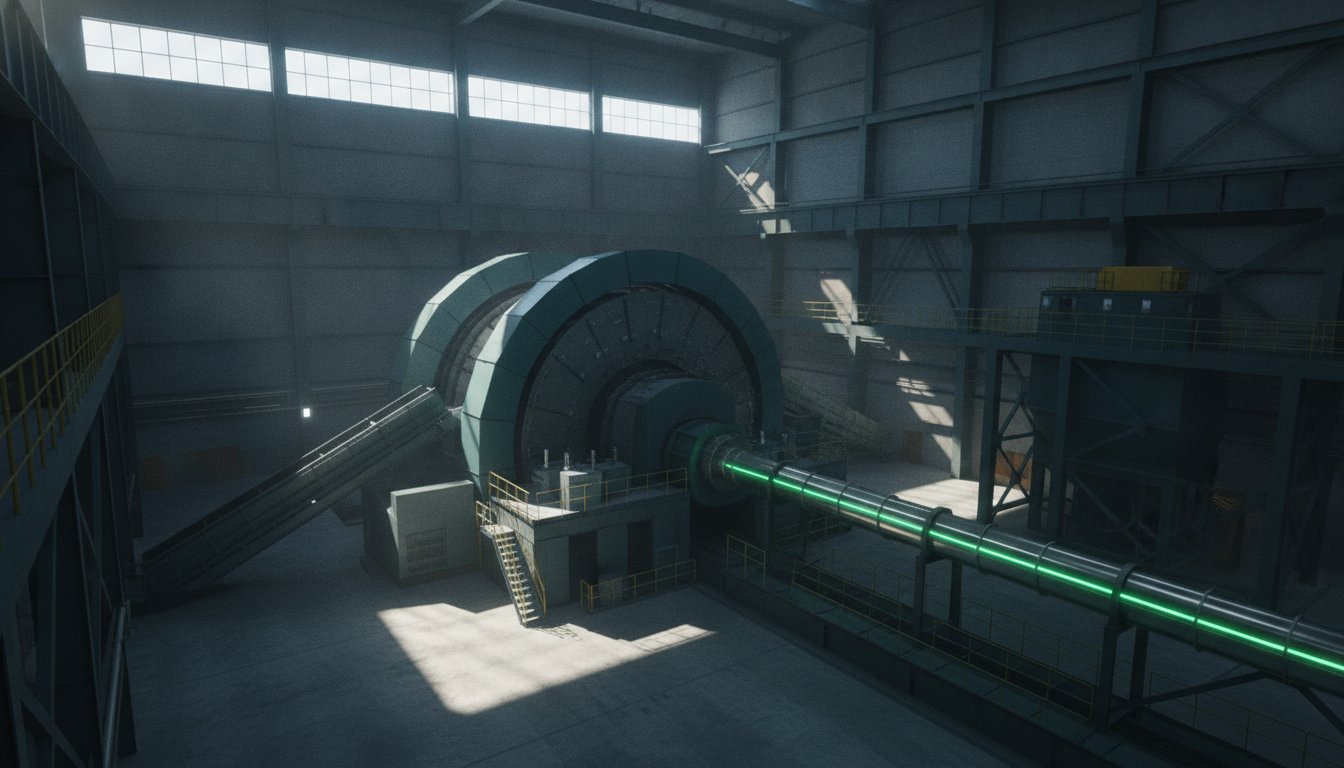
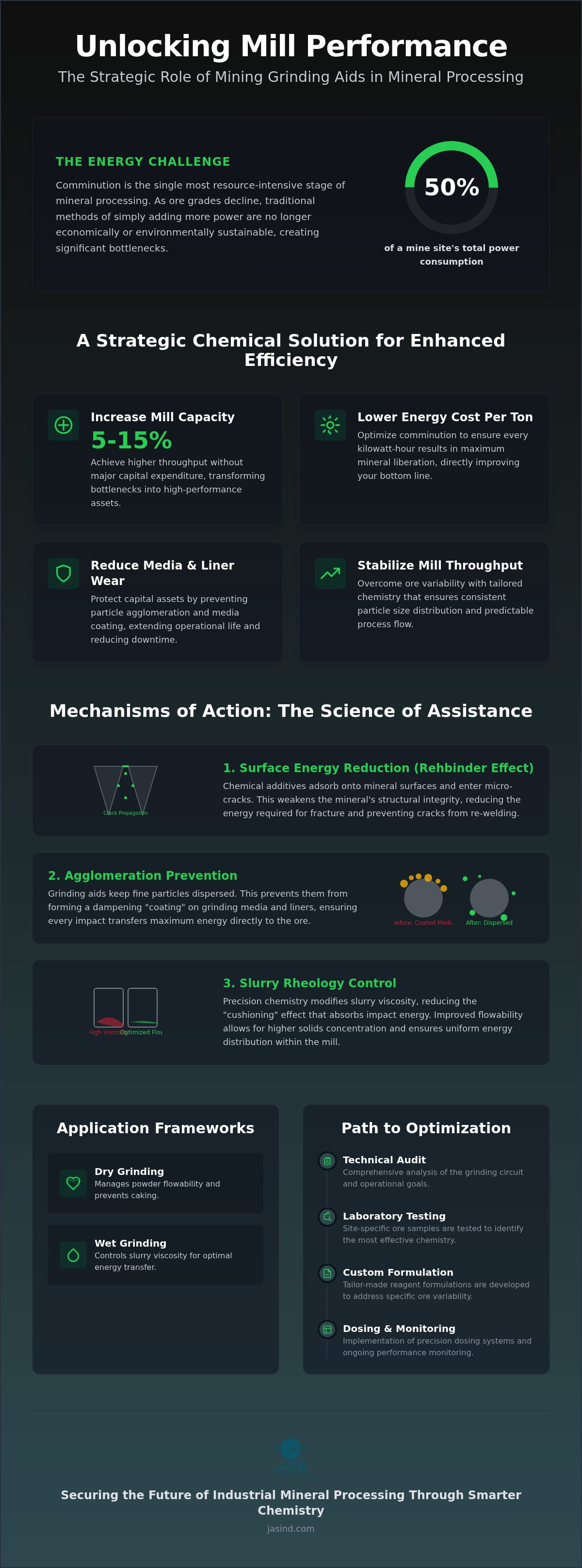
Comminution can account for up to 50% of a mine site's total power consumption, making it the single most resource-intensive stage of mineral processing. For many operators, this reality translates into staggering energy bills and persistent mill throughput bottlenecks that stifle growth. You know that as ore grades decline and variability increases, the old methods of simply adding more power are no longer sustainable. It's a challenge that demands a more sophisticated approach to particle size liberation and operational stability.
This article explores how Mining Grinding Aids serve as vital tools for energy-efficient resource liberation. By integrating these advanced chemical solutions, you can achieve a 5-15% increase in mill capacity and significantly lower your energy cost per ton. We'll examine how precision dosing reduces media wear and stabilizes consistency across complex ore bodies. From optimizing downstream recovery to securing global resource stability, we'll preview the technical strategies that transform your grinding circuit into a high-performance asset. Discover how these essential catalysts protect your margins and the future of industrial mineral processing through smarter, more sustainable chemistry.
Key Takeaways
- Understand the science of chemical-mechanical interactions, including the Rehbinder Effect, to lower the energy required for creating new mineral surfaces.
- Differentiate between dry and wet application frameworks to effectively manage powder flowability or slurry viscosity across diverse mineral circuits.
- Learn how to implement a rigorous optimization strategy for Mining Grinding Aids through comprehensive technical audits and site-specific laboratory testing.
- Explore the critical role of tailor-made reagent formulations in overcoming ore variability and securing long-term mill throughput stability.
- Gain insights into how advanced chemical assistance transforms comminution from a bottleneck into a strategic pillar of global resource security.
The Strategic Importance of Grinding Aids in Mineral Processing
Mining Grinding Aids are specialized chemical reagents engineered to optimize the comminution process. These additives function by reducing energy consumption and preventing the problematic agglomeration of fine particles. While they were once viewed as optional, they've become essential for modern mineral processing. Comminution stands as the most energy-intensive stage of mineral recovery.
The industrial challenge is significant. Grinding typically accounts for over 50% of a mine site's total power consumption. As high-grade deposits are depleted, the industry must process lower-grade, more complex ores to maintain global supply chains. This shift places immense pressure on existing infrastructure. Grinding aids provide a strategic solution for resource security, allowing operators to extract value from difficult materials that were previously deemed uneconomical.
The economic benefits extend beyond simple power savings. By optimizing the environment inside the mill, these chemicals reduce the cost-per-ton and extend the operational life of grinding media and liners. This protection of capital assets ensures long-term reliability and reduces maintenance downtime. It's a matter of operational stability and fiscal responsibility.
Addressing the Efficiency Gap in Ball and SAG Mills
Mechanical improvements in mill design have reached a plateau. While larger SAG mills and more efficient liners help, they're no longer sufficient to meet the rising demands of modern mining. Chemical energy is the next frontier. By applying specific reagents, operators can weaken mineral bonds at the molecular level. This assistance allows mechanical force to be more effective, bridging the gap between current throughput and maximum theoretical capacity. Comminution stands as the most energy-intensive stage of mineral recovery.
Sustainability and the ESG Mandate
Energy optimization is the most direct way to reduce the carbon footprint of a mining operation. Mining Grinding Aids contribute to 'Green Mining' initiatives by ensuring that every kilowatt-hour of electricity results in maximum mineral liberation. This alignment with global sustainability standards is no longer a choice; it's a requirement for a social license to operate. By reducing waste and improving efficiency, these chemical solutions protect both the environment and the long-term stability of the global resource market.
Mechanisms of Action: The Science of Chemical Grinding Assistance
The efficiency of a mill is determined by how effectively mechanical energy is transferred to the mineral particles. Mining Grinding Aids operate through complex chemical-mechanical interactions that change the physical properties of the ore and the slurry environment. At the core of this process is surface energy reduction. When a mineral particle breaks, new surfaces are created. This requires significant energy. Chemical additives adsorb onto these surfaces, lowering the energy required for fracture and preventing the immediate re-welding of micro-cracks.
This phenomenon is often described through the Rehbinder Effect. In this mechanism, the chemical environment facilitates crack propagation by reducing the hardness and strength of the mineral at the crack tip. It's a precise application of chemistry to overcome the structural integrity of the rock. Simultaneously, these reagents prevent agglomeration. By keeping fine particles dispersed, they stop the formation of a "coating" on the grinding media and mill liners. When balls are coated with fine material, their impact energy is dampened. Keeping the media clean ensures that every strike is as effective as possible.
Rheology Control and Slurry Flow
The viscosity of the ore slurry directly impacts the movement of the grinding media. High-viscosity slurries create a "cushioning" effect that absorbs impact energy rather than directing it into the ore. Precision chemistry modifies slurry rheology, reducing internal friction and improving flowability. This allows for higher solids concentration without sacrificing throughput. By eliminating "dead zones" within the mill, these modifiers ensure a more uniform distribution of energy. The result is a consistent particle size distribution and a more predictable process flow.
Downstream Compatibility and Flotation Synergy
A common concern among plant managers is whether chemical additives will interfere with flotation collectors or frothers. Modern Mining Grinding Aids are formulated with non-interfering surfactant chemistry to ensure total compatibility. Instead of hindering recovery, these aids often enhance it. By producing a more consistent particle size and cleaner mineral surfaces, they allow downstream reagents to work more efficiently. Understanding these synergies is essential for holistic plant optimization. You can explore how tailor-made formulations protect your recovery rates while maximizing throughput. This focus on the entire value chain distinguishes a strategic partner from a simple reagent supplier.
Evaluating Grinding Aids: Dry vs. Wet Application Frameworks
The choice between dry and wet grinding environments fundamentally dictates the chemical formulation of Mining Grinding Aids. While both share the goal of energy efficiency, the physical barriers to throughput differ significantly. Selection depends on ore hardness, moisture content, and the required final particle size distribution (PSD). To measure success, operators typically track Specific Energy Consumption (SEC) against Blaine fineness in dry circuits or P80 values in wet circuits. These metrics provide the data needed to justify chemical intervention.
Success isn't just about reaching a target size. It's about how efficiently you get there. In dry grinding, the focus is on maintaining powder flowability to prevent mill internal surfaces from becoming blinded by fine material. In wet grinding, the priority is managing slurry rheology to ensure the grinding media can move freely. Both frameworks require a deep understanding of the mineral's physical properties and the specific operational constraints of the plant.
Dry Grinding: Enhancing Flowability and Throughput
In dry environments, the accumulation of fine particles leads to a phenomenon known as mill coating. This build-up creates a literal buffer between the grinding media and the ore, wasting energy. Mining Grinding Aids neutralize the surface charges that cause this caking, ensuring the powder remains free-flowing. This improvement extends to the classification stage. When particles are properly dispersed, air separators can more accurately distinguish between sizes. This reduces the circulating load and increases total mill capacity without adding more power.
Wet Grinding: Optimizing Slurry Density and Recovery
Wet circuits present a different set of challenges, particularly when dealing with high-clay ores that naturally increase slurry viscosity. Effective chemistry balances the need for high throughput with the requirement for precise particle liberation. By integrating these aids with advanced mining solutions, operators can achieve a holistic optimization of the grinding and recovery cycle. This approach ensures that increased mill speed doesn't come at the cost of downstream recovery. It's about maintaining a stable process environment that protects the mineral value from the mill to the final concentrate.
Implementation Strategy: Dosing, Monitoring, and Optimization
Successful implementation of Mining Grinding Aids requires more than just high-quality chemistry. It demands a systematic approach that bridges the gap between laboratory results and full-scale mill operations. Establishing a clear baseline of your current grinding efficiency is the first step. Without accurate data on your starting point, it's impossible to quantify the value of the intervention. We begin with a comprehensive technical audit to understand the unique mechanical and mineralogical constraints of your site.
The Importance of On-Site Technical Audits
Generic, off-the-shelf solutions frequently fail in the complex environments of modern mining. Every ore body is unique; every mill has its own mechanical signature. A professional technical audit evaluates the mill charge, the condition of the liners, and the circulating load of the circuit. These variables dictate how the chemistry will interact with the mineral surfaces. Our experts analyze these factors to ensure the reagent choice aligns with your specific operational goals. Custom dosing strategies minimize reagent waste and maximize yield. This precision ensures that you aren't just adding chemicals but are actively protecting the stability of your production line.
Real-Time Optimization and Troubleshooting
Once the baseline is set and the chemistry is selected, the focus shifts to the dosing point. Maximum dispersion is critical. Introducing the reagent at the right stage of the feed ensures optimal contact time before the ore enters the high-energy environment of the mill. Monitoring this process is a continuous task. Signs of under-dosing often appear as a sudden increase in mill power draw or a coarsening of the final product. Conversely, over-dosing can lead to excessive foaming or unnecessary reagent costs without additional throughput gains.
We correlate reagent consumption with real-time data from the mill’s control system. By watching the relationship between power draw and throughput, you can adjust dosing to account for ore variability as it happens. This proactive management prevents bottlenecks before they can disrupt downstream processes. If you're ready to move beyond commodity chemicals, consult with our technical team to design a process optimization strategy that secures your mill’s performance. This level of technical oversight is what transforms a simple supplier into a vital guardian of your resources.
Custom Formulations: The JAS Global Industries Advantage
Every mining operation faces a unique set of mineralogical and mechanical challenges. Relying on off-the-shelf additives often leads to sub-optimal performance and wasted resources. JAS Global Industries distinguishes itself by providing site-specific solutions that prioritize precision over volume. We don't just supply chemicals; we engineer outcomes. Our approach begins with a deep dive into the specific characteristics of your ore body and the mechanical nuances of your grinding circuit. Protecting resources. Optimizing yields. This dual focus ensures that our Mining Grinding Aids deliver measurable value from the first day of implementation.
Operational since 1998, we've built a reputation as a vital global guardian of industrial efficiency. Our headquarters in Dubai serves as the hub for a vast global manufacturing and logistics network. This infrastructure guarantees consistent supply and reliability, even in the world's most remote mining regions. By maintaining multiple R&I centers globally, we leverage localized expertise to solve regional challenges. This decentralized research model allows us to respond rapidly to changing ore conditions, ensuring that your process remains stable and your production targets stay within reach.
Advanced Chemical Technologies for Complex Ores
As high-grade deposits become increasingly rare, the industry must turn its attention to refractory ores and difficult-to-grind minerals. These materials require more than just mechanical force; they require advanced surfactant chemistry. JAS develops specialty formulations that enhance comminution efficiency by targeting the specific surface chemistry of complex mineralogies. These technologies do more than just break rock. They support the stability of critical global resource supply chains by making the extraction of essential minerals economically viable. We view our chemical solutions as foundational pillars of modern infrastructure and global resource security.
Consulting and Process Yield Improvements
Technical consulting is the differentiator that moves our partnership beyond a simple transaction. Professional technical audits are essential for reducing operational risk and identifying hidden bottlenecks. Our specialists conduct on-site laboratory testing to establish baseline performance and simulate mill conditions with extreme accuracy. The results speak for themselves. Industry data shows that the correct application of Mining Grinding Aids can lead to a 5-15% increase in mill capacity and a 5-10% decrease in energy consumption. These aren't just statistics; they're the benchmarks of a sustainable, high-yield operation. You can contact our specialists today to begin your process optimization audit and secure the future of your mineral processing circuit.
Securing the Future of High-Efficiency Comminution
Comminution is more than a mechanical process; it's a strategic pillar of global resource stability. You've seen how Mining Grinding Aids transform mill performance by reducing surface energy and modifying slurry rheology. These chemical solutions bridge the gap between rising energy costs and declining ore grades. By moving away from generic additives, you protect your capital assets and ensure a more predictable process flow across the entire value chain.
JAS Global Industries acts as a vital guardian for your operations. We provide expert technical audits for custom dosing and leverage multiple global R&I centers to develop innovative formulations tailored to your specific mineralogy. Our reliable supply chain extends from our Dubai headquarters to the world, ensuring your stability never wavers. It's time to elevate your plant's performance through precision chemistry and long-term partnership. Optimize Your Comminution Efficiency with JAS Global Industries. We're ready to help you build a more sustainable, resilient, and profitable future.
Frequently Asked Questions
What are the primary benefits of using grinding aids in mining?
The primary benefits include increased mill throughput, reduced specific energy consumption, and improved particle size liberation. These reagents prevent fine particles from sticking to grinding media and liners; this maintains maximum impact energy during the comminution process. By optimizing the rheology inside the mill, operators achieve better liberation of valuable minerals. This leads to improved recovery in downstream processes like flotation. It's a vital strategy for maintaining profitability as ore grades decline globally.
Can grinding aids interfere with downstream flotation processes?
No, modern Mining Grinding Aids are specifically formulated to be chemically neutral or even beneficial to flotation. While older surfactants sometimes caused issues, advanced reagents use non-interfering chemistry that doesn't coat mineral surfaces in a way that blocks collectors. In many cases, the more consistent particle size distribution produced by these aids actually improves flotation kinetics and overall recovery rates. This happens because they reduce over-grinding and the production of problematic slimes.
How much energy can be saved by implementing mining grinding aids?
Operational data indicates that grinding aids can reduce specific energy consumption by 5-10% depending on the ore type and mill configuration. Since comminution typically accounts for over 50% of a mine's total power budget, even a small percentage reduction results in significant cost savings. These savings are achieved by reducing the internal friction of the slurry and facilitating faster crack propagation in the mineral particles. It's a matter of making your operation more sustainable and fiscally responsible.
Are grinding aids suitable for both wet and dry grinding circuits?
Yes, there are distinct formulations designed for both wet and dry applications. In dry grinding, the focus is on preventing pack-set and improving powder flowability through air classifiers. In wet grinding, the reagents act as rheology modifiers to manage slurry viscosity and density. Each environment requires a unique chemical approach. Selecting the right product ensures that the specific physical barriers of your circuit are addressed effectively. It's this versatility that makes them essential for diverse mineral processing operations.
How do I determine the correct dosage for my specific ore type?
Correct dosage is determined through a combination of laboratory bench-scale testing and on-site technical audits. We simulate your mill's specific conditions to establish a baseline and then identify the optimal reagent concentration. Factors like ore hardness, moisture content, and desired P80 values all influence the final dosing strategy. Continuous monitoring of mill power draw and throughput allows for real-time adjustments. This ensures the chemistry adapts to natural ore variability without wasting expensive reagents.
What is the difference between a generic grinding aid and a custom formulation?
Generic aids are broad-spectrum chemicals that may provide moderate results but often fail to address specific mineralogical challenges. Custom formulations from JAS Global Industries are tailor-made based on site-specific technical audits. These bespoke reagents target the unique surface chemistry of your ore; this maximizes efficiency while minimizing reagent waste. It's a personalized approach that ensures the highest possible return on investment. This protects the stability of your production targets and ensures long-term operational success.
Do grinding aids help in reducing the wear of grinding media and liners?
Yes, by preventing the cushioning effect caused by fine particle build-up, grinding aids ensure more efficient energy transfer. This reduces the time ore spends in the mill and decreases the abrasive contact between the media and the liners. Less recirculating load and faster throughput mean your capital assets last longer. This protection of equipment reduces maintenance downtime and extends the operational life of expensive mill components. It's a key factor in improving overall project economics.
Are JAS Global Industries' grinding aids environmentally sustainable?
Sustainability is a core pillar of our product development. Our reagents are designed to align with Green Mining initiatives by significantly reducing the carbon footprint associated with energy-intensive grinding. We focus on biodegradable and non-hazardous chemical components that meet global environmental standards. By optimizing resource recovery and reducing waste, our Mining Grinding Aids help operators maintain their social license to operate. They contribute to the stability of critical global resources through smarter, cleaner chemistry.