

Can a microscopic chemical bond determine the success of a multi-million dollar production run? In high-stakes industrial manufacturing, the answer is a definitive yes. Industrial Ceramic Binders act as the invisible guardians of structural integrity, bridging the gap between raw powder and a finished, high-performance component. You already know that the transition from a 'green' body to a fired ceramic is the most volatile stage of your process. High breakage rates and surface defects from binder migration aren't just technical hurdles. They're direct threats to your profitability and operational stability.
This article explores how advanced chemical formulations stabilize your output and eliminate the risks of inconsistent supply. You'll discover how to achieve superior mechanical strength while ensuring zero-residue burnout during the firing cycle. We'll examine the shift toward eco-friendly synthetic options, the impact of the new 2026 ASTM standards for 3D printed ceramics, and the strategic role of reliable bulk chemical partnerships in global infrastructure. By aligning technical precision with supply chain reliability, we can ensure that your production remains both efficient and sustainable.
Key Takeaways
- Understand how maximizing green strength serves as the foundation for automated production, significantly reducing breakage rates in unfired ceramic bodies.
- Learn to distinguish between organic and inorganic Ceramic Binders to ensure zero-residue burnout and maintain high chemical purity in technical applications.
- Identify the chemical mechanisms behind binder migration to eliminate surface defects and ensure uniform structural integrity during the drying phase.
- Discover the strategic value of tailor-made formulations and global supply contracts in maintaining consistent process efficiency across international operations.
- Evaluate the impact of new 2026 industry standards on your binder selection to ensure long-term regulatory compliance and technical performance.
The Essential Role of Ceramic Binders in Industrial Resource Security
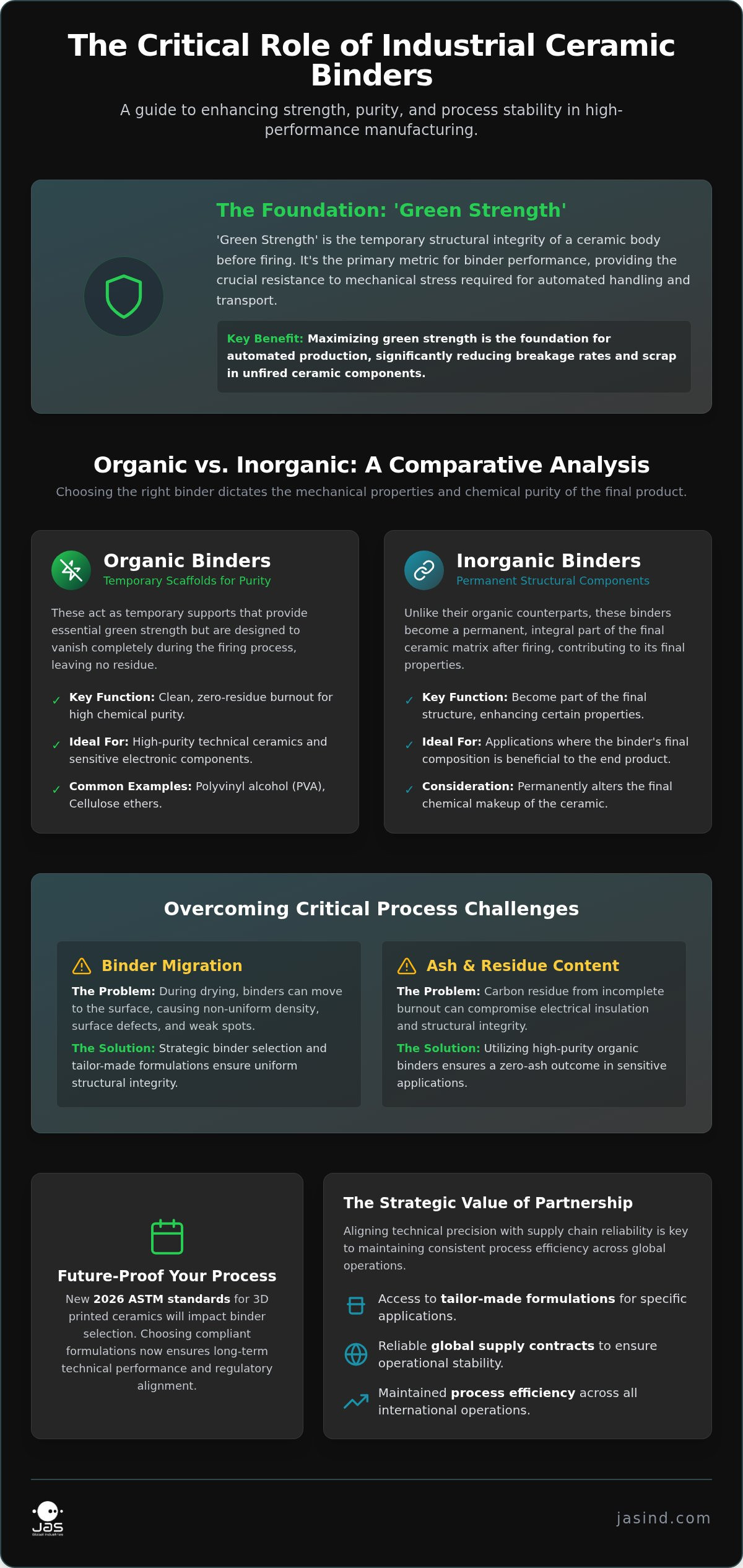
In the high-precision world of industrial manufacturing, stability is the ultimate currency. Ceramic Binders serve as the critical chemical bridge in this equation. These specialized additives are more than just processing aids; they're the Binder (material) that provides temporary structural integrity to unfired ceramic bodies. By securing the bond between raw mineral particles, these agents protect the investment made in raw materials and energy before the permanent sintering process begins.
Process reliability depends on the transition from traditional, variable clays to high-performance synthetic binder systems. While natural materials often lack consistency, synthetic formulations offer predictable rheology and burnout characteristics. This predictability is vital for reducing waste. When a green body maintains its shape under pressure, manufacturers see a sharp decline in scrap rates and a more efficient use of expensive raw material stocks. Efficiency here isn't just about cost; it's about the responsible management of industrial resources.
Understanding 'Green Strength' in Modern Ceramics
The physics of particle bonding determines whether a ceramic component survives the journey from the molding press to the kiln. In its pre-fired state, a ceramic body relies on the adhesive and cohesive forces provided by the binder to resist mechanical stress. This resistance is essential for automated handling and transport within the plant. Modern production lines move at speeds that would shatter poorly formulated pieces. Green strength is the primary metric for binder performance. Without sufficient strength, the risk of micro-cracks increases, leading to catastrophic failure during the firing stage. Reliable binders ensure that every piece remains a viable asset throughout the production cycle.
Binders as a Foundation for Global Infrastructure
Industrial ceramics are the silent pillars of modern society. They're essential for water treatment membranes, energy storage cells, and aerospace components. The stability of these sectors relies on the chemical consistency of the supply chain. For a deeper look at how these additives fit into the broader manufacturing ecosystem, see our Ceramics Chemicals: A Comprehensive Guide. By focusing on chemical stability and zero-residue performance, JAS Global Industries acts as a guardian of these critical resources. We don't just provide a product; we secure the long-term industrial partnerships that keep global infrastructure moving. Our role is to provide the technical foundation that allows complex industrial systems to operate with absolute confidence.
Organic vs. Inorganic Binders: A Comparative Analysis
Selecting the right Ceramic Binders requires a deep understanding of the chemical lifecycle of the final product. Organic binders serve as temporary scaffolds. They provide essential green strength but vanish during the firing process. In contrast, inorganic binders become a permanent part of the ceramic matrix. This fundamental distinction dictates the mechanical properties and chemical purity of the finished piece. Manufacturers must choose between these two paths based on the intended application and the required level of structural security.
In high-purity technical ceramics, low ash content is non-negotiable. Organic carriers must decompose completely to prevent carbon residue. This residue can compromise electrical insulation or structural integrity in sensitive components. Selecting the correct Binders for Ceramic Bodies ensures that the thermal decomposition phase leaves no trace, securing the quality of the end-product. While natural materials like cellulose ethers are cost-effective, synthetic polyacrylates offer superior consistency and lower dosage requirements for high-speed industrial operations.
Organic Binders: Purity and Clean Burn-out
Thermal decomposition is a controlled process. Polyvinyl alcohol (PVA) and cellulose ethers are industry standards for precision molding. PVA offers exceptional film-forming properties, while cellulose excels in high-speed extrusion due to its superior water retention. For sensitive electronics, these materials are preferred because they minimize carbon footprints within the ceramic body. Manufacturers often find that tailor-made organic formulations provide the specific viscosity profiles needed to prevent defects during rapid firing cycles. This precision ensures that the structural integrity of the piece is maintained from the press to the kiln.
Inorganic Binders: Structural Stability at Scale
Not all applications require a clean burn-out. In refractory and construction ceramics, permanent inorganic binders like bentonite or silicates are essential. These mineral-based additives enhance plasticity and maintain structural stability at extreme temperatures. They don't disappear; they fuse. This makes them ideal for large-scale industrial components where high-temperature durability outweighs the need for chemical purity. Balancing the mineral content with final product specifications is the key to cost-effective, high-volume production. These binders provide the foundational stability required for heavy-duty infrastructure, where long-term reliability is the primary goal.
Performance in high-speed extrusion often highlights the gap between synthetic polyacrylates and natural cellulose ethers. Polyacrylates offer superior consistency and are less susceptible to biological degradation. Natural ethers provide excellent plasticity but can vary in quality between batches. Understanding these nuances allows manufacturers to optimize flowability and reduce breakage across global operations, ensuring that production remains steady and resource-efficient.
Overcoming Process Challenges: Migration and Ash Content
Industrial manufacturing demands precision at every stage. While selecting the right Ceramic Binders is essential, managing their behavior during processing is equally critical. Two primary obstacles often disrupt production: binder migration and residual ash content. Migration occurs when the liquid phase moves toward the surface during drying, carrying the binder with it. This results in an uneven distribution that compromises the mechanical integrity of the piece. To mitigate this, a comprehensive overview of ceramic binders suggests that successful formulations must account for the interplay between surface tension and evaporation rates.
Process optimization also requires understanding the synergy between binders and other additives. For example, the use of Ceramic Deflocculants is vital for rheology control. These agents ensure that the mineral particles remain well-dispersed, which in turn helps the binder maintain a uniform network within the slurry or paste. Without this balance, the risk of structural weak points increases, leading to higher breakage rates during handling. Maintaining this chemical equilibrium is the only way to secure a stable and efficient production line.
Controlling Binder Migration During Drying
Evaporation acts as a pump. As water leaves the ceramic body, it pulls dissolved binders to the exterior, creating a dense "skin" on the surface. This skinning prevents deep-seated moisture from escaping, which often leads to internal cracking or bloating during the firing stage. This phenomenon also interferes with subsequent finishing. If the surface is heavily saturated with binder, glazes may not adhere properly, resulting in peeling or uneven color. Using specialized additives to lock the binder into the mineral matrix is a proven strategy for maintaining uniformity. It's a technical solution for a widespread industrial problem.
Minimizing Ash and Residue for High-Purity Yields
Technical ceramics for aerospace or electronics don't tolerate impurities. The chemical structure of the binder determines how cleanly it burns out. High-performance applications require binders with extremely low metallic impurity profiles to prevent electrical failure or structural degradation. Ash residue acts as a contaminant that can alter the final properties of the ceramic. Our JAS R&I centers optimize formulations for zero-residue requirements, ensuring that the thermal decomposition is absolute. This commitment to purity ensures that the final product meets the rigorous standards of global industrial infrastructure. We don't just provide chemicals; we provide the assurance of high-purity yields.
Strategic Selection Framework for Industrial Ceramic Binders
Choosing the right chemical partner is a strategic decision that affects the entire production ecosystem. Ceramic Binders must be evaluated not as isolated additives, but as part of a complex chemical sequence. This includes assessing compatibility with existing mineral processing reagents and mining chemicals used upstream. If a binder interferes with residual flotation collectors or grinding aids, the resulting slurry may suffer from unpredictable rheology. A successful selection framework prioritizes this chemical synergy to ensure that every stage of the manufacturing process remains stable and protected.
Rheological impact is a primary technical gatekeeper. Binders directly influence the viscosity and flowability of the ceramic body, which determines how well it fills a mold or moves through an extruder. High-speed automated lines require a precise balance. If the viscosity is too high, equipment wear increases; if too low, the green body lacks the necessary structural security. Manufacturers must conduct a meticulous cost-efficiency analysis that balances binder dosage against green state scrap rates. Reducing breakage by even a small percentage often justifies the investment in a premium, high-efficiency formulation, as the cost of discarded raw materials and wasted energy far outweighs the price of the additive.
Technical Criteria: Viscosity and Plasticity
Matching binder molecular weight to the specific forming process is non-negotiable. Pressing operations require binders with high lubrication properties, while extrusion demands superior plasticity and water retention. Water retention is particularly critical for preventing premature drying, which can lead to warping or internal stress in the green body. Engineers should test for compatibility with other specialty reagents to ensure the binder doesn't lose efficacy in the presence of deflocculants or lubricants. This technical alignment is the foundation of a reliable production cycle.
Operational Criteria: Logistics and Dosing
Industrial-scale operations require more than just technical performance; they demand logistical reliability and corporate maturity. Bulk handling requirements and standardized dosing strategies are essential for maintaining consistency across multiple plants. This global uniformity is the hallmark of a mature manufacturing operation, ensuring that a product made in one region meets the exact specifications of another. Supply chain security, rooted in localized manufacturing and technical support, protects your production from international market volatility and transport delays. Ensuring compliance with evolving global safety and environmental regulations is also a core requirement for long-term sustainability and resource protection.
To optimize your specific production line and reduce operational waste, consult with our technical process experts for a tailor-made formulation analysis.
JAS Global Industries: Engineering Reliability in Ceramics
JAS Global Industries has been a cornerstone of specialty chemical solutions since 1998. We don't just supply additives; we engineer stability for critical industrial processes. With over 25 years of expertise, our role is that of an indispensable pillar in modern manufacturing infrastructure. This deep corporate history allows us to provide more than just Ceramic Binders. We offer a technical partnership that prioritizes the long-term health and efficiency of your production line. Our mission is to secure the resources that build the modern world.
True efficiency requires a view of the entire resource lifecycle. By integrating our binder technology with broader Mining Solutions, we optimize mineral processing from the point of extraction to the final ceramic body. This holistic approach ensures that chemical reagents used in the mine don't conflict with the binders used in the plant. We provide on-site testing and technical audits to identify these synergies. This turns chemical supply into a strategic advantage for global resource security and operational stability.
Tailor-Made Formulations for Unique Industrial Needs
Every mineral deposit has a unique chemical profile. A generic binder often fails to address site-specific challenges like high salinity or variable particle size. Our global R&I centers focus on developing custom formulations that match your specific mineralogy. Through collaborative R&D, we solve complex processing hurdles that others overlook. In high-volume production environments, our customized binders are designed to significantly reduce breakage rates by optimizing the bond between specific mineral types. This precision results in higher yields and lower operational waste. We solve the technical problems that threaten your profitability.
Global Reach and Supply Chain Security
Operational reliability depends on a secure supply of critical chemicals. Headquartered in Dubai, JAS Global Industries operates international manufacturing plants to serve a global market. We ensure stability through robust bulk chemical supply contracts that protect our partners from local market fluctuations and logistical delays. Our commitment to sustainability drives us to develop cost-effective technologies that reduce the environmental footprint of ceramic manufacturing. We act as a foundational industry presence, focused on the fundamental needs of a society that relies on stable, high-quality ceramic production. Your security is our primary objective.
Securing the Future of Industrial Ceramics
Stability in industrial manufacturing isn't an accident. It's the result of precise chemical engineering and strategic material selection. You've seen how advanced Ceramic Binders act as the essential bridge between raw mineral powder and high-performance finished products. By controlling binder migration and eliminating ash residue, you protect both your equipment and your profitability. These technical choices provide the structural security needed for the world's most critical infrastructure.
Since 1998, JAS Global Industries has acted as a vital guardian for global resource sectors. Our international R&I centers specialize in tailor-made formulations that solve site-specific challenges through expert technical consulting. We invite you to optimize your ceramic process with JAS Global's specialized binders and experience the reliability of an integrated global supply chain. Let's build a more efficient and sustainable manufacturing future together.
Frequently Asked Questions
What is the primary function of a binder in ceramic processing?
The primary function is providing temporary structural integrity to the unfired ceramic body, known as green strength. Binders act as a bridge between raw mineral particles, allowing the piece to withstand mechanical stress during handling, transport, and machining. This adhesive force is essential for automated production lines where high-speed movement is standard. Without this support, the ceramic body would crumble or crack before the permanent sintering process begins.
Can organic binders affect the final color of the fired ceramic?
Organic binders don't typically affect final color if they achieve complete thermal decomposition. However, if the firing cycle is too rapid or the binder has high metallic impurities, carbon residue may remain trapped within the matrix. This can lead to gray or black discoloration, particularly in high-purity technical ceramics. Selecting a formulation with a low ash profile ensures that the intended aesthetic and chemical properties of the ceramic are preserved.
How do I prevent binder migration during the drying process?
You prevent binder migration by controlling the evaporation rate and using specialized chemical additives that lock the binder within the mineral matrix. Migration occurs when liquid moves to the surface, pulling the binder with it and causing surface skinning. Adjusting the viscosity of the slurry or adding specific coagulants can stabilize the distribution. This ensures that the structural integrity remains uniform throughout the entire thickness of the ceramic piece.
What are the advantages of synthetic binders over natural clays?
Synthetic Ceramic Binders offer superior chemical consistency and predictable performance compared to variable natural clays. While clays provide plasticity, they often contain impurities that affect technical ceramics. Synthetic options like polyacrylates or PVA allow for much lower dosage levels and provide cleaner burnout characteristics. This predictability is vital for securing global manufacturing operations where multi-plant consistency and high-purity yields are the primary operational requirements.
Is it possible to achieve zero ash residue with industrial ceramic binders?
It's possible to achieve near-zero ash residue by using high-purity synthetic organic binders designed for technical applications. These materials are engineered to decompose completely into gaseous products like carbon dioxide and water vapor during the firing stage. This is a non-negotiable requirement for electronics and aerospace components where even trace metallic residues can cause electrical failure. JAS R&I centers focus on optimizing these formulations to meet the most rigorous purity standards.
How does the choice of binder impact the efficiency of mining flotation collectors?
Binder selection directly impacts upstream efficiency by requiring chemical compatibility with residual mining reagents. If a binder interferes with the surface chemistry of mineral particles already treated with flotation collectors, it can disrupt the rheology of the final slurry. A strategic selection framework ensures that the binder works in synergy with the entire mineral processing chain. This holistic approach protects the stability of the resource supply from extraction to final molding.
What is the difference between a ceramic binder and a deflocculant?
The difference lies in their primary objective: binders provide mechanical strength, while deflocculants manage particle dispersion and flow. A binder holds the particles together in the green state. A deflocculant, or dispersant, reduces the viscosity of the slurry by preventing particle agglomeration. While they work together to create a stable ceramic body, they serve distinct roles in the chemical architecture of the manufacturing process. Each additive must be balanced to ensure process efficiency.
How do I determine the optimal binder dosage for my ceramic body?
You determine optimal dosage through systematic testing that balances green strength against burnout time and cost. Factors include the surface area of the mineral powder, the specific forming method, and the target mechanical strength. Too little binder leads to breakage, while too much can cause bloating or extended firing cycles. Technical consulting and on-site audits help identify the precise percentage needed to optimize your specific industrial production line and reduce operational waste.