
Global resource security relies on the precision and stability of the comminution circuit. In modern mineral processing, the most expensive ton of ore is the one that stays in the mill too long. You likely face the mounting pressure of rising energy costs and the technical frustration of fine particle agglomeration. These challenges do more than reduce mill efficiency; they disrupt the delicate balance of downstream flotation. Implementing high-performance Mining Grinding Aids is no longer just a tactical choice; it's a strategic necessity to protect your operational margins and ensure long-term stability.
Discover how advanced chemical solutions optimize mill throughput and reduce specific energy consumption. By preventing particle re-welding and ensuring better liberation, these formulations act as vital guardians of your production targets. This article explores the technical advantages of customized chemical dosing, from stabilizing particle size distribution to improving recovery rates. We will examine how a mission-oriented approach to chemical processing can transform your grinding circuit into a reliable pillar of operational sustainability and industrial excellence.
Key Takeaways
- Comminution is a vital yet energy-intensive stage of resource extraction. Learn how chemical intervention secures operational stability against rising energy costs.
- Understand the Rehbinder Effect and how surfactants prevent fine particle agglomeration to ensure consistent mill performance.
- High-performance Mining Grinding Aids can increase mill throughput by 5% to 15% without the need for expensive hardware upgrades.
- Better particle liberation directly impacts mineral recovery. Discover how optimized grinding stabilizes downstream flotation circuits.
- Generic solutions often fail in complex ore bodies. Discover why custom formulations and technical audits are essential for long-term recovery security.
The Role of Mining Grinding Aids in Modern Comminution
In the global effort to secure essential materials, the efficiency of the comminution circuit stands as a critical pillar. Mining Grinding Aids are specialized chemical additives engineered to enhance the performance of ball, rod, and semi-autogenous (SAG) mills. These reagents aren't merely process additives; they function as force multipliers for existing mechanical infrastructure. By modifying the slurry rheology and the surface energy of particles, they allow mills to process more tonnage without the need for massive capital investment in new hardware.
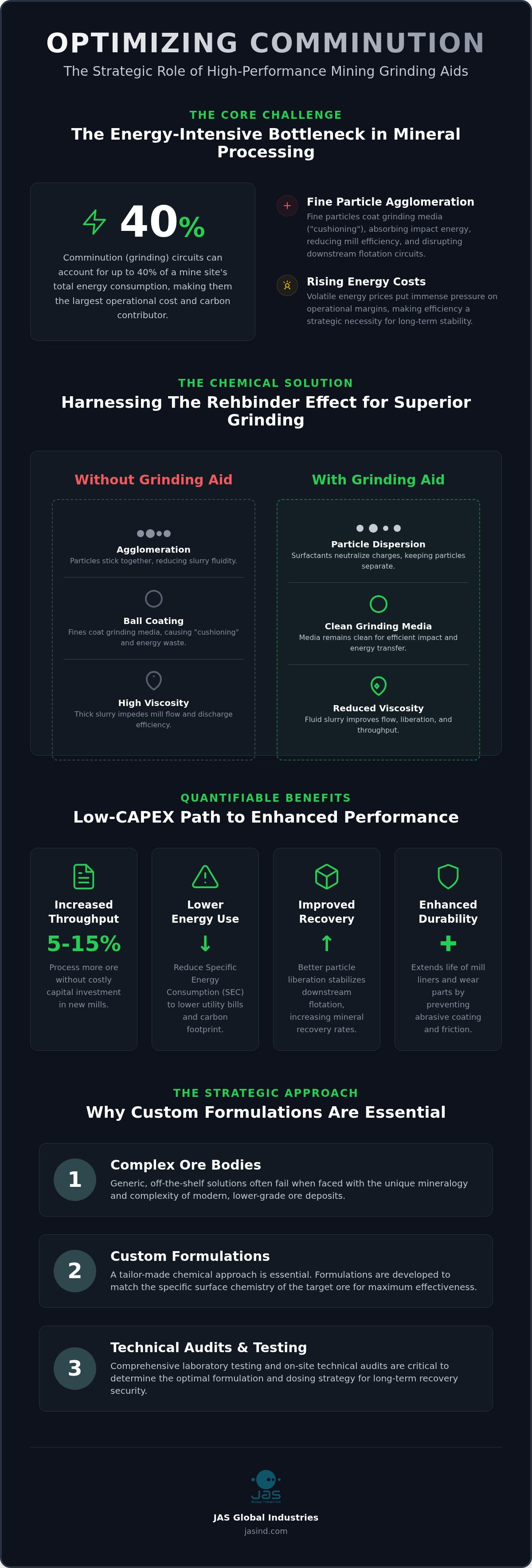
The urgency for such optimization is clear when looking at energy consumption. Industry data suggests that comminution accounts for up to 40% of the total energy used on a typical mine site. This makes the grinding circuit the single largest contributor to a facility's carbon footprint and operational cost. Improving efficiency in this sector is a matter of global resource security. It ensures that critical minerals remain accessible and economically viable even as the industry faces rising power costs and fluctuating market demands.
Addressing the Bottleneck of Fine Grinding
As high-grade ore deposits are depleted, mines must process increasingly complex, lower-grade bodies. This shift requires ultra-fine grinding to achieve proper mineral liberation for downstream recovery. However, fine grinding often leads to "cushioning." This occurs when fine particles coat the grinding media and mill liners, absorbing impact energy instead of breaking rock. Using Mining Grinding Aids prevents this coating. It keeps the media clean, reduces internal friction, and extends the life of wear parts. This directly improves mill availability and stabilizes maintenance cycles by preventing premature wear on expensive liners.
Economic and Environmental Drivers
Energy optimization is now a core component of corporate responsibility. Reducing specific energy consumption (SEC) does more than lower monthly utility bills; it significantly shrinks the environmental impact of mineral extraction. This transition from a purely transactional view of chemicals to a strategic one is essential for modern operations.
- Low-CAPEX Expansion: Grinding aids provide a path to increased throughput without the multi-million dollar price tag of installing new mills.
- Operational Profitability: Lower SEC per ton processed directly enhances the bottom line and protects margins against volatile energy pricing.
- Carbon Reduction: Efficient grinding supports global sustainability goals by minimizing the power required per unit of metal produced.
By viewing chemical reagents as strategic assets, operators can protect both their margins and the environment. This holistic approach ensures that mining remains a foundational industry that is both powerful and conscientious.
The Surfactant Chemistry: Reducing Surface Energy and Agglomeration
Chemical precision is the silent partner of mechanical force in the grinding circuit. To understand how grinding aids work, one must look at the Rehbinder Effect. This principle describes how specific chemical compounds reduce the surface energy of solids, making them more susceptible to fracture. When how grinding aids work effectively, they penetrate the micro-cracks of the ore, preventing these cracks from healing under the intense pressure of the mill. This microscopic intervention allows for faster particle breakage and higher throughput without increasing the power draw.
Beyond fracture facilitation, surfactants play a vital role in preventing re-welding. In ultra-fine grinding, the immense surface area of the particles creates high electrostatic attraction. Without chemical intervention, these particles often agglomerate, sticking back together or coating the grinding media. Mining Grinding Aids neutralize these charges. By maintaining a dispersed state, these reagents ensure the slurry remains fluid and the grinding media stays clean. This reduction in viscosity improves the flow through the mill, allowing for a more efficient discharge of the target size fraction.
Surface Tension and Particle Dispersion
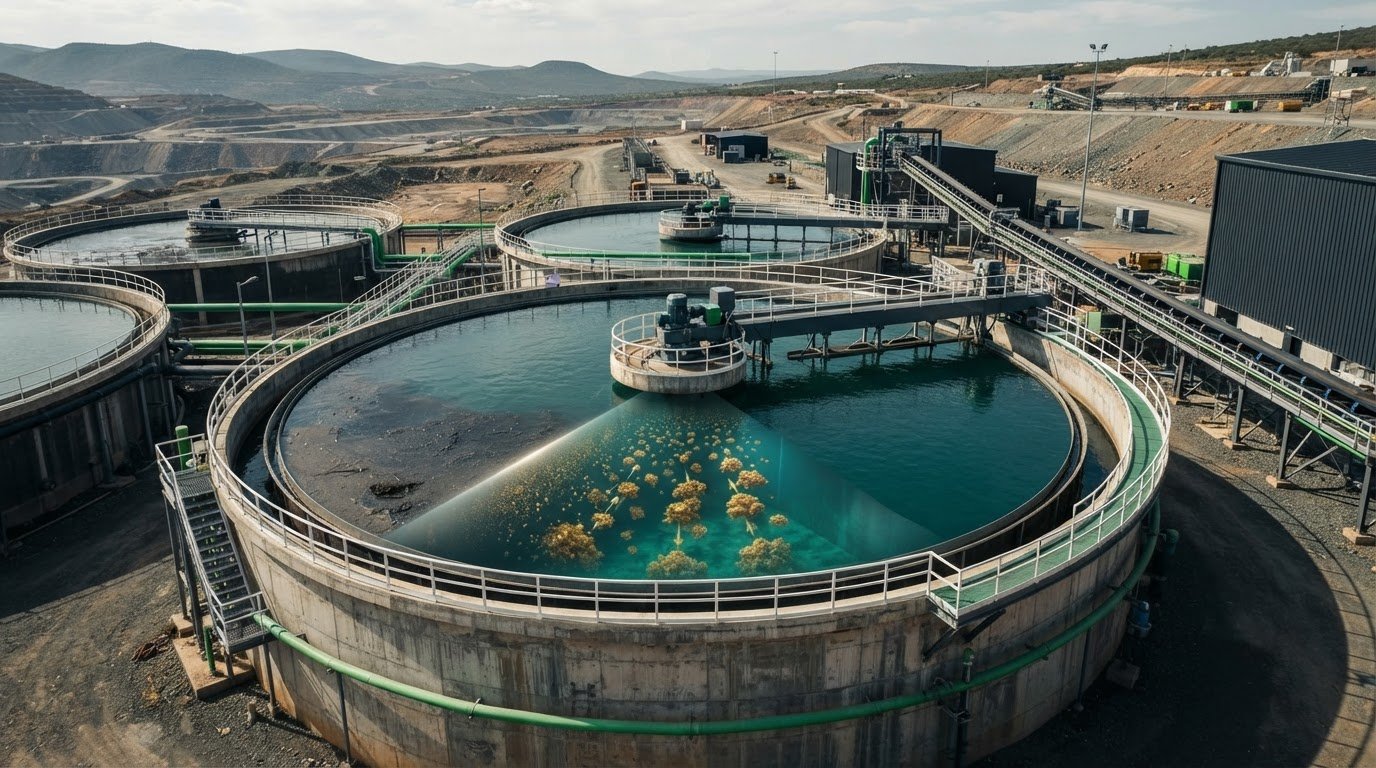
The stability of a grinding circuit depends on the dispersion of fine particles. As ore is crushed, freshly cleaved mineral faces exhibit high surface energy and unbalanced charges. These reactive surfaces quickly attract other particles or adhere to the mill liners, a phenomenon known as "ball coating." Grinding aids act as dispersants that stabilize these surfaces. Polar adsorption occurs when the active molecules of a grinding aid orient themselves on a mineral's surface through electrostatic attraction, creating a protective barrier that prevents inter-particle bonding. This chemical shield ensures that the energy of the mill is spent on breaking rock rather than overcoming internal friction and slurry resistance.
Compatibility with Mineral Recovery
A common concern in mineral processing is the potential for grinding chemicals to disrupt downstream recovery. Many generic additives can coat mineral surfaces in a way that interferes with flotation kinetics. JAS Global formulations are engineered with a focus on total circuit security. We ensure that our reagents are fully compatible with your existing mining flotation collectors and frothers. The synergy between mining solutions and grinding aids is a hallmark of our technical approach. By managing the chemical footprint in the process water, we protect the stability of the flotation cells and the quality of the final concentrate. Operators seeking to stabilize their circuits can benefit from a technical audit of their grinding chemistry to ensure long-term recovery performance.
Quantifying the Benefits: Throughput, Fineness, and Cost
Measuring the success of a comminution circuit requires looking at the intersection of energy and output. Mining Grinding Aids provide a quantifiable shift in these metrics. By optimizing the internal dynamics of the mill, operators can achieve 5% to 15% higher tonnage without any physical hardware changes. This throughput expansion is achieved by maximizing the effective breakage rate and minimizing the energy lost to friction or particle cushioning. While many generic solutions focus on cement, these benefits are particularly pronounced in complex ores such as phosphate and potash, where mineralogy demands precise chemical control.
Reducing the specific energy consumption (SEC) is a primary objective for any facility aiming for global resource security. When the mill operates more efficiently, the kWh per ton of ore processed drops significantly. This isn't just a cost saving; it's a reduction in the operational carbon footprint. Additionally, the lubricating effect of these chemicals reduces the abrasive wear on liners and grinding media. Extending the life of these high-value components reduces downtime and stabilizes the maintenance budget. It's a foundational step toward operational excellence.
Optimizing Particle Size Distribution (PSD)
Achieving the correct fineness is only half the battle. A truly efficient circuit produces a narrow particle size distribution. Mining Grinding Aids help prevent "over-grinding," which often results in the creation of wasted slimes that are difficult to recover. By ensuring better particle liberation, the downstream flotation and leaching stages become more predictable. This precision also improves filtration and dewatering efficiency. A more uniform product is easier to process in the final stages of the circuit, ensuring that recovery targets are met with consistency.
Operational Stability and Flowability
Beyond the mill, chemical optimization improves the entire material handling chain. Stabilized slurry rheology eliminates mill surges, ensuring a steady feed to the cyclones. In dry grinding applications, these reagents improve the flow of minerals through conveyors and silos. This enhanced flowability is rooted in the complex surfactant chemistry used to neutralize surface charges. By preventing material hang-ups and blockages, the facility operates with a level of reliability that generic approaches cannot match. This stability is essential for maintaining the long-term health of the entire mineral recovery circuit.
Implementation Strategy: Laboratory Testing and Dosing
Successful chemical integration begins long before the first pump is installed. A rigorous technical audit is the foundational step for any optimization project. Without a deep understanding of the current circuit baseline, the true value of chemical intervention remains hidden. JAS Global views this process as a long-term partnership. We ensure that every drop of reagent contributes to the stability of your production targets and the security of your mineral resources.
Technical Audits and Benchmarking
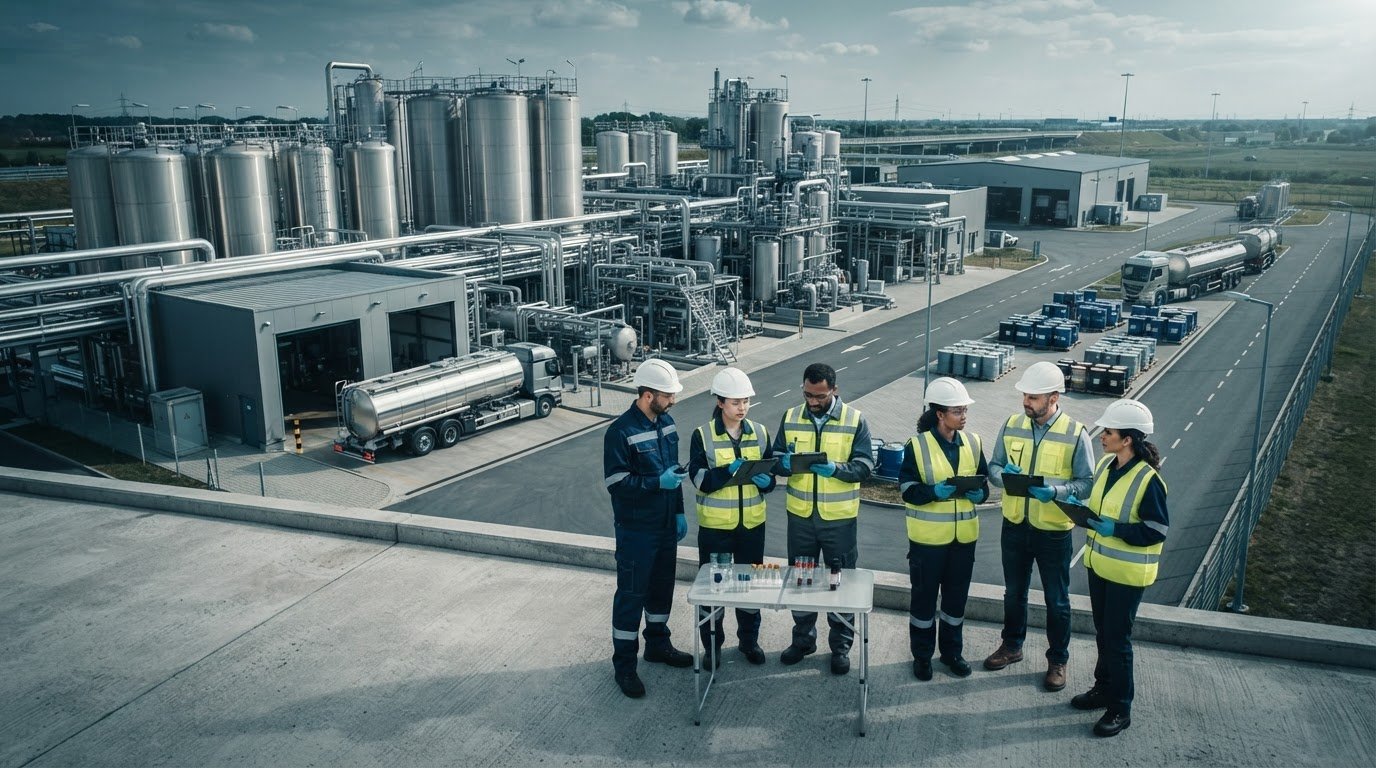
JAS Global technicians conduct comprehensive on-site audits to identify hidden efficiency gaps. We focus on collecting granular baseline data, including motor energy draw, circulating loads, and detailed PSD analysis. This data-driven approach allows us to define specific KPIs for every trial. By establishing these benchmarks, we ensure that the performance of Mining Grinding Aids is transparent and verifiable. We analyze the entire comminution circuit to ensure that improvements in the mill don't create bottlenecks elsewhere. This isn't just about selling a product; it's about securing the long-term reliability of your extraction process.
Precision Dosing and Automation
Consistency is the core of circuit stability. Laboratory-scale testing, including Bond Work Index (BWI) evaluations and comparative grind studies, allows us to predict performance with high accuracy. These studies help us determine the exact dosage required to achieve the desired fineness without over-grinding. Once testing is complete, establishing the optimal dosing point—whether at the feed belt or the mill inlet—is critical for uniform distribution. Effective chemical application requires the reagent to be thoroughly mixed with the ore before it enters the high-impact zones of the mill.
Modern mineral processing requires this application to be fully integrated with plant control systems like DCS or SCADA for real-time optimization. This ensures the dosing rate adjusts automatically as ore hardness fluctuates, preventing reagent waste and maintaining a steady mill discharge. Operating in extreme environments, such as the high temperatures of the Middle East or the remote regions of Africa, presents unique challenges. Specialized dosing hardware is required to maintain chemical integrity and prevent viscosity changes in the feed lines. Troubleshooting these logistical hurdles is part of our commitment to global reliability. Operators ready to optimize their performance can request a technical audit of their grinding circuit to begin the transition toward a more efficient, energy-conscious operation.
Tailor-Made Formulations: The JAS Global Approach
Generic chemical solutions often struggle to meet the demands of modern mineral processing. When "off-the-shelf" reagents are applied to complex ore bodies, they frequently fail to address specific mineralogical challenges. This results in inconsistent throughput and wasted energy. JAS Global Industries takes a different path. We recognize that every mine site is a unique ecosystem. Our global R&I centers focus on developing site-specific reagents tailored for gold, copper, and potash mining. This precision ensures that our Mining Grinding Aids deliver maximum impact where generic products fall short.
Our approach is rooted in technical industrial expertise and a sense of global responsibility. We don't just provide chemicals; we provide the stability needed to protect critical global resources. By aligning our formulations with the specific needs of your ore body, we ensure that your comminution circuit remains a reliable pillar of your production strategy. This commitment to custom chemistry is what distinguishes a mere supplier from a vital global guardian.
Custom Chemistry for Complex Ores
Clay-rich ores often present significant rheological hurdles. High viscosity can choke a mill, leading to surges and reduced recovery. Our technical team works to balance cost-effectiveness with high-performance chemistry. We address the unique challenges of highly viscous ores by modifying the particle surface charges to maintain slurry fluidity. This chemical precision ensures consistent mill discharge and prevents the "cushioning" effect discussed in earlier sections. In real-world applications, our tailor-made Mining Grinding Aids have stabilized circuits that previously suffered from unpredictable surges, directly supporting long-term operational profitability.
A Partner in Global Resource Security
We believe our role extends beyond that of a chemical supplier. We're an indispensable partner in the world's most critical industries. By stabilizing the grinding circuit, we help secure the global supply chain for essential minerals. Our focus on sustainability means we develop formulations with eco-friendly chemical footprints that don't compromise on performance. Reliability is built into our robust global logistics network and our recurring technical support services. We provide the operational security needed to keep your facility running at peak efficiency, regardless of geographical challenges.
Our mission is to empower your operation through technical excellence and industrial purpose. We act as a foundational presence, focused on the fundamental needs of society through resource protection. If you're ready to move beyond generic reagents and stabilize your mineral recovery, contact our technical team to schedule a comprehensive process audit. Let's work together to optimize your circuit and secure your production targets.
Securing the Future of Mineral Processing
Comminution remains the most energy-intensive stage of any mining operation. It's a critical bottleneck that dictates the performance of your entire recovery circuit. By integrating high-performance Mining Grinding Aids, you transform this challenge into a strategic advantage. We've explored how surfactant chemistry facilitates fracture and how custom formulations protect the stability of downstream processes. These reagents are essential contributors to global resource security and long-term operational profitability.
Since 1998, JAS Global Industries has provided the technical industrial expertise required to navigate complex mineralogy. Our global R&I centers develop site-specific reagents that ensure your facility remains a reliable pillar of modern infrastructure. We don't just supply chemicals; we build long-term partnerships through technical consulting and process optimization audits. It's time to move beyond generic solutions and stabilize your production targets. Optimize your grinding circuit with a JAS Global technical audit today and ensure the reliability of your mineral recovery. Your path to industrial excellence starts with a commitment to chemical precision.
Frequently Asked Questions
How much can mining grinding aids reduce energy consumption?
Mining Grinding Aids typically reduce specific energy consumption by 5% to 15% depending on the ore body and mill configuration. This efficiency is achieved by preventing particle re-welding and improving slurry rheology. By lowering the energy required per ton of ore processed, these chemicals act as a vital tool for operational stability. Reducing the power draw is essential for facilities facing rising energy costs and strict carbon footprint targets.
Will grinding aids affect the flotation recovery of my minerals?
High-performance formulations are specifically engineered to ensure compatibility with downstream recovery processes. JAS Global reagents don't interfere with the kinetics of flotation collectors or frothers. We focus on total circuit security by managing the chemical footprint in the process water. This ensures that the gains made in the grinding circuit don't compromise the grade or recovery of the final mineral concentrate in the flotation cells.
Are grinding aids suitable for both wet and dry grinding circuits?
Yes, these chemical solutions are effective in both wet and dry grinding environments. In wet circuits, they primarily act as rheology modifiers to reduce slurry viscosity and improve flow. In dry circuits, they function as dispersants that neutralize surface charges to prevent ball coating and agglomeration. This versatility makes them an indispensable part of modern infrastructure for various mineral extraction processes, including gold, copper, and phosphate mining.
What is the typical dosing rate for mining grinding aids?
Dosing rates generally range from 50 to 500 grams per ton of dry ore, though the exact amount depends on site-specific requirements. A technical audit is necessary to establish the optimal dosing point and concentration. Factors like ore hardness, feed size, and target fineness influence the final strategy. Consistent application through automated systems ensures the circuit remains stable even when the mineralogy of the incoming feed fluctuates.
Can grinding aids improve the flowability of ores in storage silos?
Chemical intervention significantly improves the flowability of dry minerals by reducing inter-particle friction and electrostatic attraction. This prevents material hang-ups and blockages in conveyors, silos, and chutes. By ensuring a steady flow of material, operators can eliminate mill surges and maintain a consistent feed rate. This stability is a key component of protecting global resource supply chains through reliable and predictable industrial operations.
How do I determine the ROI of implementing a grinding aid program?
Determining ROI involves measuring the increase in mill throughput against the cost of the chemical program. You should also factor in the reduction in specific energy consumption and the extended service life of mill liners and grinding media. When these gains are quantified, the return often far exceeds the initial investment. Technical audits provide the baseline data needed to verify these economic and environmental benefits with precision.
Are JAS Global grinding aids compatible with high-temperature environments?
JAS Global stabilizes its formulations for reliable performance in extreme climates, including the high temperatures of the Middle East and Africa. Our reagents maintain their chemical integrity and viscosity even under intense heat. This ensures that dosing remains consistent and effective throughout the year. Providing this level of reliability is part of our mission to act as a foundational presence in the world's most challenging mining regions.
How does ore mineralogy affect the choice of a grinding aid?
The mineralogical composition of the ore, especially clay content and surface charge, directly dictates the choice of surfactant. Highly viscous or clay-rich ores require specific dispersants to maintain flowability. Harder ores might need different chemistries to maximize the Rehbinder effect and facilitate fracture. Tailor-made formulations from our global R&I centers ensure the reagent is perfectly matched to your specific ore body for maximum efficiency.