
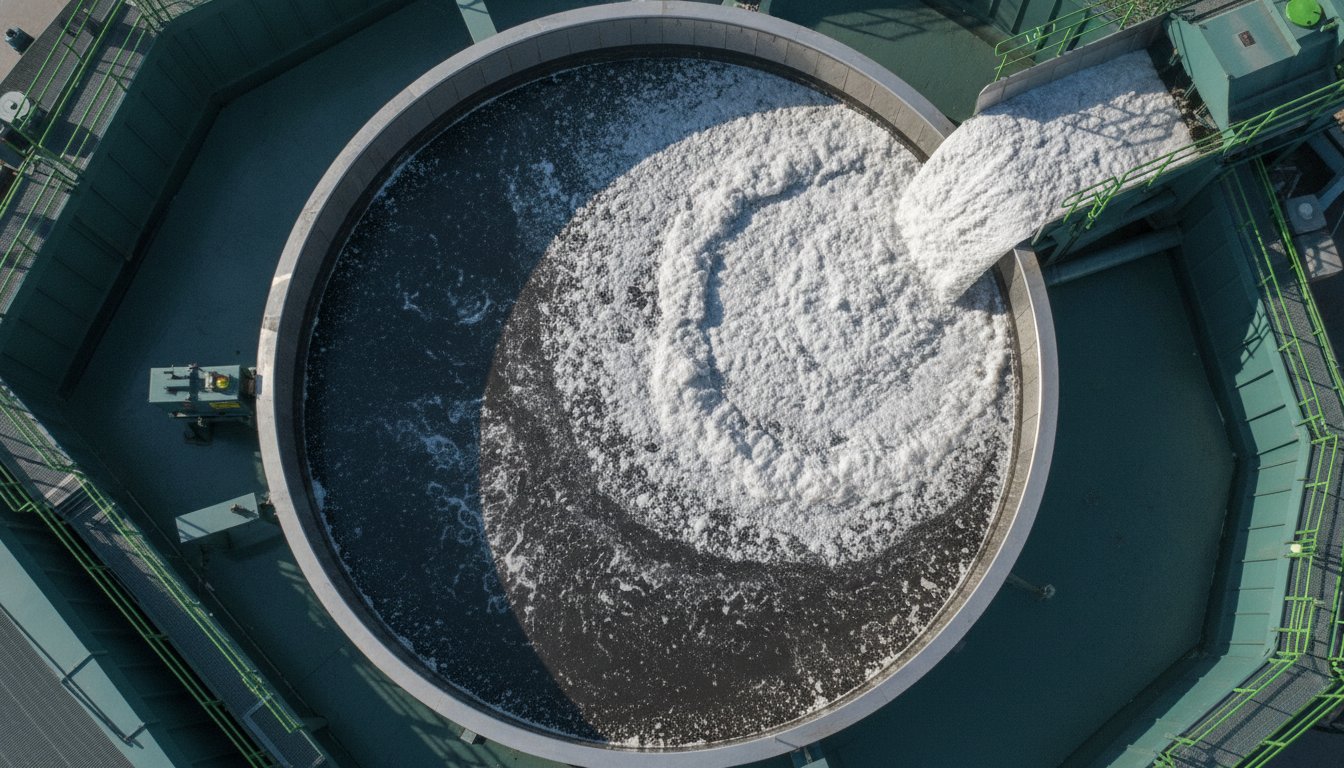
In 2026, the success of a mining operation isn't measured by the volume of ore moved, but by the precision of the chemistry used to extract it. You've likely seen how traditional, generic reagents struggle to maintain selectivity as ore grades decline and mineralogies become increasingly complex. It's frustrating to watch valuable minerals end up in the tailings because of unstable froth or poor recovery rates. We understand that every ton of processed ore represents a significant investment. Maximizing that yield is essential for both your bottom line and global resource security. High-performance mining flotation collectors are the critical link between raw earth and refined value.
This article explores how advanced, tailor-made chemistry can transform your recovery metrics. You'll discover how specialized collector formulations reduce cost per ton while ensuring compliance with the latest environmental standards, including the mandatory hazard classes for persistent and mobile substances effective as of 2026. We'll examine the shift toward sustainable reagents and how digital optimization creates more predictable outcomes. You'll learn how to select the right chemistry to stabilize your froth and secure a higher mineral grade for your operation.
Key Takeaways
- Understand the fundamental chemical distinctions between anionic and cationic agents to ensure precise mineral selectivity during processing.
- Discover how detailed mineralogical assessments and particle size analysis determine the most efficient dosage of mining flotation collectors.
- Learn to leverage the critical synergy between pH control and reagent application to stabilize recovery rates and minimize chemical waste.
- Explore how custom-formulated chemistry makes the extraction of complex and low-grade ores both commercially viable and sustainable.
- Gain insight into how specialized technical audits and global R&I collaboration protect long-term resource security and operational stability.
The Strategic Role of Mining Flotation Collectors in Resource Security
Mining flotation collectors are specialized chemical reagents designed to impart hydrophobicity to specific target minerals. This selective coating ensures that valuable particles repel water and attach to air bubbles, allowing them to rise to the surface as a concentrated froth. Without this precise chemical intervention, the separation of valuable minerals from gangue would be physically impossible at an industrial scale. In 2026, these collectors represent more than just processing aids; they are essential tools for global resource security. They act as the primary bridge between raw earth and the materials required for modern infrastructure and the energy transition.
As high-grade deposits deplete, the industry must turn to low-grade ore bodies that were previously considered uneconomical. These deposits often present complex mineralogies that traditional methods can't handle effectively. High-efficiency mining flotation collectors determine whether these sites are viable assets or stranded resources. By maximizing recovery from every ton of ore, we protect the stability of the global supply chain. This is a matter of both economic survival and strategic resource management in an increasingly competitive global market.
From Ore to Asset: Why Chemistry Matters
JAS Global Industries acts as a guardian of mineral resources by providing optimized chemical solutions. We transform raw deposits into high-grade concentrates through technical precision. Optimized selectivity means fewer chemicals are wasted and less energy is consumed during downstream processing. This directly reduces the environmental footprint of the operation. When collectors are precisely calibrated to the ore's surface chemistry, the transition from waste to wealth becomes predictable. Our global R&I centers focus on these bespoke formulations to ensure long-term operational stability and resource protection.
The Evolution of Flotation Reagents
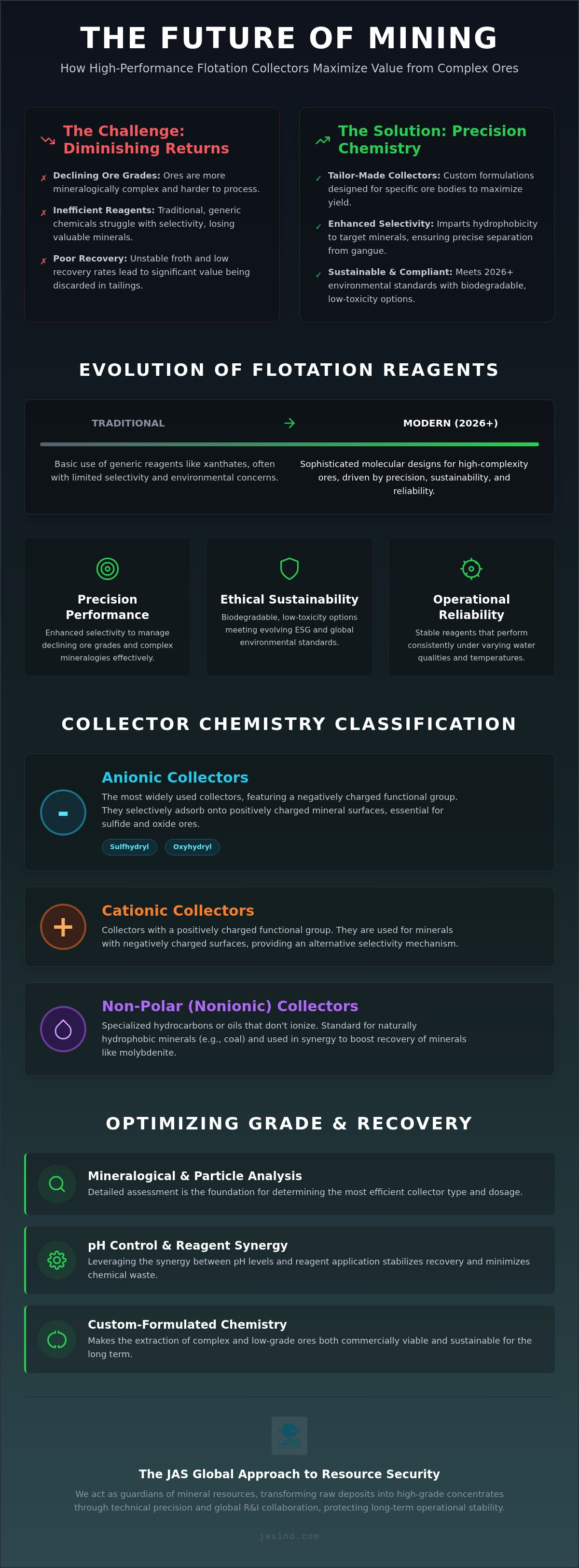
The industry has moved far beyond the basic use of traditional xanthates. Modern mining operations in 2026 require sophisticated molecular designs capable of handling high-complexity ores. This evolution is driven by the need for precision and responsibility. Advanced collectors target specific mineral faces with higher affinity, improving both grade and recovery in challenging environments. This shift includes several key priorities:
- Precision Performance: Enhancing the selectivity of collectors to manage declining ore grades.
- Ethical Sustainability: Developing biodegradable and low-toxicity options to meet evolving ESG standards.
- Operational Reliability: Creating reagents that remain stable under varying water qualities and temperatures.
These modern reagents are designed to function within tight operational parameters. They ensure that resource extraction remains a responsible and productive endeavor for the long term, securing the minerals the world needs most.
Classifying Collector Chemistry: Anionic, Cationic, and Non-Polar Agents
Effective mineral separation relies on the selective adsorption of reagents onto specific mineral surfaces. We classify mining flotation collectors primarily by their ionic charge in aqueous solutions. This chemical categorization allows engineers to match a reagent's functional group to a mineral's surface properties with industrial precision. It isn't just about basic chemistry; it's about the technical mastery required to secure high-value concentrates from increasingly difficult sources. Understanding these classifications is the first step in optimizing any flotation circuit.
The synergy between different collector types often provides the best results in mixed-mineral circuits. For example, combining an anionic collector for bulk mineral recovery with a non-polar agent can significantly boost the recovery of minerals like molybdenite. Non-polar (nonionic) collectors, such as specialized hydrocarbons or oils, are also the standard choice for naturally hydrophobic minerals like coal. By layering these chemical approaches, operators can achieve a level of selectivity that a single reagent couldn't provide alone.
Anionic Collectors for Sulfide and Oxide Ores
Anionic agents are the most widely used mining flotation collectors in the global industry. They're divided into two critical sub-groups: sulfhydryl and oxyhydryl. Sulfhydryl collectors, which include traditional xanthates, form strong chemical bonds with sulfide minerals. They're essential for the recovery of copper, lead, and zinc. These reagents work by creating a robust hydrophobic layer that ensures air-bubble attachment in the pulp.
Oxyhydryl collectors, such as fatty acids and sulfonates, are preferred for non-sulfide minerals. These are vital in processing phosphate and iron ore. These collectors interact through electrostatic forces or chemisorption. The choice between them depends entirely on the mineral's surface charge and the specific recovery goals of the operation. To ensure your circuit is using the most efficient chemical profile, it's often helpful to consult with technical experts who specialize in tailor-made formulations.
Cationic Collectors and Reverse Flotation
Cationic collectors, typically based on amine chemistry, carry a positive charge in the flotation pulp. They're indispensable for reverse flotation processes. In these scenarios, the goal is to float the impurities, such as silica or silicate gangue, while the target mineral remains in the underflow. This method is common in potash processing and the purification of industrial minerals like feldspar.
These agents are highly sensitive to fluctuations in pH and water quality. Managing these variables requires a sophisticated understanding of the mineral-water interface. Because cationic collectors can be aggressive, their dosage must be tightly controlled to prevent the accidental flotation of valuable minerals. This level of control is what separates a standard operation from one that maximizes every available resource through chemical excellence.
Optimizing Grade and Recovery: Selection Criteria for Complex Ores
Selecting the ideal reagent suite is a strategic decision that directly affects an operation's longevity. It isn't a one-size-fits-all process. The physical and chemical composition of the ore body must dictate the entire chemical strategy. A comprehensive mineralogical assessment identifies the specific mineral associations and gangue types present. This data allows engineers to deploy mining flotation collectors with surgical precision, ensuring that reagents target the valuable minerals rather than being consumed by waste rock.
Several variables influence how these reagents perform in a live circuit. Particle size distribution is a primary concern; finely ground ores require different dosage levels and collector types than coarser feeds. Water chemistry is another critical factor. Variations in pH, hardness, and salinity can drastically alter how a collector interacts with the mineral surface. In 2026, managing these variables is essential for maintaining the delicate balance between high grade and maximum recovery. High selectivity is the goal, protecting the value of the concentrate without sacrificing the volume of the yield.
The Impact of Ore Complexity on Chemical Choice
While managing mineral hardness is vital for industrial flotation, it is also a significant concern for residential water systems; to understand how these mineral levels impact your home, visit A Clear Alternative.
Complex or refractory ores often contain finely disseminated mineral particles that are difficult to liberate. These "slimes" can coat valuable surfaces and prevent bubble attachment. Custom-formulated mining flotation collectors are engineered to overcome these interferences by maintaining high affinity for the target mineral even in contaminated pulps. Technical audits serve as a vital tool here. They identify specific process bottlenecks where chemical adjustments can unlock hidden value in the ore stream. By addressing these complexities, we ensure that even the most challenging deposits contribute to global resource security.
Bench-Scale Testing vs. Industrial Application
Transitioning from a laboratory setting to a full-scale plant requires rigorous validation. While bench-scale testing provides a baseline, on-site laboratory testing under real-world conditions is essential for reagent validation. Scaling up dosing strategies involves accounting for pulp density, residence time, and circuit configuration. Leveraging JAS Global Industries' technical consulting helps bridge this gap. Our experts provide the technical oversight needed to ensure that laboratory successes translate into stable, high-yield industrial results. This collaborative approach ensures that every ton of processed ore reaches its maximum potential.
Operational Best Practices: Dosing, pH Control, and Reagent Synergy
Optimal recovery requires more than just the right chemistry; it demands operational discipline. Implementing precise dosing strategies is the only way to prevent reagent over-consumption, which directly impacts the cost per ton. We see pH as the master modifier in this process. It dictates the electrical charge of the mineral surface and the ionization of the mining flotation collectors. Without tight pH control, even the most advanced collector chemistry will fail to achieve its target selectivity.
Troubleshooting common issues like froth instability or low grade often leads back to the balance of the reagent suite. If the froth is too brittle, recovery drops. If it's too persistent, grade suffers. Achieving the right equilibrium ensures that the flotation circuit remains a reliable engine for resource security. It's about maintaining a steady state where every chemical component works in harmony to protect the value of the ore stream.
Synergistic Reagent Management
The performance of mining flotation collectors is inextricably linked to the secondary reagents in the pulp. Mining Frothers play a critical role here. They stabilize the air bubbles long enough for the collector-coated particles to reach the launder. While collectors provide the hydrophobicity, frothers provide the transport vehicle. Without this synergy, the most hydrophobic particles would simply remain trapped in the pulp.
Depressants act as the essential counterpart to this process. They selectively inhibit the flotation of unwanted gangue minerals, ensuring that only the high-value particles enter the froth. For a truly closed-loop system, integrating flocculants into the tailings management stage allows for efficient water recycling and reduced environmental impact. This holistic approach protects both the mineral asset and the surrounding ecosystem.
Advanced Dosing Technologies
In 2026, the industry has moved toward real-time monitoring and automated dosing systems. These technologies adjust chemical intake based on fluctuating ore feed characteristics. Temperature and seasonal variations also play a significant role in reagent kinetics. Cold water in winter months can slow down the adsorption rate of certain collectors, requiring precise adjustments to maintain recovery. Consistency is the foundation of reliability.
Variations in reagent purity can lead to unpredictable results and process upsets. By maintaining a steady, high-quality supply of specialty chemicals, operators can ensure their circuits perform at peak efficiency year-round. To optimize your current reagent suite and improve operational reliability, partner with JAS Global Industries for on-site technical support and specialized chemical audits.
Tailor-Made Formulations: The JAS Global Approach to Resource Security
JAS Global Industries has operated since 1998 with a singular focus on industrial stability. We don't believe in generic reagents. Every ore body is unique; therefore, every chemical strategy must be bespoke. Our approach to mining flotation collectors centers on technical precision and long-term partnership. We position ourselves as a global guardian of mineral resources, ensuring that even the most complex deposits remain economically viable and environmentally responsible. This commitment to excellence protects the fundamental needs of modern society.
Our global presence includes strategic offices in Dubai, Africa, and Asia. This reach allows us to combine world-class research with deep local expertise. We understand specific regional challenges, from water salinity in arid climates to the complex mineralogies of emerging mining districts. By focusing on process efficiency and operational reliability, we help our partners navigate a volatile global market with confidence. We act as an indispensable pillar of modern infrastructure, providing the stability required for long-term growth.
Our Research and Innovation Commitment
Innovation is the cornerstone of our service. We operate multiple R&I centers dedicated to developing JAS custom-formulated collectors. These facilities aren't just laboratories; they're simulation environments where we replicate specific plant conditions. We work side-by-side with your mine mineralogists to identify the exact chemical triggers needed for your ore. This collaborative development ensures that the reagents we deliver are perfectly calibrated to your circuit's requirements. We don't just supply chemicals; we engineer results.
In challenging environments, we've successfully optimized recovery where standard reagents failed. Our scientists analyze the mineral-water interface to overcome interference from slimes or complex gangue. This rigorous attention to detail transforms technical consulting into tangible yield improvements. We turn laboratory success into industrial reality, ensuring that your operation stays productive regardless of ore complexity. Our focus remains on the sustainability of cost-effective, high-yield chemistry.
Securing the Future of Mining
Sustainability is a core pillar of our mission. We focus on ethical resource protection and sustainable industrial growth. Our mining flotation collectors are designed to be cost-effective and high-yield, reducing the environmental footprint per ton of processed ore. We provide more than just chemicals; we provide the peace of mind that comes from a reliable, ethical supply chain. This sense of global responsibility is woven into every partnership we form.
Our global logistics network ensures that critical chemicals reach your site exactly when they're needed. We understand that operational downtime isn't an option. Reliability is our signature. To see how our advanced chemistry can protect your operation's future, contact our technical team for a comprehensive plant audit and laboratory testing session. We're ready to help you secure your resources for the next generation of industrial demand.
Securing the Future of Global Mineral Extraction
The mining industry’s success now depends on the ability to extract value from increasingly challenging and low-grade deposits. We've explored how the strategic application of mining flotation collectors transforms raw earth into critical global assets. By mastering the synergy between specialized chemical agents and maintaining strict operational discipline over pH and dosing, your plant can achieve predictable recovery even in complex mineralogical profiles. This isn't just about process optimization; it's about protecting the long-term stability of the global supply chain.
Since 1998, JAS Global Industries has acted as a vital guardian for the world's most essential industries. Our dedicated R&I centers allow us to simulate your specific plant conditions, providing bespoke formulations that generic reagents can't match. We invite you to leverage our expert technical consulting and on-site testing to unlock the full potential of your ore body. We're ready to help you navigate the complexities of modern mineral processing with confidence.
Partner with JAS Global Industries for tailor-made mining solutions.
We look forward to helping you achieve a more resilient and productive industrial future.
Frequently Asked Questions
What is the difference between a collector and a frother in mining?
A collector chemically modifies the mineral surface to make it water-repellent, while a frother reduces surface tension to create stable air bubbles. Collectors ensure the target particle attaches to the bubble, whereas frothers ensure the bubble survives long enough to reach the surface. Without the collector, the mineral stays in the pulp. Without the frother, the mineral falls back into the slurry before it can be recovered.
How do anionic and cationic collectors differ in their application?
Anionic collectors carry a negative charge and are primarily used for sulfide minerals like copper or zinc, as well as certain oxide ores. Cationic collectors carry a positive charge and are essential for reverse flotation of silicates or the recovery of potash. The choice depends on the electrical charge of the target mineral's surface. Matching the reagent's ionic charge to the ore's surface properties is vital for achieving high selectivity.
Why is pH control critical when using mining flotation collectors?
pH control is critical because it dictates the electrical potential of the mineral surface and the degree of ionization for many mining flotation collectors. If the pH drifts outside the optimal range, the collector may fail to adsorb or may begin targeting unwanted gangue minerals. Precise pH management acts as a chemical gatekeeper. It ensures that the reagent remains active only on the intended mineral faces, preventing costly recovery losses and grade dilution.
Can JAS Global Industries develop a custom collector for my specific ore type?
Yes, JAS Global Industries specializes in developing JAS custom-formulated collectors tailored to unique mineralogical profiles. Our global R&I centers use advanced simulation techniques to replicate your specific plant conditions. This collaborative process involves working with your mine mineralogists to identify the exact chemical triggers needed for your ore. We focus on creating bespoke solutions that address specific recovery bottlenecks, ensuring your operation achieves maximum efficiency and long-term resource security.
How do collectors improve the sustainability of a mining operation?
Collectors improve sustainability by maximizing the yield from every ton of processed ore, which reduces the total volume of waste generated. High-efficiency chemistry also lowers the energy consumption required for downstream processing. In 2026, the shift toward biodegradable and low-toxicity mining flotation collectors helps operations meet strict environmental compliance standards. By improving selectivity, these reagents minimize the chemical footprint in tailings management and support more efficient water recycling programs.
What are the common signs of collector over-dosing in a flotation circuit?
Common signs of over-dosing include a significant drop in concentrate grade and the presence of unwanted gangue minerals in the froth. When too much collector is added, it begins to coat non-target particles, leading to poor selectivity. You might also notice an overly persistent or tough froth that is difficult to break down. This inefficiency increases the cost per ton and can complicate downstream thickening and filtration processes due to reagent carryover.
How does water salinity affect the performance of flotation reagents?
Water salinity introduces competing ions that can interfere with the adsorption of collectors onto the mineral surface. High salt concentrations often reduce the effectiveness of traditional reagents, requiring higher dosages or specialized formulations. Salinity also affects the surface tension and air-bubble size within the flotation cell. Operations using recycled or brackish water must use reagents specifically designed to remain stable and selective under high ionic strength conditions to maintain predictable recovery rates.
What role do collectors play in the recovery of industrial minerals like phosphate?
In phosphate mining, collectors are used to separate valuable apatite from silica and carbonate impurities. This often involves a multi-stage process where anionic collectors float the phosphate minerals, followed by cationic collectors to remove residual silicates. The role of these reagents is to ensure the final concentrate meets the high-grade specifications required for fertilizer production. Precise chemical selection is essential to manage the complex interactions between the various mineral phases present in phosphate deposits.