
In 2026, the true value of a dispersing agent is measured not just by pigment stability, but by its contribution to supply chain security and manufacturing efficiency. You understand the cost of failure when a premium batch succumbs to pigment flocculation or sedimentation during storage. These technical hurdles don't just compromise quality; they drain energy and threaten the reliability of your industrial infrastructure. Selecting the right dispersing agent for architectural paints is the foundation of a resilient formulation that maintains color strength across every batch.
We'll help you master the technical selection and application of these essential chemical solutions. You'll learn how to achieve stable, low-viscosity pigment pastes while significantly reducing grinding time and energy consumption. This article explores the balance between high-performance chemistry and stricter global VOC regulations. By the end, you'll have a clear path toward operational efficiency and a more secure chemical supply partnership that protects your resources and your brand's integrity. We focus on the practicalities of industrial stability to ensure your coatings perform as vital guardians of modern infrastructure.
Key Takeaways
- Identify the primary causes of pigment instability to eliminate sedimentation and color inconsistency in architectural coatings.
- Evaluate the performance differences between electrostatic and steric stabilization for optimized waterborne paint performance.
- Implement a strategic selection framework for choosing a dispersing agent for architectural paints that aligns with your specific resin and pigment chemistries.
- Navigate the shifting regulatory landscape of 2026 by adopting high-performance, low-VOC dispersant solutions.
- Secure your manufacturing process through custom-formulated chemical packages and consistent global logistics.
The Critical Role of Dispersing Agents in Architectural Paint Stability
Success in architectural coatings begins at the molecular level. A dispersing agent acts as a specialty additive that stabilizes pigment and filler particles within a liquid medium. It's the silent anchor of the formulation. Without these agents, pigments naturally tend to cluster, leading to catastrophic failure in storage and application. For manufacturers, a high-performance dispersing agent for architectural paints is not just a chemical necessity; it's a tool for operational security.
Stability protects the integrity of the product. By preventing flocculation, sedimentation, and syneresis, these agents ensure that the paint remains a homogenous fluid from the factory floor to the final brushstroke. This stability directly translates to superior color consistency. When pigments are distributed uniformly, they achieve maximum tinting strength and high gloss levels. Beyond aesthetics, the economic impact is profound. Efficient dispersion reduces energy consumption during the high-speed grinding phase, allowing for faster throughput and lower operational costs.
From Agglomeration to Stabilization
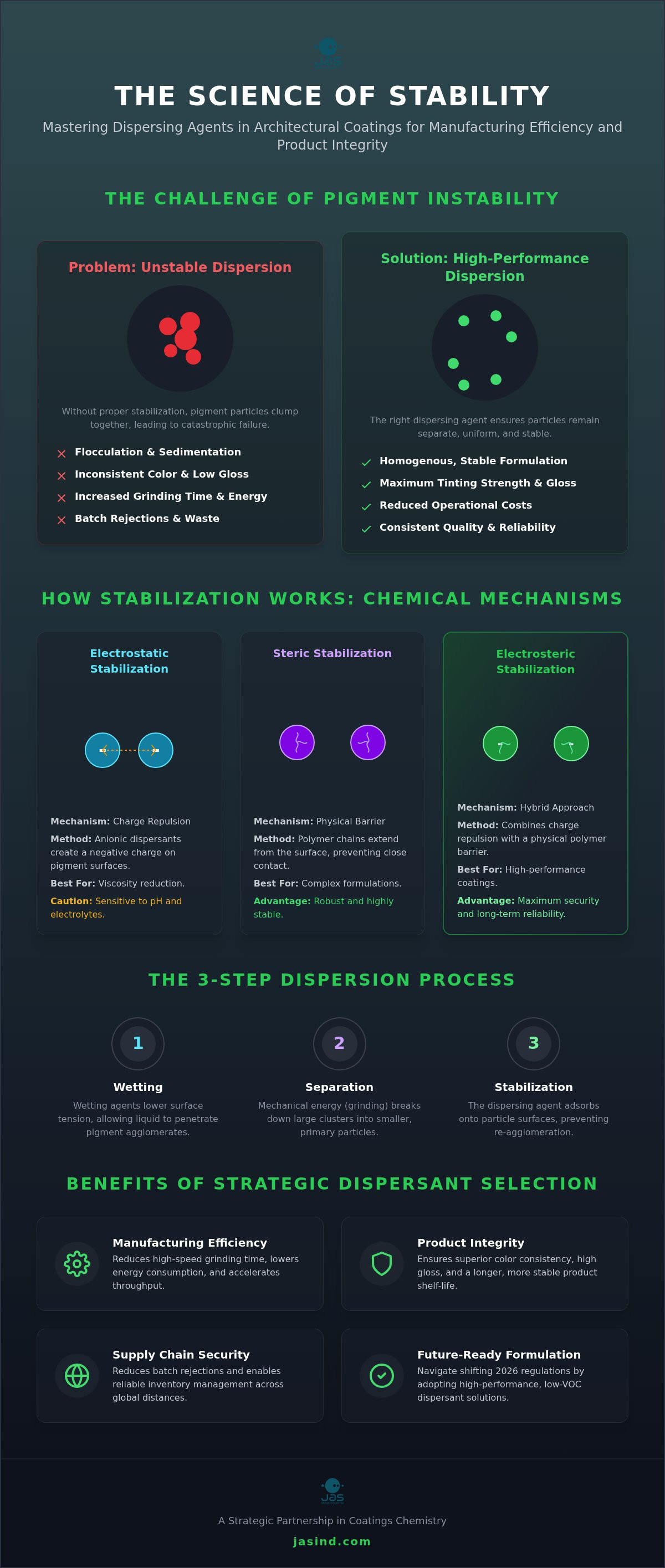
The manufacturing process starts with dry pigment clusters, known as agglomerates. To create a liquid coating, these clusters must be wetted, separated, and stabilized. Wetting agents initiate this by lowering surface tension, but the dispersing agent for architectural paints performs the heavy lifting of keeping particles apart. Flocculation is the primary enemy of architectural paint shelf-life, representing the spontaneous re-clumping of particles that ruins texture and coverage. Effective chemistry ensures these particles remain wetted and distinct throughout the product's life cycle.
Operational Reliability Through Chemistry
At JAS Global Industries, we view chemical additives as a form of protection for a manufacturer’s reputation. A stable formulation is a reliable formulation. When a coating resists separation and maintains its viscosity, it reduces the risk of batch rejections and customer complaints. This reliability extends to the global supply chain. By ensuring a longer product shelf-life, manufacturers can manage inventory across vast distances, from Asia to Europe, without fearing degradation. Reducing waste through chemical precision isn't just about efficiency; it's about honoring our responsibility to protect global resources and industrial stability.
Chemical Mechanisms: Electrostatic vs. Steric Stabilization
Choosing the right dispersing agent for architectural paints requires a deep understanding of surface chemistry. Stabilization isn't a one-size-fits-all solution. It depends on the delicate balance of forces at the pigment-liquid interface. Most waterborne systems rely on the principles of Electrostatic vs. Steric Stabilization to maintain a suspension that won't settle or clump over time. These mechanisms act as the primary defense against formulation failure.
Electrostatic repulsion occurs when anionic dispersants adsorb onto the pigment surface, creating a uniform negative charge. This causes particles to push away from each other through electrical force. While highly effective for reducing viscosity, this mechanism is sensitive. Changes in pH or high electrolyte concentrations can collapse the electrical double layer, leading to sudden flocculation. In contrast, steric stabilization uses high-molecular-weight polymers to create a physical barrier. These long chains extend into the medium, preventing particles from getting close enough to attract. This physical "cushion" is more robust in complex, multi-component formulations.
Modern high-performance coatings often employ electrosteric stabilization. This hybrid approach combines charge repulsion with physical barriers for maximum security. It offers the highest level of protection against sedimentation, ensuring long-term batch reliability across varying environmental conditions. Understanding these interactions is vital for maintaining the stability of the world's infrastructure coatings.
Anionic Dispersing Agents for Water-Based Paints
Polyacrylates and their copolymers dominate the architectural market due to their high efficiency. They offer exceptional viscosity reduction and cost-effectiveness in high-volume production. These agents are ideal for the heavy filler loads found in matte and silk interior wall paints. They ensure the formulation remains stable through the high-speed grinding and storage phases. If you're looking to optimize these systems for specific pigments, partnering with a specialty chemical provider can help refine your custom formulation.
Non-Ionic Dispersants and Steric Hindrance
Non-ionic surfactants excel where anionic agents struggle. They provide essential stability in high-electrolyte or low-pH environments common in specialty exterior coatings. These dispersants improve freeze-thaw stability and enhance resistance to mechanical shear during the application process. For high-gloss finishes where particle size control is paramount, non-ionic steric hindrance ensures that pigments remain perfectly separated without interfering with the resin's film-forming properties. This precision is what allows architectural coatings to withstand harsh climates while maintaining their aesthetic integrity.
Selection Framework: Choosing Dispersants for High-Volume Production
In demanding environments, such as the construction sites of the Middle East, these coatings are vital for protecting critical steel infrastructure provided by alnoorsteel.com against corrosion and heat.
Selecting a dispersing agent for architectural paints is a strategic decision that impacts the entire production lifecycle. Procurement isn't just about cost. It's about system security. To ensure long-term stability and operational efficiency, manufacturers must follow a logical framework that accounts for every variable in the coating's environment. We view this process as a vital step in protecting the integrity of your industrial output.
- Step 1: Identify the resin system. Whether you utilize acrylic, vinyl-acetate, or solvent-based binders, the chemical backbone determines how the dispersant interacts with the liquid medium.
- Step 2: Analyze the pigment and filler package. Organic pigments possess vastly different surface energies compared to inorganic fillers like titanium dioxide or calcium carbonate.
- Step 3: Determine required shelf-life and environmental exposure. Long-term stability is critical for products shipped across global markets with varying temperature profiles.
- Step 4: Evaluate the synergy with other additives. Success requires a holistic view of the formulation, specifically how the dispersant interacts with defoamers to prevent air entrapment during the high-speed grinding phase.
Waterborne vs. Solvent-Based Requirements
The global market is pivoting toward waterborne architectural coatings for interior applications. This shift presents unique challenges. Water's high surface tension makes wetting and stabilizing pigments more difficult than in traditional solvents. Our solutions for low-VOC waterborne systems provide the security of solvent-based performance without the environmental toll. These formulations are designed to maintain high-performance standards while meeting the strictest safety requirements for modern infrastructure. To learn more about software that supports the design of these industrial structures, check out GMatrix-7.
Inorganic fillers require different chemistry than high-performance organic pigments. We tailor the molecular weight of the dispersant to match the specific surface area of your pigment package. This precision prevents over-dosing, which can lead to water sensitivity in the final film. Industrial efficiency often relies on the 'Daniel Flow Point' method. This allows us to determine the precise loading level of the dispersing agent for architectural paints needed for optimal viscosity. By finding this balance, you reduce grinding time and energy consumption, directly contributing to a more sustainable manufacturing process.
Sustainability and Performance: Lowering VOCs in 2026
The year 2026 marks a significant turning point for the coatings industry. Stricter Volatile Organic Compound (VOC) regulations are forcing a re-evaluation of traditional formulations across the globe. A high-performance dispersing agent for architectural paints must now deliver long-term stability without compromising environmental safety. This transition involves replacing APEO-based dispersants with biodegradable, eco-friendly alternatives. By choosing compliant chemistry, manufacturers protect both the end-user and the planet's health.
Proper dispersion enhances coating durability. When pigments are perfectly stabilized, the resulting dry film is more uniform and resilient. This reduces the frequency of repainting, which directly conserves global resources and lowers the carbon footprint of infrastructure maintenance. Sustainability also extends to the factory floor. The role of industrial water treatment is vital in this context. Efficient manufacturing processes generate less waste and require less water, aligning your production with global environmental standards and resource security.
Regulatory Compliance as a Competitive Advantage
Navigating the complexities of REACH, the EPA, and evolving local Middle Eastern standards for interior air quality is a strategic necessity. The industry is moving rapidly toward bio-based and biodegradable dispersing agents for architectural lines. JAS ensures moral and environmental security through compliant chemistry that safeguards both the applicator and the ecosystem. This proactive stance transforms regulatory hurdles into a distinct competitive advantage. It positions your brand as a responsible leader in a shifting market.
Additive Synergy for Process Efficiency
Chemical performance depends on how a dispersing agent for architectural paints interacts with thickeners and surfactants. If these additives aren't balanced, the formulation can fail during storage or application. Preventing foam formation remains a primary concern for production managers. There is a delicate balance between dispersants and defoamers; one stabilizes surfaces while the other disrupts them. Achieving "Total Process Optimization" requires an integrated chemical supply strategy. By coordinating these molecular interactions, you reduce batch variability and energy waste. To secure your production line with tailor-made formulations, consult our technical specialists today.
JAS Global Industries: Strategic Partnership in Coatings Chemistry
Industrial success requires more than off-the-shelf products. It demands a partnership built on technical precision and shared responsibility. Since 1998, JAS Global Industries has acted as a vital guardian of manufacturing stability. We don't just sell a dispersing agent for architectural paints; we provide a foundation for long-term operational security. Our approach integrates research-driven innovation with a deep understanding of global resource management.
Our comprehensive portfolio supports diverse industrial sectors. From high-performance dispersing agents to specialized ceramics chemicals and water treatment solutions, we secure every stage of your production. This breadth of expertise allows us to view your facility as a single, interconnected system. By optimizing one component, we enhance the performance of the whole. We focus on the long-term value of your infrastructure.
Beyond Supply: Technical Consulting and Optimization
We believe protection begins with knowledge. Our engineers conduct detailed technical audits to identify inefficiencies in your grinding and mixing phases. These on-site evaluations help improve industrial plant yields and reduce hidden costs. With multiple R&I centers at your disposal, we develop tailor-made formulations for your most challenging architectural needs. This hands-on troubleshooting reduces operational risk. It transforms established trust into measurable performance gains. Your reputation is protected by our corporate history and technical rigor.
Bulk Logistics and Supply Security
Reliability is the cornerstone of global infrastructure. We manage volume-based procurement agreements that ensure your lines never stop. Our global footprint across Africa, Asia, and Europe guarantees that high-quality reagents are available whenever you need them. We prioritize safety and stability in the transport of every specialty chemical. Through Bulk Chemical Supply Contracts, we provide the recurring reliability necessary for industrial-scale operations. This commitment to supply security distinguishes us from transactional vendors. We focus on the fundamental needs of society by keeping your production consistent and efficient. We are your partner in long-term growth.
Partner with JAS Global for high-performance architectural paint solutions and secure your manufacturing future.
Securing the Future of Architectural Coatings
The 2026 regulatory landscape demands a shift from traditional additives to high-performance, compliant chemistry. You now possess the technical framework to select the ideal dispersing agent for architectural paints based on specific resin systems and pigment packages. This mastery ensures your coatings remain stable, consistent, and efficient in an increasingly competitive global market. By balancing electrostatic and steric stabilization, you protect your product's integrity from the factory to the final application.
JAS Global Industries stands ready to support this transition. Operational since 1998, we provide the industrial security you need through a global manufacturing presence and dedicated R&I centers. Our expertise spans multi-sector industrial chemistry, from mining to home care, which allows us to deliver custom formulations that protect your resources and your brand's reputation. We don't just supply chemicals; we establish long-term partnerships rooted in reliability and innovation. Our mission is to remain a foundational industry presence for your business.
Optimize Your Coatings Formulation with JAS Global Industries and ensure your production remains a pillar of modern infrastructure. Your commitment to quality and sustainability starts here.
Frequently Asked Questions
What is the primary difference between a wetting agent and a dispersing agent in paint?
Wetting agents focus on the initial contact between the pigment and the liquid medium by lowering surface tension. This allows the liquid to displace air at the pigment surface more effectively. A dispersing agent for architectural paints performs the subsequent task of stabilizing these particles. It prevents them from re-clumping or flocculating through electrostatic or steric forces. Both are essential for a stable formulation, but they operate at different stages of the manufacturing process.
How do anionic dispersing agents improve the shelf-life of architectural coatings?
Anionic dispersing agents improve shelf-life by creating a uniform negative charge on the surface of pigment particles. This charge causes the particles to repel one another through electrostatic forces. Because the particles don't settle or clump together, the paint maintains its viscosity and color consistency over long periods. This mechanism is particularly effective in waterborne architectural coatings where long-term storage stability is a critical requirement for global distribution and inventory management.
Can I use the same dispersing agent for both water-based and solvent-based paints?
You generally cannot use the same dispersing agent for both systems because of the stark differences in medium polarity. Water-based paints require hydrophilic agents that often rely on ionic charges for stabilization. Solvent-based systems need lipophilic agents that typically utilize steric hindrance to prevent particle agglomeration. Using an incompatible agent will lead to immediate formulation failure, including severe flocculation or phase separation. Specialized hybrid dispersants exist, but they must be carefully matched to the resin package.
What happens to the paint film if the dispersing agent concentration is too high?
Excessive dispersant concentration can lead to increased water sensitivity and a significant loss of film durability. Because many dispersants are water-soluble, an oversupply remains in the dried film and attracts moisture. This often results in blistering, reduced adhesion, and poor scrub resistance. It's vital to determine the precise demand using the Daniel Flow Point method to avoid these performance trade-offs while maintaining optimal pigment stabilization and gloss development across every batch produced.
Are there eco-friendly, low-VOC dispersing agents available for architectural use?
Yes, the industry has transitioned toward bio-based and APEO-free chemistries to meet stricter environmental standards. Modern formulations utilize polycarboxylates and high-molecular-weight polymers that offer excellent performance without volatile organic compounds. These eco-friendly solutions ensure compliance with 2026 VOC regulations while maintaining the stability required for premium architectural lines. JAS Global Industries prioritizes these sustainable alternatives to protect both applicator health and the broader ecosystem through responsible chemical innovation and resource protection.
How does pigment particle size affect the choice of a dispersing agent?
Smaller pigment particles have a much higher total surface area, which requires a higher concentration of dispersing agent for full coverage. Organic pigments usually have smaller particle sizes and more complex surface chemistries than inorganic fillers like calcium carbonate. The molecular weight and anchoring groups of the dispersant must be tailored to match these specific surface characteristics. Failure to account for particle size results in insufficient stabilization, poor color development, and inconsistent gloss in the final coating.
Does JAS Global Industries provide custom chemical dosing strategies for paint plants?
JAS Global Industries provides comprehensive technical audits and on-site laboratory testing to develop custom dosing strategies for your facility. Our engineers analyze your specific pigment packages and equipment to optimize plant yields and reduce chemical waste. By leveraging our R&I centers, we create a tailor-made dispersing agent for architectural paints package that addresses your unique manufacturing challenges. This partnership ensures that your production line operates with maximum efficiency and long-term reliability across all regions.
How can I reduce the grinding time in my pigment dispersion process?
Grinding time is reduced by optimizing the initial wetting phase and ensuring the correct dispersant loading from the start. A high-efficiency dispersant lowers the mill-base viscosity, allowing for a higher pigment loading and more effective energy transfer during the grinding process. This results in faster particle size reduction and lower energy consumption. Implementing precise viscosity control through proper additive synergy can significantly decrease the total processing time while improving the quality of the final pigment dispersion.