
In the high-stakes world of modern extraction, the difference between a profitable operation and a stranded asset often rests on a few microns of surface chemistry. Global mineral security is no longer a distant concept; it's a daily operational reality. As ore grades decline and mineral matrices grow more complex, the industry faces a critical turning point. You understand that low recovery rates and poor selectivity aren't just technical frustrations. They're direct threats to your plant's yield and the stability of the global supply chain.
This article demonstrates how advanced Mining Flotation Collectors serve as a vital pillar of resource protection. By leveraging tailor-made formulations and precision dosing, operators can overcome the inconsistencies of variable water chemistry and high gangue content. You'll discover how optimizing your collector chemistry enhances mineral grade while securing the long-term reliability of your extraction process. We'll explore the strategic transition from standard reagents to sophisticated, mission-oriented solutions that prioritize both profitability and sustainability. From technical audits to custom chemical design, learn how to turn complex ores into consistent value.
Key Takeaways
- Understand the role of collectors as strategic assets in enhancing mineral hydrophobicity and ensuring global resource stability.
- Master the molecular mechanics of the polar head and non-polar tail to optimize adsorption on target mineral surfaces.
- Learn how to evaluate complex ore matrices to select high-performance Mining Flotation Collectors that outperform standard, off-the-shelf reagents.
- Implement best practices for conditioning time, pulp density, and temperature to achieve peak yield and reduce chemical waste.
- Discover the value of tailor-made formulations developed in global R&I centers to solve unique metallurgical challenges and protect long-term operational profitability.
What are Mining Flotation Collectors and Why Do They Matter?
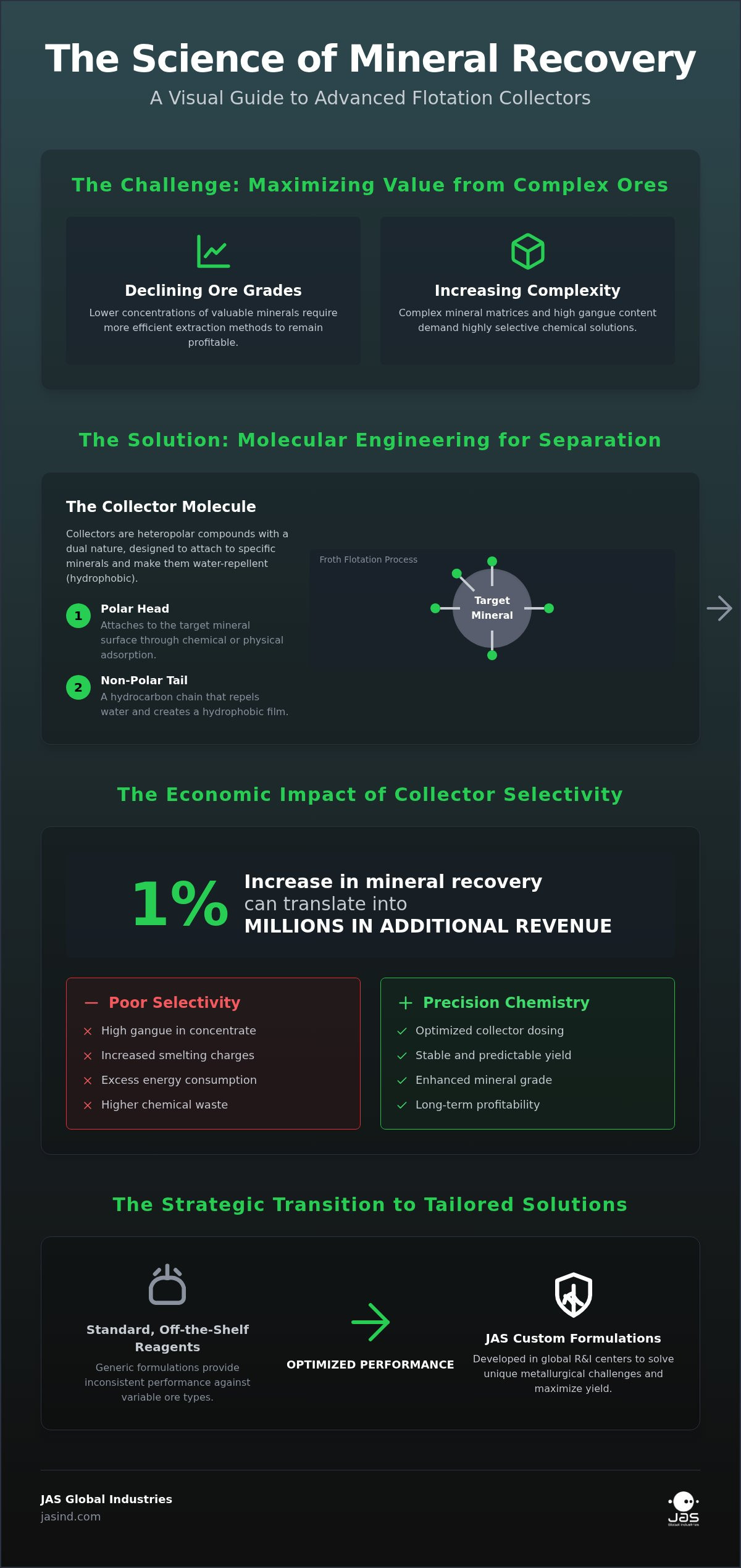
Mining Flotation Collectors are heteropolar organic compounds. They are essential to the froth flotation process. These chemicals possess a dual nature: a polar "head" that attaches to the mineral and a non-polar "tail" that repels water. This molecular design is the foundation of selective attachment. By making target minerals hydrophobic, collectors ensure that valuable materials rise with air bubbles while waste rock stays submerged. This process isn't just about chemistry; it's about the precision of surface transformation.
In an era of declining ore grades, these reagents are more than just processing aids. They are instruments of global resource security. Efficient recovery ensures that we maximize the output of every ton of earth moved. This reduces the need for excessive land disturbance and secures the supply of critical minerals needed for modern infrastructure. When we optimize the performance of Mining Flotation Collectors, we aren't just improving a plant; we're protecting the stability of global resources.
The Role of Collectors in the Flotation Circuit
Collectors act as the vital bridge between the mineral surface and the air bubble. Without this chemical modification, most minerals would remain wetted and sink. In the primary recovery stage, the goal is high mass pull to capture as much value as possible. During selective cleaning stages, the chemistry must be even more precise to reject entrained gangue. Because the collector determines which particles exit the cell as product, its performance defines the efficiency of the entire processing plant. It's the heart of the circuit.
Economic Impact of Collector Selectivity
The financial stakes are immense. In large-scale operations, a mere 1% increase in mineral recovery can translate into millions of dollars in additional annual revenue. Conversely, poor selectivity creates a cascade of costs. High gangue content in the concentrate increases smelting charges and consumes excess energy during downstream processing. It's a heavy burden on the bottom line.
Precision chemistry reduces chemical waste. Optimized dosing leads to operational reliability and predictable plant performance. When Mining Flotation Collectors are perfectly matched to the specific ore matrix, the plant achieves a stable yield. This stability is the bedrock of long-term profitability. It transforms mining from a struggle against complex mineralogy into a controlled, industrial success that benefits the entire value chain.
The Chemistry of Flotation: How Collectors Transform Mineral Surfaces
The molecular architecture of Mining Flotation Collectors determines their ability to transform mineral surfaces. Every collector molecule is built from two distinct parts: a polar "head" group and a non-polar hydrocarbon "tail." The polar head serves as the anchor; it possesses a high affinity for specific mineral surfaces. Once this head attaches, the non-polar tail extends into the aqueous phase. This orientation creates a thin, hydrophobic film that repels water and attracts air bubbles. It's this precise orientation that allows minerals to defy gravity and rise to the surface.
Adsorption is the physical and chemical mechanism that drives this transformation. It occurs in two primary forms: physical and chemical. Physical adsorption relies on electrostatic forces or van der Waals interactions. It's often reversible and less selective. In contrast, chemical adsorption, or chemisorption, involves a true chemical reaction between the collector and the mineral surface. This creates a robust, permanent bond. Effective Mining Flotation Collectors rely on this chemical bond to withstand the turbulent conditions within the flotation cell. Chemisorption is the preferred pathway for high-selectivity operations where mineral purity is paramount.
Anionic Collectors: Oxides and Sulfides
Anionic collectors carry a negative charge in their polar group. They are the most widely used reagents in the industry. Xanthates and dithiophosphates are the standard for sulfide minerals like copper, lead, and zinc. These chemicals react with the metal ions on the mineral surface to form insoluble metal-collector complexes. Beyond sulfides, fatty acid collectors play a critical role in phosphate mining chemicals and other oxide ore applications. Their ability to selectively coat non-sulfide minerals is essential for producing high-grade concentrates in complex geological environments.
Cationic Collectors: Silicates and Amines
Cationic collectors utilize a positively charged polar group, typically based on amine chemistry. Their primary application is the flotation of silicates and oxides that carry a negative surface charge. In the iron ore industry, amines are frequently used in reverse flotation to lift silica away from the valuable hematite or magnetite. They also prove indispensable in potash and feldspar processing. However, managing cationic reagents requires strict control. They are highly sensitive to pH levels and can cause over-frothing if not dosed with precision. Balancing these factors is a technical challenge that defines modern mineral processing.
Understanding these chemical nuances is the first step toward process optimization. For operations facing inconsistent recovery, a professional technical audit of your chemical suite can identify the precise molecular adjustments needed to restore stability and maximize yield.
Selecting the Best Collector for Complex Ore Matrices
Success in mineral beneficiation begins long before the first bubble forms. Effective ore characterization is the foundational step. You must map the mineralogy, grain size, and texture of the deposit to understand the chemical requirements. Standard, off-the-shelf reagents often fail when applied to modern, low-grade deposits. These generic options lack the precision needed to navigate complex mineral associations. They can't distinguish between valuable minerals and stubborn gangue in a way that maximizes yield. Using a mismatched reagent isn't just inefficient; it's a risk to the entire project's viability.
Tailor-made formulations are the industry's answer to this complexity. Specialized R&I centers allow for the development of chemistry that's specific to a single ore body. This bespoke approach ensures that Mining Flotation Collectors are optimized for the unique water chemistry and mineral matrix of a specific site. Beyond collector selection, you must balance collector strength with frother compatibility. If the collector is too aggressive, it can disrupt froth kinetics. This leads to poor drainage and lower concentrate grades. Achieving this equilibrium is essential for operational stability and long-term resource protection.
Flotation Techniques for Feldspar and Fluorspar
Separating feldspar from quartz is a classic technical challenge. It requires specialized cationic collectors and precise pH control to ensure the reagents attach only to the feldspar. In fluorspar operations, the goal is often to achieve acid-spar specifications. This requires a calcium fluoride content of over 97%. Reaching this level of purity is difficult in fluorspar-calcite-barite ores because these minerals share similar surface properties. Customizing Mining Flotation Collectors for these specific matrices allows for higher selectivity. It ensures that calcite and barite are rejected, protecting the final product's value and marketability.
Optimizing Recovery in Potash and Phosphate Mining
Potash circuits present a unique environment. Soluble salt flotation occurs in saturated brines where high density affects chemical kinetics. Standard reagents often struggle in these conditions. Similarly, phosphate beneficiation relies on anionic collectors to lift valuable minerals away from silica. A major pain point in these circuits is the presence of slimes and impurities. Custom formulations are designed to mitigate these effects. They prevent the "slime coating" of valuable particles. This ensures the collector can still reach the mineral surface. This targeted chemistry is a vital part of a broader mineral security strategy, ensuring that even challenging deposits remain viable and productive.
Operational Best Practices: Dosing and Troubleshooting
Precision in the plant is just as critical as the chemistry in the drum. Even the most advanced Mining Flotation Collectors will underperform if the application parameters are neglected. Conditioning time is the first variable to master. Adsorption is a kinetic process; it isn't instantaneous. You must allow sufficient agitation time for the collector molecules to find and bond with the target mineral surfaces. Inadequate conditioning leads to bypassed minerals, while excessive agitation can strip the collector film through mechanical attrition.
Physical variables like pulp density and slurry temperature also dictate chemical kinetics. High pulp density increases the probability of bubble-particle collisions but can also lead to non-selective entrainment. Conversely, temperature fluctuations—common in high-altitude or desert operations—alter the solubility and viscosity of reagents. Cold water typically slows down adsorption rates, requiring either longer conditioning times or the introduction of promoters to maintain throughput. Reliability depends on accounting for these environmental shifts.
Screening new reagents requires a systematic approach. Follow these steps for an effective laboratory flotation test:
- Sample Preparation: Use a representative ore sample that matches current plant feed mineralogy.
- Baseline Establishment: Run a standard test with current reagents to set a performance benchmark.
- Systematic Dosing: Introduce the new collector in incremental stages to identify the saturation point.
- Kinetic Monitoring: Record recovery at specific time intervals (e.g., 1, 2, 4, and 8 minutes) to plot a recovery curve.
- Assay and Analysis: Evaluate both grade and recovery to determine the "optimum" rather than just the "maximum" dosage.
It's vital to identify the signs of "over-collecting." When you exceed the optimal dosage, the collector begins to coat gangue minerals or creates an overly stable froth. This results in a collapse of selectivity. You'll see high recovery numbers, but the concentrate grade will plummet as waste material is pulled into the launder. Achieving the right balance is the only way to protect your plant's profitability.
Managing Water Chemistry and Salinity
Dissolved ions like calcium and magnesium can interfere with anionic collectors, essentially "consuming" the reagent before it reaches the mineral. This is particularly challenging in operations using seawater or recycled process water. High salinity alters the surface charge of the minerals and affects bubble coalescence. In these environments, using water treatment chemicals to pre-condition the feed is a strategic necessity. It ensures that the Mining Flotation Collectors can function in a stable, predictable environment regardless of water source fluctuations.
Troubleshooting Low Grade or Recovery
When performance dips, you must diagnose the root cause systematically. Is the problem the chemistry, or is it the grind size? If recovery is low but the grade is high, you may need a stronger collector or a secondary promoter to enhance kinetics. If the grade is low, check your pH. Adjusting the pH allows you to optimize the Zero Point of Charge (ZPC), ensuring the mineral surface is receptive to the collector's polar head. For operations struggling with inconsistent yields, requesting a professional technical audit can provide the data-driven insights needed to restore operational stability.
JAS Global Industries: Advanced Flotation Solutions for Global Mining
Since 1998, JAS Global Industries has operated at the intersection of industrial chemistry and global resource security. We don't view ourselves as a mere chemical supplier. We are a vital global guardian of the world's most critical mineral assets. Our mission is built on the belief that efficient resource extraction is fundamental to modern infrastructure and sustainability. By providing high-performance Mining Flotation Collectors, we ensure that mining operations remain viable even as ore bodies become increasingly complex and low-grade.
Our global footprint provides the stability your operations require. Headquartered in Dubai, we maintain a robust presence across Europe, Asia, and Africa. This extensive manufacturing and logistics network ensures that our mining solutions reach your site without delay. In an industry where downtime is measured in millions of dollars, we prioritize reliability and long-term partnership over simple transactional logistics. We protect your supply chain so you can protect your yield.
Tailor-Made Formulations and Technical Audits
Success in the flotation circuit requires more than a standard reagent. It requires a precise molecular match. JAS Global Industries specializes in developing tailor-made formulations within our specialized R&I centers. We recognize that every ore body is unique. Our technical teams conduct comprehensive on-site audits to identify hidden bottlenecks in your process. We don't guess; we measure.
Our technical consulting services go beyond chemical dosing. We provide on-site laboratory testing and operational troubleshooting to ensure your Mining Flotation Collectors perform at peak efficiency. This includes:
- Identifying the optimal collector-frother-depressant balance.
- Optimizing dosing strategies to reduce chemical waste and environmental impact.
- Providing real-time troubleshooting for fluctuating water chemistry or ore mineralogy.
- Conducting metallurgical audits to maximize grade and recovery simultaneously.
A Strategic Partnership for Resource Security
We move our partners from bulk chemical supply to long-term operational stability. This transition is essential for navigating the regulatory and economic pressures of modern mining. We ensure safety and stability in every aspect of chemical logistics, from the manufacturing plant to the conditioning tank. Our commitment to excellence is rooted in our corporate history and our vision for a more sustainable industrial future.
Your flotation circuit is the heart of your plant's profitability. Don't leave its performance to chance. Contact JAS Global Industries today for a comprehensive technical evaluation of your circuit. Let's work together to secure your resources and optimize your recovery for the long term.
Securing the Future of Global Mineral Extraction
The path to sustainable mineral recovery requires a shift from generic reagents to strategic chemical assets. We've explored how molecular precision transforms mineral surfaces and why bespoke chemistry is essential for complex deposits. High-performance Mining Flotation Collectors serve as the foundation of this process, providing the selectivity required to maximize yield while minimizing chemical waste. Operational success depends on this balance of science and strategy.
JAS Global Industries stands as your dedicated partner in this mission. Through expert technical audits for plant efficiency and custom formulations for complex ores, we ensure your operation remains a pillar of global resource security. Our global manufacturing footprint and R&I support provide the reliability you need to thrive in an increasingly volatile market. We don't just supply chemicals; we protect your long-term operational stability and profitability.
Optimize your mineral recovery with JAS Global specialized mining solutions
Your recovery rates define your success and your impact on the global supply chain. Let's build a more stable, productive, and responsible future together.
Frequently Asked Questions
What is the difference between a flotation collector and a frother?
Collectors make target minerals hydrophobic to ensure they attach to air bubbles. Frothers stabilize those bubbles to create a durable froth layer on the slurry surface. While collectors are responsible for the selective attachment of minerals, frothers manage the transport and stability of the mineralized bubbles. Without collectors, minerals don't stick; without frothers, bubbles burst before they can be skimmed from the cell.
How do I choose between anionic and cationic collectors for my ore?
Selection depends on the surface charge of your target mineral. Anionic collectors carry a negative charge and are typically used for sulfide minerals and certain oxides like phosphate. Cationic collectors have a positive charge and are preferred for silicates, potash, and feldspar. The choice is determined by the mineral's Zero Point of Charge and the specific selectivity requirements of your mineral processing circuit.
Can water salinity affect the efficiency of my flotation collectors?
Yes, salinity significantly impacts collector efficiency. High concentrations of dissolved ions can compete for adsorption sites or cause collectors to precipitate before they reach the mineral. This is common in operations using seawater or recycled process water. JAS Global Industries addresses this by integrating water treatment chemicals with specialized Mining Flotation Collectors to ensure chemical stability and recovery in high-salinity environments.
What are the risks of using too much collector in a flotation circuit?
Over-dosing leads to "over-collecting," where the reagent begins to coat gangue minerals. This destroys selectivity and results in a high-recovery but low-grade concentrate. Additionally, excess collector can interfere with frother performance, leading to an unstable or overly voluminous froth that is difficult to handle. This increases chemical waste and reduces plant profitability while complicating downstream processing and smelting costs.
How does pH level influence collector adsorption on mineral surfaces?
pH level is a primary control variable because it determines the surface charge of minerals in the slurry. By adjusting pH, operators can reach the optimal window for collector adsorption, known as the Zero Point of Charge. If the pH is too high or too low for a specific mineral, the collector molecules may be repelled from the surface, causing a total failure of the flotation process.
Why is conditioning time critical for collector performance?
Conditioning time allows collector molecules to disperse through the slurry and chemically bond with mineral surfaces. Adsorption is a time-dependent reaction. If the time is too short, minerals won't become sufficiently hydrophobic. If it's too long, mechanical agitation might strip the hydrophobic film away. Finding the precise balance ensures maximum recovery and consistent grade by allowing for stable bubble-particle attachment.
What are tailor-made flotation formulations and when are they needed?
These are bespoke chemical blends developed in specialized R&I centers to match a specific ore body's mineralogy and water chemistry. Generic reagents often struggle with complex or low-grade ores. JAS Global Industries uses on-site technical audits and laboratory testing to design these custom Mining Flotation Collectors. They are essential when standard chemicals fail to achieve grade or recovery targets in difficult geological matrices.
How do collectors impact the environmental management of tailings?
Collectors affect the surface properties of waste rock, which influences how tailings settle and dewater. High-selectivity collectors ensure that fewer reagents end up in the tailings stream, reducing environmental toxicity. By optimizing dosing, mining operations can improve the performance of downstream flocculants. This leads to clearer process water for recycling and more stable tailings storage facilities, supporting a broader mission of resource protection.