
The most expensive chemical in your desalination plant isn't the one with the highest price tag; it's the one that fails to prevent irreversible membrane scaling. Every liter of fresh water produced through desalination represents a victory for global resource stability. However, when mineral deposits begin to choke your systems, that victory becomes a costly battle against rising energy bills and premature equipment failure. You likely recognize the constant pressure to balance chemical dosing costs with the need for high recovery rates. It's a delicate equilibrium where a single miscalculation leads to expensive membrane replacements and unplanned downtime.
By mastering the technical selection and operational application of a specialized SWRO Antiscalant, you can transform these operational pains into predictable reliability. This article promises to guide you through optimizing your desalination efficiency, extending membrane life, and reducing the frequency of intensive CIP cycles. We'll explore the critical parameters for choosing the right formulations. We will also examine how the latest digital dosing trends and NSF 60-2026 standards are shaping the future of industrial water security, ensuring the protection of critical resources and the stability of modern infrastructure.
Key Takeaways
- Identify why seawater’s high ionic strength requires specialized chemical intervention to prevent the onset of mineral precipitation.
- Understand the mechanisms of threshold inhibition and crystal distortion that keep sparingly soluble salts in solution and protect membrane morphology.
- Master the technical selection of an SWRO Antiscalant by analyzing feed water profiles to ensure total compatibility with membrane polymers.
- Optimize operational reliability through precise dosing strategies and critical injection point placement before cartridge filtration.
- Leverage custom formulations and technical consultancy to extend membrane lifespan and secure the stability of critical water resources.
The Critical Role of Antiscalants in Seawater Reverse Osmosis (SWRO)
Seawater is a complex and volatile matrix. Its high ionic strength and fluctuating seasonal temperatures create an environment where mineral precipitation is an ever present threat. An The Critical Role of Antiscalants in Seawater Reverse Osmosis (SWRO) acts as a chemical barrier. It delays the onset of mineral precipitation. This delay is essential. Without it, dissolved minerals would crash out of solution as water passes through the membrane. This specialized chemical intervention allows plants to push recovery rates higher. It manages brine-side supersaturation that would otherwise lead to immediate system failure.
Seawater chemistry isn't static. Seasonal shifts in temperature change the solubility of various salts, making the feed water profile a moving target. A robust SWRO Antiscalant must adapt to these variables. It ensures that the transition from a liquid state to a solid crystal is suppressed long enough for the brine to exit the system safely. This protection is a form of strategic insurance for global water infrastructure. It balances the need for high water yield with the necessity of protecting expensive membrane assets.
Common Scale Types in Seawater Desalination
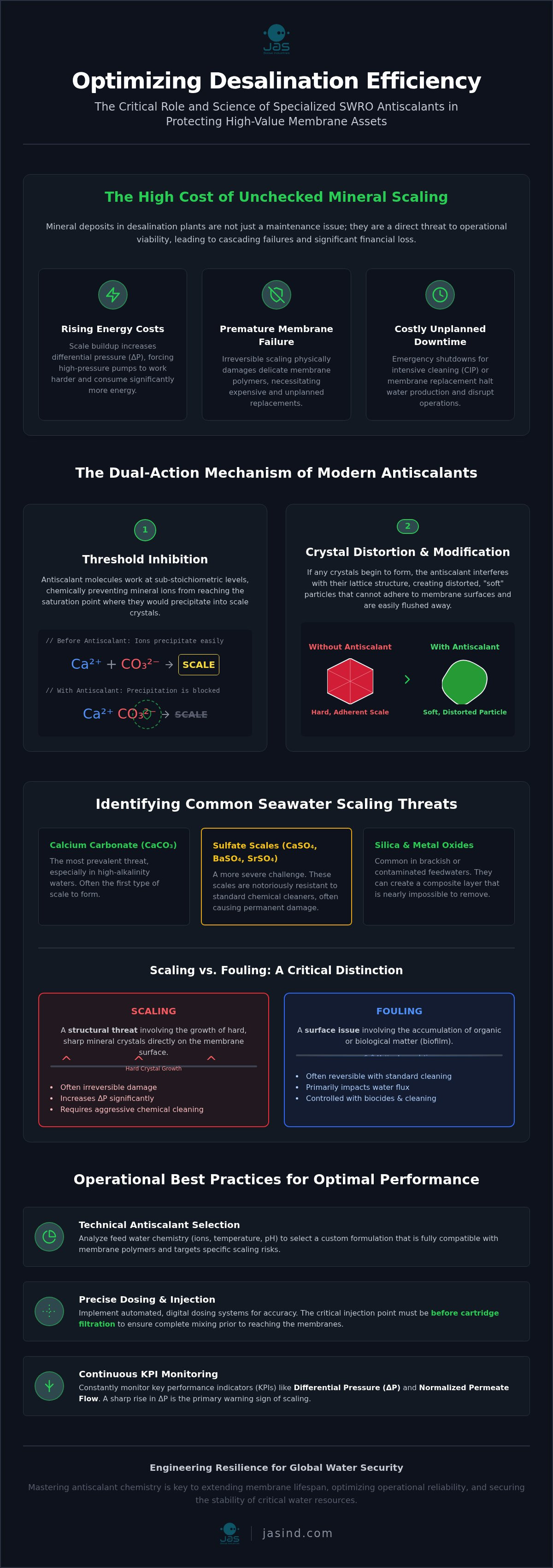
Calcium carbonate is the most prevalent threat in high-alkalinity waters. It's often the first scale to form. Sulfate scales, including calcium, barium, and strontium sulfates, present a more severe challenge. These minerals are notoriously resistant to standard chemical cleaners. Once they take hold, the damage is often permanent. In brackish or contaminated feed, operators must also manage silica and metal oxides. These complex foulants can bridge mineral scales, creating a composite layer that is nearly impossible to remove without damaging the delicate membrane polymer.
The Cost of Failure: Scaling vs. Fouling
Understanding the difference between fouling and scaling is vital for long-term asset protection. Fouling is often a reversible accumulation of organic or biological matter. Scaling is a structural threat. It involves the growth of hard mineral crystals directly on the membrane surface. Operators must identify the warning threshold before a significant flux decline occurs. A sharp rise in differential pressure (ΔP) serves as a primary indicator of trouble. This pressure increase carries a heavy energy penalty. It forces high-pressure pumps to work harder, significantly increasing the carbon footprint of the facility. Efficient chemical application aligns directly with broader industrial water treatment goals. It secures the longevity of the plant and ensures a stable supply of fresh water for society.
Chemical Mechanisms: How Modern Antiscalants Prevent Scale
The prevention of mineral scale is a battle won at the molecular level. Modern water treatment antiscalants don't rely on a single chemical reaction. Instead, they employ a sophisticated combination of threshold inhibition, crystal modification, and dispersion. These mechanisms ensure that seawater reverse osmosis remains viable even as recovery rates increase. By understanding these interactions, operators can move beyond simple dosing to true process optimization and asset security.
Threshold Inhibition Explained
The most efficient way to manage mineral precipitation is to prevent it before it starts. This is achieved through the 'Threshold Effect'. Threshold inhibition is the ability of an antiscalant to prevent precipitation at concentrations far below those required for sequestration. Unlike traditional chelating agents that require a one-to-one molecular ratio to bind minerals, a high-performance SWRO Antiscalant works at sub-stoichiometric levels. This efficiency drastically reduces the volume of chemicals required for large-scale plants. It lowers operational costs while minimizing the environmental footprint of the brine discharge, supporting the stability of global water resources.
Crystal Modification and Dispersion
Even when minerals begin to precipitate, modern formulations continue to protect the membrane through crystal distortion. The chemical agents interfere with the growth of the crystal lattice structure. Instead of forming hard, tenacious deposits, the minerals develop into distorted, 'soft' structures that cannot easily adhere to the membrane surface. This modification ensures that any solids formed are easily flushed out with the brine stream rather than choking the membrane pores.
The role of dispersants is equally critical in this process. These agents maintain a negative charge on the surface of particles, preventing them from agglomerating into larger, more damaging foulants. This process is deeply rooted in surfactant chemistry, where charge stabilization prevents colloidal fouling on the membrane surface. By combining different chemical families, engineers create a synergistic defense:
- Phosphonates: Provide superior threshold inhibition for calcium and sulfate scales.
- Polymeric Carboxylates: Offer excellent dispersion and crystal modification properties.
- Synergistic Blends: Balance these functions to handle varying seawater temperatures and salinities.
This multi-layered approach is central to The JAS Perspective: Engineering Resilience, focusing on long-term asset security and sustainable water production. For plants facing complex water profiles, consulting with technical experts for customized chemical formulations can prevent the transition from manageable fouling to catastrophic scaling.
Selecting the Optimal Antiscalant for Specific Water Profiles
Selecting the correct chemical profile is a technical imperative for any desalination facility. A generic solution often fails because it ignores the specific stressors of the local environment. Effective selection begins with a rigorous analysis of feed water parameters, specifically pH, temperature, and Total Dissolved Solids (TDS). These drivers dictate the saturation index of sparingly soluble salts. An SWRO Antiscalant must be precisely matched to these variables to prevent the onset of crystallization. Operators must also ensure membrane compatibility. Some chemical interactions between pre-treatment coagulants and antiscalants lead to irreversible fouling, compromising the very assets they're meant to protect.
High-Salinity Seawater vs. Brackish Water
Middle Eastern SWRO plants face some of the most challenging conditions on the planet. In regions like the Arabian Gulf, TDS levels frequently exceed 45,000 mg/L, and seawater temperatures swing dramatically between seasons. These factors create intense concentration factors on the brine side of the membrane. Standard formulations often lack the robust inhibition required for such extreme supersaturation. Engineering resilience in these environments requires tailor-made formulations developed in specialized R&I centers. These customized dosing strategies should be integrated into a broader chemicals management plan. This approach ensures the specific mineral profile of the local water is addressed, preventing the warning threshold of flux decline from ever being reached.
Environmental and Regulatory Considerations
The industry is currently undergoing a significant shift toward sustainable chemistry. Compliance with the latest NSF/ANSI/CAN 60-2026 standards is now a non-negotiable requirement for drinking water production. These standards ensure that chemicals added to the water supply don't introduce harmful contaminants. Beyond health standards, there's a growing focus on Antiscalant Biodegradability and Microbial Effects in marine ecosystems. Traditional phosphonates, while effective, are being scrutinized for their role in nutrient loading in coastal waters. In response, 2026 has seen an increased adoption of phosphorus-free and bio-based alternatives. These green antiscalants, derived from natural polymers like lignin or polysaccharides, offer a path toward high-recovery desalination that respects the delicate balance of the marine environment. By choosing biodegradable options, plants protect both their operational efficiency and their standing as responsible corporate citizens.
Operational Best Practices: Dosing, Monitoring, and KPIs
Operational excellence in desalination requires more than just high-quality chemicals. It demands precision in application. An SWRO Antiscalant is only as effective as the system delivering it. Finding the correct dosage is a delicate balance. Under-dosing leads to rapid, irreversible scaling. Over-dosing creates a different problem: chemical fouling. Excessive polymer can act as a bridge for organic matter, choking the membrane just as effectively as mineral scale. These operational risks demand a rigorous approach to system management and asset protection.
The injection point is a non-negotiable factor in chemical efficiency. Mixing must occur before the cartridge filters. This ensures the chemical is fully dispersed before it reaches the high-pressure pump and the RO vessels. Without adequate mixing time, localized concentration gradients can occur. This leaves sections of the membrane unprotected while others are over-exposed to chemical loading. Proper dispersion is the foundation of membrane security.
The Importance of Accurate Dosing Systems
Pump calibration is vital. Routine checks prevent cumulative errors that lead to system instability. Onsite laboratory staff should conduct regular real-time monitoring of antiscalant residuals in the brine stream. This data provides a direct feedback loop. It confirms that the chemical is present where it is needed most. Technical audits serve as an essential tool for refining industrial chemical application. These audits ensure that the dosing strategy evolves alongside changing feed water conditions, maintaining the stability of the entire desalination process.
Key Performance Indicators (KPIs) for Membrane Health
Monitoring specific data points allows operators to move from reactive maintenance to proactive asset protection. Normalized permeate flux and salt passage are standard metrics, but they often lag behind the actual onset of scaling. Normalized Differential Pressure (NDP) is the primary indicator of spacer blockage due to scaling. By tracking NDP trends, engineers can predict the need for preventative Cleaning-In-Place (CIP) cycles before permanent damage occurs. This level of monitoring should be integrated into a wider mining solutions or industrial water framework to ensure cross-sector reliability.
Performance decline demands forensic analysis. A membrane autopsy identifies the exact scale morphology, allowing for a more targeted chemical cleaning analysis. This forensic approach prevents the repetitive use of ineffective cleaners and extends the overall life of the membrane stack. To secure your plant’s future and optimize chemical consumption, consult with our technical specialists for a comprehensive process audit.
The JAS Perspective: Engineering Resilience for Global Desalination
Reliability in industrial water treatment isn't a commodity; it's a legacy. JAS Global Industries has operated as a vital guardian of industrial infrastructure since 1998. We understand that a high-performance SWRO Antiscalant is more than a chemical additive. It is a foundational component of global resource security. Our mission transcends the simple transaction of chemicals. We serve as an indispensable pillar for modern infrastructure, ensuring that the world's most critical desalination plants maintain stability and efficiency in the face of increasing water scarcity.
Our approach centers on technical consultancy rather than bulk sales. We recognize that every seawater profile is unique, demanding a level of precision that off-the-shelf products cannot provide. By positioning ourselves as technical partners, we focus on process optimization that maximizes water yield while protecting the long-term integrity of the membrane assets. This commitment to engineering resilience ensures that our partners can navigate the complexities of modern desalination with absolute confidence.
Bespoke Formulations for Complex Water Profiles
Our Dubai headquarters serves as a strategic hub for desalination innovation. This location provides us with a front-row seat to the most challenging high-salinity environments in the Middle East and Africa. We leverage this expertise to develop specialized Water Treatment Antiscalants that address the specific stressors of the GCC region. Our global R&I centers focus on tailor-made formulations, ensuring that each chemical solution is calibrated for the local pH, temperature, and mineral saturation index.
Through our technical partnerships, we have optimized the performance of large-scale SWRO facilities across the region. These collaborations move beyond the limitations of generic dosing. By conducting rigorous site-specific analysis, we help operators manage brine-side supersaturation and prevent the transition to irreversible scaling. This long-term technical partnership is essential for maintaining the operational reliability of critical infrastructure.
Securing the Future of Industrial Water
Innovation is the primary driver of sustainability in the desalination sector. As we move through 2026, we are aligning our chemical strategies with the latest NSF/ANSI/CAN 60-2026 standards. This ensures that our solutions meet the highest health and environmental requirements for drinking water production. We are also focused on the broader human impact of our technical solutions, developing bio-based and phosphorus-free alternatives that reduce the carbon footprint of the desalination process.
The stability of global water resources depends on the continuous evolution of chemical technology. Our participation in global forums, such as the Innovation Driven Water Sustainability (IDWS) 2026 conference in Jeddah, reinforces our role as a leader in industrial water security. We invite you to secure your plant’s future by engaging with our specialists. Contact our technical team today for a comprehensive plant audit and discover how our specialized process optimization can maximize your operational yield.
Securing the Future of Global Water Infrastructure
The stability of modern infrastructure depends on the relentless optimization of its most critical resources. You've seen how the strategic selection of an SWRO Antiscalant transforms operational volatility into predictable reliability. By focusing on molecular-level mechanisms like threshold inhibition and maintaining rigorous monitoring of KPIs, plants can significantly extend membrane life. This technical precision doesn't just reduce costs; it safeguards the global supply of fresh water.
JAS Global Industries has been a trusted partner in this mission since 1998. We leverage our multiple Global R&I Centers to develop tailor-made industrial formulations that address the world's most challenging water chemistry. Our expertise ensures that your facility remains resilient, compliant with NSF 60-2026 standards, and optimized for maximum yield. Don't leave your critical assets to generic solutions. It's time to elevate your operational standards through specialized technical consulting and engineering excellence.
Optimize Your Desalination Plant with JAS Global Industries and secure the long-term performance of your water infrastructure. Together, we can build a more sustainable and reliable future for global desalination.
Frequently Asked Questions
What is the difference between an antiscalant and a dispersant in SWRO?
Antiscalants function primarily by delaying the nucleation of mineral salts through the threshold effect and crystal modification. Dispersants work by maintaining a negative surface charge on particles to prevent them from agglomerating or adhering to the membrane. While a high-quality SWRO Antiscalant often contains both properties in a synergistic blend, the primary goal is to keep minerals in solution rather than just managing suspended solids.
Can I use the same antiscalant for both brackish water and seawater RO?
Seawater and brackish water possess fundamentally different chemical stressors that require specific interventions. Seawater is defined by high ionic strength and significant sulfate levels, while brackish water often presents higher silica and carbonate risks. Using a generic chemical across both profiles usually results in sub-optimal performance. Custom formulations developed in global R&I centers ensure that the specific saturation indices of your feed water are addressed with precision.
How often should I calibrate my antiscalant dosing pumps?
Operators should calibrate dosing pumps at least once a month to account for mechanical wear or changes in fluid viscosity. However, relying solely on scheduled calibration is a risk to industrial security. Real-time monitoring of residuals in the brine stream provides a more immediate feedback loop. This proactive approach ensures that the dosing remains accurate between formal audits, protecting the membrane from both under-dosing and over-dosing.
What happens if I overdose antiscalant in my RO system?
Overdosing an antiscalant is just as damaging as under-dosing. Excessive polymeric concentrations can lead to chemical fouling, where the antiscalant itself precipitates or acts as a bridge for organic matter. This creates a dense, sticky layer on the membrane surface that is notoriously difficult to remove during CIP cycles. It results in a significant flux decline and increased differential pressure, mirroring the symptoms of the scaling it was meant to prevent.
Are SWRO antiscalants safe for drinking water production?
Specialized water treatment chemicals are safe for potable water production if they comply with the latest NSF/ANSI/CAN 60-2026 standards. These regulations set strict limits on impurities and chemical contaminants to ensure public health safety. JAS Global Industries prioritizes these standards in every tailor-made formulation, providing a secure foundation for municipal water supplies and industrial infrastructure across the Middle East, Africa, and beyond.
How do I determine if my membrane flux decline is caused by scaling or organic fouling?
Identifying the root cause of flux decline requires analyzing specific data trends over time. Scaling typically manifests as a sharp increase in Normalized Differential Pressure (NDP) because mineral crystals block the feed spacers. Organic fouling usually results in a more gradual decline in permeate flux and changes in salt passage. While data trends offer a strong indication, a membrane autopsy remains the only definitive method to identify the exact morphology of the deposits.
What are the environmental impacts of antiscalant discharge into the ocean?
Traditional phosphonate-based chemicals can contribute to nutrient loading in marine environments, potentially leading to algal blooms. To mitigate these risks, the industry is shifting toward phosphorus-free and biodegradable SWRO Antiscalant options. These green chemistry alternatives, often derived from natural polymers, offer high-performance scale inhibition while ensuring that brine discharge remains compatible with local marine ecosystems and global sustainability goals.
How does temperature affect the performance of SWRO antiscalants?
Temperature is a primary driver of mineral solubility and the kinetics of crystal growth. In high-temperature environments, the risk of calcium carbonate scaling increases significantly as solubility decreases with heat. Conversely, seasonal temperature drops can affect the viscosity of the chemical itself, impacting dosing accuracy. Technical consulting and process optimization are essential to adjust dosing strategies as seasonal temperatures fluctuate throughout the operating year.