
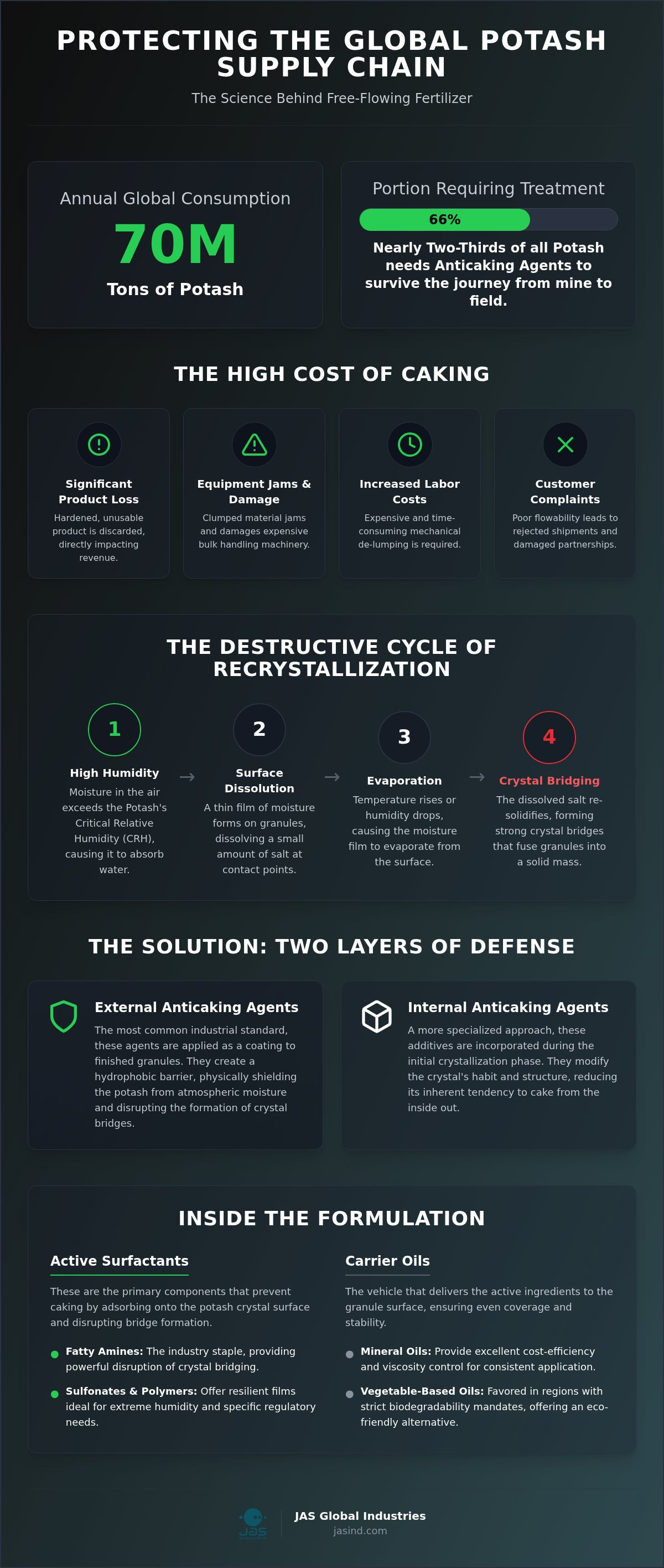
Nearly 66% of the 70 million tons of potash consumed annually requires specialized treatment to survive the journey from mine to field. Without the right Potash Anticaking Agents, the stability of this critical global resource is left to chance. This often results in hardened product that's impossible to spread. You've likely faced the frustration of granules fusing into a solid mass during high-humidity maritime transport or long-term storage. These lumps lead to significant product loss, expensive mechanical de-lumping, and legitimate customer complaints regarding poor flowability.
Maintaining the integrity of your supply chain requires more than just a generic coating. It demands a deep understanding of crystal kinetics. This article explores how advanced chemical formulations act as a vital guardian for your inventory, preventing the crystal bridging that compromises granule quality. We'll examine the science of surface-active agents, strategies for reducing dust during handling, and how custom-tailored dosing optimizes your chemical spend while ensuring free-flowing performance across global infrastructure. Discover how to protect your product and your reputation through superior chemical engineering.
Key Takeaways
- Understand the fundamental physics of crystal bridging and how it's possible for hygroscopicity to compromise Muriate of Potash.
- Evaluate the technical differences between internal and external Potash Anticaking Agents to select the most resilient barrier for your supply chain.
- Learn the operational benchmarks for dosing and application temperatures that prevent product loss without compromising granule flowability.
- Identify the specific risks that maritime transport and pile pressure pose to fertilizer quality in high-humidity regions.
- Explore how custom-engineered solutions and site-specific audits provide a reliable safeguard for global resource security.
Understanding the Mechanism of Caking in Potash Fertilizers
Caking isn't just a storage nuisance; it's a breakdown in the global supply chain. In potash fertilizers, this phenomenon involves the formation of inter-particle crystal bridges that fuse individual granules into a rigid mass. This physical transformation compromises operational reliability. When potash "clumps," the economic fallout is immediate. Bulk handling equipment jams, application rates become uneven, and end-users face the high cost of mechanical de-lumping. Product loss isn't the only concern. Poor flowability leads to customer dissatisfaction and rejected shipments, which can damage long-term partnerships. For a material that represents 22% of the global demand for an Anticaking agent, understanding the "why" behind this fusion is the first step toward resource security. Implementing effective Potash Anticaking Agents is essential to prevent these industrial bottlenecks.
Hygroscopicity and Critical Relative Humidity (CRH)
The stability of potash depends largely on its relationship with atmospheric moisture. Every grade of fertilizer has a Critical Relative Humidity (CRH), which is the specific threshold where the material begins to actively absorb water from the air. Muriate of Potash (MOP) and Sulfate of Potash (SOP) are naturally hygroscopic, though they react differently based on their chemical purity. When the ambient humidity exceeds the CRH, a thin film of moisture forms on the granule surface. This liquid layer dissolves a small amount of the salt at the contact points between particles. It's a microscopic process with massive industrial consequences. Maintaining flowability requires managing these moisture absorption points through precise chemical intervention that shields the surface from environmental flux.
The Process of Recrystallization
Temperature fluctuations during global transport trigger a destructive cycle of dissolution and recrystallization. As temperatures rise, the solubility of the potash increases, drawing in more moisture. When the environment cools or the humidity drops, the water evaporates. This forces the dissolved salts to re-solidify, creating solid bridges between the granules. This fusion effect turns free-flowing potash into impenetrable blocks. Without the protection of Potash Anticaking Agents, this cycle repeats throughout the journey from mine to farm. These specialized anti-caking agents are designed to disrupt bridge-forming kinetics. They ensure that even when moisture is present, the physical bond between granules remains weak, preserving the integrity of the product for the global market.
Evaluating Potash Anticaking Agents: Formulations and Functions
Potash isn't a monolith. Understanding Potash means recognizing its unique crystalline structure and the immense stresses it faces during global logistics. Selecting the right Potash Anticaking Agents requires a strategic choice between internal additives and external coatings. Internal treatments are incorporated during the crystallization phase to modify the crystal habit itself, reducing the inherent caking tendency. External treatments, the more common industrial standard, provide a protective barrier on the finished granule. These formulations act as a vital guardian against environmental moisture, ensuring the material retains its value from the mine to the farm.
The efficacy of these Potash Anticaking Agents depends on the synergy between active surfactants and carrier oils. Fatty amines remain a staple due to their powerful ability to disrupt crystal bridging. Sulfonates and polymer-based agents offer alternatives for specific environmental or regulatory needs, often providing a more resilient film in extreme humidity. The carrier oil serves as the vehicle for these active ingredients. Mineral oils offer excellent cost-efficiency and viscosity control, while vegetable-based carriers are increasingly favored in regions with strict biodegradability mandates. Formulators must ensure these oils remain stable under temperature flux to prevent oiling in the storage pile, which can lead to handling issues later in the supply chain.
Surface Tension Modification and Hydrophobicity
Hydrophobic coatings create a physical shield against moisture ingress. Surfactants within the formulation adsorb onto the potash crystal lattice, lowering the surface tension of any liquid film that forms on the granule surface. This prevents the wicking effect where moisture spreads between contact points. During long-term storage, the coating must withstand the immense pressure of high pile heights. A robust formulation maintains its integrity even under these compressive forces. This ensures the product remains free-flowing from the bottom of the pile to the top, protecting the investment of both producers and distributors.
Amine-Based vs. Amine-Free Formulations
Traditional amine treatments are measured by their amine number, which dictates their potency in disrupting crystal bridging. While highly effective, some global markets demand amine-free alternatives to meet specific safety or ecological standards. Selection depends on the final application and the specific mineralogy of the deposit. For example, technical grade potash used in industrial processes may require different chemical signatures than agricultural MOP. Modern R&I centers now develop tailor-made chemical technologies that balance these performance requirements with environmental responsibility. This strategic approach ensures that every shipment arrives in premium condition, regardless of the destination's climate or regulatory landscape.
Operational Best Practices for Dosing and Application
Operational reliability in fertilizer production hinges on the precision of chemical application. Implementing Potash Anticaking Agents isn't a "set and forget" process; it requires meticulous dosing control. Over-treatment leads to an "oily" final product that fouls downstream equipment and creates handling hazards. Conversely, under-treatment leaves granules vulnerable to the moisture-driven fusion discussed in previous sections. Achieving the balance between protection and process efficiency often starts with a foundational understanding of material handling, as described in the University of Idaho Fertilizer Primer. Maintaining optimal application temperatures is equally vital. Most agents must be heated to specific ranges, typically between 60°C and 80°C, to ensure the viscosity remains low enough for consistent spraying.
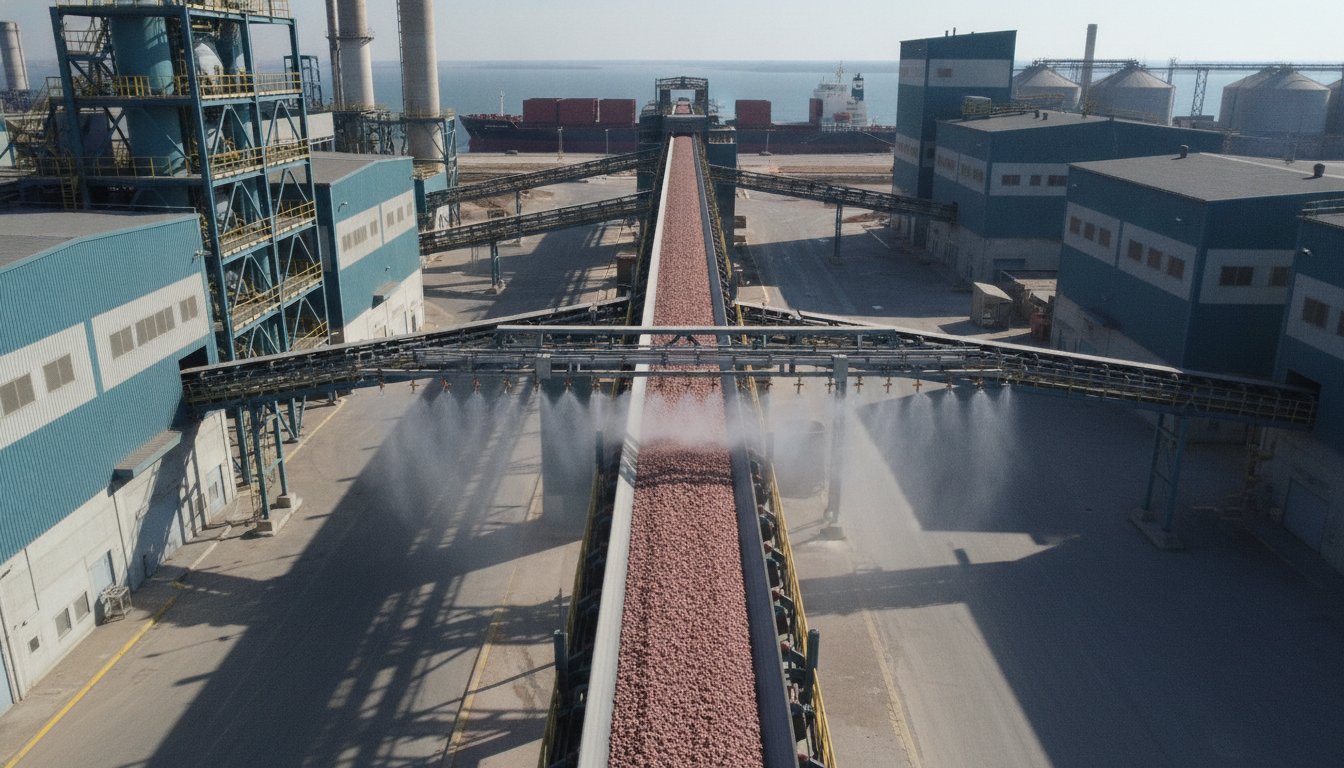
Strategic nozzle placement determines the success of the coating process. Spray systems should be positioned at points of maximum material agitation, such as coating drums or conveyor transfer points. This ensures that the falling curtain of potash granules receives immediate, even exposure to the chemical mist. Technical audits play a critical role here. By conducting site-specific evaluations, plant managers can refine dosing strategies to account for various environmental and material factors:
- Local ambient humidity and seasonal temperature fluctuations
- Specific ore mineralogy and impurity levels
- Expected storage duration and warehouse pile pressure
These audits transform a generic application into a tailor-made defense system for your inventory. They provide the necessary data to balance chemical costs with the absolute necessity of product stability.
Optimizing Spray Patterns and Coverage
Total surface coverage is the only way to prevent localized crystal bridging. High-pressure nozzles are essential for achieving fine atomization, which creates a cloud of micro-droplets that coat the complex geometry of every granule. If even a small percentage of the surface remains untreated, moisture wicking will occur at those vulnerable points. Monitoring coating efficiency through laboratory testing, such as the "accelerated caking test", provides the empirical data needed to adjust nozzle angles or pressure settings. Consistency is the hallmark of a world-class operation. It ensures that every ton of product leaving the facility meets the same high standards of flowability.
Managing Dust and Moisture Simultaneously
Modern industrial requirements demand multi-functional solutions. Dual-action Potash Anticaking Agents are now engineered to provide both moisture protection and dust suppression in a single application. This approach enhances mining safety by minimizing airborne particulates during transshipment. Integrating high-performance anti-dusting agents into the coating process protects worker health and reduces product loss. It's an efficient way to improve both flowability and environmental compliance without adding complexity to the production line. By addressing these two challenges at once, producers secure their product's value while honoring their responsibility to the workforce.
Logistics and Storage: Maintaining Flowability from Mine to Farm
The journey from a potash mine to a distant farm is a rigorous test of chemical stability. Global transport networks often involve multiple transshipment points in high-humidity regions where moisture ingress is nearly inevitable. Without robust Potash Anticaking Agents, the reliability of these critical shipments is at risk. These chemical additives are essential for ensuring that potash remains free-flowing at the port, allowing for efficient unloading and distribution. By preventing the formation of crystal bridges during transit, these agents extend the shelf life of both bagged and bulk fertilizers, protecting the product's value until it reaches the end-user.
Challenges of Long-Distance Maritime Transport
Bulk carriers experience a phenomenon known as "breathing" as they traverse different climate zones. As temperatures fluctuate between day and night, the air inside the holds expands and contracts, pulling in moist maritime air. This moisture condenses on the cargo, triggering the recrystallization cycles discussed earlier. High-performance coatings are a necessity for equatorial transit, where humidity levels are consistently extreme. Maintaining flowability is critical for rapid unloading at destination ports. If the potash has caked into a solid mass, the resulting delays and mechanical de-lumping costs can devastate the logistics budget and disrupt local agricultural schedules.
Bulk Storage Management and Pile Height
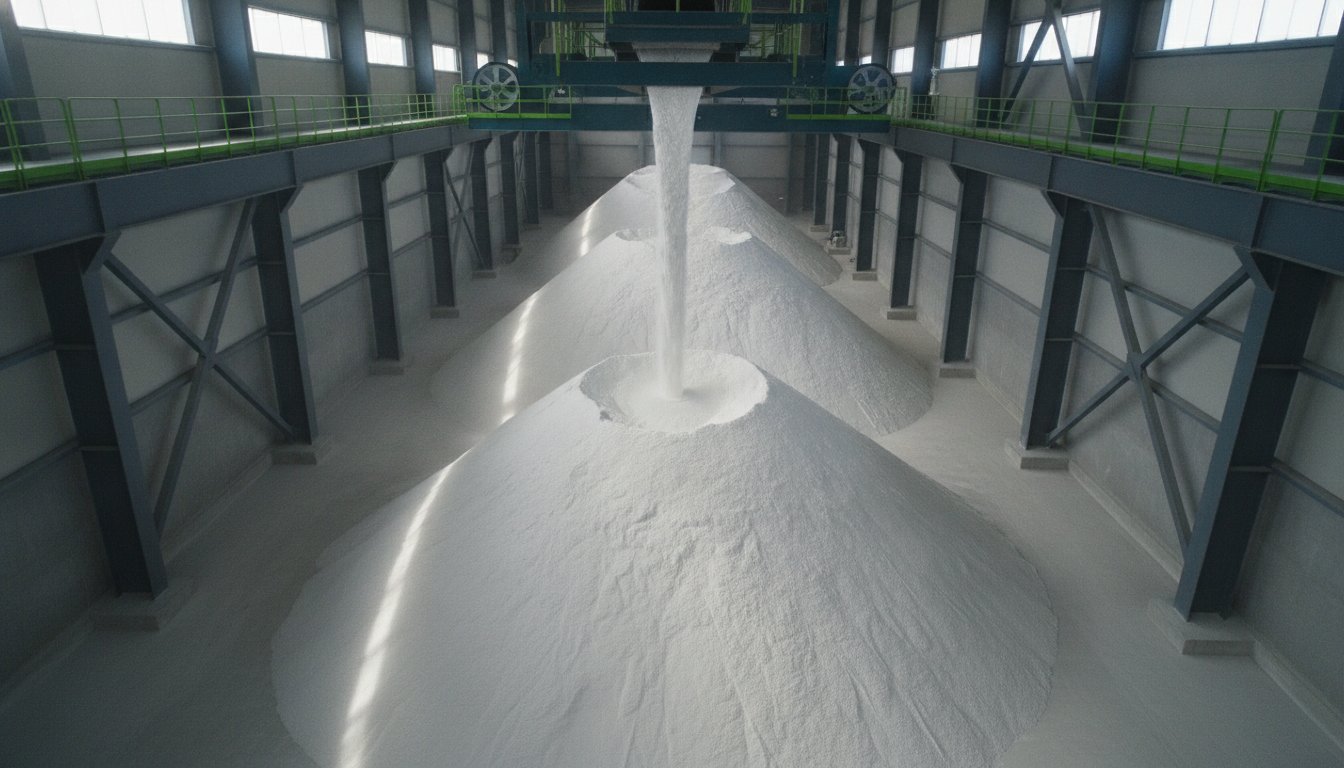
Pile pressure is a silent enemy of fertilizer quality. In large-scale warehouses, the sheer weight of the potash stack accelerates the formation of inter-particle crystal bridges at the bottom of the pile. Mechanical pressure forces granules together, making it easier for moisture to bridge the gaps. Producers use "crushing strength" tests to evaluate how well their Potash Anticaking Agents stand up to these compressive forces. This testing is a vital component of broader mining solutions designed to maintain mineral integrity throughout the handling process. A resilient coating ensures that even the material at the base of a thirty-meter pile remains easy to handle and spread.
Modern logistical demands have highlighted a significant gap in traditional treatment methods: the need to manage dust and caking simultaneously. During transshipment, airborne dust creates safety hazards and represents a tangible loss of product. Integrated formulations now provide dual protection, using a single application to suppress dust and prevent caking. This streamlined approach improves worker safety at the port while ensuring the material remains free-flowing for the farmer. Secure your global supply chain and protect your inventory by choosing specialized fertilizer anticaking agents that are engineered for the realities of global transport.
Strategic Protection: JAS Global Industries’ Tailor-Made Solutions
Operational reliability isn't a commodity; it's the result of precision engineering. Since 1998, JAS Global Industries has acted as a vital global guardian for the fertilizer industry. The brand recognizes that the stability of critical resources like potash is fundamental to global infrastructure. This approach moves beyond transactional supply. It focuses on long-term partnerships that prioritize the physical integrity of your product. By providing tailor-made Potash Anticaking Agents, the company ensures that your inventory remains a liquid asset, capable of traversing the most demanding global logistics networks without compromise.
Custom Formulations for Unique Mineral Profiles
Every potash deposit possesses a unique chemical signature. A "one-size-fits-all" approach often fails because it ignores the specific impurities and crystal structures of the ore. Generic agents might work in a laboratory, but they often break down under the real-world stresses of maritime transit and pile pressure described in previous sections. JAS Global’s multiple R&I centers specialize in developing climate-resilient formulations. Experts conduct exhaustive laboratory testing to match Fertilizer Anti-caking Agents to your specific mineral profile. This commitment to sustainable and cost-effective technologies ensures that you aren't just buying a chemical; you're investing in a solution engineered for your exact operational environment.
Global Reach and Technical Support
Headquartered in Dubai, JAS Global Industries maintains a global manufacturing and logistics presence. This allows the brand to serve the world's most critical mining and agricultural hubs with categorical precision. The service doesn't end at the factory gate. The team provides on-site technical audits to optimize dosing strategies and application efficiency. These audits are essential for reducing chemical waste and ensuring total surface coverage of granules. Every recurring supply contract is a commitment to your operational success. Technical consulting services provide the wisdom and experience needed to navigate evolving regulatory landscapes and environmental challenges. Secure your supply chain and protect your global reputation. Contact JAS Global Industries for a Technical Audit to discover how specialized Potash Anticaking Agents can optimize your production today.
Securing Global Resource Stability Through Advanced Chemistry
Maintaining the flowability of potash is more than a logistical challenge; it's an essential contribution to global food security and infrastructure stability. We've explored how the mechanism of crystal bridging is managed through precise surfactant chemistry and why site-specific audits are the only way to ensure long-term reliability. By addressing the unique mineral profiles of MOP and SOP, producers eliminate the high costs of mechanical de-lumping and product loss. It's about protecting value at every stage of the journey.
Since 1998, JAS Global Industries has served as a vital pillar in the mining and fertilizer sectors. Our R&I centers specialize in developing climate-resilient Potash Anticaking Agents that withstand the pressures of equatorial transit and bulk storage. With a global manufacturing and logistics footprint, we stand ready to optimize your process efficiency and operational reliability. Consult with our technical experts for a custom potash anti-caking strategy to protect your inventory from mine to farm. We look forward to helping you build a more resilient and efficient supply chain for the world's most critical minerals.
Frequently Asked Questions
What is the primary cause of caking in potash fertilizers?
The primary cause is the formation of inter-particle crystal bridges driven by hygroscopicity. When potash absorbs atmospheric moisture above its Critical Relative Humidity, a liquid film forms on the granule surface. This film dissolves surface salts. Subsequent drops in temperature or humidity cause this liquid to evaporate; this forces the salts to re-solidify into solid bridges between particles. This fusion process transforms free-flowing granules into large, impenetrable blocks that disrupt industrial handling equipment.
How much anti-caking agent is typically required per ton of potash?
Typical application rates range from 1.5 to 2.0 kilograms per metric ton of fertilizer. However, the exact dosage depends on the specific mineralogy of the potash deposit and the expected severity of the storage environment. Factors like particle size distribution and impurity levels also influence the required volume. JAS Global technical audits help producers refine these dosing strategies to avoid over-treatment while ensuring total surface coverage and operational reliability across the supply chain.
Can anti-caking agents also reduce dust during fertilizer handling?
Yes, many high-performance Potash Anticaking Agents are engineered with dual-action properties. These formulations include surfactants that modify surface tension to prevent caking while simultaneously acting as a binder for fine particulates. This single-application approach significantly reduces airborne dust during transshipment and bulk handling. It improves worker safety in mining and port environments while protecting the physical volume of the product from loss due to wind or mechanical agitation during transit.
Are these chemical additives safe for use in agricultural fertilizers?
These additives are specifically formulated to be compatible with soil health and agricultural standards. JAS Global Industries prioritizes sustainable chemical technologies that ensure the fertilizer remains effective without negatively impacting the environment. Our R&I centers develop agents that adhere to global safety regulations for agricultural inputs. These solutions provide the necessary protection for the granules during transport and storage; they maintain the essential nutrient delivery profile required by the end-user across global markets.
What is the difference between an anti-caking agent and a dust suppressant?
Anticaking agents are designed to disrupt the chemical and physical kinetics of crystal bridge formation between granules. Dust suppressants focus on increasing the cohesion of fine particles to prevent them from becoming airborne during handling. While they serve different primary functions, modern industrial needs often require integrated formulations. These multi-functional agents provide a comprehensive shield that maintains flowability and minimizes dust, ensuring both product quality and operational safety in a single treatment.
How do temperature changes affect the performance of potash coatings?
Temperature fluctuations trigger the "breathing" effect in bulk storage vessels and warehouses. As temperatures rise and fall, the solubility of the potash changes, which accelerates the cycle of dissolution and recrystallization. Effective coatings must remain chemically stable and physically intact during these thermal shifts. High-performance agents are designed to maintain their hydrophobic barrier even when exposed to the extreme temperature variations common during long-distance maritime transit through equatorial regions or high-humidity transshipment points.
Does JAS Global Industries provide custom chemical formulations for specific mines?
Yes, JAS Global Industries specializes in providing tailor-made chemical solutions developed in our dedicated R&I centers. We recognize that every mine has a unique mineral profile and specific impurity levels that a generic agent cannot address. Our technical team performs site-specific audits and laboratory testing to match our Potash Anticaking Agents to your specific crystal structure. This bespoke approach ensures maximum efficiency and protects the operational reliability of your global logistics network regardless of mineral complexity.
How long does the anti-caking effect last during bulk storage?
When applied with the correct dosing and temperature, the anti-caking effect is designed to last for several months of bulk storage. The coating remains resilient even under the immense mechanical pressure found at the base of high storage piles. This long-term stability is essential for maintaining the free-flowing properties of the potash from the initial production at the mine through to the final application by the farmer in a distant market, ensuring product integrity remains intact.