

A supplier can serve industry and still be the wrong fit for a particular job. If you searched for jasprim, you’re looking for PT Jasprim Dinamika Global, an Indonesian steel supplier. JAS Global Industries, by contrast, supplies specialty chemicals, including fertilizer anti-caking agents. Similar names can blur these distinctions, especially when procurement spans materials, process inputs, and logistics.
To choose the right supplier, start with the operational requirement: what input does the job need, and what must that input do? This guide separates the two company categories, then outlines practical criteria for assessing supply fit, including application, material form, process conditions, and continuity needs.
JAS Global Industries supplies fertilizer anti-caking agents for fertilizer handling and storage. These specialty chemicals support the movement of fertilizer granules through operations where caking can be a concern. They are not fertilizer products and are not a substitute for steel procurement. For chemical requirements, process fit matters as much as product category. Understanding that distinction helps you make an informed choice without treating different industrial offerings as interchangeable.
Key Takeaways
- jasprim refers to PT Jasprim Dinamika Global, an Indonesian steel supplier. Identify a supplier by its supply category, not by name alone.
- For an Indonesian steel project, assess grade, dimensions, applicable standards, documentation, and delivery coordination against the project requirements.
- Steel products and fertilizer anti-caking agents serve different operational needs and belong to separate procurement categories.
- Compare suppliers by specification fit, supporting evidence, technical support, supply continuity, and relevance to the wider process.
- Fertilizer producers managing caking and flowability may need specialty anti-caking chemistry, such as the agents supplied by JAS Global Industries.
What Does the JASPRIM Search Represent in Indonesia?
JASPRIM refers to PT Jasprim Dinamika Global, an Indonesian steel supplier. It is a company name, not a general category of industrial products. That distinction matters: a branded search can lead to one supplier even when a buyer’s actual need concerns a different material or production process.
Which company appears for the JASPRIM search?
PT Jasprim Dinamika Global describes itself as a steel supplier serving Indonesian customers, including shops and construction projects. Its company profile identifies locations in Jakarta and Tangerang. For buyers, this is a starting point for understanding the supplier’s category. Project requirements still determine whether a particular product is suitable.
If you’re sourcing steel, translate the project requirement into material specifications, dimensions, applicable standards, documentation, and delivery needs. Those details make it easier to assess whether the supplier’s stated product categories align with the purchase.
Why the search intent may not match every industrial buyer
A company-name search may mean someone wants to reach a supplier, review its profile, or understand what it sells. Other buyers may be researching a broader industrial requirement. The practical question is whether the supplier’s category matches the operational need.
Steel procurement and fertilizer process chemicals address different problems. Steel is a material input for construction and other industrial uses. Fertilizer anti-caking agents are specialty chemicals used in fertilizer processing and handling. They don’t provide fertilizer’s nutritional value and aren’t substitutes for structural or sheet steel. If fertilizer granules cake or flow poorly, the issue is in fertilizer handling, not steel sourcing.
This distinction reflects a wider supply-chain principle: matching an industrial supplier to the required input is one part of coordinating materials, processes, and delivery. Start with the problem the operation must solve, then identify the relevant input category. From there, assess fit through specifications, process conditions, documentation, technical support, and continuity of supply. This keeps the operational requirement, rather than a familiar company name, at the center of procurement.
The sections that follow apply this framework to steel sourcing in Indonesia, then distinguish that need from fertilizer anti-caking chemistry. PT Jasprim Dinamika Global and JAS Global Industries are separate companies. Their similar names do not indicate an affiliation.
How to Evaluate a Steel Supplier for an Indonesian Project
If your project requires steel, evaluate suppliers against the project documents rather than relying on a broad product list or company description. PT Jasprim Dinamika Global lists categories such as reinforcing steel and black steel plate. These examples point to the type of supply, while the project’s intended use and specifications determine the right product.
Match steel categories to the project specification
Before comparing suppliers, identify the exact material and requirements in the drawings, bill of materials, and procurement documents. A category name alone is not enough. Reinforcing steel and plate have different uses, and a product that sounds suitable may not meet the required grade or dimensions.
- Grade: Use the grade stated in the project documents. Don’t substitute based only on a general product description.
- Dimensions: Specify the required form and measurements, including length or thickness where relevant. Confirm that the dimensions in the purchase details match the project need.
- Applicable standards: Identify the standards required for the project and product. The International Trade Administration’s overview of Indonesian standards can help buyers evaluate a steel supplier in the context of the country’s standards framework. Confirm requirements against project documentation and applicable official guidance.
Assess supply information beyond a product list
A product listing helps establish what a company says it supplies. It doesn’t show, by itself, that a particular batch meets your project’s requirements. Compare the product description with the supporting quality documentation and purchase specification. Clear, consistent details reduce ambiguity before an order is placed and help project, procurement, and receiving teams work from the same requirements.
Use this checklist to structure the review:
- Documentation: Match the available material and quality records to the specified product and required standards.
- Stock visibility: Align the required category, grade, and dimensions with the purchasing schedule.
- Delivery coordination: Align quantities, delivery points, timing, and receiving arrangements with the project plan. Clear coordination helps reduce gaps between procurement and site needs.
For example, a request for “steel plate” leaves key questions open. Naming the required grade, dimensions, applicable standard, documentation, quantity, and delivery location creates a more precise basis for assessment. Apply the same discipline to a jasprim search: distinguish general product descriptions from evidence tied to your order. If your operational need is fertilizer handling rather than steel, explore fertilizer anti-caking chemistry as a separate process-chemical category.
JASPRIM Steel Supply vs Fertilizer Anti-Caking Chemistry
Industrial procurement starts with the problem to solve, not just a supplier name. JASPRIM is associated with steel supply, while fertilizer anti-caking agents belong to specialty chemical procurement. They serve different operational functions and require different evaluation criteria.
Steel is a physical material input for a project. Fertilizer anti-caking agents are process additives used to address handling and storage challenges in fertilizer operations. One category cannot substitute for the other.
| Buyer need | Input category | Relevant evaluation criteria |
|---|---|---|
| Steel for a construction or industrial project | Structural or other specified steel products | Project specification, steel category, grade, dimensions, applicable standards, documentation, and supply coordination |
| Managing caking or poor flow in fertilizer operations | Fertilizer anti-caking agent | Fertilizer formulation, process conditions, handling and storage requirements, application method, and fit with the wider production process |
When steel procurement is the actual requirement
PT Jasprim Dinamika Global is a steel supplier. For a steel purchase, use the project documents to define the product category and required specifications, then assess supporting documentation and delivery coordination against those needs. JAS Global Industries is a separate specialty chemical company, not a steel supplier. The similar names do not indicate an affiliation.
When fertilizer flowability is the operational concern
Fertilizer caking can create challenges in storage, conveying, and handling, affecting the movement of granules through an operation. An anti-caking agent is one possible process input, not a universal fix. Suitability depends on the fertilizer and production context. Formulation and process conditions matter, so assess how the additive fits the operation rather than assuming the same result in every application. For broader information about fertilizer systems and fertilizer anti-caking requirements, the International Fertilizer Development Center provides additional industry context.
JAS Global Industries supplies fertilizer anti-caking agents and develops tailored formulations for industrial partners. These are specialty chemical inputs, not fertilizer products. For more on the purpose and application context of these additives, see this resource on anti-caking agents.
What Buyers Should Compare Before Selecting an Industrial Supplier
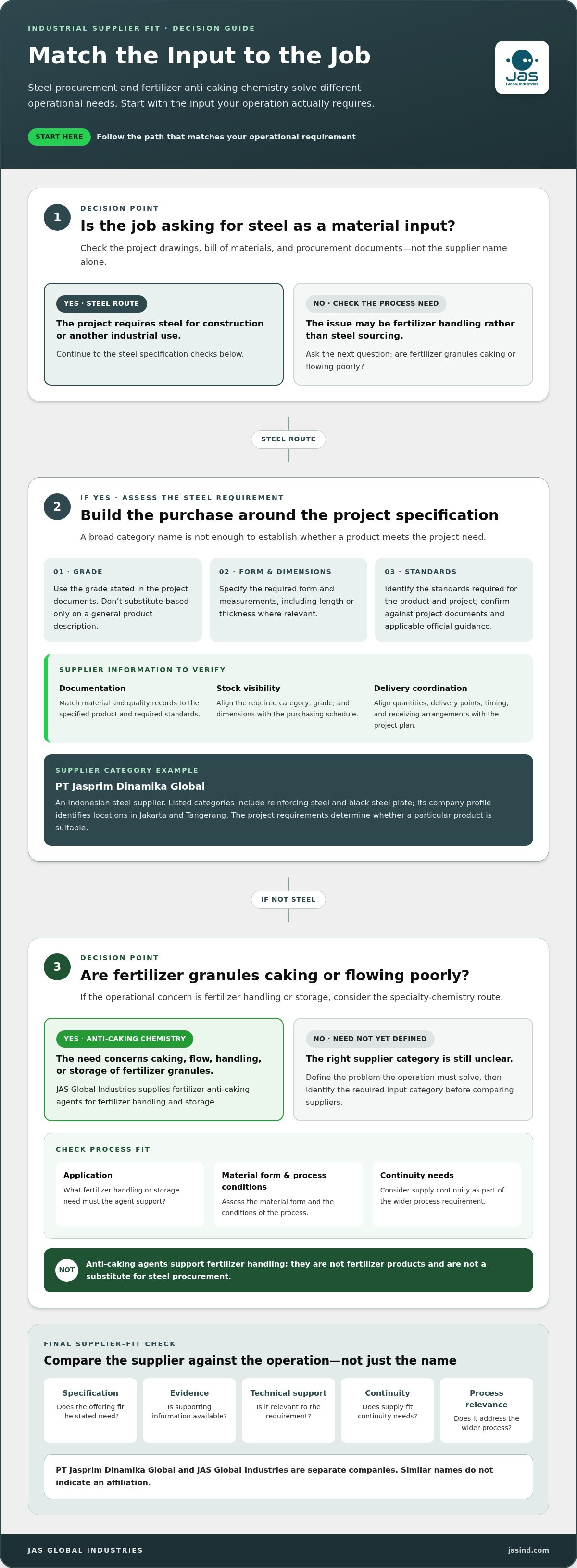
A useful comparison begins with the operational requirement, not a familiar supplier name. Jasprim may appear in a steel-supply search, but its relevance depends on whether the purchase is steel. Steel and process chemicals call for different specifications, evidence, and performance measures.
Let application fit lead the evaluation: choose the input that addresses the process need, then assess the supplier against the requirements for that input.
A practical supplier-fit sequence
- Define the requirement. Describe the material or process problem, where the input will be used, and what acceptance criteria matter. For steel, this could include project-defined grade and dimensions. For a process chemical, document the formulation and operating context, including where the additive enters the process and what outcome the operation needs to assess.
- Compare specifications and evidence. Set supplier information alongside the requirement. For steel, compare product descriptions and supporting documentation with project specifications and applicable standards. For chemicals, review technical information for relevance to the formulation and process. A broad product-category listing is a starting point, not evidence of fit for a particular application.
- Assess technical engagement and coordination. Consider whether the information and technical discussion address the application’s requirements. Then map supply coordination to operational needs, including order timing, delivery arrangements, and continuity requirements. Keep documented evidence separate from general claims about quality, stock, or support.
Questions that differ by procurement category
Use category-specific questions rather than applying one scorecard to unlike inputs. For steel procurement, check whether the proposed category, grade, dimensions, standards, and delivery arrangements align with the project documents.
For process chemicals, examine how formulation fit, dosing context, process conditions, and operational performance measures relate to the intended use. In fertilizer operations, define the caking or flowability concern and the conditions under which it occurs before assessing an anti-caking agent. JAS Global Industries develops tailored formulations for industrial partners, so technical process understanding can inform the assessment without treating a chemical additive as a universal solution.
Finally, compare overall process relevance, not just the input in isolation. A suitable material or additive must fit the operation’s handling, production, documentation, and supply needs. This keeps the decision grounded in evidence and helps distinguish a steel requirement from a specialty-chemical requirement. For fertilizer operations assessing anti-caking needs, explore fertilizer anti-caking solutions.
How JAS Global Supports Fertilizer Anti-Caking Requirements
Steel procurement and fertilizer process chemistry call for different expertise. If fertilizer granules cake or move inconsistently during handling, the requirement is a process input, not construction steel. JAS Global Industries supplies specialty chemicals, including fertilizer anti-caking agents, and develops chemical solutions for industrial applications. Its formulation decisions are grounded in the needs of the operation.
A formulation-led approach to fertilizer operations
Anti-caking requirements are application-specific. The fertilizer being handled, production process, and storage or transport conditions can all shape the problem a producer needs to address. A useful formulation discussion starts with the operational context and the performance measures the producer uses, rather than assuming one additive will suit every fertilizer or process.
JAS Global Industries develops tailored formulations for industrial partners and has research and innovation capabilities. Its formulation-led approach connects fertilizer characteristics, process conditions, and the buyer’s handling objectives so a specialty chemical can be evaluated for the actual application. Technical process understanding also helps clarify where an additive fits within wider production and handling practices, without treating it as a stand-alone solution to every flowability issue.
- Describe the issue: Identify where caking or flowability concerns arise in production, storage, or handling.
- Set the application context: Explain the fertilizer and relevant process conditions so formulation discussions reflect the intended use.
- Define evaluation measures: Use operational criteria to assess whether an anti-caking approach fits the process, rather than relying on broad claims or assumptions.
Explore JAS Global Industries fertilizer anti-caking solutions
Fertilizer anti-caking chemistry serves fertilizer operations. It is not an input for steel construction procurement, and it should be assessed against formulation fit and process needs rather than steel grades, dimensions, or project standards. This distinction also resolves potential confusion around jasprim: PT Jasprim Dinamika Global is a steel supplier, while JAS Global Industries supplies specialty chemicals. The names do not indicate an affiliation.
JAS Global Industries has served industrial sectors since 1998, with international experience and capabilities that include tailored formulations, research, and manufacturing. For fertilizer producers evaluating process-specific anti-caking needs, Explore JAS Global Industries’ specialty chemical solutions.
Make the Next Supply Decision With Confidence
Begin with the operational need. A search for jasprim points to an Indonesian steel supplier, while fertilizer anti-caking agents serve a separate process-chemical role. For steel, assess the project category, specifications, documentation, and delivery coordination. For fertilizer operations, focus on formulation fit and the process conditions affecting caking and flowability.
JAS Global Industries supports industrial partners with specialty chemicals, including fertilizer anti-caking agents. The company combines research capabilities with tailor-made formulations to support application-focused solutions. These are chemical inputs for fertilizer operations, not fertilizer products or steel supply.
If your requirement relates to fertilizer handling, explore JAS Global’s specialty chemical solutions to learn more about its anti-caking expertise. A clear understanding of the process need is a strong foundation for selecting the right input and making a more informed supply decision.
Frequently Asked Questions
What is JASPRIM?
JASPRIM refers to PT Jasprim Dinamika Global, an Indonesian steel supplier. It’s a company-specific search, not the name of a fertilizer anti-caking agent category. JAS Global Industries is a separate specialty chemical company that supplies fertilizer anti-caking agents. The two companies are not affiliated.
What products does PT Jasprim Dinamika Global list?
PT Jasprim Dinamika Global lists plain reinforcing steel, deformed reinforcing steel, and black steel plate. For a project, define the required steel category, grade, dimensions, and applicable standards using the project documents. Then compare product descriptions and supporting documentation against those requirements rather than relying on a category name alone.
Is JASPRIM a fertilizer anti-caking agent?
No. JASPRIM is a steel-supplier brand associated with PT Jasprim Dinamika Global. Fertilizer anti-caking agents are a separate category of specialty chemicals used in fertilizer operations to address handling and storage concerns. JAS Global Industries supplies fertilizer anti-caking agents as a separate company. Similar names don’t establish a business relationship or make steel and process chemicals interchangeable.
How do I compare industrial suppliers for a project?
Start by defining the application and the problem the input must solve, then match supplier information to the required specifications. For steel, compare category, grade, dimensions, applicable standards, documentation, and delivery coordination. For process chemicals, assess formulation fit, process conditions, technical information, and relevant operational measures. In both cases, distinguish evidence tied to the requirement from general supplier descriptions, and consider technical support and supply coordination.
What does a fertilizer anti-caking agent do?
A fertilizer anti-caking agent is intended to help manage granules sticking together during storage and handling, supporting product movement through relevant operations. Its role is process-related, not nutritional: it doesn’t supply fertilizer nutrients. The appropriate approach depends on the fertilizer formulation and application conditions. Review technical information for the specific use rather than assuming one agent will perform the same way in every operation.
How can fertilizer buyers evaluate an anti-caking solution?
Assess the fertilizer type, process conditions, storage and handling context, and the operational issue you want to address. Review technical evidence for relevance to that application, then define practical measures for evaluating fit, such as the handling or flowability objectives important to your operation. Discuss how the formulation relates to the process and how it will be used. Avoid assuming universal performance or savings across different fertilizers and conditions.