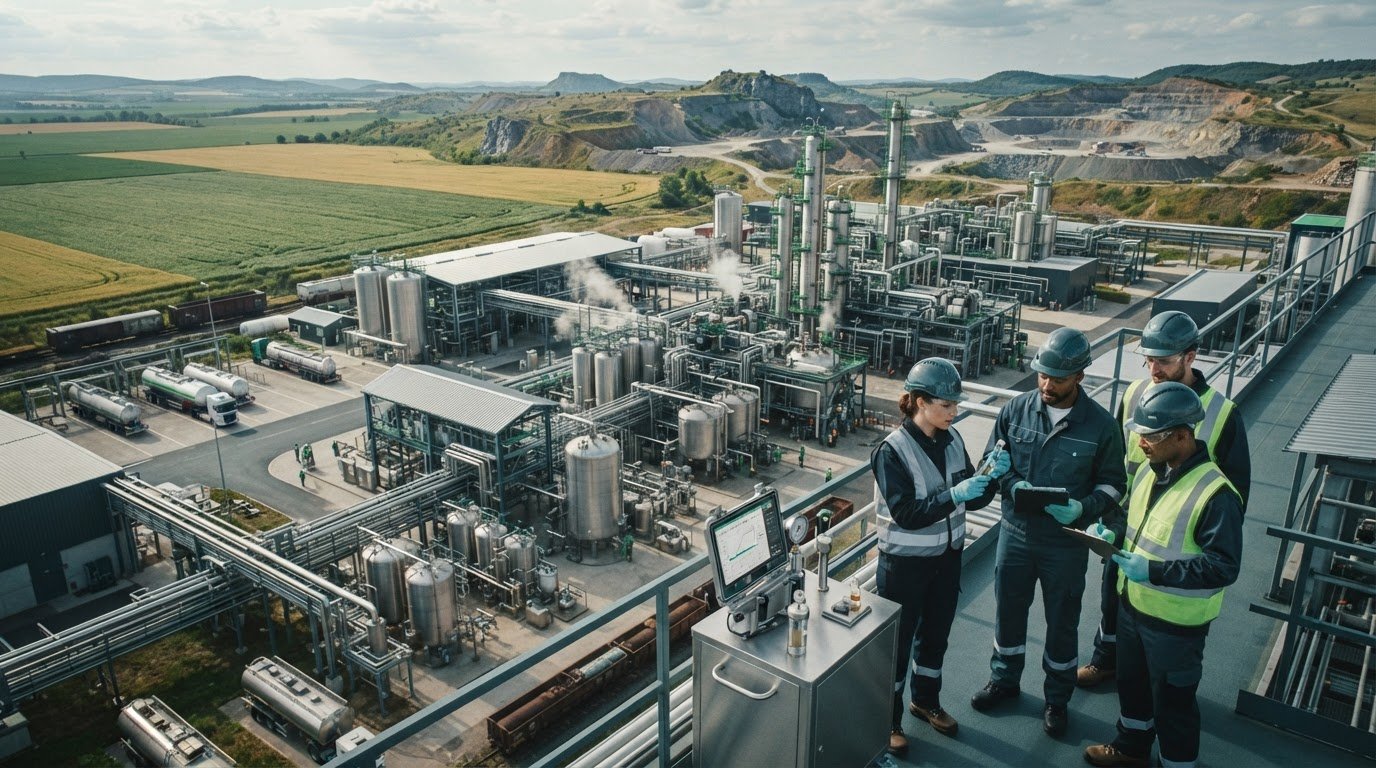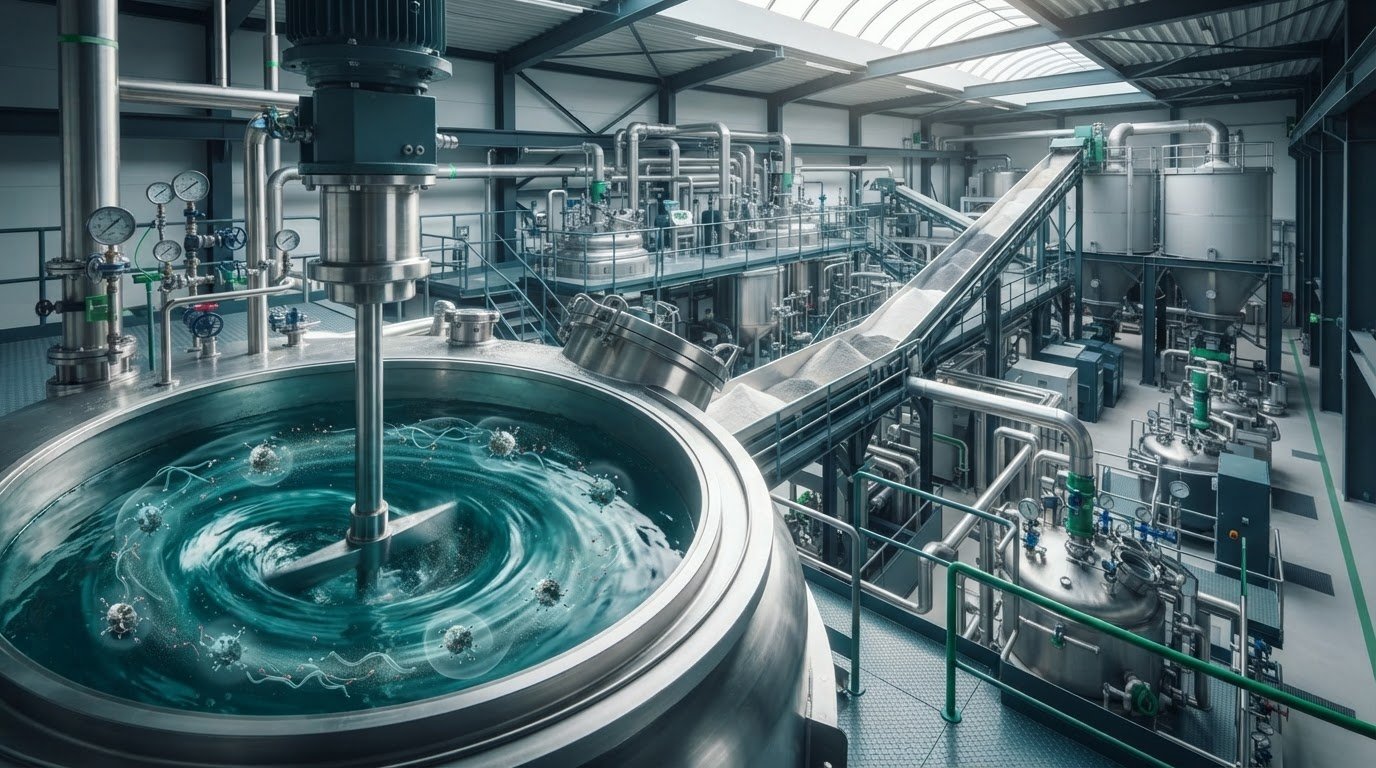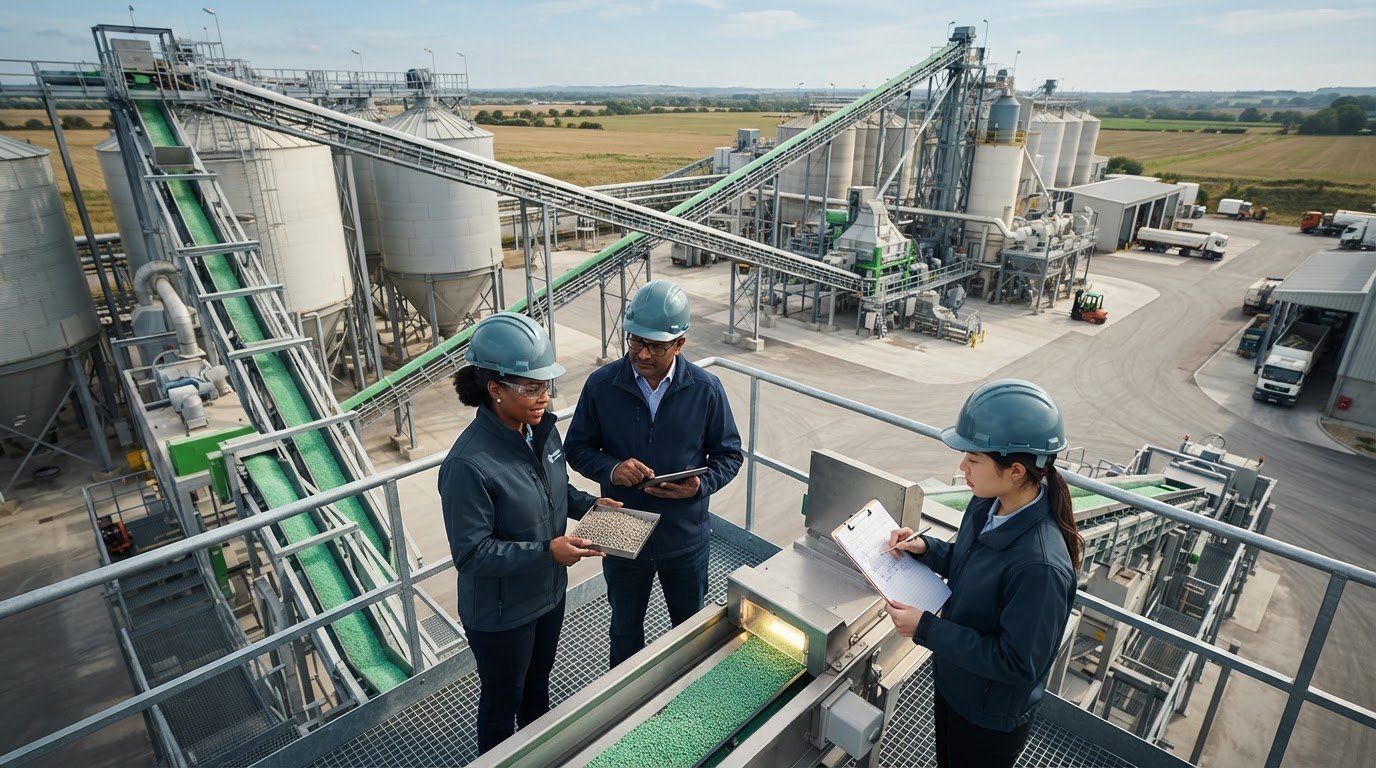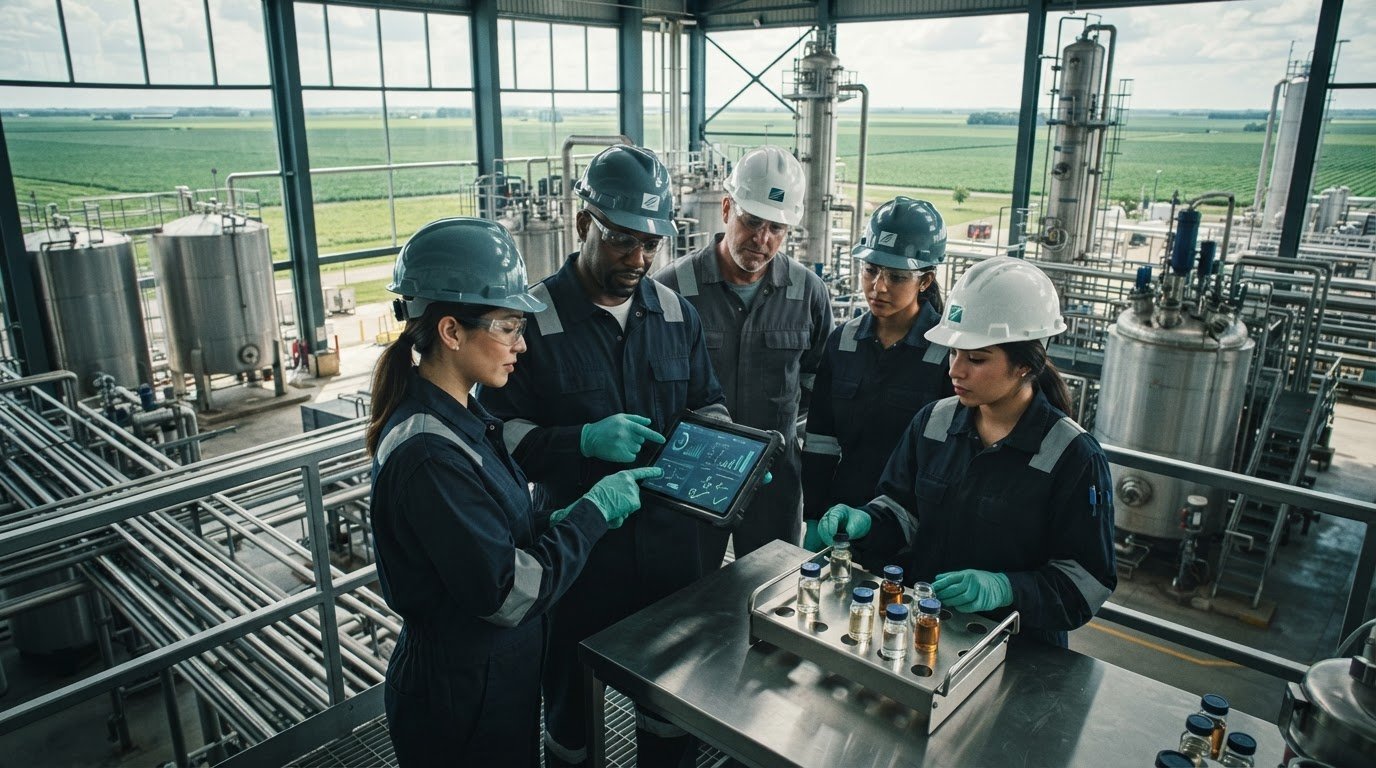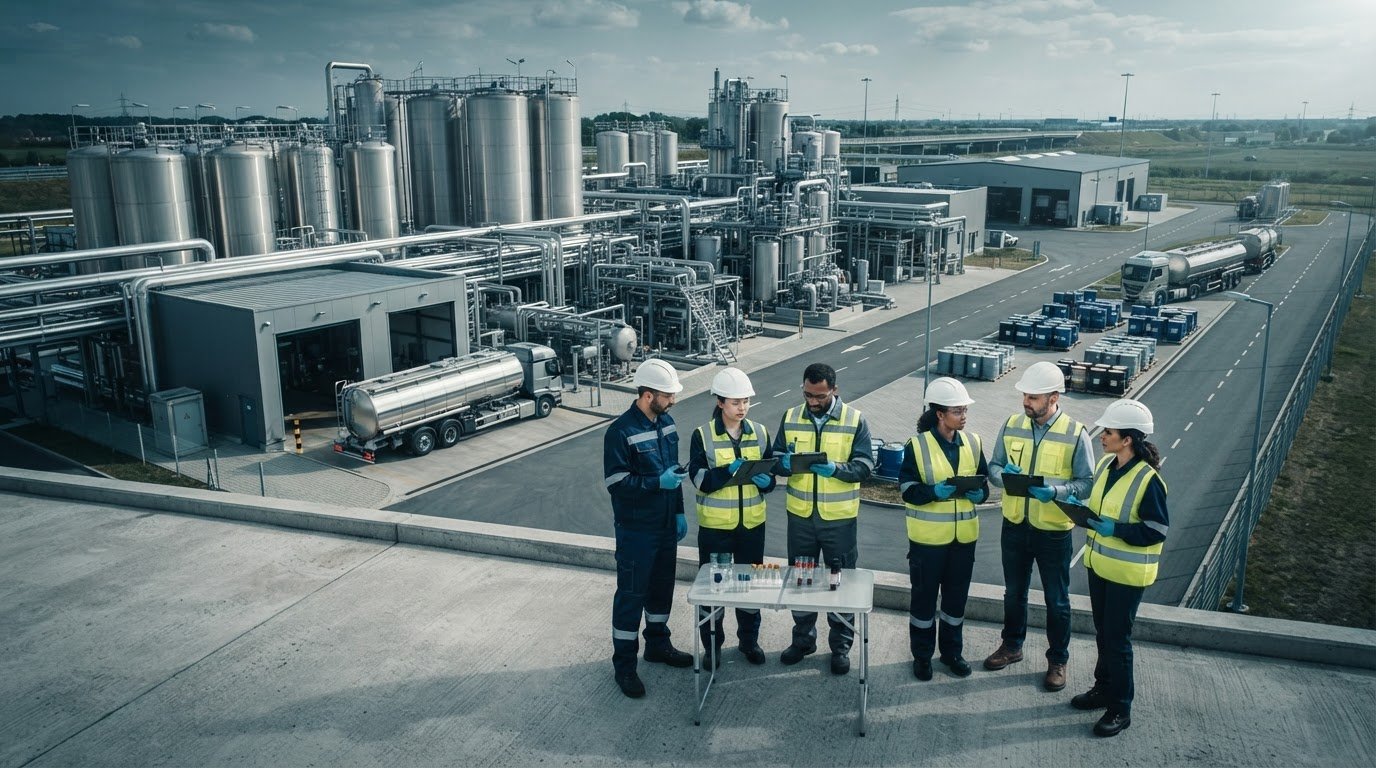

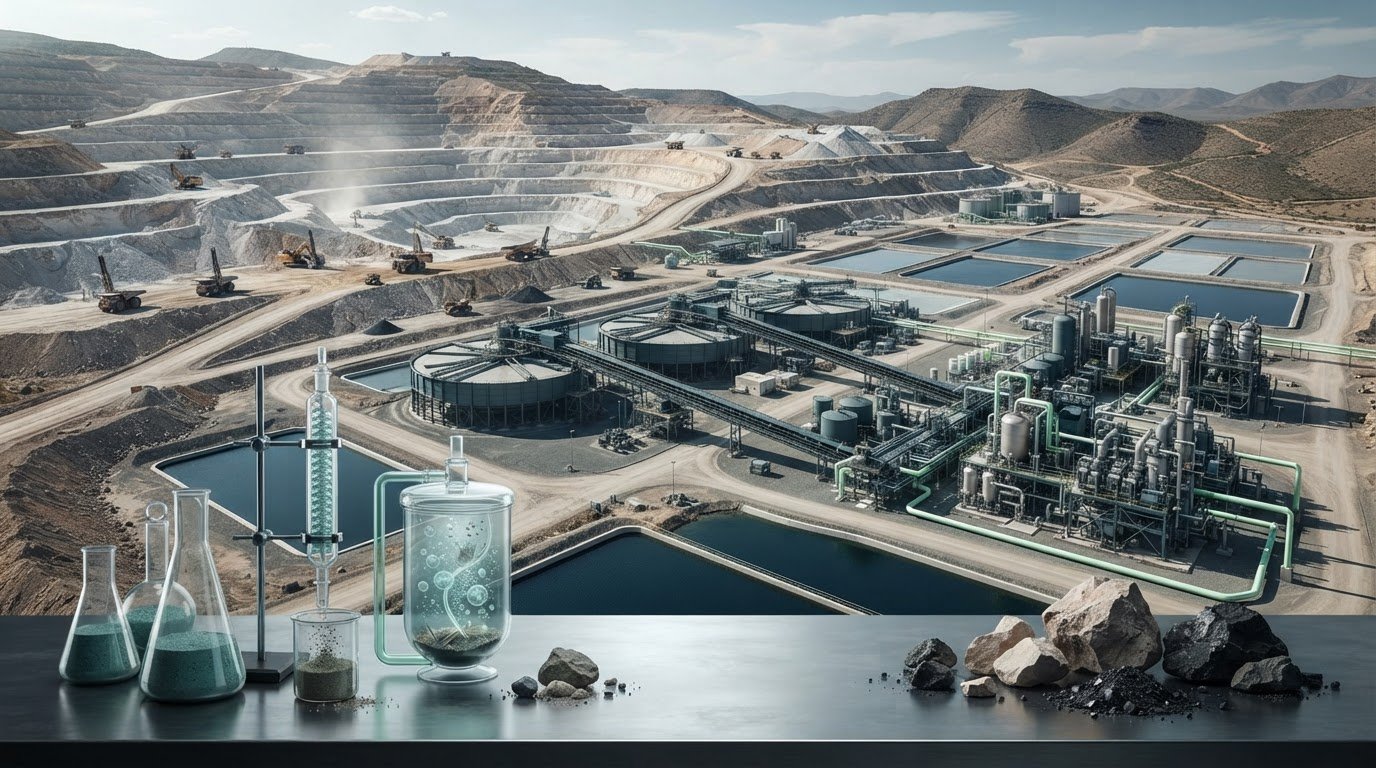
What if better phosphate recovery depends less on grinding harder and more on matching chemistry to the ore? As grades decline, complex mineralogy can make valuable phosphate harder to separate. Intensive grinding can raise energy demand, while environmental expectations put pressure on water use and tailings management. Phosphate Mining Chemicals can support these challenges by helping operators select reagents for more selective beneficiation and efficient processing.
Every point of P₂O₅ recovery matters, but concentrate quality is only part of plant performance. Moisture, water recycling, and tailings behavior also affect operations. This article explains how collectors, frothers, grinding aids, and flocculants can be considered in relation to ore characteristics and circuit conditions. The key is to evaluate each chemical as part of the process, not as a one-size-fits-all solution.
You’ll learn what to assess when selecting reagents, how to compare direct and reverse flotation, and which operating measures can help reveal whether a chemical change is working. Tailored formulations and dosing strategies can support process optimization, but results depend on the ore and plant conditions. These decisions matter beyond the mine: reliable phosphate production supports the fertilizer supply chain and global resource security.
Key Takeaways
- See how Phosphate Mining Chemicals can support selective separation, and which ore and circuit conditions to assess when recovery changes.
- Learn how mineral characteristics and process targets inform the choice between direct and reverse flotation.
- Understand the separate roles of collectors and frothers, and why their performance depends on the beneficiation circuit.
- Explore how grinding aids and flocculants can contribute to processing efficiency and water recovery, and which measures to monitor.
- Discover how JAS Global Industries’ technical audits, on-site laboratory testing, and tailored formulations can inform site-specific chemical strategies.
Phosphate Mining Chemicals: The Foundation of Global Resource Security
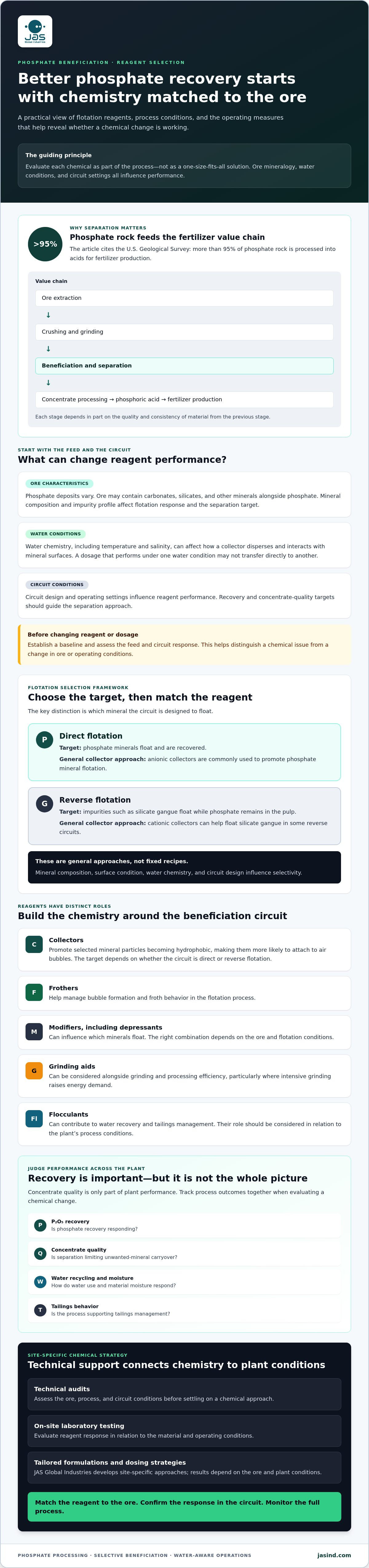
Phosphate mining chemicals are specialty reagents used during beneficiation to separate phosphate minerals from gangue, the unwanted minerals in ore. Their role extends beyond the mine. Beneficiated phosphate rock can be processed into phosphoric acid, a key intermediate in phosphate fertilizer production. Effective separation helps make better use of the resource base that supports agricultural nutrient supply. For an overview of the geology, occurrence, and environmental context of global phosphate resources, see Wikipedia’s phosphate reference.
The value chain runs from ore extraction through crushing, grinding, and beneficiation, then onward to concentrate processing and refined phosphoric acid. Each stage depends in part on the quality and consistency of the material coming from the previous one. Better separation can limit the unwanted minerals carried into downstream processing, while tailored chemistry may help make some lower-grade ores more practical to process. Outcomes depend on the ore and plant conditions, not chemicals alone.
The Growing Complexity of Phosphate Extraction
Phosphate deposits vary. Some operations process igneous ores, while many sedimentary deposits contain phosphate alongside carbonates, silicates, and other minerals. As operators work with more complex or lower-grade material, changes in the impurity profile can affect how the ore responds to flotation. Reagent selection needs to support the separation target: recover phosphate while limiting the minerals that report to concentrate.
A reagent that works well for one ore body may not meet another plant’s recovery and concentrate-quality targets. Mineralogy, water conditions, and circuit settings all affect performance. Before changing reagent selection or dosage, establish a baseline and assess the feed and circuit response. This helps distinguish a chemical issue from a change in ore or operating conditions.
Specialty Chemicals as Strategic Assets
Specialty formulations offer an alternative to using the same reagent approach across different ores. Collectors promote the attachment of selected mineral particles to air bubbles; frothers help manage bubble formation and froth behavior; modifiers, including depressants, can influence which minerals float. The right combination depends on the ore and flotation conditions. JAS Global Industries develops tailor-made mining chemical formulations and dosing strategies, supported by technical audits and on-site laboratory testing.
Chemical selection can also support resource use when it improves separation or helps a plant process material that would otherwise be difficult to beneficiate. Lower unwanted-mineral carryover can support downstream processing, while fertilizer anti-caking agents address a later stage: handling and storage of finished fertilizer. JAS offers both phosphate mining chemicals and fertilizer anti-caking agents. These serve distinct needs at different points in the phosphate value chain.
Optimizing the Beneficiation Circuit: Collectors, Frothers, and Modifiers
Flotation performance depends on how reagents interact with mineral surfaces, water, air, and one another. Collectors help selected phosphate or gangue particles become hydrophobic, making them more likely to attach to air bubbles. The target depends on the circuit: direct flotation recovers phosphate, while reverse flotation targets impurities. The U.S. Geological Survey notes that more than 95% of phosphate rock is processed into acids for fertilizer production, underscoring the value of controlling what enters the concentrate. See its data on U.S. phosphate production.
Mining Flotation Collectors: Tailoring Selectivity
Anionic collectors are commonly used to promote phosphate mineral flotation in direct circuits. In some reverse circuits, cationic collectors help float silicate gangue while phosphate remains in the pulp. These are general approaches, not fixed recipes. Mineral composition, surface condition, water chemistry, and circuit design all influence selectivity.
Temperature and salinity can also affect reagent behavior, including how a collector disperses and interacts with mineral surfaces. A dosage that performs well under one water condition may not transfer directly to another. When reviewing a collector, compare performance against the feed, water conditions, and circuit targets. JAS Global Industries develops tailored formulations and dosing strategies informed by technical audits and on-site laboratory testing, with the aim of matching chemistry to operating conditions rather than relying on a generic formulation.
Frothers and Depressants: Managing the Interface
Collectors influence which particles attach to bubbles; frothers influence bubble size, stability, and froth movement. A froth that is too persistent can hinder drainage and carry unwanted particles forward. One that is too mobile may not retain enough valuable mineral. Operators can assess froth behavior alongside concentrate grade and recovery to identify a suitable balance.
Depressants and pH regulators provide another layer of control. Depending on the ore and flotation strategy, they can help suppress selected gangue minerals, including carbonates or silica. Their effects are conditional: a reagent that depresses an impurity in one circuit may affect phosphate recovery in another. Test and monitor any change against the operation’s separation targets.
Dosage matters as much as reagent choice. Too little collector can limit mineral attachment; excess can reduce selectivity or complicate downstream processing. Frother and depressant levels also interact, so assess their combined response rather than optimizing each reagent in isolation. Excess reagent carryover may affect phosphoric acid plant performance, making concentrate quality and downstream compatibility important circuit targets. For operations reviewing their reagent approach, tailored phosphate mining chemical solutions offer a starting point for considering site-specific needs.
Direct vs. Reverse Flotation: A Reagent Selection Framework
Choose a flotation route by starting with the ore, not a preferred reagent. Direct flotation makes phosphate-bearing particles hydrophobic so they attach to bubbles; reverse flotation targets impurities, leaving phosphate in the pulp. The decision depends on mineral associations, carbonate and silica content, liberation, and grade and recovery targets. These factors shape both the reagent suite and the complexity of the circuit.
When to Choose Direct Flotation
Direct flotation can suit ores where phosphate can be separated effectively from the main gangue, including some low-carbonate, silica-rich feeds. Fatty-acid collectors, sometimes used with fuel oil blends, promote phosphate flotation. A comparatively straightforward circuit may require fewer reagent types and process stages, though actual reagent demand still depends on ore response and water conditions.
Crago double flotation adds a second separation step to address silica that remains with the phosphate concentrate. The process first floats phosphate with an anionic collector, then uses a separate stage to float silicate impurities, commonly with an amine collector. This can improve concentrate quality, but requires managing two stages with distinct pH and reagent conditions. The added complexity is justified only when the separation supports the plant’s targets.
The Case for Reverse Flotation
High-carbonate sedimentary ores, including deposits found in North Africa and the Middle East, can require a circuit designed to remove calcite or dolomite. In reverse flotation, specialized collectors promote the flotation of selected impurities while depressants help keep phosphate in the pulp. Establish the specific chemistry through ore testing because carbonate response, phosphate mineralogy, and water chemistry vary by deposit. Research at Florida Polytechnic University includes phosphate beneficiation research on dolomite separation and flotation efficiency.
Multi-stage impurity removal may help raise P2O5 grade, but extra stages can also increase reagent use and process demands. The best option is not necessarily the circuit with the fewest reagents or the highest grade in isolation. Compare alternatives using recovery, concentrate quality, reagent consumption, water behavior, and downstream suitability together.
A practical selection framework is to:
- Characterize the feed: identify phosphate minerals, carbonate and silica levels, and how closely the minerals are intergrown.
- Define the separation target: determine whether phosphate recovery or impurity rejection is the main challenge.
- Compare circuit trade-offs: assess likely grade and recovery alongside stage count, reagent diversity, and downstream requirements.
- Validate dosage and sequence: evaluate reagent combinations on representative ore rather than assuming one collector or circuit fits every feed.
For Phosphate Mining Chemicals, this ore-led framework helps balance recovery, grade, and operating demands. A tailored collector and depressant strategy can support the selected circuit, but performance needs to be confirmed against the plant’s feed and process conditions.
Enhancing Operational Yield: Grinding Aids and Water Management
Flotation is only one part of plant performance. Grinding energy, tailings settling, water reuse, and scale control also shape how efficiently phosphate ore moves through processing. Phosphate Mining Chemicals can support these connected stages, but results depend on ore properties, equipment, and operating conditions. To evaluate a change, compare measures such as specific energy consumption in kWh/t, throughput, settling behavior, and process-water quality against the plant’s baseline.
Grinding Aids: Breaking the Energy Barrier
During comminution, energy is needed to form newly exposed mineral surfaces. Mining grinding aids can influence particle interactions and reduce surface-related resistance during grinding. Depending on the ore and mill conditions, this may help maintain throughput or achieve a target grind with less energy. Confirm any change against the plant’s baseline kWh/t and product-size distribution. Performance gains are not automatic, and a finer grind is not always beneficial if it creates downstream separation challenges.
Assess grinding aids alongside feed variability, mill loading, and liberation requirements. The aim is not simply to grind finer, but to deliver particles suited to beneficiation while using energy effectively. Read more about Mining Solutions: Advanced Chemistry for Global Resource Security.
Tailings Management and Water Recovery
Mining flocculants help fine particles aggregate into larger flocs, which can settle more readily in thickening systems. Better settling can support water recovery for reuse and reduce the volume of water retained in tailings, subject to the ore, water chemistry, and circuit design. Operators can assess settling rate, overflow clarity, underflow density, and flocculant dosage together to understand the trade-offs.
Water chemistry also affects equipment reliability. Scale inhibitors and water treatment antiscalants can help control mineral deposits in process-water and phosphoric-acid circuits when selected for the specific water composition and operating conditions. Deposit control may help reduce cleaning demands and unplanned interruptions, but treatment needs monitoring as feed water changes.
Responsible operation also includes attention to odor and gas concerns. Mining odor and gas treatment chemicals can form part of an operation’s approach to managing these issues, alongside site-specific monitoring and established safety practices. For tailored support with grinding aids, flocculants, or related mining chemical categories, explore JAS mining chemical solutions.
Advanced Chemical Solutions: The JAS Global Industries Advantage
Effective chemical selection starts with the ore and the plant, not a standard recipe. JAS Global Industries provides specialty mining chemicals, including flotation collectors, frothers, and grinding aids. Its approach combines tailor-made formulations with technical consulting, audits, and on-site laboratory testing to help identify process bottlenecks and develop dosing strategies suited to site conditions.
This work has value across the phosphate chain. Mining reagents support beneficiation and concentrate preparation; downstream, fertilizer anti-caking agents help finished fertilizer resist caking during storage and handling. These are distinct process needs, but both contribute to the movement from mineral recovery toward fertilizer supply. Learn more about Fertilizer Anti-caking Agents.
Tailor-Made Formulations and Process Optimization
Ore mineralogy, water conditions, and existing circuit performance all influence reagent response. A technical audit can help identify where recovery, concentrate quality, or dosing practices may be limiting performance. From there, a chemical strategy can be developed for the operation rather than assuming one formulation suits every deposit. JAS also operates multiple research and innovation centers.
Consider a complex sedimentary phosphate feed with carbonate impurities. A practical review would examine the ore and current flotation response, then assess whether collector selection, frother behavior, depressant use, or dosing sequence warrants adjustment. The proposed changes should be validated against plant data, including recovery, concentrate quality, and reagent use. This is an evaluation framework, not a claim of a specific customer result.
Commitment to Sustainability and Resource Protection
Resource protection is tied to measurable operating choices. More effective mineral separation can support recovery objectives, while grinding aids and flocculants may help plants assess energy use and water recovery. Results depend on site conditions, so evaluate environmental performance through relevant operational measures rather than assuming it follows from a chemical selection alone.
Headquartered in Dubai, JAS maintains sales and service offices across the Middle East, Africa, Asia, and Europe. Its work with specialty chemistry focuses on matching formulations and dosing strategies to local ore and process needs, while keeping downstream handling in view.
For operations reviewing their Phosphate Mining Chemicals strategy, discuss ore characteristics, circuit constraints, and performance measures with the JAS technical team.
Build a More Resilient Phosphate Recovery Strategy
Strong beneficiation performance depends on matching reagent selection to the ore, the circuit, and the plant’s operating goals. Collectors, frothers, and depressants influence flotation selectivity, while grinding aids and water-management chemicals can help address energy use, tailings settling, and process-water recovery. Together, these decisions shape concentrate quality and support the phosphate-to-fertilizer value chain.
Phosphate Mining Chemicals work best as part of a site-specific strategy, not a standard recipe. JAS Global Industries develops tailor-made formulations and provides technical consulting, audits, and on-site laboratory testing to help identify process bottlenecks and inform dosing strategies suited to plant conditions.
Take the next step toward aligning chemistry with your ore and operating priorities. Contact JAS Global Industries to discuss phosphate mining chemicals, technical consulting, and specialty formulations. Evaluate any proposed change against plant data and the measures that matter to your operation.
Frequently Asked Questions
What are the primary types of chemicals used in phosphate mining?
Primary Phosphate Mining Chemicals include flotation collectors, frothers, and depressants, each serving a different role in mineral separation. Collectors promote attachment of selected particles to bubbles, frothers influence bubble and froth behavior, and depressants help limit the flotation of targeted minerals. Mining grinding aids support comminution, while flocculants help thicken tailings. The right combination depends on ore mineralogy, water conditions, and the plant’s process objectives.
How do mining grinding aids reduce energy consumption in phosphate processing?
Mining grinding aids can influence particle interactions during comminution, helping reduce resistance associated with newly exposed mineral surfaces. Depending on ore and mill conditions, this may support throughput or help achieve a target particle size with less energy. Results are not automatic. Compare specific energy consumption, usually measured in kWh/t, alongside throughput and particle-size distribution, then check that any grind changes still support effective downstream beneficiation.
What is the difference between direct and reverse flotation in phosphate beneficiation?
Direct flotation makes phosphate-bearing particles hydrophobic so they attach to air bubbles and rise into the froth. Reverse flotation targets selected impurities instead, while phosphate remains in the pulp. Circuit choice depends on the ore’s mineralogy, including its carbonate and silica content, and on liberation and product targets. Some flowsheets use multiple flotation stages to remove different impurities, which can improve separation but adds process and reagent complexity.
Why is water treatment critical for phosphate mining operations?
Water treatment matters because process-water quality can affect reagent behavior, equipment condition, and the ability to recycle water through the plant. Changes in dissolved minerals may contribute to scale formation, so operators may assess water treatment scale inhibitors or antiscalants for suitable circuits. Treatment should reflect actual water composition and operating conditions. Monitoring water quality and deposits helps teams evaluate whether a treatment strategy is supporting reliable processing and water reuse.
How do specialty chemicals improve the quality of downstream fertilizer products?
Mining reagents influence the separation of phosphate from unwanted minerals, which affects concentrate quality and the material sent for further processing into phosphoric acid and fertilizer. Their impact is indirect: they support beneficiation rather than determine every finished-product property. At a later stage, fertilizer anti-caking agents can help finished fertilizer resist caking during storage and handling. These separate chemical applications connect mine recovery with downstream product flow.
What role do collectors play in the flotation of phosphate ore?
Collectors help selected mineral particles attach to air bubbles by changing their surface properties and promoting hydrophobic behavior. In direct flotation, the collector is chosen to favor phosphate recovery; in reverse flotation, chemistry can instead target certain gangue minerals. Collector performance depends on ore composition, water chemistry, and circuit conditions. Assess it alongside frother and depressant selection, dosage, concentrate grade, and recovery rather than treating it as a standalone reagent.
How can mines reduce the environmental impact of their tailings through chemistry?
Mining flocculants can help fine tailings particles form larger aggregates that settle more readily in thickening systems. Depending on the material and operating conditions, this may support water recovery for reuse and reduce water retained in tailings. Evaluate flocculant selection and dosage against settling behavior, overflow clarity, and underflow density. Chemistry can contribute to tailings management, but it does not replace appropriate facility design, monitoring, or environmental controls.
Why should I choose tailor-made formulations over generic mining reagents?
Tailor-made formulations are developed with a specific ore body and process in mind, which matters because mineralogy, water conditions, and circuit settings vary between sites. A generic reagent may not deliver the desired selectivity or process response for every feed. JAS Global Industries develops tailored mining chemical formulations and provides technical audits and on-site laboratory testing to help identify bottlenecks and inform dosing strategies. Validate performance against site data and operating goals.