


A reliable chemical supply agreement is measured by evidence, not assurances. Negotiating service level agreements for chemical supply means defining measurable commitments, agreeing how performance will be tracked, and setting remedies and corrective actions for missed standards. Clear reporting, escalation routes, confidentiality terms, and regular reviews make those commitments workable.
It’s reasonable to expect dependable service, but a target protects operations only when both parties interpret and measure it the same way. This guide explains how to verify service levels, negotiate practical remedies, protect sensitive information, and address repeated failures without treating every problem as a reason to end the relationship. The process moves from setting clear measures to building a fair review and response framework that supports accountability and a durable supplier partnership.
Key Takeaways
- Define service commitments with clear measures, reporting methods, and escalation steps so performance can be assessed consistently.
- Connect missed targets to practical remedies and corrective actions that address the cause, not just the immediate impact.
- Set confidentiality and termination terms that protect sensitive information while clarifying how persistent failures are handled.
- Explore adjustments to scope, support, timing, or pricing components to resolve recurring issues and preserve a productive supplier relationship.
How can I verify service levels?
For buyers negotiating service level agreements for chemical supply, verify each service, how it is measured, and what happens if performance falls short. Put those terms in the contract, then review the evidence together.
-
Define services covered by the SLA
List the supplier activities covered by the agreement, such as order confirmation, delivery coordination, technical support, and incident handling. For each activity, define the responsible party, required outcome, and reporting method. Distinguish chemical product quality from service performance: a delayed response and an out-of-specification batch need different records and remedies. Avoid broad phrases such as “prompt support” unless the contract defines what prompt means.
-
Specify uptime and exclusions
Set a measurable target and state its measurement window. For example, an SLA may specify 99.5% service availability between 8 a.m. and 6 p.m., with different requirements at other times. Define which service or system counts as available, how partial outages count, and whether measurement is end-to-end or component-level. List exclusions precisely, including how planned maintenance is announced and recorded, so exceptions don’t erase meaningful failures.
-
Define service-level failures
State the failure trigger beside each target: availability below the agreed threshold, turnaround exceeding the promised time, or a missed delivery milestone. Assign each event a timestamp, evidence source, and severity. When negotiating service level agreements for chemical supply, distinguish acknowledgement from substantive action. An automated reply alone may not demonstrate a useful incident response. Set separate response and resolution measures for incidents of different severity.
- Address United States requirements. In the contract, allocate responsibility for applicable federal, state, and local chemical, hazmat-shipping, and environmental requirements. Identify shipment roles, required records, and how changes in applicable requirements are communicated.
- Set price-change rules. Define how price changes, surcharges, and cost escalation are documented, notified, and applied. Specify which cost components qualify and how the parties review supporting records before changes take effect.
- Control quality evidence. Attach chemical specifications and define how certificates of analysis are provided and matched to shipments. Set a process for recording, investigating, and resolving quality disputes, including the evidence each party supplies.
- Set inventory commitments. Define any agreed inventory and safety-stock responsibilities, replenishment triggers, and emergency allocation process. Tie each commitment to demand forecasts, order priorities, and clear communication when supply is constrained.
- Plan for disruption. Define force majeure and supply-disruption notice, documentation, mitigation, and update requirements. Include how the parties prioritize available supply and resume normal delivery after the disruption.
- Allocate risk and recall duties. State how liability, indemnification, and insurance responsibilities relate to the agreement. Define who leads recall notices, traceability, affected-lot identification, and corrective communications.
Remedies, service credits, and corrective actions
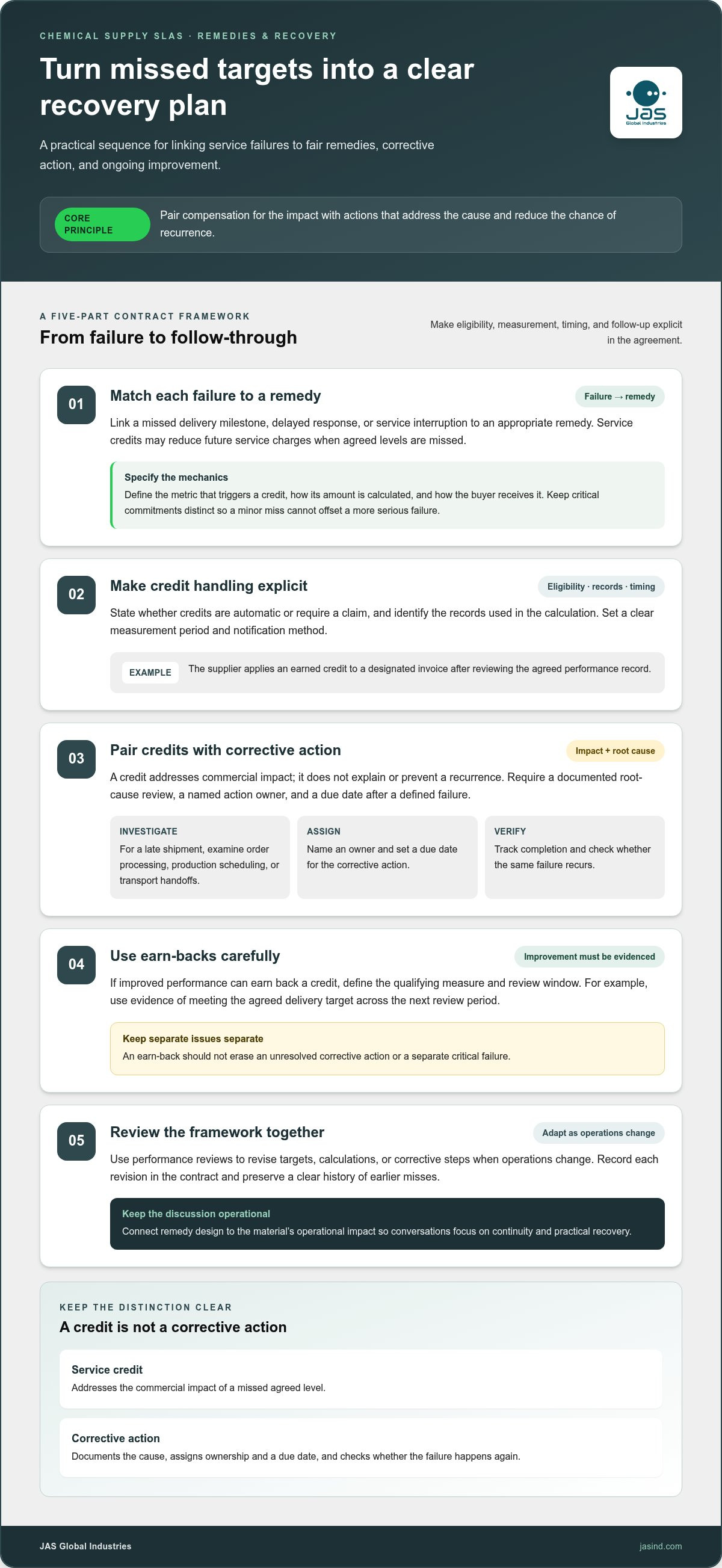
Match each missed target to a defined remedy, then tie repeated failures to corrective action. Make eligibility, calculation, timing, and follow-up clear in the contract.
- Set a remedy for each failure. Link a missed delivery milestone, delayed response, or service interruption to an appropriate remedy. Service credits may reduce future service charges when agreed levels are missed. Define the metric that triggers a credit, how the amount is calculated, and how the buyer receives it. Keep critical service commitments distinct so a minor miss cannot offset a more serious failure.
- Make credit handling explicit. State whether credits are automatic or require a claim, and identify the records used in the calculation. An automatic credit process can reduce administrative friction, but it still needs a clear measurement period and notification method. For example, specify that the supplier applies an earned credit to a designated invoice after reviewing the agreed performance record.
- Pair credits with corrective action. A credit addresses the commercial impact, but it does not explain or prevent a recurrence. Require a documented root-cause review, a named action owner, and a due date after a defined failure. For a late chemical shipment, the review might examine order processing, production scheduling, or transport handoffs. Track completion and check whether the same failure recurs.
- Use earn-backs carefully. If the supplier can earn back a credit through improved performance, define the qualifying measure and review window. Make improvement evidence-based, such as meeting the agreed delivery target across the next review period. Don’t let an earn-back erase an unresolved corrective action or a separate critical failure.
- Review the remedy structure together. Use performance reviews to revise targets, calculations, or corrective steps when operations change. Record each revision in the contract and preserve a clear history of earlier misses. For chemical supply requirements, connect remedy design to the operational impact of the material, so discussions focus on continuity and practical recovery.
Confidentiality and termination provisions
Put confidentiality, renewal, audit, and exit terms in the SLA. Include a termination right for persistent service failures, along with regular performance reviews and defined audit access.
-
Set confidentiality provisions
Identify protected information, such as product specifications, formulations, forecasts, process data, and incident reports. Define who may access it and limit its use to the supplier relationship. State how each party protects shared records, handles authorized disclosures, and reports accidental exposure. Specify what happens to confidential files when the agreement ends, including their return or destruction, and identify any records that must remain available for agreed business purposes.
Keep the clause practical: procurement, technical, and operations teams may need different information. Define permitted internal access rather than restricting routine work. Avoid broad wording that leaves sensitive production details or customer data outside the protection terms.
-
Define termination and review terms
Set out when either party may terminate, how notice is delivered, and what happens to open orders. Include the customer’s right to terminate for persistent service failures, supported by documented misses and a defined escalation process. State whether the agreement renews automatically or requires written renewal, and explain how either party gives notice of its intent.
Define audit access to relevant performance records, incident logs, and corrective-action evidence. Schedule periodic supplier performance reviews to assess results, unresolved issues, and changing operational needs. Specify who attends, which records are shared, and how review decisions become contract changes or assigned follow-up actions.
- Plan the transition. Describe how the parties will manage active orders, confidential materials, and essential records after termination. For example, state who communicates changes to affected teams and how unresolved service issues are documented. Clear transition duties reduce confusion without weakening the agreed exit right.
- Make review outcomes traceable. Record meeting decisions, audit findings, and assigned actions in a shared review record. Set a process for correcting inaccurate performance evidence and escalating unresolved disputes. Link renewal discussions to documented service history rather than informal assurances, so both parties can assess the relationship using consistent records.
Negotiation trades that preserve supplier partnerships
Repeated misses call for a practical reset, not just tougher penalties. Trade targeted changes for measurable recovery, documented accountability, and continued supply.
- Diagnose the recurring miss together. Bring order records, delivery reports, and operational impacts to the discussion. Distinguish a one-time disruption from a pattern, then identify the process causing it. For example, recurring delivery delays may involve forecasting, production scheduling, or handoffs. Agree on the cause before changing terms so each proposed adjustment addresses the actual service gap.
- Reprice affected components selectively. If a service level requires more supplier effort, discuss repricing the component tied to that commitment rather than changing the entire agreement. Define the revised scope, performance measure, and review process. Link the adjustment to documented operational needs, such as a critical delivery window, rather than an unsupported general increase.
- Consider dedicated support for critical needs. A supplier may be able to add dedicated support in exchange for a clearly defined priority or scope. Specify which orders or incidents receive that support, who coordinates them, and how performance is reviewed. Avoid vague priority language that blurs the distinction between routine requests and urgent supply issues.
- Adjust scope or rollout timing. If the agreed schedule strains capacity, discuss a revised rollout or phased scope. Record which deliveries, locations, or service activities change and how the parties will assess the revised plan. A documented adjustment can protect continuity while giving both teams a workable path toward the intended service level.
- Reserve termination rights for documented repetition. Define how repeated failures are recorded, escalated, and reviewed before termination rights apply. This gives both parties a clear route to correct performance while retaining an exit for persistent problems. Build consensus in good faith, capture agreed actions, and track completion at each performance review. To align chemical supply commitments with operational priorities, bring the required scope and recovery expectations into the discussion.
JAS Global Industries: Fertilizer Anti-caking Agents
JAS Global Industries supports fertilizer operations with specialty chemical solutions and clear supply expectations. Its Fertilizer Anti-caking Agents address a relevant product need, while Fertilizer Dust Suppressants may also suit operations managing dust during fertilizer handling. Define product requirements, delivery expectations, reporting, and corrective processes in the supply agreement so both teams understand how performance will be assessed.
Turn to JAS Global Industries when your operational needs involve these chemical solutions and you’re aligning supply commitments with production priorities. Clear specifications and communication help establish a practical basis for a long-term supplier relationship. Contact JAS Global Industries or visit jasind.com to discuss your requirements.
Put clear commitments to work
Treat the agreement as a working foundation for the supplier relationship, not a document that stays untouched after signing. As operations evolve, keep communication open and revisit whether commitments still reflect actual priorities. A disciplined approach to negotiating service level agreements for chemical supply helps teams make adjustments transparently and keep discussions focused on shared operational needs.
For chemical supply requirements, JAS Global Industries offers Fertilizer Anti-caking Agents, Fertilizer Dust Suppressants, and Mining Flotation Collectors. These offerings serve different operational contexts, so define the product requirements and service expectations that matter to your application. Clear discussions from the outset can establish a sound basis for working together.
Contact JAS Global Industries to discuss your chemical supply needs. Take the next step with clarity and confidence.
Frequently Asked Questions
Is an SLA transferable?
Whether an SLA transfers depends on its assignment and change-of-control terms. Before a business sale, restructuring, or transfer of operations, review whether the named customer or supplier can be replaced and whether written consent is required. Also identify which obligations continue during the transition. For example, an incoming operator may need access to service records and open-order details to maintain continuity.
What are key components of an SLA?
Key components include the covered services, performance measures, responsibilities, reporting, remedies, and review procedures. In chemical supply, clarify how the supply contract and SLA relate, including which document controls if terms conflict. For example, link a delivery performance measure to named order records while keeping product acceptance criteria in the applicable product specification.
What are the benefits of an SLA?
An SLA turns expectations into a shared operating framework. It helps procurement, operations, and suppliers use consistent measures, spot problems sooner, and assign follow-up clearly. For example, an agreed escalation route can help a plant team raise a delivery issue with the right supplier contact. Documented performance also gives both parties a stronger basis for discussing service changes and future planning.
What are the different types of SLAs?
Common formats include customer-based, service-based, and multi-level SLAs. A customer-based agreement covers services for one customer relationship; a service-based agreement applies common terms to a defined service; a multi-level agreement combines shared terms with customer-specific requirements. A chemical buyer might use common reporting terms across supply arrangements, then add distinct measures for materials with different operational priorities.
What common SLA mistakes do customers make?
Common mistakes include using undefined terms, measuring activity instead of outcomes, and failing to assign an owner for review. An automated acknowledgement, for example, may show that a message arrived without proving useful action began. Another mistake is setting targets without involving the teams that manage orders or receive materials. Their input helps ensure that measures reflect actual workflows and produce evidence teams can use.
What key terms should a chemical supply service level agreement include?
Include the covered supply activities, each party’s responsibilities, performance measures, data sources, reporting cadence, escalation process, remedies, corrective-action duties, confidentiality, review, and termination terms. Connect the SLA to product specifications and order documentation so service performance and product quality remain distinct. For example, define where shipment records are kept and how the parties use them during a delivery dispute or performance review.