


A second reagent supplier can reduce disruption risk, but it does not automatically lower total cost. Developing a dual-sourcing strategy for reagents can protect production and improve flexibility when an alternative source meets the same quality and supply requirements. The benefit depends on more than the number of suppliers: shared locations, raw materials, or transport routes can leave both sources exposed to the same disruption.
Weigh the added coordination against the risk of relying on a single source. This article explains how dual sourcing compares with single sourcing, when it can help manage lead times, disruptions, and costs, and why business criticality matters. It also covers how supplier locations, upstream dependencies, and production needs shape the right approach across industries.
Key Takeaways
- Map supplier locations and upstream dependencies to spot shared risks that could affect both sources.
- Compare the resilience benefits of a second source with its added coordination, inventory, and switching costs.
- Prioritize backup sourcing for materials whose interruption could halt production and that lack suitable substitutes.
- Use consistent specifications and quality criteria to make it easier to shift supply between qualified sources.
Supplier diversification by geography and upstream dependencies
Two suppliers offer limited protection if both depend on the same region, raw material, or transport route. Map those connections before allocating backup volume.
For U.S. operations, identify the regulatory framework that applies to the reagent’s intended use, then align supplier qualification, change control, and records with it. The relevant framework depends on the product and production context.
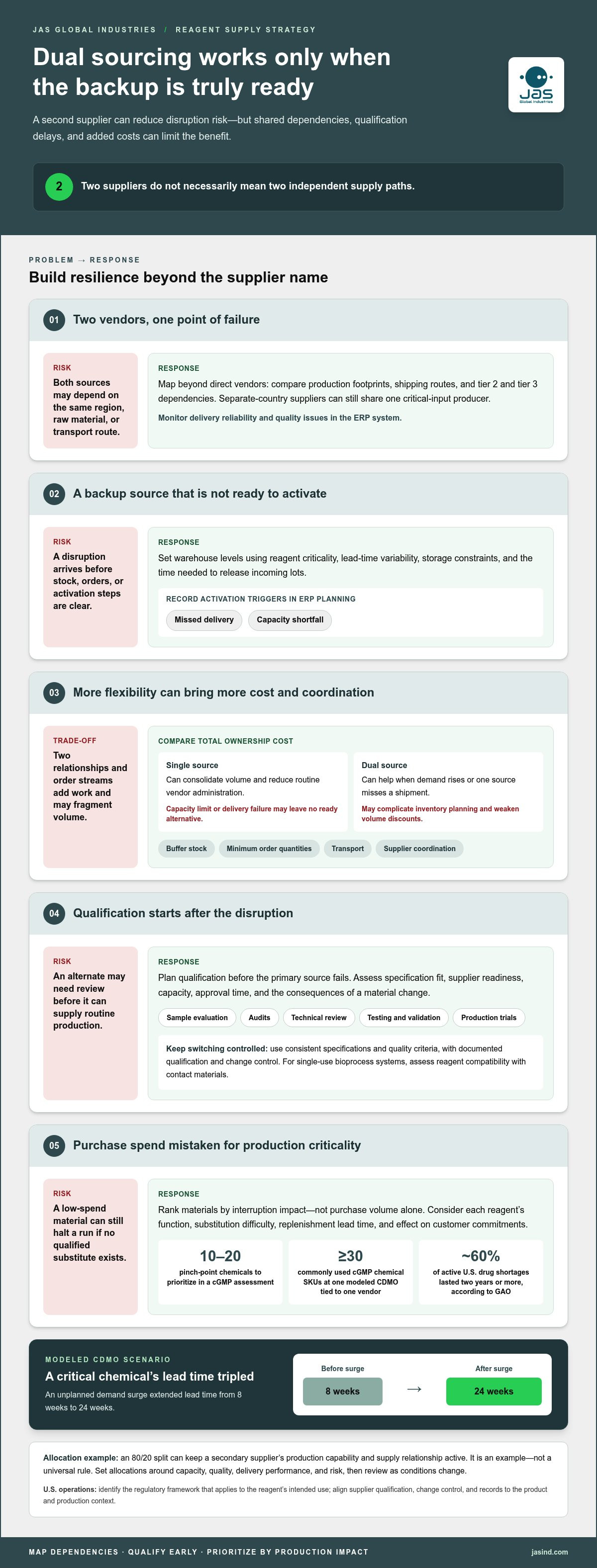
Map the supply chain beyond direct vendors, including tier 2 and tier 3 sources. For example, suppliers in separate countries may still rely on one producer for a critical input. Compare production footprints, shipping routes, and upstream dependencies, then monitor delivery reliability and quality issues in the ERP system.
Inventory and Secondary Supplier Activation
Inventory planning and secondary-supplier activation mean positioning stock and defining how the backup source will supply material during a disruption. Set warehouse levels based on reagent criticality, lead-time variability, storage constraints, and the time needed to release incoming lots. Record activation triggers in ERP planning systems, such as a missed delivery or capacity shortfall, so procurement and production teams can coordinate orders promptly.
Volume Allocation and Supplier Engagement
Volume allocation is the planned division of reagent orders between qualified suppliers. A business might use an 80/20 split, giving the secondary supplier regular orders that keep its production capability and supply relationship active. Set allocation rules around capacity, quality, delivery performance, and risk, then review them with both suppliers as conditions change. Consistent engagement makes the backup source more practical to activate.
Supplier Comparison and Qualification Risks
Compare suppliers on price, quality, lead time, and service rather than treating the lowest quote as the best option. Review batch records, delivery reliability, responsiveness, and how lot variability affects process results. For single-use bioprocess systems, assess whether a reagent’s interaction with contact materials could affect compatibility or performance. Use documented qualification and change control before shifting production volume between sources.
Dual sourcing compared with single sourcing
A single source concentrates purchasing with one vendor; dual sourcing qualifies a second supplier for the same reagent. For teams developing a dual-sourcing strategy for reagents, the decision depends on whether the added resilience justifies the extra coordination.
Single- and Dual-Sourcing Trade-Offs
These models balance purchasing simplicity with supply flexibility, shaping how procurement and operations maintain supply. A single supplier can consolidate volume and reduce routine vendor administration. However, a capacity limit or delivery failure can leave production without a ready alternative.
Dual sourcing requires teams to manage two supplier relationships, orders, and quality records. That added work can help mitigate risk when demand rises or one source misses a shipment. It can also fragment orders, complicate inventory planning, and weaken volume discounts. Compare total ownership costs, including buffer stock, minimum order quantities, transport, and supplier coordination.
Second-Source Qualification Costs and Lead Times
Qualifying a second source means assessing whether it can consistently deliver the required reagent specification and fit existing operations. For organizations developing a dual-sourcing strategy for reagents, qualification costs and lead times depend on testing, documentation, process validation, supplier readiness, and the consequences of a material change.
For example, a reagent used in a tightly controlled production process may need compatibility testing and documented quality review before routine use. A less complex material may require fewer process changes. Include sample evaluation, audits, technical review, and any production trials in the qualification plan, then estimate timing based on those activities and supplier capacity.
Plan qualification before a disruption, not after the primary source fails. Compare the alternate supplier’s lead time and capacity with demand, while accounting for approval time. Dual sourcing generally adds administrative work, so weigh that burden against the operational impact of an interruption. Base the decision on the reagent’s role, switching effort, and the value of keeping an alternative active.
Business criticality and production impact
Rank reagents by the production consequences of a supply interruption, not by purchase volume alone. A low-spend raw material can still be critical if its absence stops a production run and no qualified alternative exists. Compare each reagent’s function, substitution difficulty, replenishment lead time, and effect on customer commitments. This distinguishes routine purchasing priorities from materials that need active continuity planning.
Duration matters too. The Government Accountability Office reports that nearly 60% of active drug shortages in the United States have lasted two years or more. In a modeled CDMO scenario, an unplanned demand surge for a critical bioprocessing chemical extended lead times from 8 weeks to 24 weeks. These examples show how a material shortage can outlast short-term inventory buffers and disrupt production planning.
For cGMP operations, prioritize the top 10-20 pinch-point chemicals in a material criticality assessment. Examine where each chemical enters the process, the inventory available, and the time required to qualify an alternative. A modeled CDMO relied on one vendor for at least 30 commonly used cGMP chemical SKUs. Mapping those dependencies can reveal whether a single supplier creates a production bottleneck.
Review critical spend categories separately because high expenditure and high production risk are not the same. Segment purchases by operational impact, substitutability, supplier concentration, and demand volatility. Then compare mitigation costs with the consequences of interruption, including idle capacity and missed delivery commitments. For global supply chains, include political, regulatory, climate, and transport exposure in the risk profile. A second source is most useful when it can protect a critical process, meet quality requirements, and supply material within the production window. This gives procurement and operations teams a clearer basis for deciding where dual sourcing supports business continuity and where single sourcing remains proportionate.
Dual sourcing and its use across industries
Dual sourcing serves different purposes across industries, from protecting critical chemical inputs to keeping production components available. The common challenge is qualifying alternatives without adding unnecessary procurement complexity.
In biopharma, L.E.K. Consulting reported that CDMOs dual-source more than 70% of critical chemicals. That approach reflects the production impact of a missing reagent: an alternative source can help protect manufacturing schedules when demand shifts or a supplier encounters disruption. Qualification still matters, since a second source must meet the required specification and quality criteria before it can support production.
Other industries apply the same principle to components with concentrated supply or long replenishment routes. A Southeast Asia dual-hub model, for example, can use Vietnam for electronics and Thailand for automotive. This illustrates how procurement teams can distribute supply across different production locations and reduce reliance on one hub. It also highlights a key limitation: geographic separation helps only when the sources do not share upstream dependencies.
Across sectors, the right model depends on material criticality, supplier availability, and the cost of maintaining another qualified source. Competitive, commoditized materials with acceptable alternatives may be easier to dual-source. A unique specification, limited supplier capacity, or complex quality qualification can make a second source less practical. Match the approach to the exposure: protect high-impact inputs first, then monitor supplier delivery, quality, and responsiveness as operations evolve.
McKinsey reported that 73% of survey respondents were making progress with dual-sourcing strategies, reflecting its use beyond one industry. For manufacturers, the takeaway is to assess each material or component in its production context, rather than applying one sourcing model across every category. To explore chemical solutions for manufacturing needs, consider how material performance and supply requirements align with your process.
JAS Global Industries: Fertilizer Anti-caking Agents
JAS Global Industries supplies Fertilizer Anti-caking Agents for fertilizer operations assessing supply continuity and material performance. These specialty chemicals are relevant when caking control is part of production requirements and procurement teams are evaluating sourcing options.
For related handling needs, JAS Global Industries also offers Fertilizer Dust Suppressants. Its mining portfolio includes Mining Flotation Collectors and Mining Grinding Aids. These products serve distinct process applications, so match each offering to the material and operation rather than treating them as interchangeable sourcing alternatives.
When reviewing a supplier relationship, define the required function, quality criteria, and supply expectations first. This gives procurement a clearer basis for assessing how an offering fits operational needs and broader sourcing plans. Contact JAS Global Industries or visit jasind.com to discuss your requirements.
Turn Your Sourcing Assessment Into a Practical Plan
Make the next step an internal decision, not simply another supplier conversation. Assign clear roles to procurement, quality, and operations teams when reviewing sourcing priorities. Set a review schedule, document the conditions that would trigger a switch, and define who can approve changes. This structure keeps sourcing decisions connected to production needs as suppliers, demand, and business priorities evolve.
Developing a dual-sourcing strategy for reagents is an ongoing part of protecting operational continuity. Start with the materials where a supply gap would create the greatest challenge, then determine what a workable alternative requires. Ground the plan in documented specifications, qualification evidence, and practical supply expectations. These foundations support considered decisions rather than rushed reactions when conditions change.
For specialty chemical solutions relevant to fertilizer and mining processes, contact JAS Global Industries to discuss your requirements. A clear sourcing plan is a steady step toward more resilient operations.
Frequently Asked Questions
Can dual sourcing help reduce lead times, supply disruptions, or material costs?
Yes, dual sourcing can shorten recovery time, limit disruption, and potentially improve price competition, but none of these outcomes is automatic. A backup helps only if it can supply the required reagent when primary supply is constrained. For example, compare each source’s available capacity during a demand spike, not only its normal quoted lead time. Assess the full sourcing burden before attributing savings to a second source.
How can companies qualify alternate suppliers without adding unnecessary operational complexity?
Qualify alternate suppliers through a risk-tiered process with consistent acceptance criteria for equivalent materials. Start with document review and analytical comparison, then use a controlled production trial when process sensitivity warrants it. Maintain one shared specification, approval record, and change-control path across procurement, quality, and manufacturing. This limits duplicated workflows while preserving traceability for each supplier and material lot.
So what is a mindful procurement pro to do?
First, discuss with the incumbent supplier how it can reduce concentration exposure, then compare those measures with an independently qualified alternative. Set observable decision triggers, such as repeated allocation shortfalls or an unresolved capacity constraint, and assign responsibility for activating contingency orders. This ties mitigation to operating conditions instead of adding a supplier by default. Procurement can then review whether the response still fits current production priorities.
What is the idea behind dual sourcing?
The aim is to preserve another workable supply route if one source cannot meet demand. Dual sourcing also gives procurement the option to direct orders according to supplier performance and business needs. It means more than buying from two companies: both sources must be capable of delivering acceptable material, and teams need a controlled way to shift orders without interrupting production.
What is a dual-sourcing strategy for reagents?
A dual-sourcing strategy for reagents establishes two qualified supply paths for a specified reagent, with clear rules for approval, ordering, and substitution. In practice, it connects the reagent’s intended process use with its acceptance criteria and the evidence supporting each source. That makes the strategy more than a supplier list: it provides a controlled way to maintain supply while protecting process requirements.
How can companies assess reagent supply risk and identify critical reagents?
Trace each reagent to the production step it supports, then assess what happens if it becomes unavailable or fails acceptance testing. Critical reagents are those whose absence can stop or constrain operations, especially when no approved substitute exists. Record recovery time, supplier concentration, demand variability, and upstream dependencies in a risk register. Review the ranking with quality and production teams so it reflects actual process consequences.