


The safest supplier choice isn’t always the incumbent. Familiarity can feel like protection, especially when a chemical change could affect production, product quality, or supply continuity. But convincing your team to switch chemical suppliers shouldn’t depend on a persuasive pitch or a single price comparison. It starts with evidence that helps procurement, operations, technical teams, and leadership assess the same business need.
Your colleagues are right to be cautious. A new supplier must meet application requirements, support reliable operations, and align with responsible-sourcing priorities. The goal isn’t to change for its own sake. It’s to determine whether another supplier can better meet the business’s needs, with risks identified and managed before any transition begins.
This guide shows you how to build a shared, evidence-based reason to consider a change, create a fair evaluation framework, and plan a controlled transition. You’ll learn how to compare technical fit, operational resilience, and sourcing factors, then set phases, owners, and decision gates that protect continuity. The result is a practical path from discussion to qualification, without asking your team to take an unnecessary leap.
Key Takeaways
- Separate frustration with the current supplier from a positive, evidence-based reason to assess alternatives.
- Agree on weighted evaluation criteria before comparing suppliers, including technical fit, consistency, documentation, supply capability, and responsible sourcing.
- Use a risk register to identify potential transition issues, assign mitigation owners, and define escalation routes.
- Make convincing your team to switch chemical suppliers easier with a concise case that connects evaluation findings to each stakeholder’s priorities.
- Treat supplier approval as a decision gate, then monitor agreed measures of product consistency, technical responsiveness, documentation, and supply performance.
Why Teams Hesitate to Switch Chemical Suppliers
Changing a qualified chemical input can affect continuity, process consistency, product quality, and accountability. Teams may also anticipate technical review, testing, documentation, and coordination across departments. Those concerns are legitimate. The incumbent is familiar, while an alternative’s performance has not yet been assessed. The answer isn’t to dismiss that caution or assume a change is necessary. First establish what the business needs, what the current arrangement delivers, and whether there’s a sound reason to evaluate other options.
Keep two questions separate: “What isn’t working with the incumbent?” and “What business need could an alternative meet?” A difficult incident alone may not justify a switch. A recurring supply concern, unresolved application-fit issue, or service gap may warrant a structured review, especially if it affects a shared operational priority. A supplier-change business case links a defined need to shared operational priorities and supports a clear decision about whether to evaluate alternatives.
Identify the problem before proposing a replacement
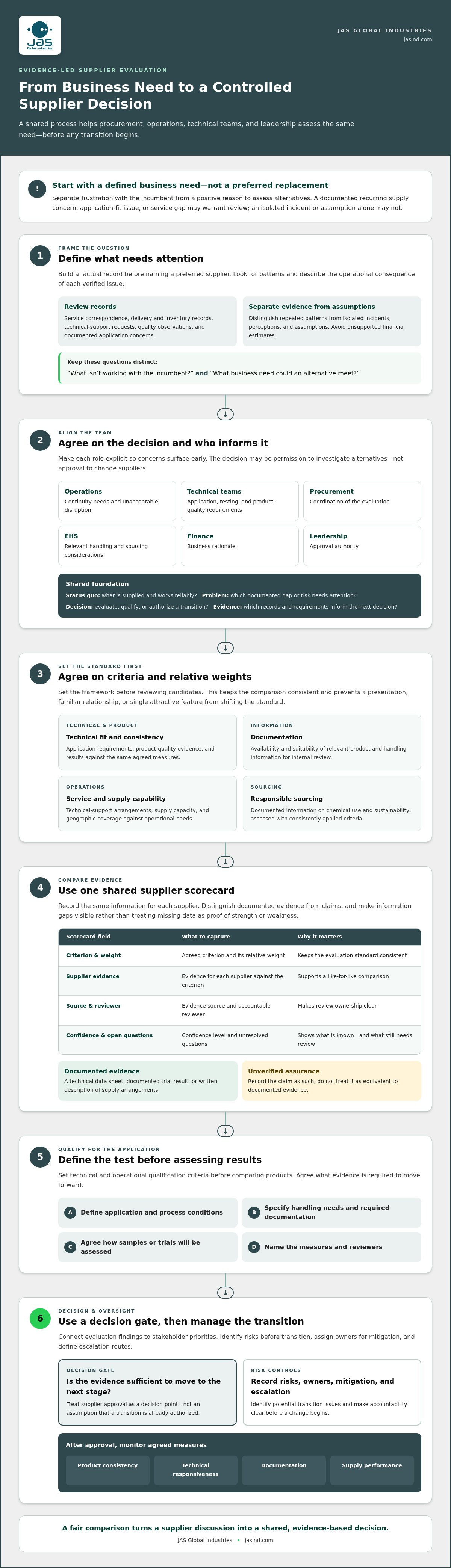
Build a factual record before naming a preferred supplier. Review internal service correspondence, delivery and inventory records, technical-support requests, quality observations, and documented application concerns. Separate repeated patterns from isolated incidents, perceptions, and assumptions. For each verified issue, describe its operational consequence, such as additional troubleshooting or uncertainty in planning. Avoid assigning financial values unless they’re supported by your organization’s records.
Understand what each stakeholder needs to trust
Map both decision-makers and affected functions. Operations can define continuity needs and unacceptable disruption; technical teams can set application, testing, and product-quality requirements. Procurement can coordinate the evaluation, while EHS reviews relevant handling and sourcing considerations. Finance assesses the business rationale, and leadership clarifies approval authority. Make each role explicit so concerns surface early rather than becoming late-stage objections.
Then write down the decision the group is being asked to make. It may be permission to investigate alternatives, not approval to change suppliers. Define the status quo, the specific problem to solve, and the evidence that would justify moving to the next stage. For example, a fertilizer operation using an anti-caking agent might review documented application-fit concerns and their effect on handling before deciding whether to assess alternatives. This keeps the discussion tied to the chemical input and the operation, not general dissatisfaction.
Agree on these foundations together:
- Status quo: What is currently supplied, and what works reliably?
- Problem: Which documented gap or risk needs attention?
- Decision: Is the team evaluating options, qualifying one, or authorizing a transition?
- Evidence: What records and stakeholder requirements will inform the next decision?
This shared framing helps with convincing your team to switch chemical suppliers because it doesn’t ask colleagues to accept change on faith. It gives them a defined question and a disciplined way to answer it. It also reflects supply chain management principles, which treat supplier decisions as part of the broader coordination of operations and partnerships.
Build a chemical supplier comparison around evidence, not promises
Once the team has agreed what it needs to solve, turn those priorities into a consistent comparison framework. Set criteria and their relative weights before reviewing candidates. This prevents a persuasive presentation, a familiar relationship, or one attractive feature from shifting the standard midway through the process.
Use a shared scorecard with a row for each criterion and columns for its weight, each supplier’s evidence, evidence source, accountable reviewer, confidence level, and unresolved questions. Distinguish observations from claims. A technical data sheet, documented trial result, or written description of supply arrangements supports a different level of confidence than an unverified assurance. For teams qualifying specialized biochemical inputs or research compounds, reviewing batch documentation from vendors like Ascend Labs illustrates how objective testing data eliminates guesswork during evaluation. Record gaps openly instead of treating missing information as proof of either strength or weakness.
- Technical fit and consistency: Compare application requirements, product-quality evidence, and results against the same agreed measures.
- Documentation: Assess whether relevant product and handling information is available and suitable for internal review.
- Service and supply capability: Review technical-support arrangements, supply capacity, and geographic coverage against operational needs.
- Responsible sourcing: Compare documented information on chemical use and sustainability using criteria the team can apply consistently.
Set technical and operational qualification criteria
Define the application, process conditions, handling needs, and required documentation before comparing products. Agree how samples or trials will be assessed, which quality and process measures matter, who reviews results, and what evidence is needed to move forward. For fertilizer operations, assess an anti-caking agent against the operation’s handling and flowability requirements rather than relying on a general performance promise. This fertilizer anti-caking agents guide offers application context for setting relevant evaluation questions.
Keep qualification gates separate from preferences. A mandatory gate is a requirement a candidate must meet, such as an agreed technical or documentation threshold. A preference is a differentiator that can be balanced against other strengths through the weighted score. Candidates that fail a mandatory gate shouldn’t advance simply because they score well elsewhere. This makes the evaluation fair, traceable, and easier to explain.
Assess supplier capability and responsible chemical management
Ask reviewers to connect each assessment to evidence: a document, a recorded discussion, a trial observation, or another defined source. Note who assessed it and whether confidence is high, limited, or unresolved. When evaluating laboratory or scientific inputs, reviewing compound purity and analytical reports from specialized vendors such as solaracompounds.com can establish a practical benchmark for product documentation. For responsible-sourcing factors, use comparable records and clearly stated measures. Avoid unsupported claims or treating broad sustainability language as verified performance.
A disciplined scorecard helps with convincing your team to switch chemical suppliers because it makes trade-offs visible instead of asking stakeholders to rely on promises. For application-specific qualification, tailored formulations and technical consulting can help frame the technical questions. Learn about JAS specialty chemical solutions and its fertilizer anti-caking agents.
Address the biggest objection: a supplier change could disrupt operations
A change to a qualified chemical input deserves careful review. Differences in application fit, handling, product consistency, or site procedures can affect operations, so a transition should be controlled rather than rushed. But staying with the incumbent also carries risks if documented supply, service, or technical concerns remain unresolved. Compare both paths using evidence, not the assumption that familiar means risk-free or that new means better.
Use a risk register to make possible failure points visible and assign accountability. For each risk, record its likelihood, consequence, mitigation owner, and escalation route. Include risks from both switching and maintaining the current arrangement. For example, a trial may raise a process-consistency concern, while the status quo may leave a recurring support issue unaddressed. Record the evidence behind each assessment, along with who is authorized to decide what happens next.
Qualification evidence and transition controls reduce uncertainty, but they cannot eliminate operational risk. This framing is credible because it avoids promising a trouble-free change. It shows stakeholders that risks will be monitored, responsibilities assigned, and decisions made at defined points.
Design a controlled trial with clear decision gates
Before testing begins, document the trial’s scope, responsibilities, acceptance criteria, and stop conditions. Define the process measures to observe and establish baseline conditions so results can be compared using consistent operating procedures. Make clear who can pause a trial if an agreed limit or safety concern arises. At each decision gate, technical, operational, and quality stakeholders should review the findings before testing proceeds or a recommendation is made.
Keep the trial proportionate to the question it needs to answer. If the evaluation concerns an application-specific chemical input, specify the operating conditions and assessment method in advance. Record deviations and observations as they occur, rather than relying on recollection after the test. Judge results against the agreed criteria, not by selectively interpreting them to support a preferred outcome.
Protect continuity while a change is evaluated
Build the evaluation sequence around site constraints, procurement commitments, and operational readiness. Identify what must be in place before each stage, who owns the decision, and how issues will be escalated. Document contingencies, including the authority to pause, repeat, or end qualification. This makes the plan practical without promising uninterrupted supply or assuming every disruption can be prevented.
Before a trial starts, align the relevant teams on how concerns will be communicated and who coordinates a response. Capture decisions and outstanding actions in a shared record. That discipline helps with convincing your team to switch chemical suppliers: colleagues can see that the proposal includes safeguards as well as potential benefits. JAS Global Industries provides tailored specialty chemical formulations and technical consulting, capabilities that can support a controlled evaluation of relevant chemical inputs.
How to get cross-functional approval for a supplier switch
Approval is easier to secure when stakeholders can follow the reasoning from evidence to decision. Keep the case focused. Start with the documented operational problem, then show the criteria agreed by the relevant functions, the comparison findings, the risks and controls, and the recommendation. This order makes clear that a supplier change is being considered against shared priorities, not promoted as a foregone conclusion.
Turn the evidence into a decision-ready business case
Summarize why the status quo merits review, then show how each candidate performed against the agreed criteria. Include technical fit, continuity considerations, documentation, and responsible-sourcing evidence. State where evidence is incomplete, what remains unresolved, and how those gaps affect confidence. A balanced case earns trust because it presents limitations as well as strengths.
Make the recommendation conditional. For example, propose proceeding only if agreed qualification results meet acceptance criteria and operational readiness requirements are satisfied. Distinguish approval to continue evaluation from authorization to implement a change. That decision gate helps leaders support the next step without implying that unresolved risks have already been accepted.
Align approval with implementation responsibilities
Name one accountable decision owner and specify which functions approve each stage. A simple responsibility matrix can prevent overlooked handoffs and clarify who provides evidence, who reviews it, and who has authority to approve progression.
- Procurement: Coordinates the evaluation record and tracks supplier commitments and documentation.
- Technical: Reviews application requirements, trial outcomes, and product-quality evidence.
- Operations: Confirms site readiness, process constraints, and continuity considerations.
- EHS: Reviews relevant handling and chemical-management information.
- Leadership: Assigns the decision owner and approves progression at defined gates.
Set review points for trial findings, document readiness, implementation readiness, and post-change monitoring. At each point, record the evidence reviewed, open actions, decision, and person accountable for the next step. This creates a traceable record that future teams can use to understand both the outcome and the criteria behind it.
Present the recommendation in a concise meeting brief, then invite each function to identify any unmet requirement before a decision is recorded. Keep the discussion anchored to evidence: technical results inform application fit, operations informs readiness, documentation supports review, and responsible-sourcing records inform broader procurement priorities. If a concern changes the criteria, document the change and apply it consistently rather than adjusting the standard for one candidate.
This structured approach makes convincing your team to switch chemical suppliers a shared decision process. Once neutral criteria are established, JAS specialty chemical solutions can be considered as part of an application-specific evaluation. The team can use its agreed technical and operational requirements to assess fit.
Move from supplier approval to a managed long-term partnership
Supplier approval is a decision gate, not the end of the change process. Implementation still depends on clear responsibilities, suitable documentation, operational readiness, and ongoing review. Before routine supply begins, translate the approval decision into an onboarding plan that names owners, sets communication routes, and records what evidence will show whether the arrangement is meeting agreed needs.
Establish onboarding and performance reviews
Agree which technical and product documents are needed, who maintains them, and how questions or issues will be escalated. Set review intervals that fit the operation, then track product consistency, technical responsiveness, documentation, and supply performance against agreed measures. Record findings and corrective actions. A shared record helps teams spot patterns, coordinate follow-up, and refine specifications or supply planning when evidence points to a need.
Keep the measures practical and tied to the original reason for evaluating a change. For example, if documentation readiness was a key requirement, review whether the agreed documents are available and kept current. If technical responsiveness matters, record questions raised, their status, and follow-up actions. This turns a general impression of supplier performance into an account of what happened and what the team did next.
- Product consistency: Compare observations with the agreed quality and application criteria.
- Technical responsiveness: Track technical questions, ownership, and follow-up.
- Documentation: Review completeness, accuracy, and updates against site needs.
- Supply performance: Record performance against the supply expectations agreed during qualification.
Make the supplier relationship support changing operational needs
Operational requirements can evolve. Schedule discussions to review changes in the application, process conditions, or site objectives, and document any proposed adjustments before adopting them. Tailored formulations may be relevant where application needs call for them. Technical consulting can help teams assess defined process objectives, but any proposed change should be tested and reviewed rather than treated as a guaranteed outcome.
For fertilizer operations, assess an anti-caking agent against the relevant handling and flowability requirements. The anti-caking agents reference guide provides context for considering this application. Keep any resulting product or process decision grounded in the operation’s own qualification evidence.
JAS Global Industries serves industrial sectors with specialty chemical solutions, including fertilizer anti-caking agents, tailored formulations, and technical consulting. These capabilities can support a potential long-term partnership when they align with your evaluation criteria and site requirements. A disciplined evaluation doesn’t require an immediate commitment; it gives stakeholders a clear basis for discussing fit and next steps.
To discuss your chemical supply requirements, connect with JAS Global Industries.
Make the next supplier decision with confidence
The next step isn’t to secure agreement at any cost. It’s to give your team a clear way to determine whether a supplier relationship fits the operation’s needs. Keep the decision open to evidence, and treat questions raised during evaluation as useful signals. A well-founded decision may be to proceed, gather more information, or retain the current arrangement. Each outcome is stronger when stakeholders understand the reasoning and their responsibilities.
That’s the practical value of convincing your team to switch chemical suppliers: not change for its own sake, but a disciplined path toward a partnership that can support defined technical and operational priorities. When your team is ready to discuss a potential fit, explore a specialty chemical partnership with JAS Global Industries.
Build the next step around your site’s requirements, and move forward at a pace your stakeholders can support.
Frequently Asked Questions
How do you convince a team to consider switching chemical suppliers?
Start with a specific operational concern the team recognizes, then invite stakeholders to decide what evidence would justify a review. For example, bring a documented pattern of delayed responses to a short meeting and ask which functions are affected and what adequate support would look like. This makes convincing your team to switch chemical suppliers a discussion about solving a shared problem, not defending an individual preference.
What should a chemical supplier evaluation include?
A useful evaluation should reflect how the chemical is used at the site, not just what appears in a supplier presentation. Consider whether product and safety documentation suits internal review, whether technical information addresses the actual application, and whether supply arrangements fit planning needs. Assign reviewers to each topic and note what evidence would resolve open questions. This helps distinguish a genuine qualification gap from information that simply hasn’t been gathered yet.
How can a company reduce risk when changing chemical suppliers?
Reduce risk by planning for decisions and contingencies before implementation, not by assuming every issue can be prevented. Identify who can pause a change, who communicates a concern, and what the site will do if results don’t meet expectations. For instance, operations and technical teams can agree in advance how an unexpected process observation is reported and reviewed. Documenting these actions gives teams a usable response path during qualification.
Should a company run a trial before changing chemical suppliers?
A trial is useful when the technical team needs application-specific evidence that documents alone can’t provide. It should answer a defined question, such as whether the candidate input is suitable under the intended process conditions. Before starting, decide what observations will be recorded and who interprets them. If testing isn’t appropriate or practical, the team can use other suitable qualification evidence while clearly recording what remains untested.
Who should approve a chemical supplier change?
The approval group should include people with authority over the chemical, the process it supports, and the associated business risks. A technical lead might approve application evidence, while operations confirms site readiness and procurement manages the commercial decision. EHS, finance, or leadership may also have review or sign-off roles, depending on internal governance. Put these responsibilities in writing so no one mistakes consultation for final approval.
When is the right time to switch chemical suppliers?
The right time is when the organization can assess the need and manage the required work, not simply when a concern first appears. Consider production schedules, planned maintenance, internal review capacity, and existing purchasing commitments. A supplier review can begin before a change date is chosen. Keep timing flexible until technical qualification and operational readiness are understood, then use the organization’s decision process to authorize the next step.
How do you compare chemical suppliers beyond product price?
Compare how each option affects the work around the chemical, as well as the product itself. Consider internal effort for receiving, storing, handling, reviewing documents, training relevant staff, and managing a changeover. Ask reviewers to note assumptions behind each comparison so an apparent advantage isn’t based on unlike conditions. This gives decision-makers a fuller view of practical fit without reducing the recommendation to a single headline figure.