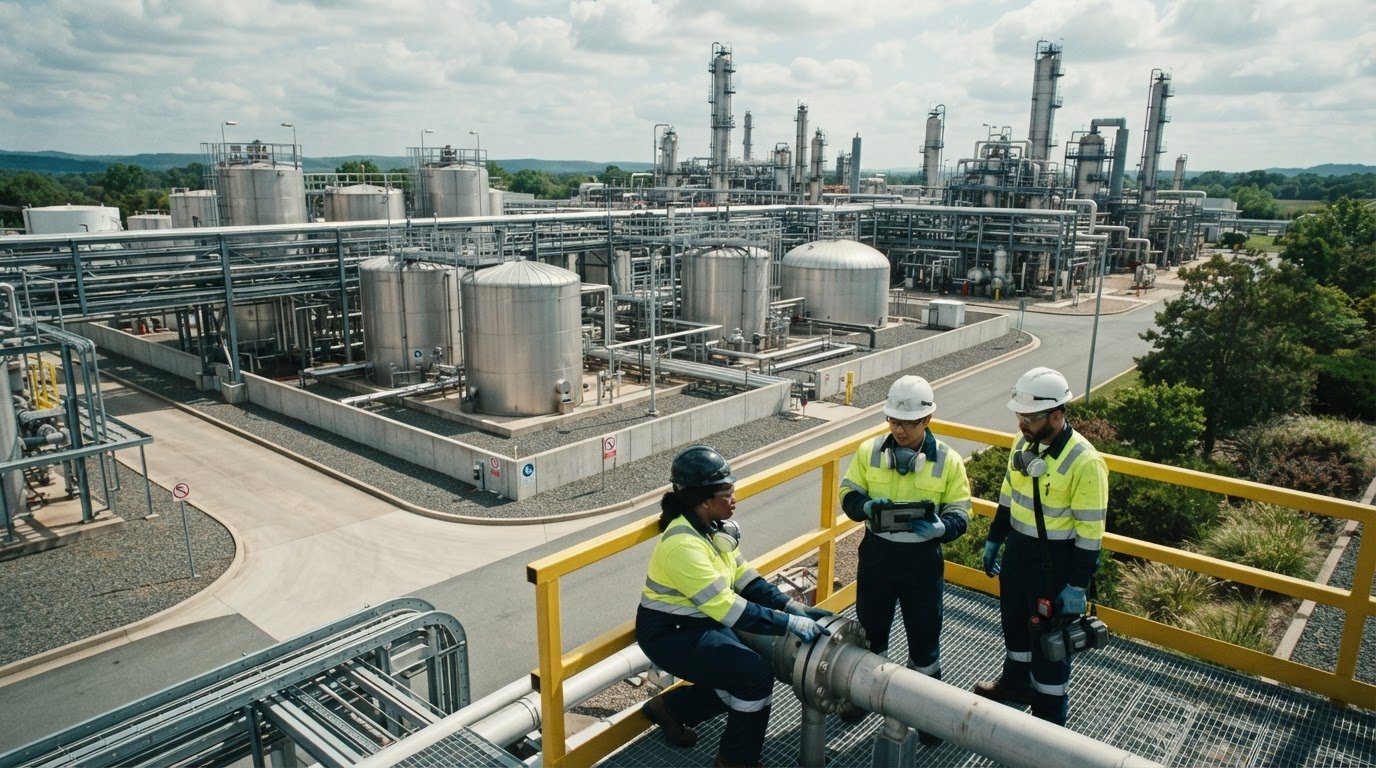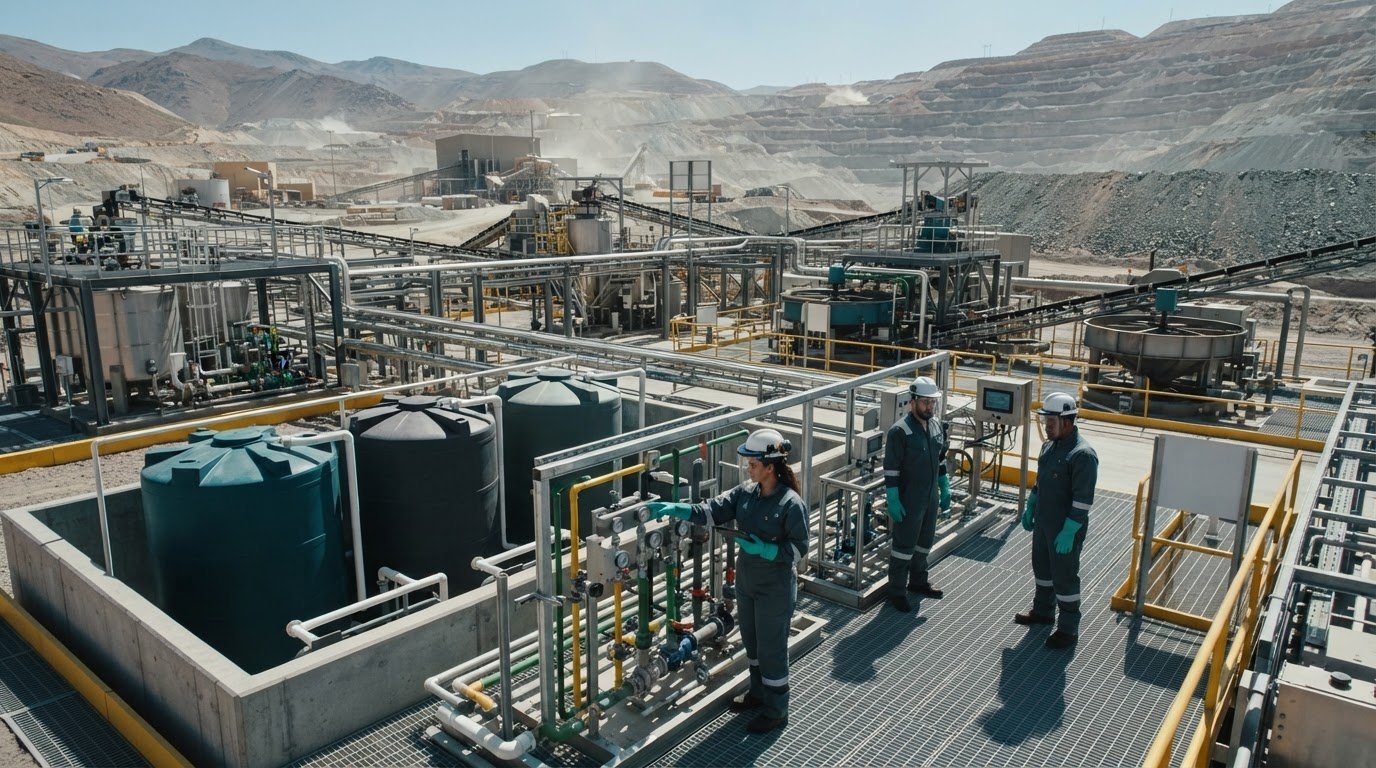


A mixture that looks stable in a beaker can behave differently under plant conditions. Compatibility is not a permanent yes-or-no label. It depends on the chemicals, proportions, and conditions being tested. That is why compatibility testing for chemical mixtures should reflect the process the mixture is expected to encounter, not just a single bench observation.
If you are unsure which signs matter, how to choose test conditions, or whether a small-scale result will hold up during scale-up, a repeatable approach can help. Visual changes are useful clues, but they are only part of the picture. Physical properties and process performance matter too. This guide explains how to plan compatibility tests systematically, compare observations, and interpret results against clear decision criteria. You will learn what to document, how to identify results that need further investigation, and when bench findings may not represent operating conditions. The goal is to reduce surprises and support better-informed decisions before a mixture moves into routine operations.
Key Takeaways
- Define the process question and intended use before setting mixture ratios, addition order, and test conditions.
- Use compatibility testing for chemical mixtures to assess a specific set of conditions, not to claim a universal yes-or-no result.
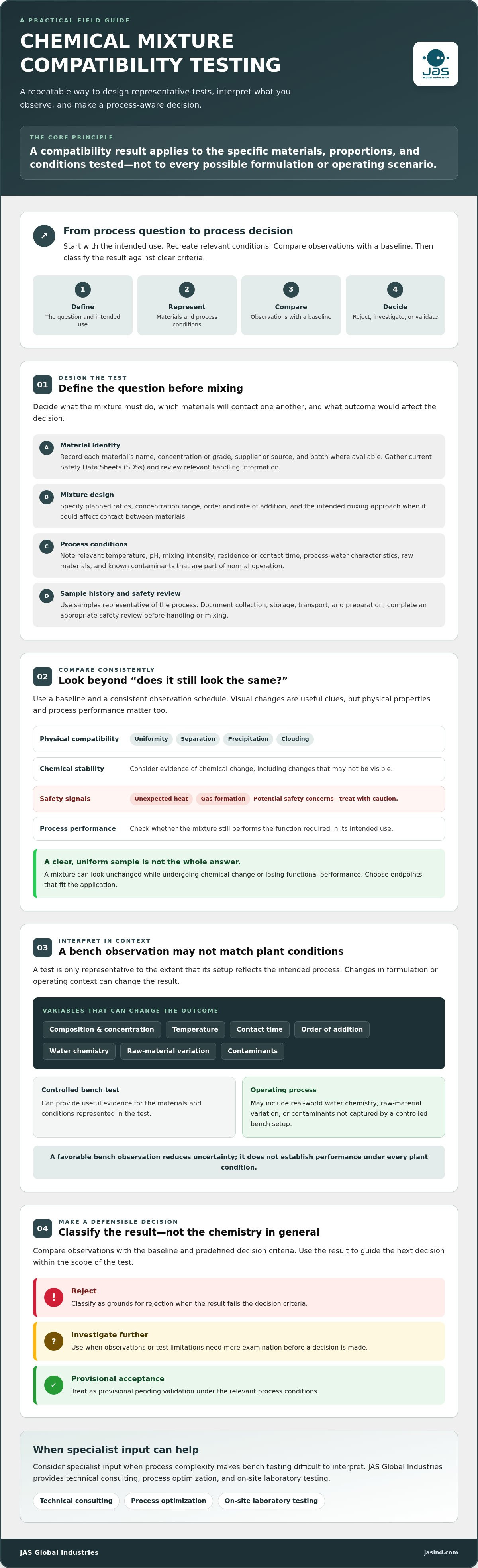
- Compare physical, chemical, safety, and performance observations against a baseline using a consistent schedule.
- Classify results as grounds for rejection, further investigation, or provisional acceptance pending process validation.
- Consider specialist input when process complexity makes bench testing difficult to interpret. JAS Global Industries provides technical consulting, process optimization, and on-site laboratory testing.
What compatibility testing for chemical mixtures can and cannot tell you
Compatibility testing assesses how a defined combination of materials behaves under stated conditions. It helps answer a practical question: does this mixture remain suitable for its intended use under the conditions tested? The result applies to that combination and those conditions, not to every possible formulation or operating scenario.
Chemical compatibility can involve interactions between substances and their suitability for contact with materials used in storage or handling. In a process, the relevant outcome may also include whether a mixture remains stable and performs its intended function.
What does chemical compatibility mean in a mixture?
Look beyond whether a sample appears unchanged. Physical incompatibility may show up as separation, precipitation, clouding, or gas formation. Unexpected heat is another important observation and should be treated as a potential safety concern, not simply a change in appearance.
A clear, uniform mixture can still undergo chemical change that is not visible. It may also lose functional performance, such as behaving differently in the process for which it was selected. The right endpoint depends on the application: appearance may matter for one process, while stability, safe handling, or retained performance may be more consequential in another.
Why a compatibility result is not a universal pass or fail
A compatibility result describes how specific materials behave at defined proportions and under defined conditions. Change those conditions, and the result may change.
Composition and concentration matter, as do temperature, contact time, and order of addition. A mixture tested with one component added slowly may behave differently when the addition sequence changes. A short observation may also miss a change that develops after longer contact.
Process context matters too. Water chemistry, raw-material variation, or contaminants in an operating system can influence behavior. A bench test using clean water and controlled inputs may not capture those variables. Design compatibility testing for chemical mixtures around the intended process, while recognizing that a favorable bench observation does not establish performance under every plant condition.
- Physical compatibility: Does the mixture remain uniform, or does it separate or form solids?
- Chemical stability: Is there evidence of a reaction or change, whether visible or not?
- Safety: Are there signs such as unexpected heat or gas formation that require caution?
- Process performance: Does the mixture still meet the function required in its intended use?
Use the result to guide the next decision, not as a blanket assurance. A representative test can reduce uncertainty, but conditions outside its scope may need separate evaluation.
How to design a representative chemical mixture compatibility test
A useful test starts with the process question, not the mixing vessel. Decide what the mixture must do, which materials will contact one another, and what outcome would affect the decision. Compatibility testing for chemical mixtures is informative only when its setup reflects the intended use closely enough to address that question.
Set the test question, materials, and operating conditions
First, define the proposed use and the decision the results will support. Then record the test inputs and operating context before combining any materials:
- Material identity: Record each material’s name, concentration or grade, supplier or source, and batch where available. Gather current Safety Data Sheets (SDSs) and review relevant handling information.
- Mixture design: Specify the planned ratios, concentration range, and order and rate of addition. Include the intended mixing approach if it could affect contact between materials.
- Process conditions: Note relevant temperature, pH, mixing intensity, residence or contact time, and process-water characteristics. Include raw materials or known contaminants if they are part of normal operation.
- Sample history: Use samples representative of the process and document how they were collected, stored, transported, and prepared. A sample altered by storage or handling may not reflect operating conditions.
Before handling or mixing, complete an appropriate safety review and confirm that the people, procedures, and facilities are suitable for the materials and planned work. Do not begin if hazards or safe handling requirements have not been assessed.
Build a controlled test sequence
Where practical, change one factor at a time. A controlled sequence can help distinguish an interaction from a change caused by an individual material or the process medium:
- Observe each material separately under the planned test conditions.
- Test the proposed mixture at the intended ratio and addition sequence.
- Include a process-relevant control, such as the process medium without the added mixture, when it helps interpret the result.
- When needed to answer the test question, compare defined concentration levels or alternative addition sequences without changing several variables at once.
Set observation times and measurement approaches before the test begins. Record what will be checked, such as appearance, separation, temperature, pH, or an application-relevant performance measure. Use consistent methods across comparisons. Replicates can help show whether an observation is repeatable, where the plan and resources allow. Document any variation rather than treating one result as conclusive.
A structured assessment also makes assumptions visible. The U.S. EPA describes a defensible process for chemical assessment. That resource is not a mixture-testing protocol, but it illustrates the value of documenting evidence and evaluation steps. For process-specific questions, teams may also explore technical consulting and process optimization as part of planning an assessment.
How to compare test results and identify meaningful incompatibility
A result is meaningful only when the mixture is compared with an appropriate baseline under the same defined conditions and observation schedule. Record the starting state, then compare observations at matching time points. This helps distinguish a mixture-related change from variation in temperature, sample handling, or the process medium.
Which signs should the test team monitor?
Organize findings so a visible change is not mistaken for the whole answer. Record observations consistently, including when they occur and whether they persist or develop further.
- Physical change: Note phase separation, sediment, precipitation, color change, or a change in viscosity.
- Chemical change: Track pH, temperature, or other measurements relevant to the materials and intended application.
- Safety: Unexpected heat, pressure, fumes, or other hazardous signs call for stopping the test and following applicable safety procedures. Do not continue simply to complete the observation schedule.
- Function: Assess whether the mixture still performs the process role for which it is being considered, using criteria set for that application.
Reference materials can help flag known hazards, but they do not replace a process-specific assessment. For example, Stanford's Chemical Incompatibility Guide outlines hazardous incompatibility examples. Use relevant safety information to guide review, not as proof that a particular process mixture will behave identically.
When do results justify further analysis?
Escalate when observations are inconsistent, difficult to interpret, or potentially consequential for safety or process performance. A mixture that looks clear may still have changed chemically or lost function. Conversely, a visible change may need context before its practical significance can be judged.
Visual checks are a starting point. If they cannot answer the test question, qualified technical experts should select suitable analytical methods based on the materials, suspected change, and decision at hand. Do not choose a method just because it is familiar. Its relevance should be established for the specific question. Repeat testing may also be appropriate if results vary or the conditions were not adequately controlled.
Observable compatibility describes what can be seen under test conditions. Verified performance shows whether the mixture meets defined application criteria under those same conditions. Keep that distinction clear in reports. The team responsible for the intended application should set acceptance criteria before interpreting results, including what constitutes a meaningful change and what requires review. Compatibility testing for chemical mixtures supports a sound decision when observations, measurements, safety signals, and functional criteria are considered together, rather than reduced to a simple “clear” or “cloudy” verdict.
How to turn compatibility testing into a defensible process decision
Test observations become useful when they lead to a clear, documented decision. The conclusion should be conditional: it applies to the materials, formulation, and operating conditions assessed, and it should state what remains uncertain. A structured record also helps reviewers understand why a mixture was rejected, investigated further, or considered for a controlled next step.
Create acceptance criteria before reviewing outcomes
Set application-specific criteria before interpreting results. Define what is acceptable for appearance, process performance, handling, and effects on equipment or downstream operations. Criteria should reflect the intended use and be set by qualified personnel, not adjusted after an unfavorable result to make the mixture appear acceptable.
Document the test conditions and decision trail, including the materials and batches assessed, observations, measurements, deviations, repeat tests, and unresolved questions. Identify who reviews the evidence and who has authority to approve a formulation or operating change. This keeps the rationale transparent and makes it easier to revisit if process conditions change.
Use three practical decision paths:
- Reject or pause: A safety concern or failure to meet a critical acceptance criterion is a reason not to advance the mixture under the assessed conditions. Follow appropriate safety procedures and determine whether further review is needed.
- Investigate further: Inconsistent findings, unexplained changes, or insufficient evidence call for additional assessment before a decision.
- Proceed provisionally: Results may support a limited next step when criteria are met, but this is not blanket approval. State what validation is still needed.
Additive interactions can complicate interpretation, particularly when a formulation contains multiple components. For background on the role of surfactants in industrial formulations, see this guide to industrial surfactant chemistry. It can inform the discussion, but it does not replace testing of the specific mixture and process.
Know when bench tests are not enough
A small sample cannot fully reproduce every plant condition. Compare the test setup with actual mixing energy, temperature, residence time, feed sequence, and equipment contact. Differences may affect behavior, especially if process water or raw materials vary. Do not scale up solely because a bench sample showed no visible change.
Where results are uncertain, inconsistent, or safety-relevant, refer the evidence to qualified technical personnel. A pilot or staged evaluation may be appropriate to check performance under increasingly representative conditions before broader implementation. Define the scope and approval criteria for each stage, and stop to reassess if results depart from expectations.
For help evaluating a process-specific challenge, discuss compatibility and process needs with JAS Global Industries. Its listed capabilities include technical consulting, process optimization, and on-site laboratory testing. The appropriate scope depends on the question and should be confirmed.
When to involve a chemical compatibility and process specialist
Specialist review can help when results are inconsistent, a mixture contains several interacting components, or bench conditions are difficult to match to plant operation. It is also prudent when an unexpected change could affect safe handling, equipment, downstream processing, or product performance. A specialist can help frame the technical question and identify what evidence is still needed, but confirm the scope of any testing or analysis before work begins.
What information should you prepare for a technical discussion?
A clear technical summary helps focus the discussion. Gather the information available, and flag what is uncertain rather than filling gaps with assumptions:
- Materials: Identities, concentrations, batch details where available, and relevant Safety Data Sheets.
- Process conditions: Addition sequence, mixing approach, temperature, contact time, process water, and other conditions that could affect behavior.
- Test evidence: Methods used, controls, observation schedule, results, acceptance criteria, and any deviations or repeat tests.
- Open questions: Unresolved observations, differences between bench and plant conditions, and the decision the assessment needs to support.
Protect confidential formulations. Share sensitive technical information through appropriate company channels and follow your organization’s procedures for handling proprietary data.
How JAS Global Industries may support process evaluation
JAS Global Industries develops specialty chemical solutions and lists technical consulting, process optimization, and on-site laboratory testing among its capabilities. Its work in fertilizer, mining, and water-treatment sectors may be relevant when the compatibility question relates to those applications. For example, a fertilizer-mixture assessment may involve additive interactions and process performance. This fertilizer anti-caking guide offers related formulation context.
These capabilities do not mean that every compatibility test, analytical method, or assessment is available for every mixture. Confirm the proposed scope, methods, sample requirements, and how the work relates to your process before proceeding. Compatibility testing for chemical mixtures is most useful when the technical question and operating context are clearly defined, and findings are interpreted within those limits.
If your team has unresolved questions, contact JAS Global Industries to discuss the materials, process conditions, objectives, and evidence gathered so far. This can help determine whether its technical consulting, process optimization, or on-site laboratory testing may be appropriate for the challenge.
Build Confidence Before You Scale
Compatibility testing for chemical mixtures is most useful when each result is tied to the materials, proportions, and process conditions assessed. A clear sample alone does not confirm chemical stability or retained performance. Compare observations with application-specific criteria, document uncertainty, and treat bench results as evidence for the next decision, not a guarantee of plant behavior.
A repeatable workflow can make that decision more defensible: define the test question, control conditions, compare results consistently, and decide whether to reject, investigate further, or proceed to staged validation. Bring in qualified technical support when findings are unclear or process conditions are difficult to represent at bench scale.
JAS Global Industries lists technical consulting, process optimization, and on-site laboratory testing among its capabilities. The right scope depends on your materials and process, so start with a clear account of your objectives and outstanding questions. Discuss your chemical process requirements with JAS Global Industries to consider an appropriate next step.
Frequently Asked Questions
What is compatibility testing for chemical mixtures?
Compatibility testing for chemical mixtures assesses how specified materials behave together under defined conditions. The test may examine visible physical changes, chemical stability, safety indicators, or whether the blend retains its intended process function. Results apply to the tested composition, concentrations, temperature, contact time, and other conditions. They are not a universal approval for every formulation or operating situation, so document the scope and limits.
How do you test whether two chemicals are compatible?
Start by defining the intended use and the question the test must answer. Identify both chemicals, their concentrations, and relevant process conditions, then complete a safety review before handling or mixing. Compare the individual materials and proposed mixture under controlled, relevant conditions, using consistent observations and measurements. Set observation times and acceptance criteria in advance. If results are unclear or safety-relevant, pause and seek qualified technical review rather than assuming compatibility.
Can a jar test prove that a chemical mixture is safe?
No. A jar test can reveal certain changes in a small sample, but it cannot establish that a mixture is safe in every handling or operating condition. A clear appearance does not rule out chemical change or loss of function, and a small vessel may not reproduce plant mixing, heat transfer, pressure, or equipment contact. Use suitable safety information and procedures, and have qualified personnel assess whether further evaluation is needed before implementation.
What should be included in a chemical compatibility test plan?
A test plan should state the objective, intended application, material identities, concentrations, batches where available, and relevant Safety Data Sheets. Record mixture ratios, addition order, sample preparation, and process conditions such as temperature, pH, mixing, residence time, and process-water characteristics. Define controls, replicates where practical, observation times, measurement methods, and acceptance criteria. Include the safety review, responsibilities, documentation requirements, and how deviations or unexpected findings will be handled.
What are signs that chemicals are incompatible when mixed?
Possible warning signs include phase separation, sediment, precipitation, unexpected color or viscosity changes, and gas formation. Changes in pH or temperature may also matter, depending on the materials and application. Unexpected heat, pressure, fumes, or other potential hazards should prompt stopping the test and following applicable safety procedures. Not every visible change has the same significance, and some chemical or performance changes may not be visible, so interpret observations against defined criteria.
Does compatibility testing guarantee a mixture will work at industrial scale?
No. A bench result applies to the conditions tested and cannot guarantee behavior at industrial scale. Plant equipment, mixing energy, temperature, residence time, feed sequence, process water, and raw-material variation may differ from the test setup. Treat a favorable small-scale result as evidence for a conditional next step, not blanket approval. Compare test and operating conditions, document gaps, and consider a staged or pilot evaluation before broader implementation when appropriate.
When should a company ask a specialist to review chemical compatibility?
Ask for specialist input when results are inconsistent, the mixture has several interacting components, process conditions are difficult to reproduce, or findings raise safety or performance concerns. Prepare material identities, concentrations, Safety Data Sheets, process conditions, test results, criteria, and unresolved questions. JAS Global Industries lists technical consulting, process optimization, and on-site laboratory testing among its capabilities. Contact JAS Global Industries to discuss whether its capabilities may be relevant to your process evaluation.